- What should you do first after a hit and run in Chicago?
- How do you contact 911 and what should you say to CPD?
- How do you file and get a CPD crash report?
- What evidence should you collect at the scene?
- How can you find the fleeing driver in Chicago?
- How do Illinois hit and run laws affect civil claims?
- What are the reporting rules and thresholds in Illinois?
- What medical and documentation steps help your claim?
- How do uninsured motorist claims work in Illinois?
- What is the statute of limitations for Illinois hit and run cases?
- What damages can you claim and how are they proven?
- How does comparative negligence work in Illinois?
- What should defendants or insurers consider in a contested hit and run?
- What mistakes should you avoid after a Chicago hit and run?
- How can a Chicago personal injury attorney help your case?
- Why choose GoSuits for a Chicago hit and run case?
- References and resources
What should you do first after a hit and run in Chicago?
Safety and documentation come first. If you can, move your vehicle to a safe location, turn on hazard lights, and check for injuries. Call 911 immediately so the Chicago Police Department can respond and create an official crash report. Illinois law requires drivers involved in injury or fatal crashes to stop, remain at the scene, and render aid [1]. Even if the other driver fled, you should stay and cooperate with officers.
While waiting for help, begin preserving evidence. Take photographs and video of vehicle positions, debris, skid or yaw marks, glass, license plate fragments, and any paint transfer. Note the time, weather, and lighting. Write down what you remember about the fleeing vehicle, including color, make, model, damage location, and any partial plate number. If injuries make this difficult, ask a passenger or bystander to help.
Many people turn to Chicago car accident lawyers to coordinate evidence, coverage, and medical billing while they focus on healing. Timely steps often make the difference in identifying the driver and protecting insurance benefits.
What immediate actions help preserve critical evidence?
- Call 911 without delay so CPD can document the scene and issue a report that insurers and the court will rely on [11].
- Photograph everything including close ups and wide shots. Capture damage from multiple angles and measure or estimate distances when possible.
- Identify witnesses and save their names, cell numbers, and email addresses. Ask what they saw and whether they captured video.
- Canvass for cameras on nearby buildings, CTA buses and trains, storefronts, and private residences. Note locations and request that owners preserve footage.
- Preserve your own data including dashcam files, vehicle infotainment crash data, and smartphone photos. Do not overwrite or edit originals.
How do you contact 911 and what should you say to CPD?
Call 911 and state that you have been involved in a hit and run crash with injuries or property damage. Provide your location, the direction the other driver traveled, vehicle description, and whether anyone needs medical attention. When officers arrive, give a clear, factual statement. Avoid speculation. Ask for the RD number and the officer’s name and star number so you can obtain the CPD crash report later [11].
What details should you prepare to share with the responding officer?
- Vehicle description including color, make, model, unique damage, and any partial plate characters, even one or two letters or numbers.
- Direction of travel and last seen location to help dispatch broadcast a flash message to nearby units.
- Witness contact information and summaries of their observations or recordings.
- Visible injuries and symptoms including pain levels, dizziness, confusion, or loss of consciousness.
How do you file and get a CPD crash report?
The CPD traffic crash report is foundational for insurance claims and lawsuits. If officers respond, they typically produce an Illinois Traffic Crash Report. You can request a copy through CPD’s service portal for traffic crash reports [11]. The report will list involved vehicles, diagrams, initial fault observations, and any citations.
Why is the CPD crash report important for your civil claim?
- Insurers rely on it to evaluate liability and coverage, including uninsured motorist benefits if the driver cannot be identified [7].
- It locks in early facts such as locations, witness names, and observed conditions.
- It can trigger evidence preservation requests to nearby businesses and agencies.
What evidence should you collect at the scene?
Evidence tends to disappear quickly. In Chicago’s dense traffic network, cameras and passersby may offer crucial leads. Prioritize gathering and preserving the following.
Which physical and digital evidence is most valuable?
- Scene photographs and video showing vehicle damage, debris fields, traffic signals, lane markings, and visibility conditions.
- Vehicle damage documentation including repair estimates and parts that show paint transfer from the fleeing vehicle.
- Witness statements memorialized in writing or recorded with permission.
- Dashcam and smartphone files exported and stored with original timestamps intact.
- Nearby surveillance from residential doorbell devices, storefront cameras, and parking garages.

How do you preserve evidence without violating privacy laws?
- Request preservation, do not take private footage on your own. Ask owners to save copies and provide them to you or your insurer.
- Use lawful requests such as written preservation notices and, when appropriate, public records requests under the Illinois Freedom of Information Act [13].
- Avoid altering files and keep an unedited original plus a working copy for review.
- Follow court rules about discovery and electronically stored information, including obligations to avoid spoliation [12].
How can you find the fleeing driver in Chicago?
In many cases, quick action leads to identification. Chicago has active corridors with public and private cameras. Timelines matter because many systems overwrite footage in days.
Which steps can help identify the driver?
- Canvas for cameras immediately at adjacent intersections, gas stations, parking structures, and transit stops.
- Leverage partial plates combined with vehicle color and model to narrow matches when shared with investigators.
- Submit public records requests for available city held recordings where permitted by law [13].
- Track repair leads by documenting unique damage to the fleeing vehicle, often noticeable at nearby body shops.
What if the driver is never found?
Illinois requires uninsured motorist coverage in most auto policies, which can apply to unknown or uninsured drivers in many scenarios [7]. If identification fails despite diligent efforts, you may still pursue compensation through your own policy. Your insurer may investigate fault and damages before paying benefits.
How do Illinois hit and run laws affect civil claims?
Illinois law imposes duties to stop, render aid, and share information after crashes. Leaving the scene can lead to criminal charges, especially when injuries are involved [1] [2] [3]. While criminal liability is separate from civil liability, the same facts often overlap. A guilty plea or conviction may be admissible in certain civil contexts, but each case turns on its own record.
Which statutes are most relevant to a civil hit and run claim in Illinois?
- Duty to stop in injury crashes requires stopping and rendering aid after injury or death [1].
- Duty in property damage crashes covers collisions with attended vehicles or property [2].
- Duty to give information and aid requires exchange of name, address, and insurance and arranging care for the injured [3].
- Duty when striking an unattended vehicle requires locating the owner or leaving written notice at the scene [4].
These duties inform how juries evaluate reasonableness and often intersect with negligence standards. Breaching statutory duties can support the plaintiff’s case under negligence per se principles, subject to defenses available under Illinois law. The exact impact depends on how the court applies the statutes to the facts and whether the alleged statutory violation is found to be a proximate cause of the harm.
What are the reporting rules and thresholds in Illinois?
Illinois requires reporting certain crashes to law enforcement and the state based on injury and damage thresholds. The Secretary of State’s Rules of the Road explains that motorists must report crashes involving injury or death and those with property damage at or above statutory thresholds [8]. In practice, most injury collisions in Chicago are documented by CPD and result in an Illinois Traffic Crash Report [11].
Why do reporting thresholds matter for your insurance claim?
- Claim validation because insurers look for a timely official report when evaluating fault and coverage.
- Compliance with policy terms since many auto policies require prompt notice and cooperation after a loss [7].
- Data accuracy for later analysis of vehicle speeds, signal timing, and roadway design.
What medical and documentation steps help your claim?
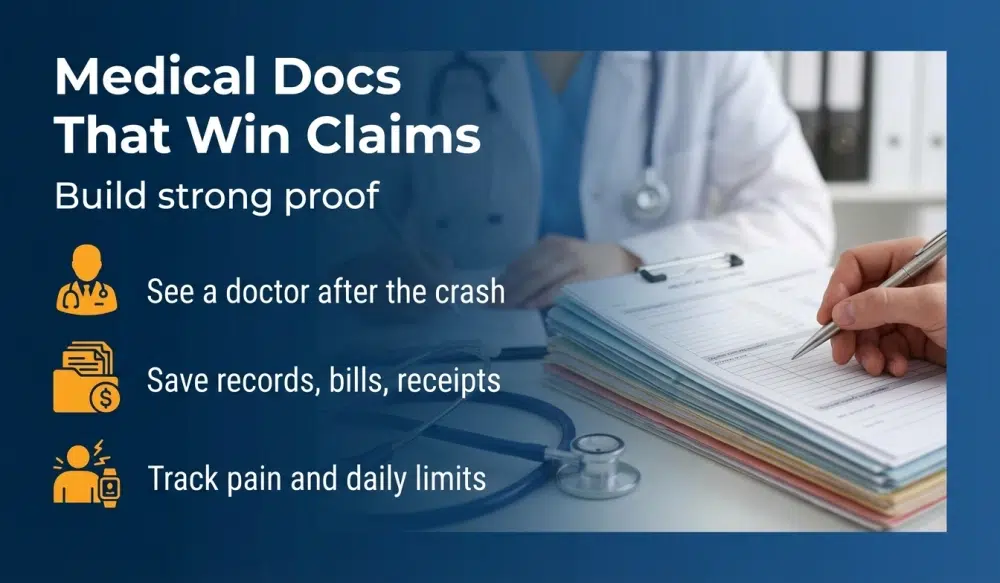
Prompt medical care protects your health and creates contemporaneous records. Many traumatic injuries are not obvious at the scene. Diagnostic imaging, follow up visits, and specialist referrals may be needed to capture the full scope of harm. Keep copies of all medical records, bills, and mileage related to treatment. Use a journal to track pain, sleep disruption, and daily limitations.
Which records should you organize from day one?
- Emergency care records including ambulance run sheets, emergency department notes, and imaging results.
- Primary care and specialist notes that document symptoms and functional restrictions.
- Physical therapy logs and home exercise programs.
- Pharmacy receipts and over the counter product costs when related to injuries.
- Employer documentation for missed time, job duty changes, and wage loss.
How do uninsured motorist claims work in Illinois?
Illinois requires uninsured motorist coverage in most auto policies, typically at least the bodily injury minimum limits. This coverage can apply when the at fault driver cannot be identified or is uninsured [7]. Your policy will define prerequisites, such as prompt notice, cooperation, and proof of loss.
What steps help you start an uninsured motorist claim?
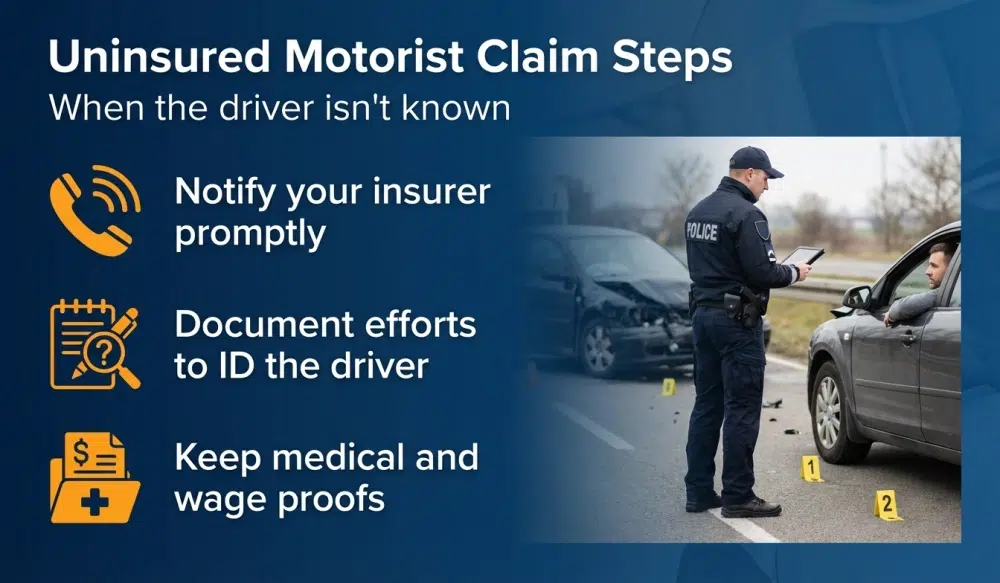
- Notify your insurer promptly and provide the CPD report number, photographs, medical records, and witness contacts [11].
- Document efforts to identify the driver including camera canvassing and preservation requests, which insurers may require to confirm the driver is unknown.
- Keep all medical and wage proofs to establish damages under your UM coverage.
Can you stack coverages or use medical payments benefits?
Many Illinois policies offer medical payments coverage, which can help with immediate medical bills regardless of fault. Stacking policies or coverages depends on the policy language and Illinois law. Review all declarations pages to identify every potentially applicable coverage. For disputed UM claims, arbitration or litigation may be necessary under contract terms and Illinois practice.
What is the statute of limitations for Illinois hit and run cases?
Illinois generally allows two years to file a lawsuit for personal injury and five years for property damage, measured from the date of the crash [5] [6]. Certain exceptions can apply, such as when a minor is injured or where fraudulent concealment is alleged, but these are fact specific. Contract claims under UM coverage may have different notice and suit limitation provisions. Tracking all deadlines early is essential because late filings are typically dismissed.
What damages can you claim and how are they proven?
In a Chicago hit and run case, recoverable damages can include medical expenses, future medical needs, lost wages, diminished earning capacity, property damage, out of pocket costs, and non economic harms such as pain and loss of normal life. Families in fatal cases may pursue wrongful death and survival claims under Illinois law. Proof comes from medical records, expert evaluations when needed, employment records, photos and video of injuries, and testimony from family and friends about daily impacts.
How do you quantify non economic harms credibly?
- Track daily limitations in a contemporaneous journal that documents pain levels, sleep disruption, and activity changes.
- Use consistent treatment records that tie symptoms to clinical findings and functional deficits.
- Document activities you can no longer perform including household tasks and recreational activities, with supporting witness statements.
How does comparative negligence work in Illinois?
Illinois follows modified comparative negligence. A plaintiff’s recovery is reduced by their percentage of fault and barred entirely if they are more than 50 percent at fault [14]. In hit and run cases, defendants or insurers may argue that the plaintiff’s conduct contributed to the crash. Evidence such as traffic signal timing, speed analyses, and independent witness statements can be decisive.
What evidence can influence fault apportionment?
- Signal phase and timing data gathered from intersection controllers or traffic engineering records.
- Skid and crush damage analysis correlating with speed and direction of travel.
- Independent witness accounts evaluated for vantage point and consistency.
What should defendants or insurers consider in a contested hit and run?
For defendants, timely counsel engagement and preservation of telematics, cell site data, and vehicle repair records can be crucial. If misidentification is alleged, alibi evidence, vehicle location data, and shop work orders can rebut claims. For insurers evaluating UM claims, close review of prompt notice, corroborating evidence of a phantom vehicle, and medical causation is common under Illinois law and policy language [7] [12].
How do court rules affect discovery and preservation?
- Preservation obligations attach when litigation is reasonably anticipated, including for electronically stored information [12].
- Proportional discovery focuses on what is reasonably accessible and relevant to disputed issues [12].
What mistakes should you avoid after a Chicago hit and run?
- Delaying medical care which risks your health and weakens documentation of causation.
- Failing to get a CPD report because insurers and courts expect an official record [11].
- Not preserving footage as many cameras overwrite in days, eliminating critical leads.
- Posting on social media which can be misinterpreted against your claim.
- Missing notice or suit deadlines including UM policy notice requirements and Illinois statutes [5] [6].
How can a Chicago personal injury attorney help your case?
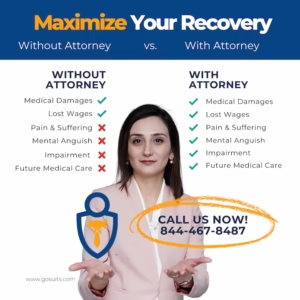
A qualified personal injury lawyer in Chicago can coordinate investigation, evidence preservation, insurance benefits, and litigation if needed. In complex cases, counsel often issues preservation letters to businesses and agencies, seeks available public records under FOIA when permitted [13], and works with consultants to reconstruct the crash. Experienced trial counsel can also prepare the case for court if negotiations do not resolve liability and damages disputes.
When choosing representation, consider whether the firm has the staffing, technology, and courtroom experience to handle contested matters from the outset. Early strategy often shapes results months later. Many people in Chicago choose to consult with Chicago car accident lawyers to help set up uninsured motorist claims, coordinate medical billing, and preserve evidence across multiple custodians.
What do Illinois and Chicago data show about hit and run risk?
Statewide reporting shows thousands of injury crashes annually, a portion involving drivers who leave the scene. Illinois roadway crash publications detail recent fatality and injury trends [9]. Nationally, NHTSA has reported that hit and run crashes contributed to a substantial share of pedestrian fatalities in recent years, underscoring the importance of rapid evidence preservation and investigation [10]. Locally, Chicago’s Vision Zero program tracks serious traffic injuries and fatalities, focusing on high injury corridors to direct safety improvements and enforcement strategies [15].
Why do these statistics matter to your civil claim?
- They explain context for insurers and juries about roadway risks and the urgency of evidence preservation.
- They support foreseeability arguments in roadway design and maintenance discussions when relevant.
- They inform settlement expectations by aligning injury patterns and medical needs with similar fact patterns.
What are the practical steps to protect your claim from day one?
- Call 911 and get medical care even if symptoms seem minor.
- Secure the CPD report number and later obtain the report copy for your records [11].
- Photograph and video the scene thoroughly, including surroundings and traffic control devices.
- Identify and contact witnesses before memories fade.
- Canvass for cameras and send preservation requests promptly to nearby owners and, where allowed, submit FOIA requests [13].
- Notify your insurer and open a UM claim if the driver is unknown or uninsured [7].
- Track expenses and losses including medical bills, wage loss, and out of pocket costs.
- Consult with counsel to coordinate evidence, coverage, and deadlines.
Why choose GoSuits for a Chicago hit and run case?
Hit and run cases are time sensitive and evidence intensive. Our practice focuses on personal injury claims across Illinois, including Chicago, with a team that blends litigation skill and technology. We offer a free consultation so you can understand options for your claim, how uninsured motorist coverage may apply, and which steps will best protect your case timeline and evidence.
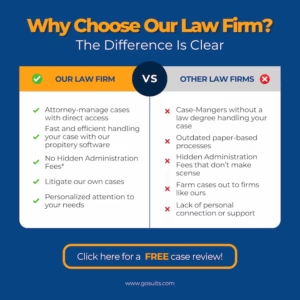
GoSuits uses exclusive proprietary software to accelerate core tasks such as evidence mapping, preservation workflows, and medical record retrieval. This technology driven approach helps us move quickly while maintaining rigorous quality controls. Even with advanced tools, every client has a designated Chicago personal injury attorney from start to finish. We do not use case managers for client communications. You have direct, unfettered access to your lawyer.
We bring 30 years of combined experience and trial readiness to negotiations. Preparing cases for court from day one frequently improves results by clarifying liability theories, organizing proof of damages, and applying pressure based on real trial posture. Our track record includes results for clients in serious injury cases and contested liability matters. You can review representative outcomes at prior cases, meet the professionals who will handle your file at our attorneys, and learn more about our firm at about us.
We handle a wide range of personal injury matters, including car, motorcycle, pedestrian, and truck collisions, premises liability, construction injuries, product liability, and wrongful death. Explore our full list at practice areas. The sooner we are involved, the faster we can issue preservation notices, coordinate with CPD and insurers, and set up benefits under your policy while you focus on recovery.
References and resources
- 625 ILCS 5/11-401 Accidents involving death or personal injuries; duty to stop – Illinois General Assembly
- 625 ILCS 5/11-402 Accidents involving damage to vehicle or property; duty to stop – Illinois General Assembly
- 625 ILCS 5/11-403 Duty to give information and render aid – Illinois General Assembly
- 625 ILCS 5/11-404 Duty upon striking unattended vehicle – Illinois General Assembly
- 735 ILCS 5/13-202 Personal actions; 2 year limitation – Illinois General Assembly
- 735 ILCS 5/13-205 Actions on unwritten contracts and property damage; 5 year limitation – Illinois General Assembly
- 215 ILCS 5/143a Uninsured motorist coverage required – Illinois General Assembly
- Illinois Rules of the Road Guide – Illinois Secretary of State
- Crash Facts and Statistics – Illinois Department of Transportation
- Hit-and-Run Crashes 2012 to 2021 DOT HS 813 318 – NHTSA
- Traffic Crash Reports – Chicago Police Department
- Illinois Supreme Court Rule 201 Discovery and ESI – Illinois Courts
- 5 ILCS 140 Freedom of Information Act – Illinois General Assembly
- Vision Zero Chicago Traffic Safety Data – City of Chicago