- What is this Chicago commercial vehicle crash evidence checklist, and who should use it?
- What immediate steps should you take at the scene in Chicago, IL?
- How do you document injuries and medical care without risking privacy?
- What vehicle and electronic data should you secure, including ELD and black box?
- How do you request the CPD police report and other official records?
- What witnesses and third party videos matter, and how do you preserve them?
- How do FMCSA and CDL rules affect fault in Illinois crashes?
- What property damage evidence helps with a commercial insurance claim?
- How do you prevent spoliation and send a preservation letter in Chicago?
- How long do you have to file in Illinois, and where are cases filed in Cook County?
- How does accident reconstruction work, and what reports should you expect?
- What common defenses do commercial carriers raise, and how do plaintiffs respond?
- What is the complete Chicago commercial vehicle crash evidence checklist?
- What Chicago specific road conditions and infrastructure issues should you capture?
- How can GoSuits support your Chicago commercial vehicle crash case?
- Where can you find references and resources?
What is this Chicago commercial vehicle crash evidence checklist, and who should use it?
If you or a loved one has been hurt in a commercial vehicle crash in Chicago, this evidence checklist helps you collect, preserve, and organize proof for a civil claim. It applies to collisions with semitrailers, delivery vans, box trucks, buses, rideshare fleet vehicles, and construction vehicles traveling on city streets or interstates near Chicago. Commercial vehicles are subject to federal safety rules and Illinois law, so documentation often involves company records, electronic driver logs, and agency reports in addition to the items seen in ordinary car crash cases [1] [2].
Crashes involving large trucks have higher risks. Nationally, fatalities in crashes involving large trucks increased in recent years, which is why complete evidence preservation is so important for both injury and liability analysis [10]. At the Illinois level, statewide crash data tracks the number and severity of large truck crashes and offers insight into contributing factors, times of day, and roadway types that can be useful during investigation [11].
Whether you are a plaintiff seeking compensation or a defendant company protecting against unfounded claims, the same core principle applies: the party with reliable, well preserved evidence is in a stronger position during negotiations and trial. The steps below explain what to collect and how to prevent loss of key data.
What immediate steps should you take at the scene in Chicago, IL?
What should you record before vehicles move?
Safety comes first. After calling 911, if it is safe to do so, take comprehensive photos and video of every angle of the scene. Include vehicle positions, skid marks, gouge marks, fluid trails, road debris, traffic signals, lane markings, construction zones, and temporary signs.
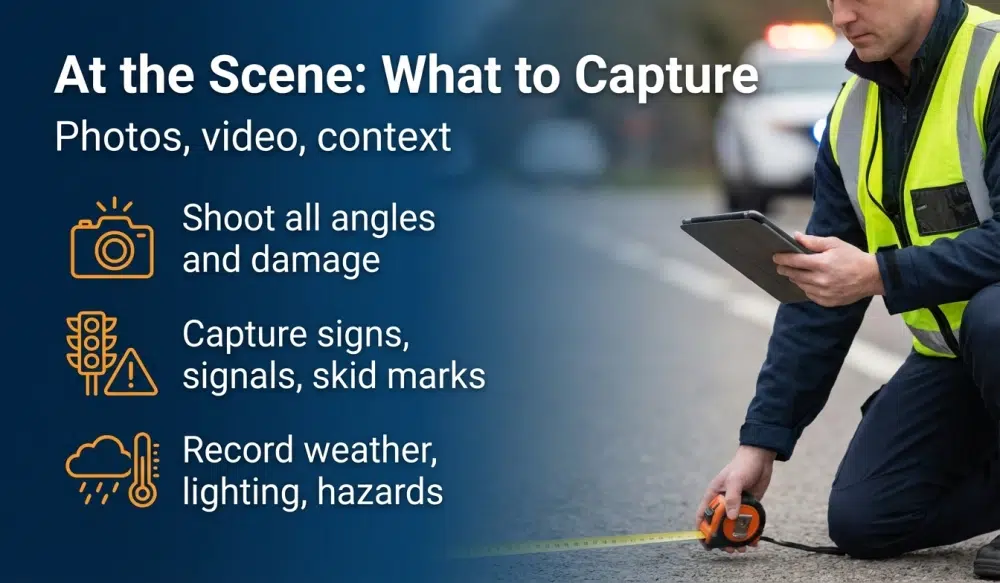
- Photograph vehicle resting positions to support later accident reconstruction.
- Capture close ups of damage to all vehicles and cargo doors, or tie downs that might have failed.
- Record the roadway environment, including lighting, weather, standing water, potholes, and snow or ice accumulation if present.
- Document traffic control devices, such as stop signs, signal heads, and pedestrian crossings.
What identifying information should you collect from drivers and companies?
- Driver identification, including name, license number, and phone number.
- Commercial carrier name and USDOT number displayed on the cab door for interstate carriers, plus MC number if visible.
- Vehicle identifiers, including VIN, license plate, and trailer number if applicable.
- Insurance information for all parties and the motor carrier.
How do you preserve time sensitive digital data at the scene?
Politely note visible cameras, both on vehicles and nearby buildings, and state that you will be sending a written preservation notice. You can also save your smartphone location history and timestamped photos to verify timing. If emergency responders are present, ask which agencies will prepare official reports, which often include measurements and diagrams that are crucial later.
How do you document injuries and medical care without risking privacy?
Request your medical records and billing statements from every provider involved, including emergency departments, imaging facilities, physical therapy clinics, and follow up physicians. Under federal privacy rules, patients have a right to obtain copies of their medical records within a reasonable time frame, usually in thirty days, and to receive them in the format requested if readily producible [12].
- Admission and discharge summaries show mechanism of injury and initial diagnoses.
- Imaging studies and radiology reports capture objective findings that may corroborate trauma.
- Operative notes detail procedures and findings when surgery is required.
- Therapy notes and progress reports demonstrate ongoing limitations and functional outcomes.
- Itemized bills and liens establish damages for medical expenses.
Why should you keep a symptom and recovery journal?
A contemporaneous journal describes pain levels, sleep disturbance, work limitations, and missed daily activities. These entries support non economic damages by showing how injuries affect daily life. If you are a defendant responding to a claim, obtain prior medical records that may reveal preexisting conditions relevant to causation, within the bounds of privacy rules and court orders.
What vehicle and electronic data should you secure, including ELD and black box?
For interstate commercial drivers, federal rules require drivers and motor carriers to maintain records of duty status and related supporting documents. The six month retention rule for these records is critical. A timely preservation letter can help prevent normal deletion of log data [1] [2]. If fatigue or hours violations may have contributed to the crash, request the following:
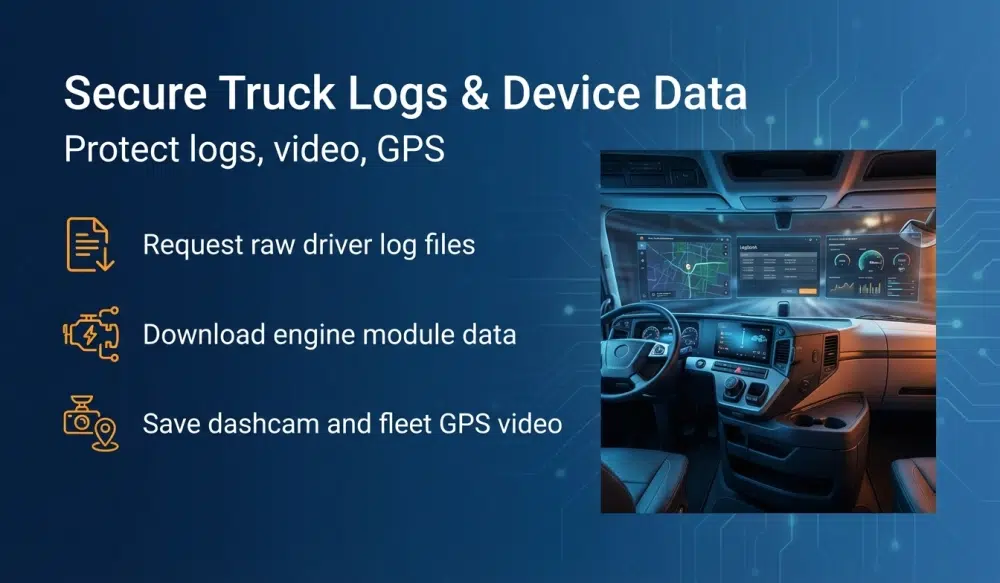
- Electronic logging device files, including raw data and any edits or annotations.
- Records of duty status summaries for the thirty days before the crash and the day of the crash [1].
- Supporting documents, such as fuel receipts, toll receipts, bills of lading, and dispatch records that cross check log accuracy [1].
- Hours of service policy documents used by the motor carrier to train and audit drivers [2].
What other onboard and corporate data should be requested?
- Engine control module data, which may contain speed, braking, throttle, and fault codes around the time of the crash.
- Telematics and GPS data from fleet management platforms that record vehicle location, speed, and harsh event triggers.
- Dashcam or inward and outward facing camera video, often retained for limited periods unless preserved promptly.
- Driver qualification file, including application, prior employer checks, road test certificate, motor vehicle record, and medical examiner certificate where applicable [14].
- Drug and alcohol testing records related to post accident testing where required by regulation [15].
To guard against permanent loss of electronically stored information, parties often cite federal and state preservation duties. Courts can impose remedial measures if a party fails to preserve relevant electronic data once litigation is reasonably anticipated [4].

How do you request the CPD police report and other official records?
In Chicago, a police report is typically generated when officers respond to a traffic crash, and additional records, such as body worn camera footage or 911 audio, may be available through public records requests. The City of Chicago provides an online portal to request records under the Illinois Freedom of Information Act [13]. Provide date, time, location, incident number if known, and a short description of the records requested.
What should you verify in the report?
- Location accuracy, including intersection, direction of travel, and lane of impact.
- Vehicle and carrier identifiers, such as USDOT number, trailer number, and hazardous materials placards if any.
- Witness details with full contact information.
- Citations or violations noted, which may reference federal or state rules.
- Diagram and narrative to compare with photos and electronic data.
What witnesses and third party videos matter, and how do you preserve them?
- Independent eyewitnesses not affiliated with any party who can describe signals, speed, lane changes, or unsafe turns.
- Responding officers and investigators who can testify to conditions, measurements, and statements.
- Company representatives who may address policies and driver supervision.
- Nearby business owners or employees who may have camera footage of the incident or circumstances just before impact.
How can you locate and save third party video?
Identify potential sources, such as building security cameras at gas stations, retail stores, and parking structures along the route of travel. Time windows for overwriting can be short, sometimes days. Send prompt written preservation letters and follow up with in person visits when appropriate. For traffic cameras and public transit video, use public records requests where available. Coordinate requests with the Chicago records portal when targeting city held footage [13].
How do FMCSA and CDL rules affect fault in Illinois crashes?
- Hours of service rules covering driving limits, required breaks, and rest periods [2].
- Electronic logging device compliance and retention of records used to verify duty status [1].
- Driver disqualification standards for certain moving violations and offenses that can suspend commercial driving privileges [3].
- Driver qualification file contents that document hiring and monitoring steps [14].
Evidence showing violations of these rules can be significant in civil negligence cases by illuminating how the crash occurred or whether company oversight was reasonable. Defendants may rely on records to show compliance with federal and Illinois standards, while plaintiffs may point to gaps or inconsistencies suggesting rule breaches.
How do statistics support investigation priorities?
National crash data indicates that fatal crashes involving large trucks have shown year to year variation, and certain behaviors such as speeding and fatigue are recurring factors [10]. Illinois data sets help investigators focus on location specific risks, including urban intersections, freeway on ramps, and high truck volume corridors [11].
What property damage evidence helps with a commercial insurance claim?
What vehicle damage documentation is most persuasive?
- High resolution photos of crush profiles from all sides and at varying distances.
- Repair estimates and parts lists with labor times and frame straightening measurements.
- Pre loss photos or service records to counter claims that damage was preexisting.
- Cargo condition photos to show load shift or spillage that may indicate improper securement.
Why should you track rental and downtime?
Maintain receipts for rental vehicles and a log of days your vehicle is out of service. For business claimants, document lost use with delivery schedules, cancelled contracts, or business records that show the operational impact.

How do you prevent spoliation in Chicago?
Spoliation is the destruction or significant alteration of relevant evidence. Courts can order measures ranging from additional discovery to adverse jury instructions or sanctions, depending on the circumstances and the governing rules [4] [5]. Timely written preservation notices to carriers, brokers, shippers, and third parties are a key step for both plaintiffs and defendants.
What should a preservation letter cover?
- Scope of evidence, including vehicles, parts, ELD data, ECM data, telematics, dispatch records, and video.
- Retention timeframe extending through the anticipated litigation period and any regulatory retention period [1].
- Instructions to suspend auto deletion on log servers, camera systems, and email archives.
- Contact information for coordinating inspections, downloads, and data exchanges.
In Illinois, negligent spoliation is recognized through existing tort principles rather than a separate cause of action, and parties should act diligently to avoid loss of relevant evidence once litigation is reasonably foreseeable. Courts also rely on state discovery rules to address discovery conduct and provide remedies when appropriate [5].
How long do you have to file in Illinois, and where are cases filed in Cook County?
Illinois generally sets a two year statute of limitations for personal injury actions arising from negligence [6]. Wrongful death actions are also typically subject to a two year period, with certain variations depending on the underlying circumstances [8]. Property damage claims often have a five year period [7]. Exceptions can apply based on the parties involved or when an injury is discovered. Filing on time is critical to preserve claims and defenses.
Where are Chicago cases filed, and how are they managed?
Most civil cases arising from Chicago crashes are filed in the Circuit Court of Cook County. The court provides local rules and procedures, and cases are subject to statewide Illinois Supreme Court Rules regarding discovery, motions, and trial practice [9] [5]. Electronic filing is in use across Illinois courts, and parties should follow local standing orders and scheduling requirements issued by the assigned judge.
How does accident reconstruction work, and what reports should you expect?
- Scene measurements, including skid distances, yaw marks, and point of rest.
- Vehicle inspections for brake condition, lighting, reflectors, underride guards, and steering components.
- Electronic data from ELD, telematics, GPS, and ECM downloads when available.
- Weather and lighting data that help evaluate visibility and stopping distances.
- Witness statements to time events and maneuvers.
What deliverables should parties expect after a commercial vehicle crash?
- Photogrammetry and scaled diagrams compiled from scene imagery and measurements.
- Time distance analysis to assess speed, perception response time, and available stopping distance.
- Vehicle dynamics analysis addressing lane departure, rollover risk, and stability under braking.
- Causation opinions tied to data that summarize contributing factors and rule compliance or deviations.
Because many commercial vehicles are equipped with multiple electronic systems, early coordination for downloads and inspections is essential. Courts can help set protocols for inspections and protective orders when parties disagree about scope or confidentiality [5].
What common defenses do commercial carriers raise, and how do plaintiffs respond?
- Comparative negligence, arguing that the plaintiff failed to yield, made an unsafe lane change, or followed too closely.
- Independent contractor status to dispute vicarious liability where a driver is not an employee.
- Sudden emergency, such as unexpected mechanical failure or third party intrusion into the lane.
- Compliance defenses, citing driver logs, inspection records, and training files to show reasonable conduct [1] [14].
How do plaintiffs typically counter these defenses?
- Electronic corroboration comparing ELD, GPS, and telematics to show speed, location, and duty status inconsistencies [1] [2].
- Maintenance and inspection records to challenge sudden mechanical failure claims when defects were known, or should have been found.
- Company safety policies and audits to address negligent hiring, training, or supervision theories where supported by the facts [14].
- Scene and video evidence to confirm signal phases, lane positions, and driver behavior at critical moments.
What is the complete Chicago commercial vehicle crash evidence checklist?
- Photographs and video of vehicles, debris, skid marks, signals, signs, and roadway defects.
- Measurements and diagrams if available from responding officers or later inspections.
- Weather documentation, including temperature, precipitation, visibility, and sunrise or sunset time.
- Vehicle components and parts retained after repairs that may be relevant to failure analysis.
What personal and witness information should you collect?
- All driver and carrier identifiers, including USDOT number and insurance details.
- Names and contact details for witnesses captured at the scene and through follow up canvassing.
What medical documentation supports injury claims?
- Emergency medical records, including EMS run sheets and emergency department records.
- Diagnostic imaging and reports, such as CT, MRI, and X ray results.
- Treatment and therapy records covering the full course of care.
- Itemized billing and insurance EOBs to quantify costs.
What electronic and corporate records are essential?
- ELD data and records of duty status with supporting documents for the period before and after the crash [1].
- Telematics and GPS data from fleet systems, including speed and event markers.
- ECM and event data, including pre and post impact parameters if available.
- Dashcam and surveillance footage from the vehicle and nearby businesses or residences.
- Driver qualification file with motor vehicle records, prior employment checks, and medical certificate where applicable [14].
- Training and safety audits, including hours of service audits and remedial training records [2].
- Drug and alcohol testing documents required after certain qualifying crashes [15].
What official records help build the timeline?
- CPD crash report and supplements, including diagrams and narratives [13].
- 911 audio and dispatch logs to confirm response times and statements [13].
- Cook County court filings and orders once litigation begins [9].
What preservation and procedural steps should you take?
- Send preservation letters to the carrier, driver, broker, shipper, tow yard, repair facility, and any third party with potentially relevant data [4] [5].
- Calendar statutes of limitations for injury, wrongful death, and property damage claims [6] [7] [8].
- Request official records early to avoid deletion under normal retention cycles [1] [13].

What Chicago specific road conditions and infrastructure issues should you capture?
High truck traffic corridors include the Dan Ryan, Kennedy, Eisenhower, Edens, Stevenson, and Bishop Ford expressways, along with access routes to distribution centers and intermodal yards. In urban neighborhoods, pay special attention to left turn movements across bike lanes, wide right turns at tight intersections, and loading zones that may obstruct views. The timing of signals and presence of pedestrian countdown timers can be pivotal; record the full cycle, if possible, using video.
How do weather and seasons affect evidence in Chicago?
Winter brings snow, ice, and reduced daylight, while spring and fall can involve heavy rain and wind. Capture evidence of plowed snow piles that block sightlines, salt residue, standing water, and active street resurfacing. Illinois statistics show that weather and lighting are frequent factors examined in crash analysis, which supports documenting the environment thoroughly [11].
How can GoSuits support your Chicago commercial vehicle crash case?
Commercial vehicle cases are complex, and early investigation can make a real difference for plaintiffs and defendants. A focused legal strategy helps you request and preserve the right evidence before it goes missing. Speaking with truck accident lawyers early allows you to align medical documentation, ELD and telematics requests, and court procedures with the facts of your case.
GoSuits represents clients in personal injury and wrongful death matters across Illinois, with a focus on Cook County and surrounding counties. Our team uses a technology focused approach that brings speed and organization to every stage of the case. We deploy exclusive proprietary software that streamlines records collection, data analysis, and litigation timelines, which supports faster, better results grounded in the evidence.
Clients work directly with designated attorneys from day one. We do not use case managers to filter communication, and each client has unfettered access to their attorney for strategy, updates, and preparation before critical events, such as depositions or trial settings. Our litigation group has secured favorable outcomes for clients in complex transportation cases, and you can review representative outcomes in our posted prior cases.
With more than 30 years of combined experience, our attorneys bring trial readiness to negotiations, which often improves settlement discussions. When trial is necessary, courtroom experience helps present technical evidence like ELD logs, ECM data, and reconstruction testimony with clarity and care.
We encourage a free, confidential consultation so you can understand timelines, evidence priorities, and next steps without pressure. Meeting early helps you avoid missteps like missed preservation windows or incomplete requests to agencies and carriers. If you prefer to learn more about our team, visit our attorneys and about us. For a complete view of our services beyond trucking and commercial vehicle cases, see our practice areas.
If you would like local guidance tailored to Chicago streets, Cook County courts, and Illinois statutes, you can speak with Chicago truck accident lawyers who routinely handle ELD and corporate document discovery in commercial cases. That early planning can position your claim or defense for a smoother path through litigation.
Where can you find references and resources?
- 49 CFR 395.8 Driver’s record of duty status, retention and supporting documents – LII
- Summary of Hours of Service Regulations – FMCSA
- 49 CFR 383.51 Disqualification of drivers – LII
- Federal Rule of Civil Procedure 37 including ESI sanctions – LII
- Illinois Supreme Court Rule 219 Discovery sanctions – Illinois Courts
- 735 ILCS 5/13-202 Personal actions, two year limitation – Illinois General Assembly
- 735 ILCS 5/13-205 Five year limitation for certain actions – Illinois General Assembly
- 740 ILCS 180/2 Wrongful Death Act limitation period – Illinois General Assembly
- Circuit Court of Cook County official site – Cook County Courts
- Traffic Safety Facts 2022 Data including Large Trucks – NHTSA
- Illinois Crash Facts and Statistics – IDOT
- Individuals’ Right under HIPAA to Access Health Information – HHS OCR
- Freedom of Information Act Requests for City of Chicago – City of Chicago
- 49 CFR 391.51 General requirements for driver qualification files – LII
- Overview of FMCSA Drug and Alcohol Testing Program – FMCSA