- Why do crash photos matter in Chicago civil claims?
- What safety steps should you take before taking any photos?
- What exactly should you photograph at a Chicago crash scene?
- How should you photograph injuries respectfully and clearly?
- How do you capture vehicle and property damage effectively?
- Which road, traffic control, and environment details matter most?
- How can phone settings, timestamps, and metadata help authenticate photos?
- How many photos are enough, and how should you organize them?
- What mistakes should you avoid when photographing a crash scene?
- Which Illinois and federal rules affect photo evidence and preservation?
- How do CPD crash reports and Illinois crash reporting relate to your photos?
- How do photos influence insurance claims and civil litigation strategy?
- What privacy and courtesy practices should you follow while documenting?
- What timelines and deadlines apply to Illinois car crash claims?
- What printable Chicago car crash photo checklist can you keep in your glovebox?
- Who is GoSuits, and how do we help injured people in Chicago, IL?
- References and resources
Why do crash photos matter in Chicago civil claims?
Your photos can become some of the most persuasive evidence in a Chicago, IL car crash claim. They help reconstruct how the collision happened, show the severity of damage and injuries, and preserve the condition of the roadway before it changes. Under rules of evidence, photos that are relevant and properly authenticated can be admitted for the judge or jury to consider [1] [2] [4] [15]. Relevance is a low bar, but the court can exclude even relevant images if they are unfairly prejudicial or cumulative, so clarity and neutrality matter [3].
Accurate photographs can also shorten disputes with insurers. If an adjuster sees high quality angles of a crushed rear quarter panel, deployed airbags, debris patterns, and skid marks, it can help establish impact direction and speed consistent with your narrative. State and federal discovery rules allow parties to request and exchange digital photos and metadata, so careful preservation from the start protects your case [5] [7] [14].
What safety steps should you take before taking any photos?
Your safety and the safety of others comes first. Before taking pictures, take these steps if you can do so safely in Chicago traffic:
- Move to a safe location. If vehicles are drivable, pull to the shoulder or a nearby lot. Turn on hazard lights. Set out reflective triangles or flares if available.
- Check for injuries and call 911. Report urgent medical needs first. Do not move an injured person unless there is immediate danger.
- Call the police for a crash report. For many collisions in Chicago, a police response is appropriate, and a report can help corroborate your photos later. Illinois law also has reporting requirements for certain crashes [10] [11].
- Wear a safety vest at night or in low light if you have one. Visibility reduces risk while you step outside to document the scene.
Once the area is reasonably safe, begin your documentation. Use your phone’s flashlight judiciously at night, and avoid walking into active lanes while composing shots.
What exactly should you photograph at a Chicago crash scene?
Think of your camera as a neutral observer that records where, when, what, and how. Capture broad context first, then medium-range relationships, then closeups. Follow this checklist:
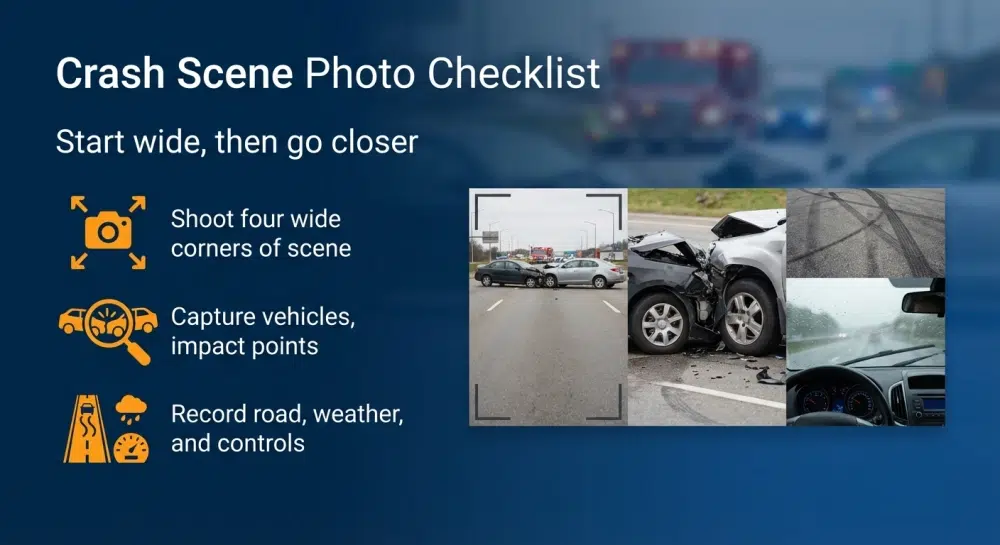
- Overall scene from multiple corners. Take wide shots from four sides that show vehicle resting positions, lane markings, intersections, crosswalks, and nearby landmarks. Include street signs that confirm location.
- Traffic control devices. Photograph signal heads, stop signs, yield signs, pedestrian signals, and any signage that might bear on right of way. Include the light cycle if relevant by shooting multiple frames.
- Roadway surface and condition. Document skid marks, yaw marks, gouges, potholes, standing water, gravel, ice, or snow. Road condition can affect stopping distance and liability analysis [12].
- Vehicle positions and contact points. Show how vehicles relate to each other, curbs, and lanes. Capture the angles of impact and the direction of crush.
- Closeups of damage with scale. Add a ruler, coin, or your key for scale. Take photos per panel and per damaged component, including bumpers, fenders, rocker panels, wheels, glass, and deployed airbags.
- Debris field and fluid spills. Photograph the spread and directionality of debris, which can indicate impact location and force.
- Weather and lighting. Capture the sky, sun position, rain, fog, or streetlight outages. Lighting affects visibility and stopping distance.
- License plates and VINs. Photograph plates, DOT numbers on commercial vehicles, and VIN plates visible through windshields when safe.
- Driver and witness information. Photograph license, insurance, and registration documents only with permission. Alternatively, photograph the exchange form you complete together.
Statistically, Illinois records tens of thousands of injury crashes each year. IDOT’s statewide crash facts show how common intersection and rear-end collisions are, which makes clear why context photos of traffic control and sightlines can be decisive [12]. Nationally, traffic fatalities remain high, with recent federal estimates highlighting the continued importance of documenting conditions that contribute to severe outcomes [13].
How should you photograph injuries respectfully and clearly?
Injury photos can corroborate medical records and testimony. When safe and appropriate, consider:
- Ask permission and be respectful. If photographing another person, obtain consent. Avoid faces unless necessary to document the injury.
- Use neutral backgrounds and good light. Natural light or soft diffused light helps show swelling, discoloration, bruising, and lacerations without harsh glare.
- Provide scale. Place a ruler or a common object next to the injury for context. Keep the object clean and do not obstruct the view.
- Time progression. Photograph again over the next hours and days to document changes, bruising development, or inflammation.
- Protect privacy. Avoid posting injury photos online. Keep them in a secure folder so they can be shared appropriately during claims or litigation [5] [7].
How do you capture vehicle and property damage effectively?
Damage photos often link mechanics to causation. Take these systematic steps:
- Walk around both vehicles clockwise. Capture damage panel by panel. Photograph both the exterior and visible interior damage such as dashboard buckling or seatbelt marks.
- Photograph safety systems. Airbags, seatbelts with witness marks, child seats, crumple zones, and headrests indicate force vectors and occupant kinematics.
- Check beneath and behind. Squat to photograph undercarriage scraping, leaking fluids, or wheel misalignment that might not appear in upper body photos.
- Show before-and-after context if available. If you have a recent photo of your vehicle pre-crash, save it. Comparative images can help demonstrate the change in value and condition.
- Include property damage beyond vehicles. Photograph damaged guardrails, bus stops, fences, storefronts, or signs. Include identifying markers to connect the property to the location.

Which road, traffic control, and environment details matter most?
When liability disputes turn on visibility, timing, or right of way, photos that capture conditions can be decisive:
- Lane markings and arrows. Turn arrows, double yellow lines, and merge indicators inform who had the right of way.
- Signal visibility and phasing. If a signal head was obstructed by a tree or sign, or if left-turn arrows were flashing yellow, photograph that carefully.
- Sightlines and obstructions. Parked trucks, snowbanks, construction fencing, and billboards can block views. Take photos from driver eye height.
- Construction zones. Photograph cones, barrels, lane shifts, and signage. Work zones often change quickly, so date-stamped images matter.
- Pedestrian infrastructure. Crosswalk markings, curb ramps, and pedestrian signal timing are important when a walker or cyclist is involved.
How can phone settings, timestamps, and metadata help authenticate photos?
Authentication usually requires testimony that a photo fairly and accurately depicts what it purports to show, or that a device or process reliably produced the image [1] [4] [15]. Improve your foundation with these steps:
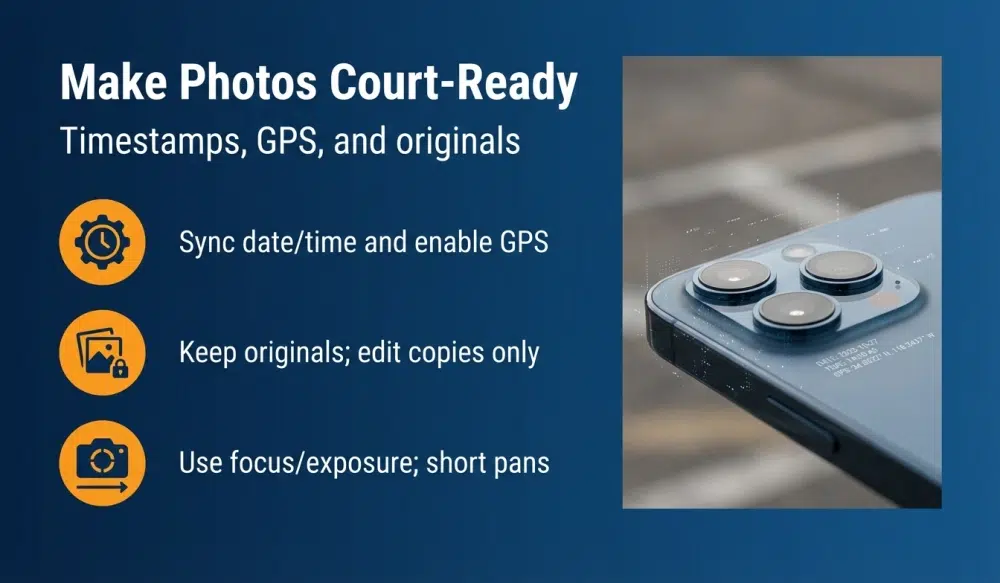
- Activate automatic date and time. Keep your phone’s time synced. Screenshots of your settings can help if timing is disputed.
- Enable location services for the camera. GPS coordinates in EXIF metadata can corroborate where the photo was taken. Preserve original files to keep metadata intact [5] [6].
- Avoid editing originals. Save any edits as copies. Keep unaltered originals in a separate, read-only folder for production if requested in discovery [5] [7].
- Use exposure compensation and focus lock. Tap to focus, adjust for backlighting, and take multiple exposures so details are not lost in shadows or glare.
- Record short video pans. Brief, stable pans can capture spatial relationships. Keep clips short to reduce file sizes and simplify review.
How many photos are enough, and how should you organize them?
Err on the side of more coverage rather than too few images, but avoid needless duplication that adds little. A practical target is 50 to 150 images for a two-car collision, spread across scene context, vehicle damage, injuries, road conditions, and documents.
- Group by topic and timestamp. Create folders such as Scene, Damage, Injuries, Documents. Within each, keep originals and a separate folder for resized copies.
- Use descriptive file names. For example, 2026-01-08_Clark-Washington_Scene_NEcorner.jpg and 2026-01-08_VehicleA_RFender_Closeup.jpg.
- Back up promptly. Save to cloud and local storage to prevent loss. Preservation is important once a claim is anticipated [5] [6].
If litigation becomes likely, your counsel can guide how to maintain a defensible chain of custody for digital evidence under discovery rules [5] [7] [14].
What mistakes should you avoid when photographing a crash scene?
- Skipping wide shots. Closeups without context can be challenged as unhelpful or misleading under relevance and balancing standards [2] [3].
- Standing in traffic. Never step into live lanes for the sake of a better angle.
- Editing or filtering originals. Keep originals untouched. Edits can complicate authentication under rules that require a reliable process and fair depiction [4] [15].
- Posting publicly. Social media posts can be discoverable and sometimes misconstrued. Share through appropriate channels during claims or litigation [5] [7].
- Ignoring injuries that develop later. Photograph evolving bruising and swelling over days. Early photos may not capture delayed symptoms.
Which Illinois and federal rules affect photo evidence and preservation?
Courts admit photographs that meet basic evidentiary requirements. In Illinois civil cases, the Illinois Rules of Evidence mirror many federal standards on relevance, authentication, and prejudice, applied by judges case by case [1]. Federal rules articulate similar standards and are often cited in guidance materials [2] [3] [4] [15].
- Relevance. Evidence is relevant if it makes a material fact more or less probable. Photos of skid marks, impact points, or signal phases usually qualify [2].
- Balancing. Courts may exclude even relevant images if they risk unfair prejudice or confuse issues. Keep images clear and factual [3].
- Authentication. A witness can testify that a photo fairly and accurately depicts the scene, or a party can show a reliable process created the image. Metadata can help [1] [4].
- Preservation. Once litigation is reasonably anticipated, parties should preserve relevant information. Federal and Illinois discovery rules address disclosures and sanctions for lost electronically stored information [5] [6] [7] [14].
How do CPD crash reports and Illinois crash reporting relate to your photos?
The Chicago Police Department often prepares a traffic crash report for collisions in the city. Your photos can support what the report records, including time, location, diagrams, and stated contributing factors. Separately, Illinois requires drivers to report certain crashes to the state when there are injuries, death, or enough property damage. The Illinois Motorist Report is part of that process, and your photos can help you accurately describe the event [10] [11].
The statewide crash database and annual IDOT statistics underscore how roadway conditions, weather, and human factors correlate with collision types, which is why precise photo documentation is valuable for both claims and safety analysis [12].

How do photos influence insurance claims and civil litigation strategy?
In negotiations, insurers often weigh photo clarity, angles, and coverage when evaluating liability and damages. Photos can help establish that forces involved were consistent with claimed injuries and that property damage matches the mechanics of the collision. Photos can also reveal comparative negligence issues in Illinois, where damages can be reduced if a plaintiff shares fault, and recovery may be barred if a plaintiff is more than 50 percent at fault [9].
If settlement fails, photos become exhibits in litigation. Courts apply the familiar rules of relevance, prejudice, and authentication, and discovery procedures guide how parties exchange and discuss digital images and metadata [1] [2] [3] [4] [5] [7] [14]. Working with car accident lawyers who regularly present photo evidence in Illinois courts can help you avoid pitfalls and use your images effectively.
What privacy and courtesy practices should you follow while documenting?
- Focus on facts and impact areas. Avoid intrusive images of individuals without consent. Keep faces out unless necessary for context.
- Protect minors and bystanders. Do not photograph children or identifiable bystanders unless essential and with consent.
- Secure storage. Keep your files in a password-protected location and share only through appropriate legal channels [5] [7].
What timelines and deadlines apply to Illinois car crash claims?
Illinois has a statute of limitations for most personal injury actions, generally two years from the date of injury. There are exceptions and special rules for claims against government entities, minors, or wrongful death cases, so early evaluation is important [8]. Your photos taken on the day of the crash can make early case evaluation more accurate and efficient.
What printable Chicago car crash photo checklist can you keep in your glovebox?
What quick steps should you follow right after a crash?
- Call 911. Report injuries and request police if appropriate.
- Move to safety. Use hazards, cones, and safe positions.
- Check for injuries. Seek medical attention as needed.
What photos do you take first for scene context?
- Four wide corners of the scene. Show both vehicles, lanes, and landmarks.
- Traffic control devices. Signals, signs, crosswalk indicators.
- Roadway condition. Skid marks, debris, potholes, water, ice.
What relationship and closeup shots matter next?
- Contact points on both vehicles. Bumpers, quarter panels, doors.
- Safety systems and interiors. Airbags, seatbelts, seats.
- VINs and license plates. Identification details.
How do you document injuries and paperwork?
- Visible injuries with scale. Use a ruler or coin.
- Exchange information. Driver’s info and insurance cards with permission.
- Tow scene and tow truck. If towed, photograph the process and tow tags.

What preservation steps should you take after leaving?
- Back up originals. Cloud plus local storage.
- Create organized folders. Scene, Damage, Injuries, Docs.
- Avoid editing originals. Keep unaltered files for discovery [5] [6].
In addition to the checklist, consider discussing your photos early with Chicago car accident lawyers who can evaluate relevance, potential objections, and discovery needs. If you are comparing options in the market, Chicago car accident lawyers can help you align your photo set with Illinois rules and local practice.
When you speak with your legal team, it is helpful to share your folder in a secure way and label the most important images. In our experience, photos that quickly orient the viewer to the intersection and controls, then connect specific damage patterns to impact direction, often carry the most weight. For general insights and court-focused preparation, car accident lawyers can help you decide which images are strongest and which ones to omit if cumulative [3].
Who is GoSuits, and how do we help injured people in Chicago, IL?
If you or a loved one was hurt in a Chicago collision, speaking with a lawyer early can clarify your rights, protect key evidence, and reduce the risk of missing deadlines that affect your claim under Illinois law [8] [9]. Our team handles civil injury cases arising from vehicle collisions, and we offer a free, no obligation consultation to review your photos, the crash report, and next steps. We serve clients in Chicago, IL and surrounding communities.
- Technology-driven approach. GoSuits uses exclusive proprietary software to collect, organize, and analyze photo evidence and records faster, which helps streamline case timelines and improve file readiness for negotiation or trial.
- Leadership in innovation. We pioneered a data-informed workflow that prioritizes early evidence mapping, structured discovery plans, and courtroom-focused preparation.
- Attorney access, not case managers. Every client has direct access to a designated attorney. We do not route clients through case managers, and your lawyer remains your point of contact from intake through resolution.
- Results and experience. With 30 years of combined experience, our trial teams have achieved meaningful outcomes for clients across a wide range of crash scenarios. See our prior cases.
- Trial readiness. When insurers undervalue a claim, trial experience can help present your photos and other evidence effectively to a judge or jury.
- Practice areas. We handle car, truck, and motorcycle collisions, wrongful death, and other personal injury matters. Explore our practice areas and meet our attorneys. Learn more about us.
If you already gathered a strong photo set using this Chicago car crash photo checklist, we can walk through what to prioritize for claim submission and what to hold for litigation in case settlement talks stall. When you are ready, schedule a free consultation to talk through your options and the litigation path that fits your goals.
For those evaluating options, k in Chicago can guide you through preserving originals, preparing discovery disclosures, and litigating contested issues under Illinois rules. Sharing your photos early helps us build a focused strategy tailored to your case.
References and resources
- Illinois Rules of Evidence – Illinois Courts
- Rule 401 Relevance of Evidence – LII
- Rule 403 Excluding Relevant Evidence – LII
- Rule 901 Authenticating or Identifying Evidence – LII
- Rule 26 Duty to Disclose; General Provisions Governing Discovery – LII
- Rule 37 Failure to Make Disclosures or to Cooperate in Discovery; Sanctions – LII
- Illinois Supreme Court Rules, including Rules 201 and 219 – Illinois Courts
- 735 ILCS 5/13-202 Limitation of actions – ILGA
- 735 ILCS 5/2-1116 Comparative negligence – ILGA
- 625 ILCS 5/11-406 Duty to report accident – ILGA
- Illinois Motorist Report Information – IDOT
- Illinois Crash Facts and Statistics – IDOT
- Early Estimate of Motor Vehicle Traffic Fatalities in 2023 – NHTSA
- Federal Rules of Civil Procedure – U.S. Courts
- Federal Rules of Evidence – U.S. Courts