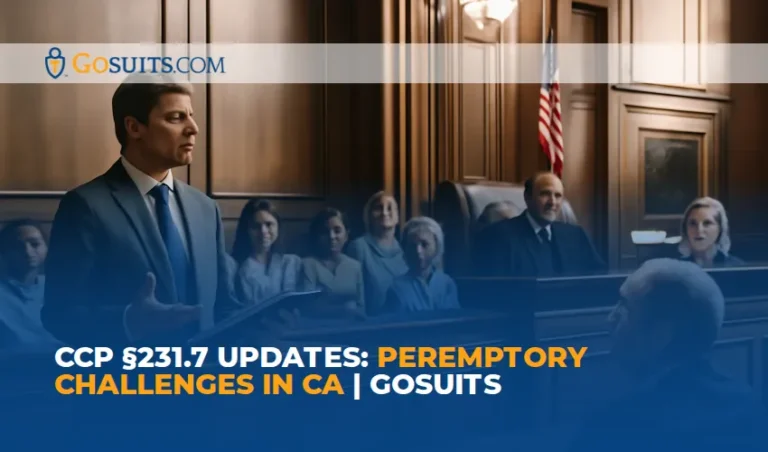
- What is CCP §231.7 and why does it matter in California civil jury trials?
- Have there been recent changes to CCP §231.7 or related law?
- How do peremptory challenges work in California civil cases and what is the procedure under CCP §231.7?
- What is the difference between a peremptory challenge and a challenge for cause?
- How do anti-discrimination rules (Batson/Wheeler) interact with CCP §231.7?
- What practical strategies should plaintiffs and defendants use when exercising peremptory challenges in personal injury trials?
- When do peremptory challenges get decided, and how does that affect appeals or trial timing?
- What common mistakes should litigants avoid when seeking to remove a prospective juror under CCP §231.7?
- How does CCP §231.7 affect personal injury cases in California cities like Los Angeles, San Francisco and San Diego?
- How can Gosuits help if you are a personal injury plaintiff or defendant facing jury selection issues?
- References / Resources
What is CCP §231.7 and why does it matter in California civil jury trials?
CCP §231.7 is the section of the California Code of Civil Procedure that governs removal of prospective jurors by peremptory challenge in civil cases. It establishes the procedural framework for exercising peremptory challenges during jury selection (voir dire) and works together with other statutory provisions and case law that regulate jury selection, fairness, and the removal of jurors for cause. Courts and litigants treat peremptory challenges as a limited, but strategically important, tool to shape the composition of a jury. For civil personal injury matters — for example, a San Francisco or Orange County trial — effective use of peremptory challenges can affect the jury’s makeup on issues like credibility, attitudes toward insurance companies, or attitudes toward injury and damages. For the controlling statutory text, see the California Code of Civil Procedure itself [1]. For practical court-level guidance about jury selection in California, see the California Courts resources on jury selection [2].

Have there been recent changes to CCP §231.7 or related law?
California statutory text can be amended from year to year, and case law refines how statutes operate in practice. As of the latest official publication, the operative statutory text is available on the California Legislative Information site; check the statute directly for the current language [1]. Courts and practitioners commonly watch three places for “changes” that affect peremptory challenges:
- Legislative amendments to the Code of Civil Procedure (text and subsection changes) — consult the official state site [1].
- Appellate and Supreme Court decisions interpreting peremptory challenge law or setting standards (for example Batson-type doctrine for racial or other discriminatory exclusion) — see United States Supreme Court and California case law summaries [4].
- Local court practices and jury administration rules (each superior court has procedures for voir dire and strikes) — use the California Courts resources and your local county court site [2].
If you are following a specific proposal or statutory amendment, verify the exact bill language and the effective date on the California Legislative Information website [7]. If there are no authoritative sources showing a legislative change, do not assume an update has been enacted.
How do peremptory challenges work in California civil cases and what is the procedure under CCP §231.7?
What is a peremptory challenge?
A peremptory challenge allows either party to remove a prospective juror without stating a cause. In California civil jury trials, each side receives a limited number of peremptory strikes. The number depends on the case type and statutes that allocate strikes by party or side. Peremptory strikes differ from challenges for cause because they do not require a factual showing of bias or inability to be impartial.

When and how are peremptory challenges exercised (procedure)?
The usual procedural steps during civil voir dire are:
- Questioning and information-gathering: the court and counsel ask the potential jurors questions to elicit information about background, views, relationships, and other factors relevant to impartiality.
- Challenges for cause: parties first move to remove any juror for cause (bias, relationship to parties/witnesses, incapacity). The court rules; if granted, the juror is removed without using a peremptory strike.
- Peremptory challenges: after cause challenges, parties exercise peremptory strikes according to the sequence the court sets. CCP §231.7 contributes to that framework; consult the statute text for the exact procedural elements and cross-reference local court rules and judicial instructions [1] [2].
Courts typically announce the sequence (e.g., plaintiff uses a strike, then defendant, or vice versa) and whether alternating or grouped strikes will be used. Each peremptory challenge reduces the party’s remaining strikes.
What is the difference between a peremptory challenge and a challenge for cause?
A challenge for cause requires specific grounds (e.g., prior knowledge of the case, strong bias or personal relationship to a party or witness, inability to apply the law). If the court grants a challenge for cause, the juror is excused and the party does not expend a peremptory strike.
A peremptory strike requires no stated cause, but it is limited in number. Peremptory strikes cannot be used to remove jurors for discriminatory reasons (see next section on Batson/Wheeler). If opposing counsel suspects discriminatory use, they may move for a Batson/Wheeler inquiry.
How do anti-discrimination rules (Batson/Wheeler) interact with CCP §231.7?
The U.S. Supreme Court’s decision in Batson v. Kentucky prohibits removal of jurors from federal and state juries on the basis of race. California courts follow Batson and the state-level Wheeler doctrine (People v. Wheeler) when a peremptory challenge is alleged to be discriminatory based on race, ethnicity, or sex. These limitations apply in civil and criminal jury selection, so a peremptory challenge that appears to be motivated by a prohibited group characteristic will prompt judicial inquiry.
The Batson test is a three-step process: (1) objecting party makes a prima facie showing of discrimination, (2) the proponent of the strike must articulate a race-neutral reason, and (3) the court decides whether the reason is pretextual and whether discrimination occurred. For the Batson decision text, see the U.S. Supreme Court record [4].
In California civil practice, trial counsel must be careful to avoid patterns of strikes that could create a successful Batson/Wheeler challenge. Courts will examine the record and may require counsel to explain the strike with neutral, non-pretextual reasons.
What practical strategies should plaintiffs and defendants use when exercising peremptory challenges in personal injury trials?
Jury selection is a strategic process. Below are practical, ethical, and court-approved considerations both sides should weigh.
For plaintiffs (including personal injury plaintiffs)
- Prioritize juror traits that favor injury claim credibility: look for jurors with empathy for accident victims, prior experience with medical or insurance systems that suggests fair-mindedness, or life experiences that favor a damages award when appropriate.
- Use cause strikes first: remove any juror whose answers show clear bias with a motion for cause to conserve peremptories.
- Preserve a record: when opposing counsel exercises strikes that seem questionable, make a timely record and, if needed, raise an objection sufficient to preserve an appeal or Batson/Wheeler inquiry.
- Coordinate voir dire themes: ensure voir dire elicits attitudes on compensation, comparative fault, and attitudes toward big business or insurance carriers — important areas in many personal injury cases like truck collisions and motorcycle incidents.

For defendants (including insurers and corporate defendants)
- Test juror sympathy early: ask questions designed to uncover leanings on plaintiff sympathy, pain-and-suffering valuations, and views of negligence related to driving, product use, or premises liability.
- Guard against Batson exposure: document race-neutral reasons for strikes (e.g., prior experience with litigation, stated positions on relevant topics) when exercising peremptories.
- Consider juror backgrounds in heavy-injury cases: in catastrophic injury matters (brain injury, spinal injury, 18-wheeler cases), jurors’ pre-existing attitudes toward medical care, long-term disability, and the fairness of large verdicts matter.
How a local personal injury lawyer helps
Experienced trial counsel help manage voir dire, craft neutral reasons for strikes, and preserve the record for appeals. If you are consulting a firm about an auto collision, slip-and-fall, or truck crash, an experienced California trial attorney can explain how CCP §231.7 and related doctrines apply in Los Angeles, Orange County, Bay Area courts, and elsewhere in California.
If you are searching for representation, look for counsel who handle personal injury matters across California — for example, firms that list practice areas for truck accidents and car crashes and have trial experience in Los Angeles and San Diego courts. Phrases you might see when searching include car accident lawyers and truck accident lawyers. For someone injured in Los Angeles, you may search for Los Angeles car accident lawyers or truck accident lawyers in Riverside, CA. If you were hit while on two wheels, you may search for motorcycle accident lawyers or injured motorcyclist attorneys in your county.
When do peremptory challenges get decided, and how does that affect appeals or trial timing?
Peremptory strikes are typically exercised during voir dire before the final panel is sworn. Trial judges usually announce the strike order and require parties to identify strikes at set points. If a Batson/Wheeler objection arises, the court may pause jury selection and hold a hearing. That hearing and its ruling may be appealed after final judgment; preserving the record on the issue is critical if an appeal is contemplated.
Appellate timing and strategy vary by county, and some procedural rulings about strikes and voir dire can be appealed — see example appellate procedure and precedents discussed in California opinions and local practice guides [6].
What common mistakes should litigants avoid when seeking to remove a prospective juror under CCP §231.7?
- Exhausting peremptories prematurely: Burning peremptories on jurors who could instead be removed for cause can leave you vulnerable later in selection.
- Failing to create a record: If you suspect discriminatory use of strikes, timely object and make a record so a later Batson/Wheeler challenge is viable.
- Using pretextual reasons: Courts will examine proffered race-neutral reasons for pretext. Avoid reasons that are facially inconsistent or manufactured.
- Self-representation during voir dire: voir dire is both a fact-finding and strategic proceeding. Effective questioning and objection practice is a courtroom skill; do not represent yourself if jury selection is critical to your case.
How does CCP §231.7 affect personal injury cases in California cities like Los Angeles, San Francisco and San Diego?
In high-value personal injury matters (brain injury, spinal injury, 18-wheeler cases, serious truck collisions), the jury’s composition can be decisive. CCP §231.7 defines how parties exercise peremptory challenges statewide, but local courts have specific voir dire length, courtroom protocol, and supplemental rules that counsel must follow. For example:
- Los Angeles and Orange County: large urban trial calendars and significant jury pools, frequent voir dire, and local preferences about questionnaires and juror notes make an experienced local trial attorney valuable.
- Bay Area and San Francisco: complex civil calendars and sometimes more extensive juror questionnaires mean voir dire strategy is often tailored to probing for particular attitudes about liability and damages.
- San Diego and Riverside: counsel must adapt to county-specific procedures and practical courtroom norms for peremptory strikes.
If you are a potential personal injury plaintiff, do not rely on an insurance adjuster’s timeline. Consult experienced counsel who regularly litigate catastrophic injuries and understand how to employ peremptory challenges consistent with CCP §231.7 and anti-discrimination rules.
How can Gosuits help if you are a personal injury plaintiff or defendant facing jury selection issues?
If your case involves serious injury, complex liability, or tight jury selection issues under CCP §231.7, a free consultation with a qualified personal injury attorney can clarify your options and next steps. Gosuits offers a client-focused approach to jury preparation and trial strategy.

How a free consultation can help you right now
- Free immediate consultation 24/7: When jury selection is upcoming, speaking with a trial attorney immediately helps preserve issues and build a voir dire plan.
- Assessment of juror strategies: We can explain how many peremptory challenges you are likely to have, the sequence used in your county, and how to document discriminatory strikes for a Batson/Wheeler record.
- Case triage: We explain whether voir dire strategy, settlement posture, or immediate discovery is the right next step.
About Gosuits and how we can add value in CCP §231.7 situations
Gosuits is a personal injury firm that focuses on quality, not volume. Here is how we help clients with jury selection and peremptory challenge issues:
- What we do: Investigate claims, prepare demand, negotiate with insurers, litigate, handle discovery, and apply jury selection strategy tailored to your jurisdiction (Los Angeles, San Diego, Sacramento, Orange County, Bay Area, Riverside).
- Our strength and uniqueness: We use a proprietary personal injury case-management system that speeds investigation, demand preparation, negotiations, litigation, and discovery workflow — a tool built for law practice to beat insurance-company timelines.
- Experience and track record: Over 30 years of combined experience; litigated 1,000+ cases with published settlements and verdicts. See our past results at prior cases and read about our attorneys at our attorneys. Learn about the firm at about us and our full practice areas.
- Awards and recognition: multiple recognitions including TopVerdict placements, top settlement awards in Texas, national recognitions for attorneys, Best Lawyers listings and Super Lawyers selections.
- Case workflow and tools: Our proprietary software enhances investigation and discovery, helping preserve juror issues and create records for Batson/Wheeler challenges when necessary.
- Fee policy and transparency: We work on a contingency model — No win, No Attorney Fees (No win, No Attorney Fees) — and there are no hidden administrative fees.
- Availability and communication: We are available 24/7 for immediate free consultation and have attorneys and staff on-site at our locations around the clock. We provide multilingual customer service, including 24/7 Spanish and Farsi speakers.
- Community and professional involvement: Active community participation, board memberships with trial lawyer organizations, and support for local nonprofit and civic groups.

How we help immediately if jury selection is near
- Immediate file review and voir dire plan: We rapidly review the case file and build voir dire themes aligned with your damages and liability theory.
- Juror questionnaire and template objections: Where permitted, we draft juror questionnaires and prepare timely cause-challenge templates.
- Preserving appeals and Batson records: We advise on preserving an objection record that is essential for any appellate review.
Contact & locations: We have offices and 24/7 staff ready in California and Texas. If you need immediate help with an impending jury selection, contact us for an immediate free consultation.
References / Resources
- California Code of Civil Procedure §231.7 – California Legislative Information
- Jury Selection and Voir Dire – California Courts
- Peremptory Challenge – Legal Information Institute (Cornell Law School)
- Batson v. Kentucky, 476 U.S. 79 (1986) – U.S. Supreme Court (text)
- Trends in Jury Trials (National Center for State Courts)
- Sandlin v. McLaughlin, Cal. Ct. App., 2020 (court opinion PDF)
- California Legislative Information – Home
- The Jury System – United States Courts
- California QuickFacts – U.S. Census Bureau
- Jury Programs and Resources – California Courts (programs and jury administration)