<?xml encoding=”UTF-8″>
- What does lost work mean in a Texas personal injury case?
- What documents prove lost wages in Carrollton TX?
- How do you get employer wage verification and what should it include?
- How do hourly salaried and tipped workers calculate lost income?
- How do self employed and gig workers in Carrollton prove lost income?
- What medical documentation supports time off and causation?
- How is lost earning capacity different from lost wages and how do courts view it?
- What if you used PTO or sick leave can you still claim it?
- How do taxes W2s and 1099s factor into proof of income after an accident?
- Which Texas evidence and discovery rules help you get records admitted?
- What deadlines apply in Texas and when should you act?
- What is the Carrollton TX lost work proof checklist step by step?
- What mistakes should you avoid when documenting lost income?
- How do insurers and adjusters evaluate wage loss evidence?
- What should defendants and insurers request to test lost income claims?
- What are quick answers to common questions about lost work proof?
- Why choose GoSuits for a Carrollton TX lost work claim?
- References and resources
What does lost work mean in a Texas personal injury case?
Lost work in a Texas personal injury case means the time you could not perform your job because of accident related injuries, plus the income you missed and benefits you had to use as a result. In civil cases, economic damages include past lost wages and future lost earning capacity. Lost wages are the actual earnings you did not receive between the date of injury and your return to work. Lost earning capacity is the reduction in your ability to earn income in the future because of lasting limitations. Texas law allows recovery of these economic losses if you can link them to the incident with competent evidence and file within the deadline for personal injury claims, which is generally two years in Texas [1].
If your case is filed in state court in Dallas, Denton, or Collin County serving Carrollton, you will need organized and admissible records. Texas discovery rules require parties to disclose the calculation of damages and the documents on which each calculation is based [2]. Texas evidence rules also address how business records like payroll and HR files can be admitted [3][4].
What documents prove lost wages in Carrollton TX?
To build a reliable lost work proof checklist, gather items that show what you earned before the injury, how your schedule changed after the injury, and why your doctor limited your work.
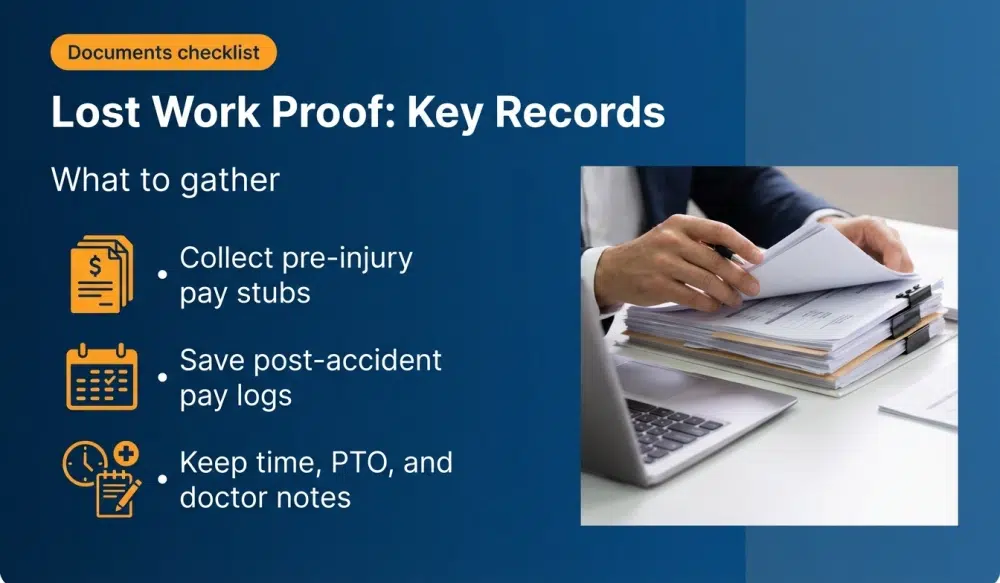
- Pay history before the accident Recent pay stubs for at least 13 weeks before the injury, or longer if your income fluctuates seasonally. These show hourly rate, salary, overtime, bonuses, commissions, and tips if recorded.
- Year to date earnings summaries Payroll summaries and W2s for employees, and 1099s for contractors. These give a baseline for typical earnings [8].
- Post accident pay records Pay stubs and payroll registers after the accident showing reduced hours, light duty pay, or unpaid time off. This helps calculate the difference.
- Employer verification letter A letter on company letterhead confirming job title, regular schedule, hourly or salary rate, dates missed, light duty dates, and any lost bonuses or commissions tied to reduced performance.
- Time and attendance logs Timesheets, clock in and clock out data, and attendance calendars to confirm missed workdays and shortened shifts.
- Medical excuse notes Provider notes prescribing no work, restricted duty, or limited hours, with dates and restrictions. FMLA certifications may also support the medical necessity for time off [9].
- PTO and sick leave records Documentation of vacation, sick time, or personal time used for recovery. Even if paid, this is a compensable loss in many cases because those benefits were expended due to the injury.
- For sales or bonus driven roles Commission statements, pipeline reports, and target metrics showing lost performance tied to work restrictions.
- For self employed or gig workers Business bank statements, invoices, accounts receivable reports, profit and loss statements, prior tax returns, and any canceled contracts or bookings. IRS publications explain recordkeeping best practices for small businesses that can help organize these materials [7][8].
- Transportation and logistics proof For delivery, rideshare, or field workers, route logs, platform dashboards, deactivation logs, and mileage summaries showing activity before and after the injury.
- Independent verification If your employer is slow to respond, IRS tax transcripts can corroborate income history while you wait for payroll records [7].
A strong package anticipates authenticity objections by gathering business records that meet Texas evidence rules for the business records exception and self authentication where appropriate [3][4].
How do you get employer wage verification and what should it include?
Ask your supervisor or HR to prepare a wage verification letter on letterhead. Many employers in Carrollton already have a human resources template. If not, keep it simple and factual.
- Employee identification Full name, job title, department, and work location.
- Employment status Full time or part time, exempt or nonexempt, and hire date.
- Pay terms Hourly rate and typical hours per week, or salary amount and pay frequency, plus overtime and shift differential policies.
- Schedule history Typical work schedule before the accident and any approved overtime or weekend shifts.
- Dates missed Specific dates not worked due to injury and whether they were unpaid or covered by PTO, sick leave, or disability plans.
- Light duty Dates and pay rate for any light duty or reduced hours assignments.
- Variable pay How bonuses, commissions, tips, or incentives are calculated and what was lost because of missed work.
- Records custodian signature Signed by an HR representative who can later verify company records under Texas Rules of Evidence if needed [3][4].
Keep a copy of the request you sent and any emails or portal messages. These help show diligence under discovery rules requiring you to disclose the documents you will rely on to compute damages [2].
How do hourly salaried and tipped workers calculate lost income?
How do hourly workers in Carrollton convert missed time into dollars?
For hourly workers, the basic formula is hours missed multiplied by the regular rate. Use your pay stubs and attendance logs. If you regularly worked overtime, include the average weekly overtime hours from the prior 13 weeks, paid at the applicable overtime rate. If your hours varied, calculate an average weekly earnings number before the accident and compare it to actual weekly earnings after the accident to find the difference, week by week.
How do salaried employees compute lost wages for missed days?
Salaried employees can convert salary to a daily or hourly rate. For example, divide annual salary by 52 to get weekly salary, then divide by 5 for daily rate or by typical weekly hours for an hourly equivalent. Then multiply by workdays or hours missed. If your employer paid you but required you to use PTO, claim the value of PTO used because that benefit was consumed due to the injury.
What about tipped or commission based workers?
For tipped roles, use declared tips on pay stubs and point of sale tip reports to calculate average daily tips before the injury. For commissions, gather a 6 to 12 month history of commissions and show how missed work reduced your pipeline or closed deals. Support the link between time off and lost variable pay with emails, CRM reports, and manager statements. Be conservative in your method and rely on actual historical averages rather than projections, because adjusters and courts prefer objective records.
Serious motor vehicle collisions can produce substantial wage losses across Texas. National cost data shows that motor vehicle crashes impose hundreds of billions of dollars in economic costs, including productivity losses from missed work [10][11].

How do self employed and gig workers in Carrollton prove lost income?
What records best support self employed lost income?
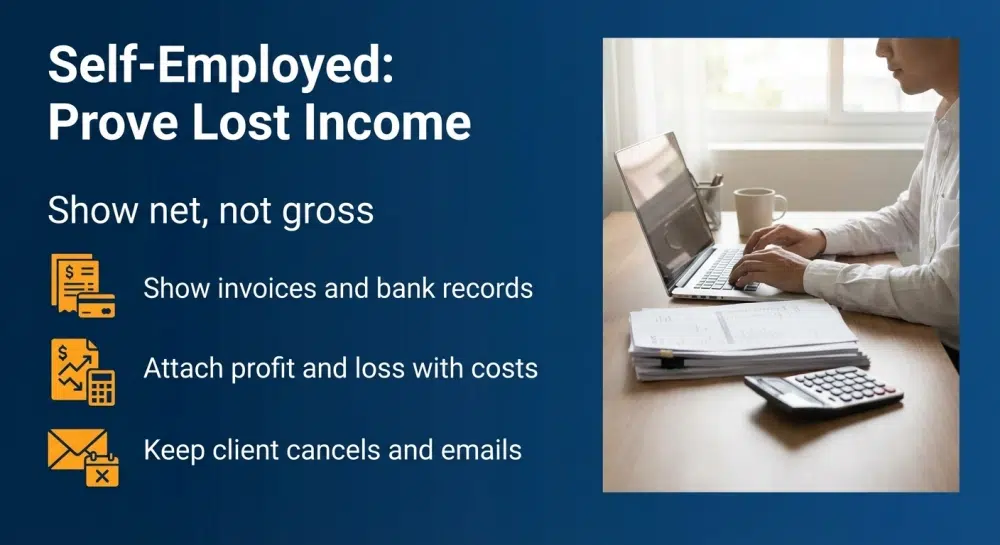
Self employed and independent contractors should show both pre injury earnings capacity and post injury decline. Useful items include business bank statements, invoices, client contracts, booking calendars, profit and loss statements, and tax returns covering at least the prior two years. IRS Publication 334 explains recordkeeping for small businesses and supports why these records are reliable indicators of income [8]. If clients canceled projects or you declined gigs due to medical restrictions, keep those emails and texts.
How do you account for business expenses when claiming lost income?
Courts and insurers typically focus on lost net income rather than lost gross receipts for self employed claimants. To avoid disputes, calculate lost revenue minus variable expenses that would have been incurred to earn that revenue. Fixed expenses that you still had to pay, like rent or software subscriptions, are part of the loss because they continued even without revenue. Attach a clear profit and loss statement showing these distinctions, with bank statements corroborating deposits and payments. If you need historical confirmation, IRS transcripts can help verify reported income [7].
What if your work is seasonal or project based?
Use multi year averages and document the seasonality. Show prior busy season calendars and compare to the period you missed. Provide signed client statements or booking system screenshots confirming the work you could not accept. Where possible, obtain independent corroboration so that your calculation does not depend solely on your own testimony. Under Texas evidence rules, detailed business records kept in the ordinary course can qualify for admission by custodian affidavit [3][4].
What medical documentation supports time off and causation?
Medical documentation connects your inability to work to the accident. The most persuasive evidence is a clear provider note listing your diagnosis, specific work restrictions, and the expected duration. If you are an employee eligible for FMLA, the federal certification form requires your provider to explain the medical facts and need for leave [9]. Keep copies of every work status note and ensure the dates align with your time records.
- Work status notes Physician or advanced practice provider notes that specify no work, limited hours, lifting limits, or light duty. Dates must match missed time.
- Treatment timeline Appointment logs and therapy schedules that explain late arrivals or partial day absences.
- HIPAA authorizations Signed releases allow your attorney to obtain medical records quickly. Federal guidance explains your right to access these records [14].
The more precise the medical restrictions, the stronger your wage loss proof. Adjusters and juries want to see that missed days were medically necessary, not just preferred.
How is lost earning capacity different from lost wages and how do courts view it?
Lost wages refer to the actual pay you missed before trial. Lost earning capacity refers to the reduction in your ability to earn money in the future due to permanent or long term limitations. This can exist even if you return to work in some capacity, because you might work fewer hours, lose overtime eligibility, or be unable to perform higher paying roles. Legal references describe lost earning capacity as a separate element of damages distinct from past wages [5].
How do you prove lost earning capacity in Texas?
- Medical permanence Records and opinions showing lasting impairments that limit work.
- Vocational evidence Analysis of your skills, education, and job market options in Carrollton and the Dallas area.
- Earnings comparison Historical earnings versus projected earnings with limitations, using credible data sources and work history.
- Mitigation evidence Proof that you made reasonable efforts to work within restrictions, since the duty to mitigate damages applies [6].
Calculations should be conservative and grounded in documents. A well organized file of pay records, job postings, and medical restrictions will carry more weight than estimates without support.
What if you used PTO or sick leave can you still claim it?
Yes. If you exhaust PTO, sick leave, or personal days because of the injury, you lost a valuable employment benefit. Document the number of hours used and the value per hour. Include screenshots from HR portals, payroll reports, and any manager approval emails. Even if your employer later replenishes some leave, keep those records so you can credit any replenished hours and avoid duplication.

How do taxes W2s and 1099s factor into proof of income after an accident?
Tax records help corroborate your typical income level. For employees, W2s show annual wages and payroll deductions. For contractors, 1099s report nonemployee compensation. The IRS provides secure ways to obtain transcripts if you cannot locate prior returns [7]. For small businesses, IRS Publication 334 outlines recordkeeping that supports income calculations, including retaining invoices, receipts, and account statements [8]. When calculating self employed losses, focus on net income after business expenses, supported by your profit and loss statements and bank records.
Which Texas evidence and discovery rules help you get records admitted?
What is the business records exception and why does it matter?
Texas Rules of Evidence allow business records to be admitted if a custodian can testify or certify that the record was made at or near the time by someone with knowledge, kept in the course of regularly conducted business, and that making the record was a regular practice. This is found in Texas Rule of Evidence 803(6) [3]. Payroll registers, time sheets, and HR attendance logs often meet these criteria.
Can you authenticate payroll records without live testimony?
Yes. Texas Rule of Evidence 902(10) permits self authentication of business records through an affidavit from a records custodian if the affidavit and records are served in advance as required [4]. Many defendants and insurers accept wage records accompanied by a proper custodian affidavit without requiring a deposition.
What discovery rules require disclosure of your wage loss calculation?
Texas discovery rules require initial disclosures identifying the computation of each category of damages and the documents on which the computations are based. This obligation is similar in spirit to Federal Rule of Civil Procedure 26(a)(1)(A)(iii) [2][15]. Organizing your payroll, tax, and medical records early makes these disclosures accurate and complete.
What about employer recordkeeping requirements?
Texas employers must keep certain wage and hour records. The Texas Workforce Commission publishes employer recordkeeping guidance that can help you identify what to request from HR or payroll [13].
What deadlines apply in Texas and when should you act?
In most Texas personal injury cases, you must file suit within two years of the date of injury [1]. Some claims have shorter notice requirements. Because payroll systems overwrite old data and supervisors change, request your records promptly. Early collection also helps satisfy disclosure requirements and reduces the risk of missing key documents. If you are in Carrollton, your case may be filed in Dallas County, Denton County, or Collin County district courts depending on the facts and venue. Each court will expect complete disclosures and timely evidence exchange under the Texas Rules of Civil Procedure [2].
What is the Carrollton TX lost work proof checklist step by step?
How do you build a strong wage loss file in one week?
- Day 1 request employer records Send HR a written request for pay stubs, attendance logs, and an employment verification letter covering 6 months before and after the accident. Ask for the records custodian to be identified for potential business records certification [3][4].
- Day 2 collect your pay stubs Download the last 13 weeks of pay stubs from your payroll portal, plus all post accident stubs. Save PDFs with clear file names.
- Day 3 secure medical notes Ask your provider for a detailed work status note explaining restrictions and dates. If your employer uses FMLA forms, get the certification completed [9].
- Day 4 pull tax confirmations Retrieve W2s or 1099s and, if needed, IRS wage and income transcripts for the prior year to corroborate your baseline [7][8].
- Day 5 document PTO and overtime Export PTO usage reports, and gather proof of regular overtime prior to the injury if relevant.
- Day 6 organize self employed records For contractors or business owners, assemble invoices, bank statements, and a draft profit and loss showing net income impact [8].
- Day 7 prepare a calculation sheet Build a simple table listing each week, pre injury average earnings, actual post injury earnings, and the weekly difference. Attach footnotes to the documents that support each figure.
What belongs in the final wage loss packet?
- Summary letter One page narrative explaining dates of injury, job role, and a summary of lost time and pay.
- Calculation exhibits Weekly or monthly worksheets showing how you computed the loss.
- Employer letter Employment and wage verification on letterhead with custodian contact.
- Payroll and attendance Pre and post accident stubs and logs.
- Medical records Work status notes with clear restrictions and dates.
- Tax corroboration W2s, 1099s, or transcripts corroborating typical earnings [7][8].
- Self employed attachments Invoices, bank statements, P and L, and client cancellation notices if applicable.
- Business records affidavit If available, a custodian affidavit to support self authentication of payroll records for trial [4].
What mistakes should you avoid when documenting lost income?
- Relying only on estimates Use documents. Estimates alone invite disputes. Anchor each number to a record.
- Ignoring variable pay Do not forget commissions, tips, differentials, and bonuses, but prove them with historical data.
- Overstating overtime Average overtime from a meaningful period. Avoid cherry picking peak weeks.
- Skipping medical causation Tie every missed day to a medical restriction and treatment schedule.
- Missing deadlines Request records promptly and calendar the two year Texas limitations period [1].
- Forgetting taxes and expenses Self employed claims should focus on lost net income, not gross receipts [8].
- Not mitigating Document good faith attempts to work within restrictions to satisfy mitigation duties [6].
How do insurers and adjusters evaluate wage loss evidence?
Insurers look for gaps, inconsistencies, or unsupported assumptions. Adjusters often score a wage loss claim by strength of documentation and medical support. Independent facts that corroborate the claim, like time clock exports, payroll system logs, and tax transcripts, increase credibility. Public data shows injuries and crashes carry large productivity costs nationwide, which helps explain why thorough documentation matters in settlement negotiations [10][11]. In practice, you will be asked to produce the records you will rely on, consistent with required disclosures [2][15].

What should defendants and insurers request to test lost income claims?
Defendants in civil cases evaluate whether the evidence proves time off, pay rate, and causation. A focused request set usually includes the following.
- Complete payroll records Pay stubs, wage statements, and YTD summaries before and after the injury.
- Timekeeping data Time clock reports, attendance records, and schedule assignments.
- Job description and policies Documents showing essential job functions and overtime practices that relate to limitations.
- Medical work restrictions All return to work notes and restrictions for the disputed period [9].
- Tax returns and transcripts W2s, 1099s, returns, and IRS transcripts to test accuracy of stated earnings [7][8].
- Self employed financials Bank statements, invoices, and profit and loss statements to evaluate net income impact.
- Business records affidavits Certifications that make payroll and attendance records admissible without live witnesses [4].
These items go to admissibility and weight under Texas evidence rules and discovery obligations [2][3][4].
Why choose GoSuits for a Carrollton TX lost work claim?
If you were hurt in a traffic crash, a fall, or another incident in Carrollton, organizing a wage loss file can be the difference between a fast, fair settlement and a drawn-out dispute. Our team focuses on civil injury cases across Texas, including vehicle collisions and premises incidents. When you contact us for a free consultation, we walk you through a step-by-step lost work proof checklist, identify any gaps in employer or medical records, and explain the next steps to protect your claim timeline.
We serve clients throughout Texas. GoSuits uses a technology-driven approach to accelerate evidence collection. Our exclusive proprietary software streamlines payroll subpoenas, medical record retrieval, and damage modeling, helping deliver faster and better results while keeping your file organized for required disclosures and trial presentation. Even with advanced technology, every client has a designated attorney. We do not route cases through case managers. You have direct access to your lawyer for strategy, updates, and preparation.
Our attorneys have more than 30 years of combined experience in personal injury litigation, including trials in courts across the state. Trial experience matters because it shapes early strategy, evidence preservation, and negotiation leverage. You can review a selection of outcomes on our page of prior cases, read about our attorneys, learn more about us, and explore our practice areas.
If your case involves a vehicle crash, you may be comparing options similar to Carrollton personal injury lawyers and wondering what sets firms apart. We combine a modern evidence system with hands on advocacy by trial ready lawyers. This balance helps us prepare clean, admissible wage records that comply with Texas Rules of Evidence and the current Texas discovery framework [2][3][4]. If you are considering counsel, reach out to discuss your wage documentation questions and case timeline.
References and resources
- Texas Civil Practice and Remedies Code Section 16.003 Statute of Limitations for Personal Injury Claims – Texas Legislature Online
- Texas Rules of Civil Procedure Required Disclosures and Discovery Rules – Supreme Court of Texas
- Texas Rules of Evidence Rule 803(6) Records of a Regularly Conducted Activity – Supreme Court of Texas
- Guide to Texas Court Rules including Evidence Rule 902(10) Business Records – Texas State Law Library
- Lost Earning Capacity Overview – Cornell Law School Legal Information Institute
- Mitigation of Damages Doctrine – Cornell Law School Legal Information Institute
- Get Transcript Service for Tax Records – Internal Revenue Service
- Publication 334 Tax Guide for Small Business – Internal Revenue Service
- 29 CFR 825.306 FMLA Certification of Health Care Provider – Electronic Code of Federal Regulations
- Cost of Crash Injuries and Productivity Losses – Centers for Disease Control and Prevention
- Economic Impact of Motor Vehicle Crashes 2019 Summary – National Highway Traffic Safety Administration
- Nonfatal Occupational Injuries and Illnesses Requiring Days Away From Work – Bureau of Labor Statistics
- Employer Recordkeeping Requirements for Wages and Hours – Texas Workforce Commission
- Individuals Right under HIPAA to Access Health Information – U.S. Department of Health and Human Services
- Federal Rule of Civil Procedure 26 Initial Disclosures and Computation of Damages – Cornell Law School Legal Information Institute