- Who can legally use California carpool HOV lanes?
- What are HOV 2 plus vs 3 plus rules and hours in California cities?
- Can motorcycles use the carpool lane in California and what safety rules apply?
- What actions lead to a carpool lane ticket in California and how serious are the fines?
- What should you know about civil liability if a crash happens in a carpool or express lane?
- How can you avoid common HOV and express lane mistakes?
- What local notes matter for Los Angeles, San Diego, San Jose, San Francisco, Sacramento, and Orange County?
- Why GoSuits can help after a California traffic injury
- References and resources
Who can legally use California carpool HOV lanes?
In California, carpool lanes are officially called high occupancy vehicle lanes, marked with a diamond symbol and signs stating occupancy and hours. The baseline rule is set in the California Vehicle Code: only vehicles that meet posted occupancy requirements may use HOV lanes, with specific exceptions for certain vehicle types [1]. Federal law for HOV facilities also sets minimum access for some vehicle classes, which states implement through their own codes and signage [7].
Here is who can generally use HOV lanes in California, subject to posted signs:
- Vehicles with the required occupants: Most corridors are HOV 2 plus, some corridors or time periods are HOV 3 plus. You must have the posted number of people in the vehicle, not counting infants as cargo, but counting every person regardless of age who is safely seated and belted [5].
- Motorcycles: Motorcycles may use HOV lanes regardless of the number of riders unless a particular segment is signed otherwise for safety, consistent with state law and federal policy [1], [7].
- Buses and vanpools: Public transit and vanpools meeting the occupancy threshold are permitted and often prioritized by design [5].
Even if your vehicle type qualifies, you must obey all entry and exit markings. It is illegal to cross double parallel solid lines to enter or leave an HOV lane except where designated openings exist [2]. In practice, that means waiting until a dashed or single broken line provides a legal ingress or egress point.
What are HOV 2 plus vs 3 plus rules and hours in California cities?
Occupancy requirements and operating hours are set by each corridor and posted on roadside signs. California operates one of the nation’s largest HOV networks, with corridors managed by Caltrans and regional partners. The core principles appear statewide, but the details vary by region [5].
- HOV 2 plus is the default: Most carpool lanes require at least 2 people per vehicle during operating hours. If no hours are shown, assume the restriction may apply full time until signs indicate otherwise [5].
- HOV 3 plus on busy approaches: Some corridors post HOV 3 plus to keep traffic flowing, especially near major bridges or bottlenecks. For example, several Bay Area segments display HOV 3 plus during peak times [12].
- Hours vary by corridor: Many Bay Area lanes are active only during weekday peak periods, while some Southern California corridors run 24 hours a day, 7 days a week. Always follow the specific roadside signs for that segment [5], [12].
Examples by region, driven by signage and posted rules:
-
Los Angeles and Orange County: Extensive HOV networks, with some 24-hour operations and multiple express lane facilities that may shift to HOV 3 plus for toll-free travel in peak periods. Check each segment’s posted signs and any adjacent express lane instructions [5].
-
San Diego: I-15 includes a major express lane corridor with variable occupancy and toll policies depending on the time of day. General HOV segments elsewhere in the region typically run HOV 2 plus with posted hours [5].
-
San Jose and the South Bay: Several express lane segments and peak hour HOV operations exist on major freeways. HOV 3 plus is used on limited approaches and during limited times depending on the corridor [12].
-
San Francisco and the East Bay: State-owned bridges now generally require HOV 3 plus for toll discounts. Major corridors like I-880 operate from 5 a.m. to 8 p.m. and require a FasTrak Flex for toll-free travel, so verify signs carefully [12].
-
Sacramento: Be alert for the “Fix 50” construction project on US 50, which affects lanes through mid-2026. Most HOV lanes operate only during peak periods (e.g., 6–10 a.m. and 3–7 p.m.) rather than 24 hours [5].
If you are unsure, do not guess. Occupancy and hours are enforced, and violations can lead to a carpool lane ticket California drivers often find unexpectedly costly. When in doubt, drive in general purpose lanes until you can verify rules through signage or official corridor information [5], [8].

Can EVs and Plug-in Hybrids Drive Solo in California Carpool Lanes?
No. As of 2026, EVs, plug-in hybrids, and other low-emission vehicles are not allowed to use California HOV (carpool) lanes with a single occupant.
The Clean Air Vehicle decal program, which previously granted solo access to qualifying vehicles, ended on September 30, 2025, due to the expiration of federal authority (Section 166 of Title 23 of the United States Code). Congress did not renew it, so all privileges, including solo HOV access and any toll discounts in express lanes, terminated statewide.
Key points:
- Solo drivers in EVs or plug-in hybrids must now meet the posted occupancy requirements (typically 2+ or 3+ people, depending on the corridor and time) to use HOV lanes legally.
- In express lanes, solo low-emission vehicles pay full tolls (where applicable), with no special discounts. FasTrak transponders may still be required, and occupancy rules are strictly enforced.
- Enforcement is handled by the California Highway Patrol, with citations possible for violations.
California’s zero-emission vehicle fleet continues to grow rapidly, with cumulative light-duty ZEV sales exceeding 2.46 million through Q3 2025 and ZEVs representing a rising share of new registrations (reaching nearly 30% in some quarters). Operators now rely solely on standard occupancy requirements, carpools, dynamic pricing, and other tools to manage congestion and support mobility goals.
Always check roadside signs for current HOV rules, as they vary by corridor and time of day. For the latest updates, visit the DMV or Caltrans websites.
Can motorcycles use the carpool lane in California and what safety rules apply?
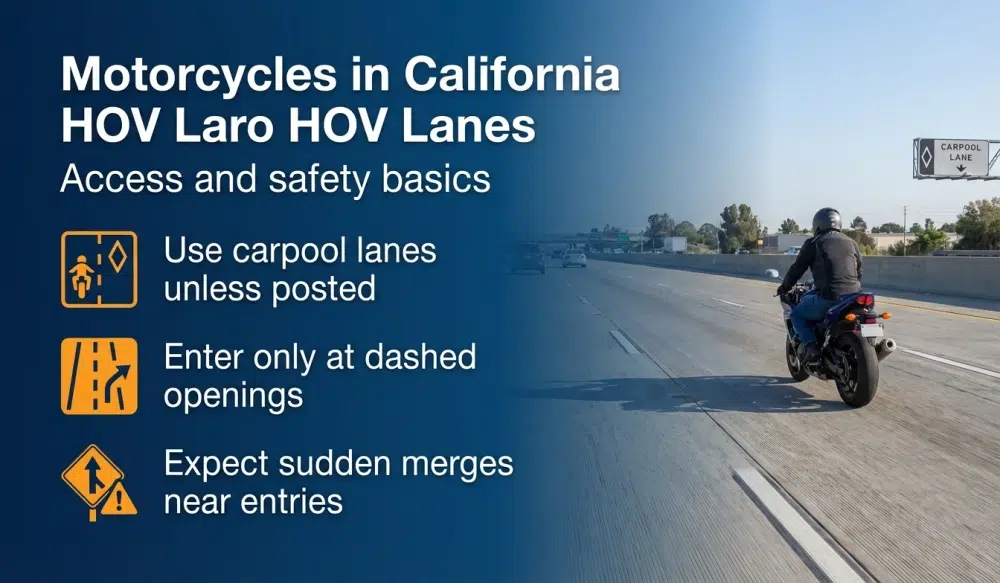
Yes. Motorcycles may use carpool lanes in California, regardless of the number of riders, unless a particular segment is posted to prohibit it for safety reasons. This access is permitted by California law and reinforced by federal policy on HOV facilities [1], [7].
Safety considerations matter. California permits lane splitting under conditions that require judgment and care. The California Highway Patrol publishes guidance to promote safer behavior for riders and drivers. When entering or exiting HOV lanes, riders should avoid crossing double parallel lines and should enter only at designated openings, like all vehicles. Signal early, anticipate speed differentials, and be alert for drivers making sudden lane changes into or out of the carpool lane [2], [13].
If a rider is hurt in an HOV or express lane incident, including sudden lane changes by larger vehicles, families sometimes look for motorcycle crash attorneys who understand both HOV rules and rider dynamics. Because California follows comparative fault, the facts and evidence surrounding lane positioning, signaling, and traffic flow can be critical to any motorcycle injury claims [1].
How Do California Express Lanes and FasTrak Flex Settings Work?
Express lanes are managed lanes that use dynamic pricing and electronic tolling to maintain reliable travel speeds. Many are built by converting or adding to existing HOV lanes. Caltrans and regional partners set the rules for each corridor, including whether carpools travel discounted or toll-free and when occupancy increases to HOV 3+ in peak hours.
Key points:
- FasTrak and FasTrak Flex: Most express lanes require a transponder. A FasTrak Flex transponder includes a 1-2-3+ switch to declare occupancy. Drivers must set the switch correctly before entering the lane to match the actual number of occupants (motorcycles and 2-seater vehicles with 2 people often set to 3+ for full benefits). Misrepresenting occupancy can lead to citations and toll violations. Corridor signage and operator pages explain transponder requirements.
- Carpools and vanpools: Depending on the corridor and hour, qualifying carpools (typically 2+ or 3+ people) and vanpools may travel free or at a discount with a properly set FasTrak Flex. Some corridors require HOV 3+ for toll-free travel in peak hours and allow HOV 2+ at a discount at other times. Always follow posted signs and operator instructions.
- Motorcycles: Motorcycles are generally allowed toll-free in most express lanes (often by setting FasTrak Flex to 3+ where required). Some corridors require a transponder for detection, even if no toll is charged. Riders should confirm specific corridor rules in advance and watch entry signs.
To reduce the chance of a carpool lane ticket, California drivers should check FasTrak Flex settings before entry. If you drive through multiple express lane networks in one trip, verify the setting each time you cross into a new corridor. If a crash occurs in a dynamic toll lane, understanding these rules also helps attorneys and adjusters evaluate whether a driver’s conduct complied with posted requirements.
What actions lead to a carpool lane ticket in California and how serious are the fines?
Enforcement focuses on safety, fairness, and lane performance. Common violations include:
- Insufficient occupants: Driving in HOV lanes without meeting the posted occupancy requirement is a violation of state law [1].
- Crossing double lines: Entering or exiting an HOV lane over double parallel solid lines, or outside of designated openings, violates the Vehicle Code and is a frequent basis for citations [2].
- Misusing express lanes: Entering without a required transponder, failing to set the FasTrak Flex occupancy switch correctly, or ignoring posted toll instructions can lead to citations and toll enforcement actions [6].
Penalties vary by county and court schedule. While base fines may appear modest in the code, mandatory assessments and fees can substantially increase total costs. If you receive a citation, the California Courts Self Help Center explains options such as paying the ticket, possible eligibility for traffic school, or contesting the citation in court [8].
When a ticket accompanies a collision claim, both sides often consider the citation along with all other evidence. A citation alone does not automatically decide Self-Helpcivil fault. In a dispute over an HOV-related crash, car accident lawyers review the law, roadway design, signage, electronic toll records, and witness statements to evaluate liability.
What should you know about civil liability if a crash happens in a carpool or express lane?
California uses a comparative fault system. That means a plaintiff’s recovery can be reduced by their percentage of fault, and more than one party can share responsibility. The principle flows from California Civil Code section 1714 and the California Supreme Court’s landmark decision recognizing comparative negligence. For both plaintiffs and defendants, this makes careful fact development critical in carpool or express lane cases [1], [9].
Key civil issues in HOV and express lane crashes include:
- Lane change and entry violations: Crossing double parallel lines to enter or exit an HOV lane, or moving into the HOV lane without yielding to a vehicle that has the right of way, can factor into negligence analysis. The presence of illegal crossing can be a significant data point for adjusters and courts [2].
- Occupancy or toll compliance: Failing to meet a posted occupancy or misusing a FasTrak Flex setting does not automatically cause a collision, but it can be evidence of careless operation if related to the events leading to the crash. Toll records and camera data sometimes help reconstruct timelines [6].
- Speed differentials and following distance: HOV lanes often travel faster than adjacent lanes. Sudden lane changes by drivers attempting to enter can trigger rear end and sideswipe impacts. In serious cases, parties may consult collision reconstruction and use CHP reports to understand sequences [15].
- Motorcycle dynamics: A rider lawfully traveling in the carpool lane can still face unexpected merges from drivers attempting to enter at dashed openings. Liability turns on signaling, lookout, and safe execution of merges by all involved [13].
If the crash involves a public agency, such as an incident linked to alleged dangerous condition of public property or issues with an express lane operated by a public entity, special claim rules apply. Generally, a written claim must be presented to the public entity within six months of the incident before a lawsuit can proceed, with limited exceptions. Missing this claim step can affect rights significantly [10].
California’s general statute of limitations for personal injury is two years from the date of injury. Shorter administrative deadlines may apply first if a public entity is involved. Tracking and meeting deadlines protects your ability to present a case effectively [11], [10].
How can you avoid common HOV and express lane mistakes?
Quick, practical steps help you stay compliant and safer:
- Read every sign at the entry: Confirm occupancy, hours, and whether a transponder and specific lanes are required. Do not assume rules are the same on every freeway [5], [6].
- Obey the lane lines: Wait for dashed openings. Avoid crossing double parallel lines to enter or exit HOV lanes. Plan merges early and signal well in advance [2].
- Set your FasTrak Flex before entry: Verify the 1 2 3 setting matches your actual occupants. Remember that some corridors shift to HOV 3 plus for toll free in peak periods [6].
- Space and speed: HOV lanes can travel faster than general lanes. Keep a safe following distance and anticipate vehicles merging in at openings, including larger commercial vehicles.
- Motorcycle awareness: Drivers should scan mirrors before moving into HOV lanes and avoid sudden lane changes. Riders should expect erratic merges near opening segments and maintain space where possible [13].
What local notes matter for Los Angeles, San Diego, San Jose, San Francisco, Sacramento, and Orange County?
While state law frames the rules, local corridors differ in key ways. Use these quick notes as reminders to always verify posted signs:
- Los Angeles: Dense HOV network with several corridors operating 24 hours. Multiple express lane facilities integrate with HOV segments, and peak periods may require HOV 3 plus for toll free travel. Check signs at every entry [5], [6].
- San Diego: I 15 express lane system uses dynamic pricing and occupancy requirements that change with traffic. General HOV segments elsewhere often operate in peak periods. Always observe entry signage [6].
- San Jose: South Bay express lanes and peak hour HOV segments commonly use HOV 2 plus, with limited HOV 3 plus segments near major chokepoints. Operators may require a transponder even for toll free HOV travel [6], [12].
- San Francisco and the East Bay: Several corridors, including approaches to the Bay Bridge, use peak hour HOV 2 plus and HOV 3 plus rules. Study signs carefully, especially when transitioning near metering lights and bridge queues [12].
- Sacramento: HOV facilities exist along main arteries with posted peak hour rules. Enter and exit only at openings, and watch for speed differentials during peak commutes [5].
- Orange County: Mix of HOV and express lane segments with different transponder requirements. Verify FasTrak Flex settings and posted occupancy before entering [6].
Why GoSuits can help after a California traffic injury
You came here for clarity on California carpool lane rules, and many injured Californians also need clarity on what to do after a crash. At GoSuits, we focus on helping people injured in traffic incidents across California, including those that occur in HOV and express lanes in Los Angeles, San Diego, San Jose, San Francisco, Sacramento, and Orange County.
- Free consultations for injury cases: If you were hurt in a freeway crash, talking with a California injury attorney can help you understand your options and timelines, particularly where HOV rules and FasTrak Flex settings apply.
- Statewide practice: We handle matters throughout California’s major metro areas and corridors.
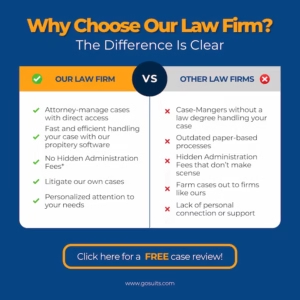
- Technology driven approach: GoSuits uses exclusive proprietary software to streamline investigation, obtain records faster, and organize evidence for negotiation and trial, helping deliver faster, better results.
- Leadership in innovation: Our systems integrate corridor specific data, CHP reporting, and medical documentation to keep cases moving efficiently.
- Attorney access: While we use technology to expedite your case, you work directly with a designated attorney. We do not rely on case managers. Every client has unfettered access to their attorney.
- Proven results: See a sample of outcomes on our page of prior cases, along with more about our attorneys and the firm’s background on about us.
- Trial readiness: With 30 years of combined experience and trial capability, we prepare cases as if they will be tried, which can strengthen settlement posture when liability is contested, such as disputes over HOV 2 plus vs 3 plus rules or improper entry over double lines.
- Broad practice areas: We handle a full range of personal injury matters, including those often connected to HOV and express lanes:
- Car accident lawyers and auto collision lawyers for freeway and arterial crashes.
- Motorcycle accident lawyers and injured motorcyclist attorneys for rider claims.
- Truck accident lawyers for commercial truck and semi-truck accidents or heavy vehicle cases.
- Catastrophic harm: serious brain injury claims and wrongful death matters.
To learn more about how we support clients and the technologies we use, visit our practice areas page and explore how our approach can fit your situation.
References and resources
- California Vehicle Code section 21655.5 HOV Lanes – California Legislative Information
- California Vehicle Code section 21655.8 Preferential Lanes, Entry and Exit – California Legislative Information
- California Vehicle Code section 5205.5 Clean Air Vehicle Decals
- Clean Air Vehicle Decals for Using Carpool Lanes – California DMV
- High Occupancy Vehicle HOV Lanes Program – Caltrans
- Express Lanes in California – Caltrans
- 23 U.S.C. § 166 High Occupancy Vehicle Facilities – Legal Information Institute
- Traffic Tickets Self Help – Judicial Branch of California
- Li v. Yellow Cab Co., 13 Cal.3d 804 1975 – CourtListener
- Government Code section 911.2 Claims Presentation – California Legislative Information
- Code of Civil Procedure section 335.1 Two Year Statute of Limitations – California Legislative Information
- Carpool Lanes in the Bay Area District 4
- Lane Splitting Safety Tips – California Highway Patrol
- Zero Emission Vehicle and Infrastructure Statistics – California Energy Commission
- Collision Report Request CHP 190 – California Highway Patrol