- What should you know about a Vermont Ave and 3rd St accident in Koreatown?
- What are the first steps to take right after a crash at Vermont and 3rd?
- When do you call 911, and how do you report the collision to LAPD?
- How do you exchange information and document the scene effectively?
- How can you obtain a traffic collision report for a Koreatown crash?
- Do you have to file the California DMV SR-1 form after a Los Angeles crash?
- Why is a prompt medical evaluation crucial after a Central Los Angeles collision?
- How does California’s comparative negligence rule impact your claim?
- What are the California deadlines to file claims and lawsuits?
- How do insurance claims work in Los Angeles, and what should you expect?
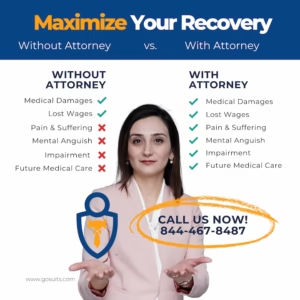
- What damages are commonly pursued in California car accident cases?
- What local evidence can you gather in Koreatown and Central Los Angeles?
- What if your Vermont and 3rd crash was a hit and run?
- What happens if your case proceeds in Los Angeles Superior Court?
- What Los Angeles car crash FAQs do people ask most?
- Why choose GoSuits for a Vermont and 3rd St accident case?
- References and Resources
What should you know about a Vermont Ave and 3rd St accident in Koreatown?
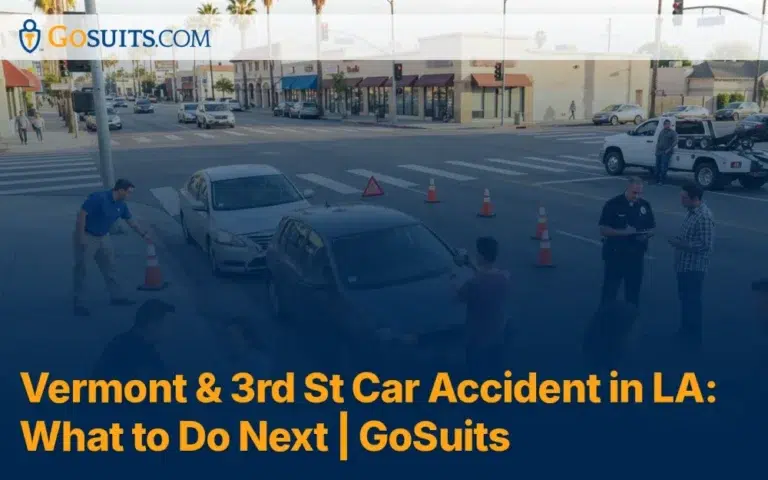
You are not alone if you experienced a Vermont Ave and 3rd St accident in Koreatown. This busy Central Los Angeles intersection sits near residential buildings, shops, and frequent bus traffic. Heavier foot traffic, turning vehicles, and rush hour congestion can raise the risk of intersection conflicts. Whether you were a driver, passenger, cyclist, or pedestrian, the immediate steps you take can protect your health, your rights, and your ability to bring a civil claim.
California law sets clear rules for what happens after a collision that causes injury, death, or property damage. Drivers must stop at the scene, assist the injured, and exchange information with anyone impacted by the collision [3] [4]. If injuries or death are involved, you should call 911 and wait for emergency responders to arrive. In addition, California has specific reporting requirements to the DMV if certain thresholds are met [1] [2].
If you are unsure about your next move, it is wise to speak with a Los Angeles personal injury attorney who handles intersection crashes in Koreatown and Wilshire Center. Early guidance helps you organize evidence, meet short deadlines, and avoid common claim mistakes that can weaken your position.
What are the first steps to take right after a crash at Vermont and 3rd?
Safety and documentation come first. If you can move safely, switch on hazard lights and move vehicles out of live lanes only if it is safe to do so. If anyone is hurt, call 911 immediately. Even if you feel okay, consider that some injuries are not obvious at the scene.
- Check for injuries. Call 911 for life-threatening bleeding, head trauma, confusion, or difficulty breathing.
- Stay at the scene. California requires you to stop after a collision. Leaving can create criminal and civil consequences [3] [4].
- Warn other drivers. Use hazard lights, flares, or reflective triangles if available, and only if you can deploy them safely.
- Document the location. Note Vermont Ave and 3rd St details, nearby landmarks, and directional approaches of all vehicles.
- Call the police if there are injuries or significant damage. Police documentation often becomes key for civil claims and insurance decisions.
If you already left the area, write down your memory of the Vermont Ave and 3rd St accident while it is fresh. Include traffic light status, turning maneuvers, lane positions, weather, and any statements made by drivers or witnesses.
When do you call 911, and how do you report the collision to LAPD?
Call 911 if someone is injured or if the crash blocks traffic. Dispatch may send LAPD officers and Los Angeles Fire Department paramedics. If no injuries are apparent and traffic is not blocked, you can still request a non-emergency response. A responding officer may create a traffic collision report that summarizes statements, diagrams, and preliminary findings, which can be valuable evidence in a civil claim.
Even if police do not come to the scene, you still must meet California’s post-collision obligations. For injury or death, you must stop, provide reasonable aid, and share specified information [3]. For property damage only, you must stop and exchange information [4]. Depending on damage and injuries, you may need to file a DMV report within 10 days [1] [2].
How do you exchange information and document the scene effectively?
California law lists the information you need to share at the scene, which commonly includes names, addresses, vehicle registration, and the name and address of the vehicle’s owner [3] [4]. To build your civil case, collect more than the basics.
- Gather driver and vehicle details. Obtain driver’s license number, phone number, insurance company and policy number, license plate, and car make, model, and color.
- Photograph the accident scene. Capture vehicle positions, skid marks, road debris, damage points, airbag deployment, traffic signals, crosswalks, and signage.
- Record intersection features. Note Vermont Ave and 3rd St signage, visibility obstructions, lane markings, and curb paint. Take wide and close shots.
- Find witnesses. Ask for names, phone numbers, and consent to record a short statement about what they saw.
- Preserve digital evidence. Save dashcam clips and smartphone videos to cloud storage. Back up immediately to prevent loss.
Thorough documentation helps address disputes about traffic signals, right of way, turning movements, and speed. The more contemporaneous your records, the stronger your credibility.
How can you obtain a traffic collision report for a Koreatown crash?
Police traffic collision reports are often available to involved parties and insurance carriers. California Vehicle Code section 20012 addresses the confidentiality of such reports and who can access them [5]. If LAPD prepared the report, you can typically request a copy as an involved party or the registered owner. Provide the incident number, date, intersection location, and driver names for a smoother request.
Review the report for accuracy, including driver statements, the primary collision factor, and any listed vehicle code violations. If you believe the report has a factual error, you can politely request a correction with supporting evidence. Keep in mind that while the report can be persuasive, liability in a civil claim depends on the totality of evidence, not solely the officer’s opinion.
Do you have to file the California DMV SR-1 form after a Los Angeles crash?
California law requires an involved driver or vehicle owner to file a DMV SR-1 Report of Traffic Accident Occurring in California within 10 days if anyone is injured or killed or if property damage appears to exceed the statutory threshold [1] [2]. This duty applies even if law enforcement took a report. The SR-1 asks for information about the parties, vehicles, insurance, and injury descriptions.
- Deadline. File within 10 days of the collision if it meets the reporting criteria [1] [2].
- Who must file. Any driver or vehicle owner involved, regardless of fault, when the criteria are met [2].
- Why it matters. Failure to file can affect your driving privileges and verification of financial responsibility.
Keep a copy of the SR-1 and proof of submission with your claim file. The California DMV provides the form and filing instructions online [1].
Why is a prompt medical evaluation crucial after a Central Los Angeles collision?
Adrenaline after a crash can mask pain. Some injuries, including concussions or soft tissue injuries, become apparent hours or days later. A timely exam helps protect your health and creates medical records that connect your symptoms to the Vermont Ave and 3rd St accident. Delays in care can invite disputes about whether the crash caused your injuries. National public health guidance emphasizes prompt assessment for crash injuries, especially for head, neck, and back symptoms [10].
- Go to urgent care or ER if needed. Sudden headaches, dizziness, nausea, confusion, numbness, or vision changes warrant urgent evaluation.
- Follow the treatment plan. Adhere to medications, physical therapy, or specialist referrals. Gaps in care can undermine your claim.
- Keep all records. Save discharge papers, imaging results, and billing statements. Ask for ICD codes or problem lists to help document diagnoses.
How does California’s comparative negligence rule impact your claim?
California follows a comparative negligence system, which reduces your recovery based on your percentage of fault. This means even if you are partly responsible, you may still recover compensation for the portion of losses caused by others. Comparative negligence affects settlement discussions and trial strategies, including how evidence about traffic signals, speed, and visibility is presented [15].
Insurers and defense counsel often argue that both drivers share fault at busy intersections like Vermont Ave and 3rd St. Your documentation, witness statements, and any video can help clarify who had the green light or the right of way. When liability is contested, experts and reconstruction methods may be considered to analyze timing and vehicle dynamics, though many cases resolve through negotiation based on the available scene evidence and medical records.

What are the California deadlines to file claims and lawsuits?
Time limits are critical. Missing a statute of limitations can bar your claim entirely. Key California deadlines include:
- Personal injury. Two years from the date of injury to file a lawsuit for bodily injury in most cases [6].
- Property damage. Three years for damage to a vehicle or other property [7].
- Claims against public entities. A written administrative claim must generally be presented within six months for personal injury or property damage [8]. If the public entity denies the claim, you often have six months from the denial to file a lawsuit [9].
Do not wait to calculate deadlines. Complexities can arise if a minor is injured, if the defendant is out of state, or if the case involves a dangerous roadway condition. These rules are strictly construed, so prompt action improves your options.
How do insurance claims work in Los Angeles, and what should you expect?
After a Koreatown car crash, you will typically open a claim with the at-fault driver’s insurer and may also open first-party claims under your own policy. California regulates claim handling and prohibits unfair settlement practices that can harm policyholders or third-party claimants [14].
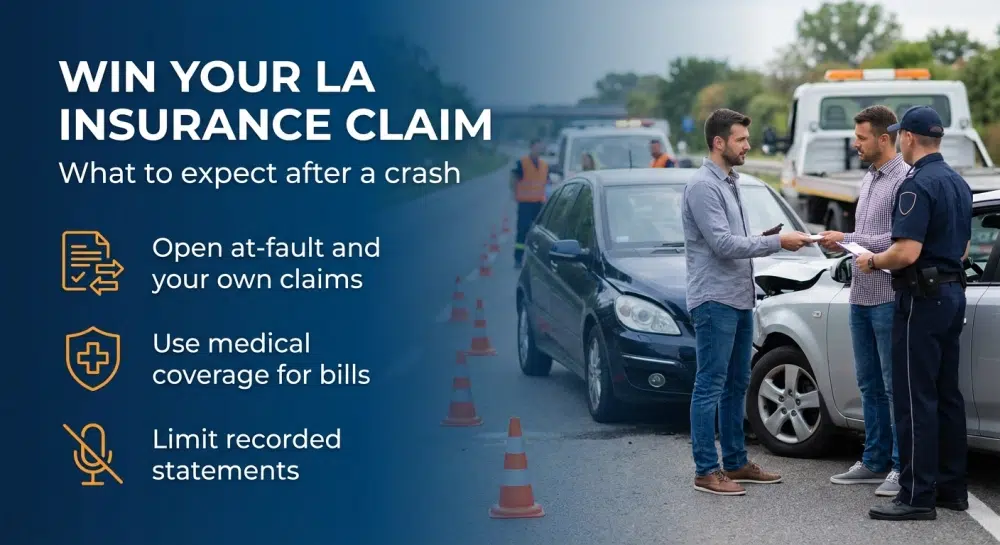
- Liability claim. The at-fault driver’s insurer evaluates fault, damages, and coverage limits. Provide a clear, organized demand package including the police report number, medical records, bills, wage loss documentation, and photos.
- Med pay. Some policies include medical payments coverage that can help with immediate medical bills, regardless of fault.
- UM or UIM. Uninsured and underinsured motorist coverage can help if the other driver lacks insurance or has inadequate limits.
- Recorded statements. Be cautious when providing statements to an adverse carrier. Keep answers factual and concise. Consider consulting a Los Angeles personal injury attorney before giving detailed statements.
Settlement negotiations normally begin after you complete initial treatment. If liability is disputed or injuries are significant, the claim may take longer. Keep a detailed ledger of your out-of-pocket expenses and save all receipts. California recognizes a wide range of economic and non-economic losses when liability is proven.
What damages are commonly pursued in California car accident cases?
In civil cases, you can pursue compensation for harms caused by another’s negligence. Depending on the facts, damages may include the following categories.
- Medical expenses. Emergency care, hospital stays, imaging, therapy, surgery, medications, and future medical needs supported by physician opinions and treatment plans.
- Lost income and reduced earning capacity. Time missed from work, diminished hours, and long-term vocational impact. Pay stubs, employer letters, and tax returns help substantiate losses.
- Property damage. Vehicle repair or total loss, towing, storage, and diminished value when supported by appraisals and repair estimates.
- Pain and suffering. Physical pain, limitations, anxiety, loss of enjoyment of life, and daily challenges well-documented in medical notes and personal journals.
- Out-of-pocket expenses. Transportation to appointments, medical equipment, and home modifications when medically necessary.
Thorough records and consistent treatment are crucial to support your claim. Ideally, you assemble a complete demand package that connects each category of loss to evidence, including bills, medical notes, and before-and-after proof of daily living impacts.
What local evidence can you gather in Koreatown and Central Los Angeles?
Evidence near Vermont Ave and 3rd St can be wide ranging. Some sources are immediate, while others require formal requests.
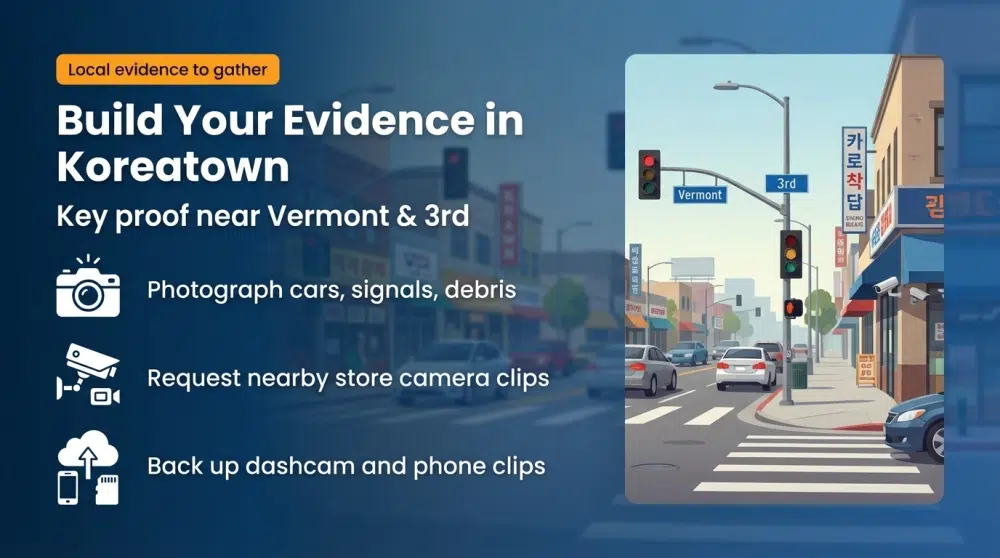
- Scene photos and videos. Capture crosswalks, light cycles, curb cuts, turn pockets, lane striping, and any construction signage.
- Surveillance video. Nearby businesses or residences may have cameras facing the intersection. Politely ask for copies quickly, as many systems overwrite within days.
- Vehicle data. Modern vehicles can store airbag control module and infotainment data that show speed or braking. Preservation letters can help prevent loss.
- Police traffic collision report. Obtain the report number and request a copy if permissible under California law [5].
- Public crash data. California offers statewide crash data and tools to identify collision patterns that may support arguments about intersection risk profiles [11] [12].
For planning purposes, the UC Berkeley TIMS portal is a useful public tool to map reported crashes and analyze conditions by year and collision type [12]. While general data does not prove fault in your specific crash, it can provide context for settlement discussions.
What if your Vermont and 3rd crash was a hit and run?
California treats leaving the scene seriously. If you were the victim of a hit and run, report it immediately to LAPD and your insurer. If you carry uninsured motorist coverage, that protection can step in for injuries caused by an unidentified driver. Even if you do not have a license plate, witnesses, nearby businesses, and dashcams may help identify the vehicle. California law requires drivers involved in injury or fatal crashes to stop and provide assistance and information [3]. For property damage only, stopping and exchanging information is also required [4].
Document your injuries and vehicle damage thoroughly. Ask neighbors or store managers near Vermont Ave and 3rd St if their cameras captured the event. Act fast because many systems overwrite footage in 3 to 7 days.
What happens if your case proceeds in Los Angeles Superior Court?
If negotiations do not resolve your claim, your attorney may file a civil lawsuit in the Los Angeles Superior Court. The court provides guidance on civil filing, procedures, and resources for litigants [13]. Litigation includes discovery, depositions, potential expert disclosures, law and motion practice, settlement conferences, and possibly trial.
- Pleadings. The complaint sets out claims and damages. The defense answers with admissions, denials, and affirmative defenses such as comparative negligence.
- Discovery. Parties exchange documents and take depositions. Discovery helps clarify disputed facts, including light timing, lane positions, and medical causation.
- Settlement efforts. Courts often encourage early settlement discussions or mediation to narrow issues and save costs.
- Trial. If unresolved, a jury or judge decides liability and damages. California’s comparative negligence framework can reduce the award by the plaintiff’s percentage of fault [15].
Your attorney will track the statute of limitations and any pre-suit claim requirements, such as notice to public entities for dangerous condition allegations [8] [9].
What Los Angeles car crash FAQs do people ask most?
What if I feel fine at the scene, then pain shows up later?
Get evaluated as soon as symptoms appear. Soft tissue injuries and concussions can manifest hours or days later. Early diagnosis improves your health trajectory and links your condition to the crash [10].
Should I talk to the other driver’s insurer right away?
Be cautious. Provide only basic information until you understand the scope of your injuries and damages. Consider speaking with a car accident lawyer Los Angeles residents trust for guidance on recorded statements and document requests.
Can I recover if I was partly at fault in a Koreatown car accident?
Yes, California’s comparative negligence allows recovery reduced by your percentage of fault [15]. Evidence like photos, witness accounts, and traffic signal data can make a difference.
Will I need a police report to start an insurance claim?
Not always, but it helps. An LAPD accident report can clarify the who, what, when, and where, and often contains diagrams and preliminary fault factors. Some insurers require the report number to proceed.
Do I really have to file the California DMV SR-1 form?
If the crash involved injury, death, or property damage over the statutory threshold, yes. The SR-1 is separate from any police report and must be filed within 10 days [1] [2].
What if the other driver did not have insurance?
Your uninsured or underinsured motorist coverage can apply. California regulates unfair claims practices and requires insurers to handle claims in good faith [14].
What if a city-owned vehicle or roadway hazard contributed to the crash?
Claims against public entities carry short deadlines and specific procedures. You typically must present a written administrative claim within six months, then follow strict timelines after a denial [8] [9].
How soon should I call a lawyer after a Koreatown collision?
The sooner you consult, the better your chances to preserve evidence, avoid missteps, and meet deadlines. Los Angeles car accident lawyers can help you coordinate medical care, obtain the traffic collision report, and position your claim for fair evaluation.
What local insights matter for a Vermont and 3rd St collision?
Understanding the context of a Koreatown car accident can help shape your claim strategy. Publicly available safety data and mapping tools provide a high-level view of collision trends across Los Angeles. The California Office of Traffic Safety releases research and statewide crash data each year that can frame risk discussions in dense urban corridors like Wilshire Center and adjacent neighborhoods [11]. The UC Berkeley TIMS portal allows the public to visualize crash patterns near Vermont Ave and 3rd St and export data summaries [12].
While these sources do not decide fault in your specific case, they can support broader arguments about intersection control, turning conflicts, and pedestrian exposure. In settlement talks, adding credible, neutral sources can help establish the reasonableness of your narrative and the foreseeability of certain collision types at busy intersections.
What step-by-step checklist can you follow after a Koreatown car crash?
- Get to safety. Move to a safe area if possible and call 911 for injuries.
- Stay at the scene. Comply with stop and exchange duties under the Vehicle Code [3] [4].
- Exchange information. Share names, addresses, registration, and insurance details. Photograph documents where appropriate.
- Document everything. Take photos and videos of vehicles, debris, signals, and the Vermont Ave and 3rd St environment.
- Identify witnesses. Gather contact information and brief statements while memories are fresh.
- Seek medical care. Prompt evaluation protects your health and your claim [10].
- Report to DMV if required. File the SR-1 within 10 days when the legal criteria are met [1] [2].
- Open insurance claims. Notify your insurer and consider UM or med pay coverage in appropriate cases.
- Request the police report. Obtain the traffic collision report if available to involved parties under California law [5].
- Consult counsel. Before detailed statements or releases, consider a consultation to understand your options and timelines.
How should plaintiffs and defendants approach a Vermont and 3rd St case strategically?
How might a plaintiff build a strong claim?
- Liability theory. Tie conduct to clear duties, like red light violations or unsafe turns, and address any comparative negligence arguments early [15].
- Medical causation. Link each diagnosis to the crash with physician notes, imaging, and consistent treatment timelines.
- Economic proof. Substantiate wage loss with employer letters and tax records, and property damage with independent estimates.
- Non-economic proof. Use pain journals and consistent provider notes to document activity restrictions and daily impacts.
How might a defendant challenge liability or damages?
- Comparative negligence. Identify plaintiff conduct that contributed to the crash, such as speed, distraction, or late yellow light entry [15].
- Alternative causation. Question whether reported symptoms stem from preexisting conditions or unrelated incidents.
- Mitigation. Argue that delays or gaps in treatment increased costs beyond what was reasonably necessary.
Both sides benefit from early, good-faith evidence exchange. California’s claim handling rules prohibit unfair practices in evaluating losses [14].
What local insurance and documentation pitfalls should you avoid?
- Do not skip the SR-1. File it when required and keep proof of submission [1] [2].
- Do not release medical records broadly. Provide only relevant records tied to the crash period unless otherwise required.
- Do not sign blanket liens. Understand medical lien terms, interest, and how they affect net recovery.
- Do not overlook UM or med pay. These coverages can bridge gaps while the liability claim develops.
- Do not miss short public entity deadlines. Six-month administrative claim windows can pass quickly [8].
What traffic context and statistics affect Central Los Angeles claims?
High population density, multimodal travel, and frequent left turns characterize the urban landscape of Central Los Angeles. Consequently, intersection safety in this bustling district is a significant concern for both state and national public health organizations, as they witness firsthand the toll of roadway injuries in their communities [10] . In light of these statistics, prevention and timely care for crash victims are emphasized by authorities. California’s Office of Traffic Safety routinely publishes research and releases city- and county-level indicators that can help inform safety priorities and may even provide context in cases of litigation about intersection risk and enforcement [11] . These public mapping tools also offer a way to visualize crash concentrations and movement corridors, especially those near Koreatown [12] .
When should you involve legal counsel after a Koreatown crash?
If you’ve experienced injuries due to an accident, are dealing with disputes about liability, have any involvement with government vehicles, roadway conditions, or have received early requests for recorded statements or broad medical authorizations, it would be wise to seek legal counsel as soon as possible. Engaging the services of a car accident lawyer in Los Angeles can help navigate such issues while ensuring that you preserve crucial evidence, manage communication, and focus on healing during this difficult time.
If you want a second opinion on fault or damages, car accident lawyers can review your police report, medical records, and scene photos to help estimate a reasonable settlement range and identify issues that might require further investigation.
Why choose GoSuits for a Vermont and 3rd St accident case?
If you were injured in a Koreatown car accident, our team at GoSuits focuses on helping crash victims across Central Los Angeles and throughout California. A free consultation can clarify your next steps, from gathering evidence and filing the California DMV SR-1 form to coordinating medical care and negotiating with insurers. We practice in state and federal courts across California and handle cases in Los Angeles County, including Wilshire Center, Koreatown, and surrounding neighborhoods.
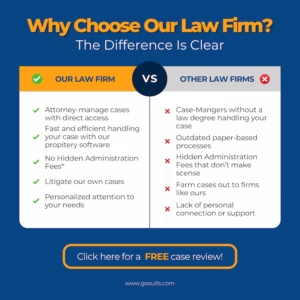
- Technology-driven representation. We built exclusive proprietary software to streamline evidence intake, deadline tracking, and claim valuation for faster, more reliable results.
- Attorney access. Although we leverage technology to expedite your case, every client works directly with a designated attorney. We do not use case managers, and you have unfettered access to your attorney.
- Leadership in innovation. GoSuits invests in secure, analytics-based tools that help organize complex medical and collision data for clear, persuasive presentations.
- Past results. See examples of outcomes we have achieved for clients at prior cases. Results vary by case facts, liability, and coverage.
- Trial readiness. Our lawyers have tried cases in California courts. Read about the team at our attorneys and firm background at about us.
- Practice coverage. We handle personal injury matters that include car, motorcycle, and trucking collisions, as well as wrongful death, among other areas. Explore practice areas.
- Experience. With 30 years of combined experience, we handle disputed liability, comparative negligence, and complex damages with a practical, client-first approach.
We help clients navigate every step, from obtaining the LAPD traffic collision report to preparing a comprehensive demand package. If you are searching for car accident lawyers in Los Angeles, our team is here to help you understand your options and timeline.
What is the bottom line after a Vermont and 3rd St accident?
- Protect your health. Get timely medical care and follow your treatment plan [10].
- Follow California’s rules. Stop, exchange information, and report when required [3] [4] [1] [2].
- Organize your evidence. Photos, witness contacts, and records strengthen your claim.
- Track deadlines. Statutes and public entity claim periods are unforgiving [6] [7] [8] [9].
- Seek guidance. Consider a consultation with car accident lawyers to review liability, damages, and next steps.
References and Resources
- Report of Traffic Accident Occurring in California SR-1 Form – California DMV
- California Vehicle Code § 16000 Accident Reports to DMV – California Legislative Information
- California Vehicle Code § 20001 Duty to Stop at Accident Involving Injury or Death – California Legislative Information
- California Vehicle Code § 20002 Duty to Stop at Accident Involving Property Damage – California Legislative Information
- California Vehicle Code § 20012 Confidentiality of Reports – California Legislative Information
- California Code of Civil Procedure § 335.1 Two-Year Personal Injury Limitations – California Legislative Information
- California Code of Civil Procedure § 338 Three-Year Property Damage Limitations – California Legislative Information
- California Government Code § 911.2 Claims Presentation Deadline – California Legislative Information
- California Government Code § 945.6 Time for Commencement of Action After Denial – California Legislative Information
- Transportation Safety and Injury Prevention – Centers for Disease Control and Prevention
- Traffic Safety Data and Research – California Office of Traffic Safety
- Transportation Injury Mapping System TIMS – UC Berkeley SafeTREC
- Civil Division Resources – Los Angeles Superior Court
- California Insurance Code § 790.03 Unfair Practices – California Legislative Information
- Comparative Negligence Overview – Cornell Law School Legal Information Institute