- What happened at Sepulveda Blvd and Roscoe Blvd and why are intersections in Los Angeles high risk?
- What should you do immediately after a crash at Sepulveda and Roscoe?
- How do you report a Los Angeles intersection collision and what deadlines apply?
- How do you get the LAPD or CHP traffic collision report and fix errors?
- What medical and documentation steps protect your health and claim?
- Who can be liable in a North Hills intersection crash and how is fault proven?
- How does California comparative negligence change a settlement or judgment?
- What insurance steps should you take after a Sepulveda and Roscoe crash?
- What if it was a hit-and-run at Sepulveda and Roscoe?
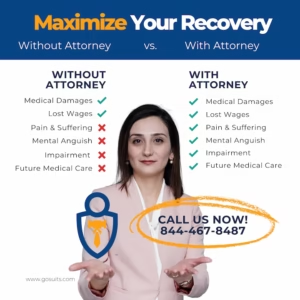
- What damages are available in a California car crash case?
- What deadlines apply, including the statute of limitations and claims against government entities?
- How are intersection crashes investigated and what evidence helps most?
- How are rear-end and T-bone collisions evaluated under California law?
- Do you need a Los Angeles car accident lawyer and how can legal help make a difference?
- What Los Angeles court and filing FAQs should you know?
- Who is GoSuits and how does a technology-driven law practice support your case?
- References and Resources
What happened at Sepulveda Blvd and Roscoe Blvd and why are intersections in Los Angeles high risk?
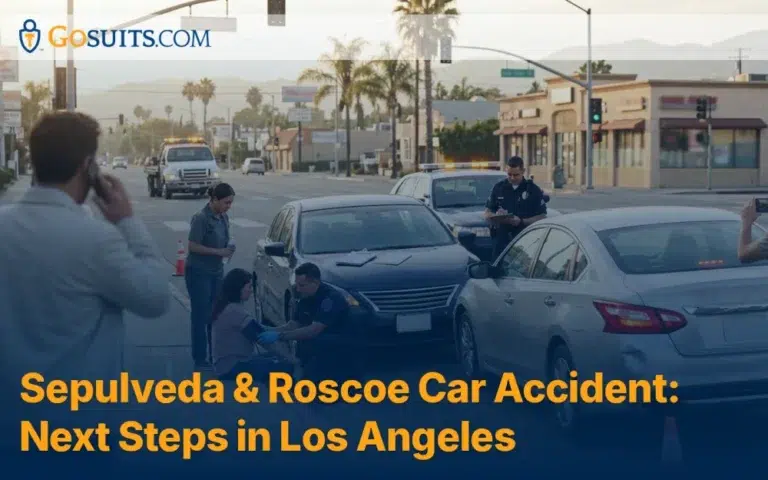
If you’ve recently been involved in a collision at the intersection of Sepulveda Blvd and Roscoe Blvd in North Hills near Van Nuys, know that you are not alone. Intersections are complex environments where drivers, pedestrians, cyclists, and buses all converge with changing signals and turning movements. Across the nation, a large proportion of crashes take place at or near intersections. Research backed by the National Highway Traffic Safety Administration has long pointed to human decision errors at intersections as a significant factor in these incidents. This includes not yielding properly, misjudging gaps, and having insufficient surveillance of the surroundings [1] .
At a local level, the arterial grid system of the San Fernando Valley directs heavy traffic mainly through Sepulveda and Roscoe Boulevards. This is particularly noticeable during commute hours and school pick-up times. The high volume, speed variations, limited visibility due to parked vehicles, and multiple left turn phases significantly increase the risk for rear-end collisions, side impacts, and pedestrian accidents in these areas. California traffic laws expect drivers to follow signals, yield when necessary, and be attentive to their surroundings at all times, especially in busy locations such as Los Angeles.
What should you do immediately after a crash at Sepulveda and Roscoe?
Your health and safety come first. After ensuring you are away from traffic if possible, consider these steps while conditions are fresh:
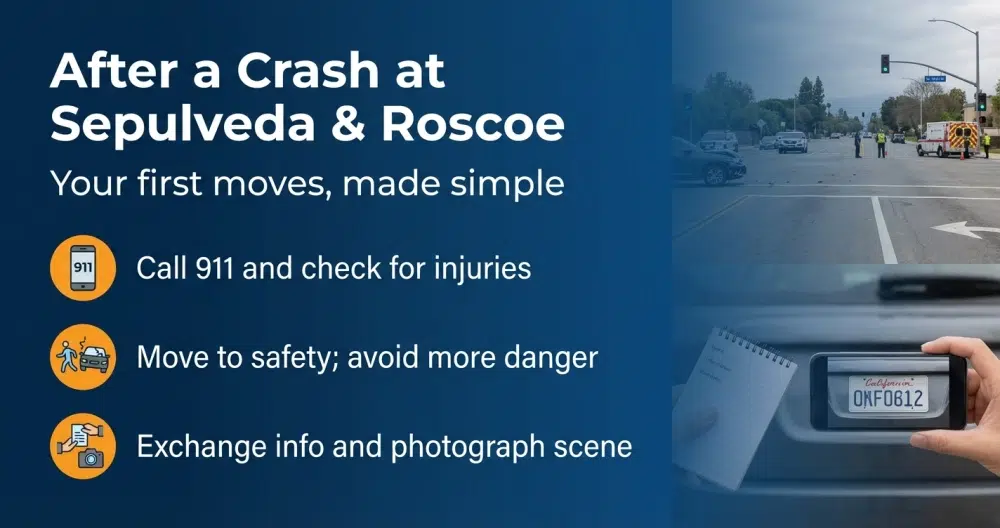
- Call 911 if anyone is hurt. Paramedics can evaluate injuries that may not be obvious at the scene. Police can help manage traffic and document what happened.
- Move to safety if you can. If your car is drivable and it is safe to do so, move to the shoulder or a nearby parking lot to avoid a secondary crash.
- Exchange information. Get driver license numbers, license plates, insurance details, and contact information from all involved drivers and witnesses.
- Photograph the scene. Capture vehicle positions, skid marks, traffic signals, damage, debris, crosswalks, signage, and visibility obstructions. Take wide shots and close-ups.
- Note intersection details. Write down the exact lane you were in, your direction of travel, the signal phase, and whether any vehicles were turning left or right.
- Check for cameras. Look for nearby businesses, residences, or buses with cameras that may have captured the collision. Ask staff to preserve footage.
- Seek medical evaluation the same day. Some injuries are delayed. Timely care protects your health and creates a medical record linked to the crash.
How do you report a Los Angeles intersection collision and what deadlines apply?
California law imposes two distinct reporting duties that often apply to urban intersection crashes:
- Police reporting. If anyone is injured or killed, a driver must report the collision to the local police or California Highway Patrol within 24 hours [2]. In the City of Los Angeles, this often means an LAPD response or a report at a station house. When in doubt, call 911 from the scene.
- DMV SR-1 reporting. Any crash involving injury, death, or property damage of $1000 or more must be reported to the California DMV within 10 days using Form SR-1, regardless of fault and even if the other driver lacks insurance [3].
At the intersection of Sepulveda Boulevard and Roscoe Avenue, law enforcement response is usually provided by the LAPD Valley Traffic Division, responsible for North Hills and Van Nuys areas. Officers investigate car accidents at this location and prepare a Traffic Collision Report that both insurance companies and lawyers rely upon [4].
How do you get the LAPD or CHP traffic collision report and fix errors?
After most injury crashes, police generate a formal Traffic Collision Report using standards compatible with CHP 555. You can request a copy once it is approved for release. For collisions investigated by CHP, you can submit CHP 190 with identification and fees to obtain the report [5]. For LAPD Valley Traffic Division reports, contact the division records unit for instructions on obtaining the report number, fees, and release timing [4].
If your report contains any factual errors, such as incorrect vehicle positions or misstated signal phases, you can submit a written request along with supporting evidence like photos, videos, or witness statements. It is important to note that while a police report is not the final determination of civil liability, it can still carry weight for insurance companies and juries. In court, properly prepared public records may be considered admissible under the official records exception to hearsay, based on the Evidence Code [6] .
What medical and documentation steps protect your health and claim?
Typical intersection crashes often result in side or rear impacts which can lead to injuries like head, neck, chest, back, and knee damage. Rapid and subsequent medical assessments help identify less-visible soft tissue injuries, concussions, and internal trauma that might not be apparent at the scene itself.
- Follow a clear treatment plan. Attend all appointments, follow restrictions, and keep copies of prescriptions, imaging, and referrals.
- Track symptoms and limitations. Keep a daily journal of pain levels, sleep disruption, missed work, and activities you can no longer perform.
- Save expense records. Store invoices and receipts for medical bills, medications, transportation to appointments, and assistive devices.
- Document property damage. Obtain written repair estimates and take high-resolution photos of all vehicle damage from multiple angles.
Who can be liable in a North Hills intersection crash and how is fault proven?
In California, civil law mandates that each driver must exercise reasonable care for the safety of others while on the road. Jurors are guided by fundamental negligence principles, primarily focusing on whether a prudent person would have acted differently under comparable conditions [14] . The allocation of responsibility can vary depending on the specifics of an incident at Sepulveda and Roscoe; multiple parties might hold partial or shared accountability.
- Turning drivers who failed to yield or misjudged a gap on a protected or permissive left turn.
- Through drivers who entered on a red or failed to keep a proper lookout for pedestrians in crosswalks.
- Rear drivers who followed too closely or were distracted when traffic slowed for a yellow or a red.
- Commercial vehicle operators whose longer stopping distances or wide turns required added caution in dense traffic.
- Public entities where a dangerous condition of public property, such as an inoperative signal or obscured sightlines from overgrown vegetation, contributed to the crash. Claims against government agencies follow special rules [10].
Proof can include signal timing records, vehicle data, collision reconstruction, dashcam video, and eyewitness testimony gathered promptly. Liability may be established by showing a violation of the California Vehicle Code, failure to yield the right of way, or disregard of traffic signals.

How does California comparative negligence change a settlement or judgment?
California follows pure comparative negligence. If both drivers contributed to a crash, each can still recover damages reduced by their percentage of fault. The California Supreme Court adopted this rule in Li v. Yellow Cab Co., replacing older all-or-nothing contributory negligence defenses [8]. In practice, if a jury determines a driver is 20 percent at fault in a T-bone collision at Sepulveda and Roscoe, any award is reduced by 20 percent.
Comparative fault often arises at intersections where one driver was speeding slightly while the other failed to yield. Strong documentation and expert analysis can narrow dispute over percentages.
What insurance steps should you take after a Sepulveda and Roscoe crash?
Insurance claims move more smoothly when you act promptly and keep careful records:
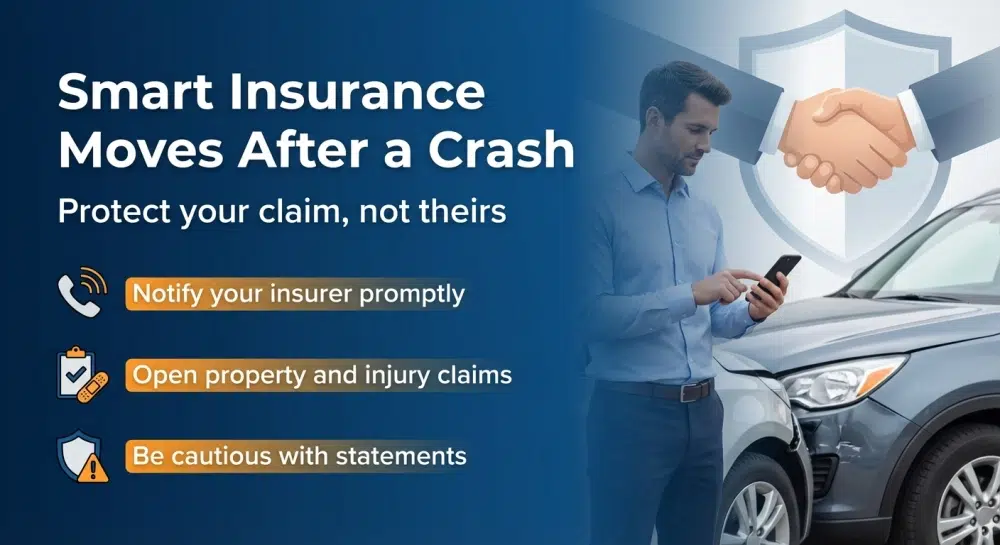
- Notify your insurer quickly. Most policies require prompt notice. Provide facts but avoid speculation about fault while the investigation is ongoing.
- Open claims wisely. Typically there are two claims: property damage and bodily injury. Separate claim numbers help track progress.
- Use your coverages. Collision coverage, med pay, rental, and uninsured or underinsured motorist coverage can provide critical benefits depending on your policy.
- Respond to information requests. California fair claims regulations set timelines for insurers to accept or deny claims and communicate status, including a general 40-day decision period after receiving proof of claim [9].
Be cautious with recorded statements from another driver’s insurer. Stick to facts, and consider consulting legal counsel if injuries or liability are disputed.
What if it was a hit-and-run at Sepulveda and Roscoe?
Leaving the scene of a collision is a crime. California law distinguishes between collisions causing property damage and those causing injury or death, with heightened duties for injury crashes [13]. If the other driver fled:
- Call 911 immediately. Provide a description of the vehicle, direction of travel, and any partial plate numbers.
- Look for cameras. The intersection and nearby businesses may have recorded the event. Request preservation right away.
- Check for witnesses. Collect contact information from anyone who saw the collision. Even small details can be valuable leads.
- Use uninsured motorist coverage. If the driver is not identified, uninsured motorist coverage can pay for injuries if your policy includes it.
What damages are available in a California car crash case?
Compensation in civil cases aims to make you whole for losses caused by another’s negligence. In a Los Angeles intersection case, recoverable damages may include:
- Medical expenses for emergency care, follow-up visits, imaging, therapy, and surgery if needed.
- Future medical care where ongoing treatment, injections, or surgery are reasonably anticipated.
- Lost income for time missed from work, plus loss of future earning capacity if injuries limit your career.
- Pain and suffering measured by how injuries affect daily life, sleep, hobbies, family roles, and mental health.
- Property damage including repair or total loss, diminished value, personal items damaged inside the car, and rental car costs.
In wrongful death cases arising from a fatal crash, certain family members may pursue claims for economic and non-economic harms under California law’s separate time limits and procedures.
What deadlines apply, including the statute of limitations and claims against government entities?
California imposes firm deadlines that can bar a claim if missed:
- Statute of limitations. Personal injury claims generally must be filed within two years of the date of injury [7].
- Government claims. If a public entity may be at fault such as for a dangerous intersection condition or a city-owned vehicle, you must typically present a government claim within six months, with limited exceptions [10].
Other deadlines may apply, including contractual time limits in insurance policies. Filing early helps preserve evidence and witness memory.
How are intersection crashes investigated and what evidence helps most?
Intersection collisions are uniquely suited to evidence that clarifies movement through space and time. Evidence to prioritize includes:
- Signal timing and phasing. Request timing sheets and signal logs if available, which can corroborate the light color when each vehicle entered.
- Traffic collision report. Obtain and review the LAPD Valley Traffic Division report for diagrams, measurements, and witness statements [4].
- CHP 555 standards. CHP’s form and instructions guide many agencies’ reporting practices, providing a structured analysis of primary collision factors [5].
- Vehicle event data. Modern cars often record pre-impact speed, braking, and seatbelt use. Preserving this data early is vital.
- Video and images. Dashcam, bus, storefront, and home security footage can show signal indications and right-of-way.
- Injury biomechanics. Consistency between vehicle damage profiles and injuries helps validate causation.
Los Angeles remains one of the highest volume crash jurisdictions in the state, and statewide data dashboards reflect elevated collision counts for large cities [12]. Fast, methodical evidence work levels the playing field with insurers who start investigating immediately.
How are rear-end and T-bone collisions evaluated under California law?
Although every case is fact specific, certain patterns recur at Sepulveda Blvd and Roscoe Blvd:
- Rear-end collisions. Often arise when a driver approaches a yellow phase and slows while a following driver fails to react in time. Liability frequently hinges on following distance and attentiveness. Even so, disputes may arise if the lead vehicle executed a late stop or lane change.
- Side-impact T-bone collisions. Common when a turning driver misreads a permissive green, or a through driver runs a late red. Right-of-way rules, witness vantage points, and signal timing documents often drive outcomes.
- Pedestrian and bicyclist impacts. Marked crosswalks at busy boulevards create scenarios where drivers must yield. Visibility, parked vehicles, and sun angle can become factors, but drivers still have duties to exercise care.
Civil juries are instructed to decide whether a driver used reasonable care under the circumstances, applying California’s negligence standards [14]. Where evidence shows multiple errors, comparative fault apportionment follows [8].
Do you need a Los Angeles car accident lawyer and how can legal help make a difference?
Civil claims following a Sepulveda Blvd and Roscoe Blvd car accident involve overlapping laws, strict deadlines, multiple insurers, and complex evidence. Independent investigation, interviews, preservation of video before it is overwritten, and timely SR-1 and government claims can be decisive. For many people, working with car accident lawyers helps manage medical billing, coordinate benefits, and present a clear claim to insurers and, if needed, to a jury.
When injuries are significant, liability is disputed, or the crash involves a commercial vehicle or public entity, experienced guidance can safeguard your rights and focus the case on the strongest facts. For those in the San Fernando Valley and across Los Angeles, connecting early with Los Angeles car accident lawyers can clarify options and timelines while you focus on recovery.
What Los Angeles court and filing FAQs should you know?
Many Los Angeles intersection cases resolve through insurance claims, but some proceed to litigation in Los Angeles Superior Court. Here are common questions:
- Where are personal injury cases filed? Most motor vehicle injury cases in Los Angeles County are handled in the Personal Injury courts, with eFiling and centralized procedures [11].
- How long do cases take? Timelines vary with injury severity, medical treatment duration, and court calendars. Early evidence preservation can reduce delays.
- Will I have to go to trial? Many cases settle. If not, trial provides a path to a binding decision. Trial readiness can motivate fair outcomes.
- What if the police report is wrong? You can provide supplemental evidence and witness declarations. Police reports may be considered under the official records exception but are not conclusive on fault [6].
Who is GoSuits and how does a technology-driven law practice support your case?
If your crash happened at Sepulveda Blvd and Roscoe Blvd in Los Angeles, our work aligns with your needs. GoSuits focuses on civil injury cases throughout California, including the San Fernando Valley. We offer a free consultation to help you understand the process, timelines, and what information will strengthen your claim.
- Technology-driven approach. We use exclusive proprietary software to collect, analyze, and present evidence faster, helping organize medical records, bills, and video so your story is clear and timely.
- Attorney access. Even with advanced technology, every client works directly with a designated attorney. We do not route cases through case managers. You have unfettered access to your lawyer for strategy and updates.
- Leadership in innovation. Our internal tools streamline SR-1 submissions, track insurer timeframes, and flag comparative fault issues early so they can be addressed with targeted evidence.
- Results and trial experience. Our team brings 30 years of combined experience and has achieved substantial outcomes for injured clients across California. Past results are shared to illustrate our approach, and we are prepared to take cases to trial when appropriate. Outcomes depend on facts and law unique to each case.
- Comprehensive practice areas. We handle car, motorcycle, truck, pedestrian, and wrongful death cases, as well as other personal injury matters. Explore our prior cases, meet our attorneys, learn about us, and review our practice areas.
Whether your case involves a rear-end at a yellow phase, a T-bone during a left turn, or a hit-and-run near North Hills, clear documentation and timely action can shape the outcome. We can help you navigate insurance claims, evidence preservation, and litigation if needed, with an emphasis on accuracy and efficiency supported by our proprietary tools.
What local steps should you take right now in Los Angeles?
- Request your traffic collision report from LAPD Valley Traffic Division once available [4].
- File your DMV SR-1 within 10 days if the crash involved injury or $1000 plus in damage [3].
- Collect and secure video from nearby shops or residences before routine overwriting.
- Document treatment and keep all receipts for out-of-pocket expenses.
How should defendants and insurers evaluate an intersection claim?
Balanced analysis helps both sides reach fair outcomes:
- Preserve vehicle data and scene measurements promptly to test consistency between claimed mechanics and physical evidence.
- Identify alternative contributing factors such as sun position, sight obstructions, or sudden stops, while recognizing duties to maintain safe following distance and obey signals.
- Apply California comparative negligence to allocate responsibility where warranted, without overstating minor contributory acts [8].
- Follow fair claims regulations on timely communications and decision-making [9].
How should injured plaintiffs strengthen their Los Angeles claim?
- Act within deadlines for DMV SR-1 and civil filing [3] [7].
- Obtain and review the police report quickly, and submit supplements if necessary [4] [5].
- Retain treating records and bills and follow prescribed care to document causation and damages.
- Consider expert input on signal phasing, human factors, and crash reconstruction when disputes arise.
What context should San Fernando Valley drivers know about crash trends?
Large urban jurisdictions see a high volume of crashes. State analysis tools consistently rank major cities by collision count and rate, reflecting both population and traffic density [12]. At arterial intersections like Sepulveda and Roscoe, congestion, turning traffic, and pedestrian flows require heightened attention. Proactive safety steps include maintaining safe speeds, scanning crosswalks before turning, and anticipating sudden stops near yellow phases.
What evidence tips apply specifically to Sepulveda and Roscoe?
- Map your exact path. Use a simple sketch showing approach lanes, arrows for turns, and the signal color when you entered the intersection.
- Identify vantage points. List the storefronts or residences that may have useful camera angles along each approach leg of Sepulveda Blvd and Roscoe Blvd.
- Time of day matters. Note whether sun glare, school dismissal, or peak-hour congestion influenced line-of-sight and stopping distances.
- Bus and rideshare clues. Metro buses and rideshare vehicles may have data or video. Capture trip logs or request preservation quickly.
How should you approach property damage and rentals after a crash?
- Get multiple written estimates. Detailed line-item estimates support fair valuation.
- Diminished value. If your vehicle is repaired, you may still experience loss of market value. Document pre-loss condition with photos and maintenance records.
- Rental or loss-of-use. Keep receipts and track days without a vehicle. Loss-of-use can be claimed even without renting, depending on the facts.
What policy limits and uninsured coverage issues arise in Los Angeles?
Many collisions involve modest liability policy limits. If injuries are significant, policy limits can be reached quickly. Uninsured and underinsured motorist coverage can bridge the gap, especially in hit-and-run events or where the other driver is minimally insured. California requires prompt and transparent insurer communications, and claimants can expect timely decisions when they provide proof of claim [9].
How do you connect injuries to the crash in a way insurers and juries accept?
- Consistency. Early complaints to paramedics and ER staff that match later diagnoses strengthen causation.
- Imaging and testing. Objective findings such as MRIs and nerve studies can corroborate subjective pain reports.
- Functional impact. Employer notes, timesheets, and family statements documenting limitations help quantify losses.
What legal terms might you encounter and what do they mean?
- Negligence. The failure to use reasonable care to prevent harm to others, evaluated under California’s jury instructions and case law [14].
- Primary collision factor. The main violation or behavior identified in a traffic collision report that contributed to the crash.
- Comparative fault. Apportionment of responsibility among parties, reducing recoveries by each party’s percentage of fault [8].
What is the bottom line after a Sepulveda Blvd and Roscoe Blvd car accident?
Focus on safety, preserve evidence, meet reporting and filing deadlines, and seek appropriate help. Intersections concentrate risks, but they also concentrate evidence. Thoughtful steps in the first days can significantly affect the outcome months later.
References and Resources
- Crash Factors in Intersection-Related Crashes: An On-Scene Perspective – NHTSA
- California Vehicle Code section 20008 – California Legislature
- When a Traffic Accident Occurs and SR-1 Reporting – California DMV
- Valley Traffic Division – Los Angeles Police Department
- CHP 190 Collision Report Request – California Highway Patrol
- Evidence Code section 1280 Official Records – California Legislature
- Code of Civil Procedure section 335.1 Statute of Limitations – California Legislature
- Li v. Yellow Cab Co., 13 Cal.3d 804 – CourtListener
- Fair Claims Settlement Practices Regulations – California Department of Insurance
- Government Claims Act section 911.2 – California Legislature
- Civil Division Information – Los Angeles Superior Court
- Traffic Safety Rankings by City and County – California OTS
- California Vehicle Code section 20001 Hit and Run Injury – California Legislature
- Civil Jury Instructions CACI Overview – Judicial Council of California