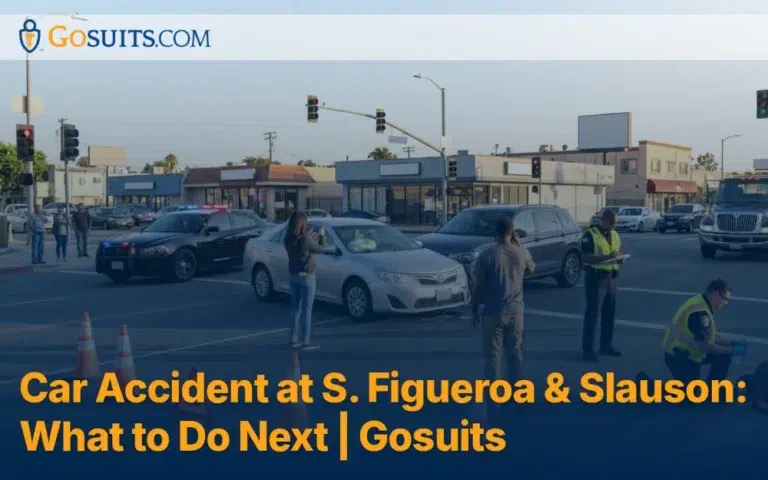
- What should you do right now after a crash at S. Figueroa St and Slauson Ave in South Los Angeles
- How do you report a car crash in Los Angeles and which official forms matter
- When and why should you seek medical attention even if you feel fine
- What should you document at the intersection to protect your claim
- How does comparative negligence work in California and how can it change your recovery
- What deadlines apply to California car accident cases including claims against government entities
- How do insurance claims work in Los Angeles and what should you watch for
- What damages are available in a California car accident case and how do you prove them
- Who can be liable for an intersection crash at S. Figueroa and Slauson besides the other driver
- How do police reports and the California Traffic Collision Report affect a civil case
- What common mistakes after a South Los Angeles crash can hurt your case
- What should defendants and insurers consider after an intersection collision in Los Angeles
- How can technology and evidence preservation strengthen an intersection crash case
- What are the most common questions about Los Angeles intersection accidents
- Why consider GoSuits after a South Los Angeles intersection crash
- Where can you find the sources cited in this article
What should you do right now after a crash at S. Figueroa St and Slauson Ave in South Los Angeles
Crashes at busy South Los Angeles intersections like S. Figueroa St and Slauson Ave can be disorienting. Taking clear steps in the first few minutes and days helps protect your health and your civil claim. Intersections are complex traffic environments with turning vehicles, pedestrians, buses, and cyclists. National safety authorities report that a large share of serious crashes involve intersections, which highlights why careful documentation and timely reporting matter [1].
- Get to a safe location. If vehicles are drivable and there are no serious injuries, move out of traffic to reduce the risk of a secondary collision.
- Call 911. Request police and medical support. California law requires reporting certain crashes to law enforcement, especially those with injuries or fatalities [4].
- Check for injuries. Offer basic assistance if you are able and it is safe. Avoid moving anyone with suspected neck or back injuries unless there is an immediate danger.
- Exchange information. Share names, addresses, driver license numbers, plate numbers, and insurance details as the Vehicle Code requires [5].
- Document the scene. Take photos and video of lane markings, traffic signals, debris, skid marks, vehicle damage, and any visible injuries. Capture the surrounding businesses and buildings that may have cameras.
- Identify witnesses. Gather names and contact details for anyone who saw the collision. Note rideshare or delivery drivers who were nearby, and any transit or commercial vehicles.
- Avoid discussing fault. Save detailed statements for later and keep your communications factual and brief.
If you are unsure what to do next and feel overwhelmed, you are not alone. Many people choose to contact Los Angeles car accident lawyers to help coordinate medical care, preserve evidence, and manage insurance communications while they focus on recovery.
How do you report a car crash in Los Angeles and which official forms matter
California has specific reporting rules after traffic collisions. Understanding what to file and when can prevent penalties and strengthen your civil case record.
Which law enforcement report is required and when
If anyone is injured or killed, the collision must be reported to the appropriate police agency within 24 hours [4]. The responding officers typically prepare an official Traffic Collision Report. On state highways this often involves the California Highway Patrol and their standardized CHP 555 report form [6]. Within Los Angeles city limits, local police will prepare a comparable report that includes driver statements, diagrams, and preliminary findings.
Do you have to file a separate DMV report
Yes. You must submit a DMV Form SR-1 within 10 days if anyone was injured, if there was a fatality, or if property damage appears to be one thousand dollars or more. This is required even if law enforcement also responded, and even if the other party is at fault [2] [3].
- Who files. Each driver involved should file an SR 1 when the criteria apply [2].
- What you need. Insurance policy details, vehicle information, location, and a short description of the collision.
- Why it matters. Failure to file can lead to license suspension regardless of fault [2].
How do you get a copy of the police report
You can typically request a copy from the investigating agency after processing. For CHP investigations, the agency provides public request instructions for collision reports. These may be necessary for insurance claims and civil litigation [6].
When and why should you seek medical attention even if you feel fine
After a crash, adrenaline can mask pain. Some injuries such as concussions, whiplash, or internal injuries emerge hours or days later. Early evaluation protects your health and creates a timely medical record that connects your symptoms to the crash. The Centers for Disease Control and Prevention notes that head injuries can have delayed symptoms and should be taken seriously, with prompt medical assessment and follow up [10].
- Go to urgent care or an emergency department. Describe the mechanism of the crash and all symptoms, even mild ones.
- Follow the treatment plan. Attend follow up appointments and imaging. Keep receipts and visit summaries.
- Track symptoms. Maintain a daily log of pain levels, sleep disruption, headaches, dizziness, and mobility changes.
Timely care is not just about health. Insurers look for gaps in treatment to question causation and necessity. Immediate documentation reduces disputes later in your Los Angeles claim.

What should you document at the intersection to protect your claim
Evidence disappears quickly at busy intersections like S. Figueroa and Slauson. Preserve what you can safely gather at the scene and follow up within days.
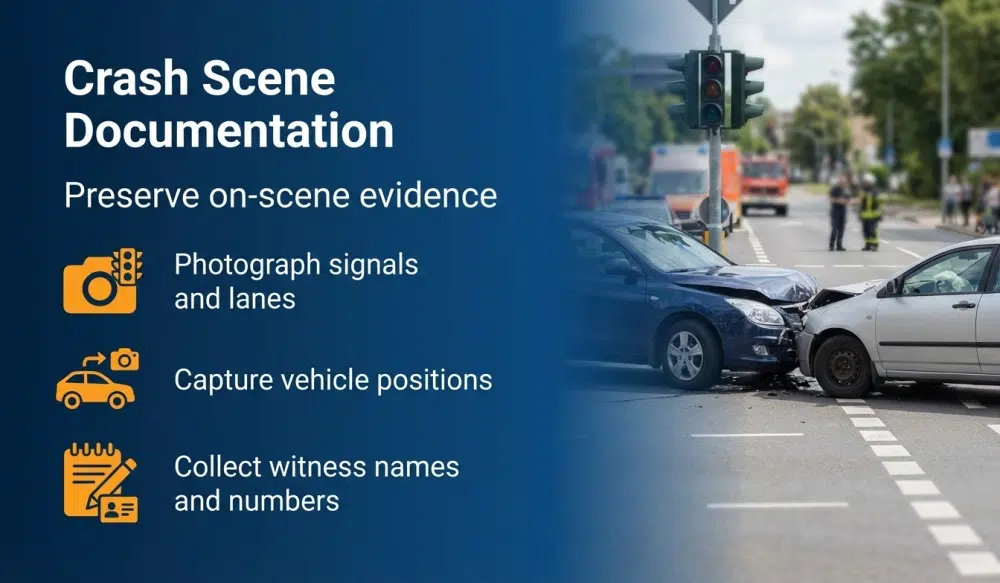
- Traffic control. Photograph signal heads, crosswalk signals, signage, and any temporary construction controls. Note the light cycle if known.
- Vehicle positions. Capture the final resting positions and any pre impact skid or yaw marks. Take wide angle and close shots.
- Roadway conditions. Document potholes, pooled water, oil, sand, or faded lane lines that may affect braking and visibility.
- Surroundings. Identify storefronts, gas stations, transit shelters, and homes that may have cameras facing the intersection.
- Witness details. Save names and phone numbers. Ask if anyone took photos or video you can receive by text or email.
- Injury and damage. Take clear photos of bruises, lacerations, airbag deployment, seatbelt marks, and vehicle damage inside and out.
If available, ask your medical provider to photograph visible injuries at initial and follow up visits. Those records carry clinical weight and often withstand defense challenges better than casual photos. If you later retain counsel, your legal team can send preservation notices quickly to nearby businesses to reduce the risk of overwritten camera footage.
How does comparative negligence work in California and how can it change your recovery
California follows pure comparative negligence. That means a plaintiff can recover damages even if they share some fault, but the recovery is reduced by their percentage of responsibility. The California Supreme Court adopted this system in a landmark decision decades ago, and courts apply it routinely in collision cases [12].
- Example. If a jury finds your damages are one hundred thousand dollars and you were 20 percent at fault for entering late on a yellow, your net recovery would be eighty thousand dollars.
- Intersection variables. Turn phases, sight lines, speed, and pedestrian activity can make fault allocation complex. Expert analysis of signal timing and event data recorder downloads may be necessary.
Defendants and insurers often raise comparative fault to reduce payout, for example by alleging a rolling stop, distracted driving, or unsafe speed. Plaintiffs counter with traffic engineering evidence, objective data, and witness corroboration. Meticulous evidence gathering at S. Figueroa and Slauson can make the difference.
What deadlines apply to California car accident cases including claims against government entities
California law imposes strict deadlines. Missing them can end a case even if liability is clear.
- Personal injury statute of limitations. Generally two years from the date of injury to file suit in court [7].
- Government claims. If your claim involves a public entity such as a city vehicle or a dangerous public roadway condition, you must file a written claim with that entity within six months of the incident in most personal injury cases [8]. The California Government Claims Program provides guidance on filing procedures [9].
- DMV crash report. Ten days to file the SR 1 report if required [2] [3].
- Law enforcement notification. Within 24 hours for injury or fatal crashes [4].
Shorter deadlines may apply to minors when they reach adulthood or in wrongful death claims. If you suspect a public entity may be involved, take action immediately to protect your rights.
How do insurance claims work in Los Angeles and what should you watch for
California insurers must follow Fair Claims Settlement Practices Regulations that set timelines for acknowledging claims, investigating, and accepting or denying benefits [11]. Understanding these consumer protections can help you navigate the process with fewer surprises.
What steps should you take with your insurer and the other driver’s carrier
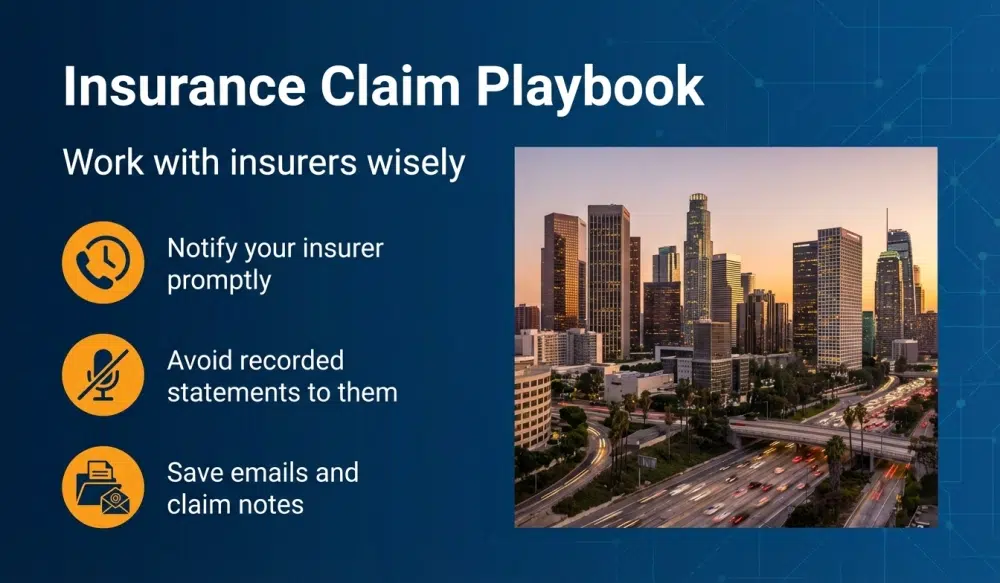
- Notify your insurer quickly. Report the crash and provide basic facts. Cooperate with your policy duties while avoiding speculation.
- Be careful with recorded statements. You generally must cooperate with your own insurer, but you are not required to give a recorded statement to the other driver’s company. These can be used to limit or dispute your claim [13].
- Track deadlines. Insurers must respond within set timeframes, such as acknowledging a claim within a reasonable time and making a coverage decision within a set window after receiving proof of claim [11].
- Document all communications. Save emails, letters, and claim notes you receive. Confirm phone calls with a follow up message summarizing what was discussed.
Intersection collisions often involve conflicting accounts. Independent evidence such as signal timing data or video can speed up liability decisions. If fault is disputed, consider requesting preservation of footage from nearby businesses within days of the crash.
When evaluating counsel, many people prefer to work with car accident lawyers who handle intersection disputes and understand insurer tactics. In a city with complex traffic and many carriers, having a steady hand on claims handling can reduce stress.
What damages are available in a California car accident case and how do you prove them
California civil law permits recovery of both economic and non economic damages when another party’s negligence caused harm. The specific amounts depend on evidence, medical findings, and how the injuries affect daily life.
- Medical expenses. Emergency care, hospital bills, physician visits, imaging, therapy, medications, assistive devices, and future care supported by provider opinions and billing records.
- Lost income and reduced earning capacity. Pay stubs, tax returns, employer letters, and vocational evaluations for longer term limitations.
- Property damage. Vehicle repair or replacement costs and damage to items inside the car.
- Pain, suffering, and loss of enjoyment. Testimony from you and those close to you, daily logs, therapy notes, and photographs documenting the course of recovery.
For serious injuries, independent medical examinations, life care planning, and economic experts may be used to prove future costs. California traffic fatalities and serious injury rates underscore the need for a full accounting of losses after major crashes [14].

Who can be liable for an intersection crash at S. Figueroa and Slauson besides the other driver
Multiple parties may share fault in an intersection collision, and identifying all potential defendants is essential to a complete recovery.
- Other motorists. Red light violations, unsafe turns, distracted driving, or speeding can establish negligence with eyewitness and forensic evidence.
- Commercial drivers and employers. Vicarious liability may apply when a driver was acting within the scope of employment. Vehicle telematics and logs can be crucial.
- Rideshare or delivery drivers. App data and trip logs can shed light on distraction and duty status.
- Public entities. In limited circumstances, dangerous roadway conditions or signal timing defects can form the basis of a claim, subject to special notice rules and immunities. Timely government claims are required [8] [9].
- Vehicle manufacturers or part suppliers. Brake or airbag defects can contribute to injury severity and may create a product liability claim, often requiring expert analysis.
Early case evaluation in South Los Angeles is vital. Businesses near S. Figueroa and Slauson may overwrite camera recordings within days, and onboard vehicle data may be lost once a car is repaired or totaled. Immediate preservation efforts can make or break a liability case.
How do police reports and the California Traffic Collision Report affect a civil case
Police reports are central to most intersection crash claims, but they do not automatically decide civil liability.
- What they include. Diagrams, statements, officer observations, citations, and at times preliminary fault opinions. The standardized CHP 555 format is widely used [6].
- How they are used. Insurers rely on them heavily, but civil courts may limit or exclude certain conclusions. Foundational facts like positions of rest can be influential.
- How to correct errors. If the report contains factual mistakes, you can submit a supplemental statement to the agency. Your attorney can also obtain body worn camera footage or call recordings when appropriate.
Police documentation combined with photos, video, and physical evidence forms a consistent narrative that supports settlement negotiations and trial presentation. Where discrepancies exist, collision reconstruction can bridge the gaps.
What common mistakes after a South Los Angeles crash can hurt your case
- Leaving before exchanging information. California law requires exchanging identifying and insurance information after a collision with property damage or injury [5].
- Skipping the DMV SR 1. Failing to file within ten days when required can lead to license issues and can complicate insurance claims [2] [3].
- Delaying medical care. Gaps in treatment invite causation disputes and can reduce claim value [10].
- Posting on social media. Photos and comments can be taken out of context and used to challenge your injuries.
- Giving a recorded statement to the other insurer. These are often designed to limit liability. You can politely decline and refer them to your representation [13].
- Not preserving evidence. Camera footage is often overwritten within days. A prompt preservation letter helps protect vital proof, and courts may consider the impact of missing evidence [15].
What should defendants and insurers consider after an intersection collision in Los Angeles
Defendants and their insurers also benefit from prompt and careful action, both to comply with law and to evaluate exposure fairly.
- Secure vehicles and data. Preserve event data recorder downloads, driver cell phone records, and fleet telematics where applicable.
- Identify third party evidence. Seek video from nearby businesses and transit authorities, and obtain traffic signal timing data.
- Evaluate comparative fault. Assess speed estimates, sight obstructions, and compliance with turning rules to determine apportionment under California’s pure comparative negligence system [12].
- Follow fair claims regulations. Adhere to timelines and communicate clearly with claimants [11].
Early and transparent evaluation can resolve many intersection cases without litigation. When disputes remain, a focused discovery plan on liability issues at S. Figueroa and Slauson can narrow the trial to what truly matters.
How can technology and evidence preservation strengthen an intersection crash case
Modern intersection cases often turn on objective evidence. Technology can clarify what happened and why.
- Event data recorders. Many vehicles capture pre impact speed, brake use, and throttle position. Prompt downloads before repairs are critical.
- Video and telematics. Business cameras, rideshare dashcams, bus cameras, and telematics can provide independent timelines.
- Signal timing and phasing. Engineering data can show whether a protected turn was active or whether clearance intervals were adequate.
- Digital preservation. When litigation is reasonably anticipated, parties should take steps to preserve electronically stored information. Courts may impose consequences when relevant data is lost, particularly in federal litigation involving electronic evidence [16].
Combining these sources with medical and economic evidence creates a clearer, more persuasive picture for settlement and trial.
What are the most common questions about Los Angeles intersection accidents
What if the other driver left the scene at S. Figueroa and Slauson
Report the hit and run immediately and provide all details to law enforcement. Your own policy may include uninsured motorist coverage that can help with injuries and property damage. Documentation of damage and any partial plate helps, and nearby cameras often capture useful views.
Do I have to use the body shop the insurer recommends
No. You can choose your own repair shop. Keep all estimates and invoices. If safety related damage is suspected, request that the shop preserve parts for inspection.
How long do I have to decide whether to settle
Insurers may set response times for offers, but the ultimate deadline is the statute of limitations. Do not let a limitation period lapse while negotiating. Calendar the two year period in California for most personal injury cases [7].
How much is my Los Angeles intersection claim worth
Every case is different. Value depends on liability clarity, medical findings, future care needs, wage loss, and how injuries change your daily life. National and state safety data show that intersection collisions are a significant source of serious injuries, which underscores the importance of a careful, evidence based evaluation [1] [14].

Should I get legal help or just work with the insurer
Claims adjusters protect their company’s interests. Many people choose to consult a personal injury attorney to understand options, protect deadlines, and coordinate medical and financial documentation. When settlement discussions stall, an attorney can evaluate next steps including filing suit in Los Angeles County Superior Court.
Why consider GoSuits after a South Los Angeles intersection crash
If you were hurt in a crash at S. Figueroa St and Slauson Ave or anywhere in Los Angeles, a free consultation can help you understand timelines, evidence needs, and options. We focus on civil cases that involve injuries from traffic collisions. GoSuits represents clients in California and other select jurisdictions, and we bring 30 years of combined experience to intersection, freeway, pedestrian, bicycle, rideshare, and commercial vehicle cases.
- Technology driven approach. We built exclusive proprietary software that organizes medical records, crash data, and claims communications faster and with fewer errors. This helps move cases forward with clarity.
- Attorney access. Although we use technology to expedite the case, every client works directly with a designated attorney. We do not assign case managers. You have unfettered access to your lawyer from start to finish.
- Trial readiness. Our attorneys prepare every case as if it is going to trial. That level of preparation often strengthens settlement positions and helps identify the proof most likely to matter at verdict.
- Documented results. We invite you to review our prior cases and learn about outcomes we have achieved for people in a range of collision scenarios.
- Team and mission. Meet our attorneys and learn more about us. Explore our practice areas to see how we support clients after complex roadway events.
When you are ready to talk, we are here to listen, gather the facts, and help you chart a path that fits your goals. Many people find that starting early preserves more evidence and reduces claim stress. If you prefer, we can start by discussing how the collision at S. Figueroa and Slauson happened and outline the next steps to preserve your rights.
People searching for support after a South Los Angeles car crash often look for car accident lawyers who understand intersection dynamics. If you want guidance tailored to Los Angeles, you can speak with a team that handles these cases daily and can help protect medical and wage documentation while the claim proceeds.
If you are comparing options, some readers find it helpful to talk with car accident lawyers in Los Angeles for an overview of reporting requirements, evidence, and timelines specific to the city and county.
Where can you find the sources cited in this article
- Intersection Safety overview and statistics – Federal Highway Administration
- Submit an Accident Report SR 1 – California DMV
- Vehicle Code section 16000 – California Legislature
- Vehicle Code section 20008 – California Legislature
- Vehicle Code section 16025 – California Legislature
- Collision Report CHP 555 information – California Highway Patrol
- Code of Civil Procedure section 335.1 – California Legislature
- Government Code section 911.2 – California Legislature
- Government Claims Program guidance – California Department of General Services
- Traumatic brain injury symptoms and timing – Centers for Disease Control and Prevention
- Fair Claims Settlement Practices Regulations overview – California Department of Insurance
- Li v. Yellow Cab Co. of California – Google Scholar
- Auto insurance claims consumer guide – California Department of Insurance
- Traffic safety quick stats – California Office of Traffic Safety
- Evidence Code section 413 – California Legislature
- Federal Rule of Civil Procedure 37 on failure to preserve ESI – Cornell Law School Legal Information Institute