- What makes Harvard Ave and Michelson Dr in Irvine a high-risk intersection?
- What immediate steps should you take right after a crash at Harvard Ave and Michelson Dr?
- How do you report the collision to the police and DMV in California?
- Where should you get medical care in Irvine and what records matter most?
- How do California negligence and comparative fault rules affect your claim?
- What insurance notifications and claims deadlines apply after an Irvine crash?
- How do you document the scene and preserve evidence for an Irvine car accident claim?
- What damages can be recovered in a California car accident case?
- How long do you have to file a lawsuit in California after a car accident?
- How do pedestrian, cyclist, rideshare, and commercial vehicle crashes change the analysis?
- What if the at-fault driver is uninsured or flees the scene?
- What happens if a government vehicle or dangerous road condition contributed?
- How do lawsuits proceed in Orange County Superior Court and what should you expect?
- How can an Irvine car accident lawyer help without delay?
- Who is GoSuits and how can technology-driven representation help after an Irvine crash?
- References and Resources
What makes Harvard Ave and Michelson Dr in Irvine a high-risk intersection?
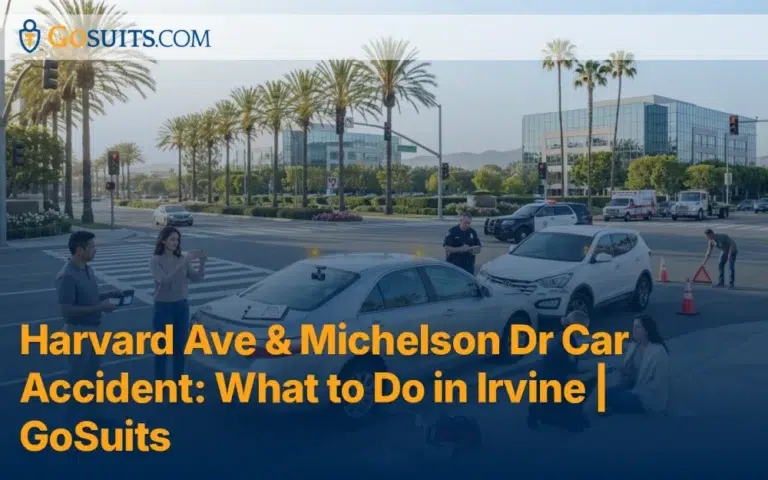
You do everything right when you drive, but intersections can be unpredictable. Harvard Ave and Michelson Dr in Irvine, CA is a busy connector with multiple lanes, nearby residential communities, and commuter traffic traveling to and from business centers and campus areas. Intersections like this are where turning vehicles, pedestrians in crosswalks, cyclists, and through traffic meet, creating complex sightlines and quick decision points. Statewide data show that intersection-related collisions are a persistent source of injuries, and safety agencies continue to emphasize defensive driving and post-crash steps to protect your health and your rights [12] [13].
Even if you are careful, the decisions of other drivers can create sudden hazards. Left-turn conflicts, yellow-light dilemmas, speed variance, and failure to yield to pedestrians or cyclists commonly appear in collision narratives at signalized intersections. If you were involved in a crash at Harvard Ave and Michelson Dr, you are not alone, and there are clear steps you can follow right away to prioritize safety, meet California reporting rules, and build a strong insurance or civil claim.
What immediate steps should you take right after a crash at Harvard Ave and Michelson Dr?
Your safety comes first. After any collision, follow this practical checklist drawn from national safety guidance and California requirements [5]:
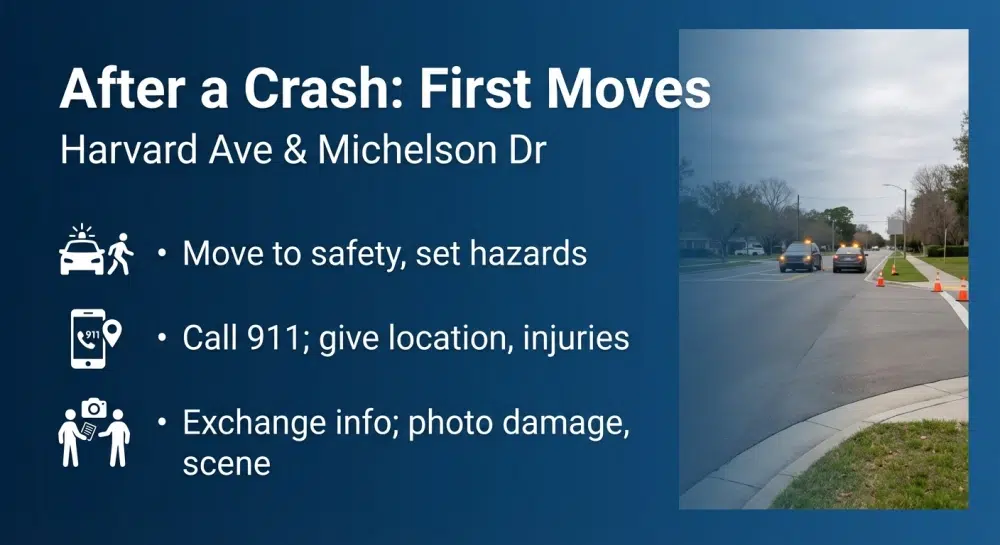
- Get to a safe location. If vehicles are drivable, move to the shoulder or a nearby parking area out of active lanes, set hazards, and check for fire or fuel leaks [5].
- Call 911 for injuries. Request paramedics for anyone who is hurt. Report your exact location as Harvard Ave and Michelson Dr in Irvine, describe vehicles involved, and advise if traffic is blocked.
- Exchange information the right way. Obtain driver names, contact details, license numbers, vehicle plates, and insurance information for all involved. Photograph insurance cards to reduce transcription errors.
- Document the scene thoroughly. Take wide and close photos of vehicle positions, damage points, skid marks, debris, traffic signals, lane markings, and any visible injuries. Capture weather, lighting, and signage. Make brief voice memos to timestamp your recollection [5].
- Identify witnesses quickly. Ask bystanders for names, phone numbers, and a short description of what they saw. Independent witnesses often clarify fault at intersections.
- Avoid speculative statements. Do not admit fault or guess at causes. Give the facts you know to responding officers and your insurer without adding assumptions.
- Seek prompt medical evaluation. Even without obvious pain, get checked the same day, since soft-tissue, head, and internal injuries can be delayed in onset.
- Preserve all physical evidence. Keep damaged parts, torn clothing, child car seats, and any in-vehicle footage. Do not authorize repairs until photos and inspections are complete.
These early steps protect health and create an objective record for insurance adjusters, courts, and, if needed, accident reconstruction professionals [5].
How do you report the collision to the police and DMV in California?
California has separate reporting rules for law enforcement and the DMV. Understanding both timelines helps you remain compliant and avoid penalties.
- Police report for injury or fatality. If a person is injured or killed, the driver must report the accident to the local police department or California Highway Patrol within 24 hours if an officer did not investigate at the scene [2].
- Request a traffic collision report. If Irvine Police Department responded, ask the Records unit how to request the report. For CHP-investigated collisions, use the CHP process and form to request the report with proper proof of involvement [3].
- DMV SR-1 within 10 days. Any collision involving injury, death, or property damage reaching the DMV’s threshold must be reported to the DMV by submitting an SR-1 within 10 days, regardless of fault or insurance status [1]. You will need insurance details and vehicle information to complete it.
- Financial responsibility and license consequences. Reporting helps the state verify financial responsibility. Failure to report or maintain required insurance coverage can lead to license or registration consequences under the Vehicle Code [1].
When in doubt, err on the side of reporting. Keep a copy or confirmation of any submission to the DMV and your police report request number for your records.
Where should you get medical care in Irvine and what records matter most?
If you or a loved one suffered injuries at Harvard Ave and Michelson Dr, do not wait to be evaluated. Prompt treatment protects your health and connects your symptoms to the collision date for insurance and legal purposes.
- Emergency care options. For severe or time-sensitive injuries, consider the nearest emergency department capable of trauma evaluation, such as UCI Medical Center’s emergency department, which provides 24-hour emergency care [4].
- Document every complaint. Tell clinicians about all symptoms, even if minor. Dizziness, headaches, neck or back pain, numbness, and abdominal discomfort can signal hidden injuries. The medical record should reflect the mechanism of injury and restraint use.
- Follow-up and referrals. Adhere to recommended imaging, specialist referrals, and physical therapy. Gaps in treatment are frequently cited by insurers when disputing causation and damages.
- Keep copies of records and bills. Maintain discharge summaries, imaging reports, itemized bills, and pharmacy receipts. These documents are essential for calculating past medical expenses and future care needs.
If you are unsure about the right level of care, err on the side of getting checked. Delays can complicate recovery and the evaluation of your claim [5].

How do California negligence and comparative fault rules affect your claim?
Most Irvine car accident cases turn on whether a driver failed to use reasonable care and whether that failure caused harm. California’s civil jury instructions identify four basic elements for negligence: duty, breach, causation, and damages [6]. At intersections, breaches often involve speeding, running a red light, unsafe left turns, distracted driving, or failing to yield to pedestrians in a marked crosswalk.
California applies pure comparative negligence. This means a judge or jury can assign a percentage of fault to each party and reduce recoverable damages by your percentage, but you are not barred from recovery if you are partially at fault [7]. For example, if a left-turning driver failed to yield but you were slightly over the speed limit, fault could be apportioned between both drivers. Clear documentation, timely witness statements, and objective crash scene evidence help refine these determinations.
From a defendant’s perspective, comparative fault can limit exposure by highlighting a plaintiff’s speed, distraction, or failure to mitigate damages after the crash, such as missing follow-up care. From a plaintiff’s perspective, comparative fault can still allow meaningful recovery even if you made a mistake. That is why thorough investigation at Harvard Ave and Michelson Dr should start early.
What insurance notifications and claims deadlines apply after an Irvine crash?
California requires prompt notice to insurers and imposes timing rules on how insurance companies must handle claims. Understanding these timelines helps you move your claim forward and respond to insurers appropriately.
- Notify your insurer quickly. Most policies require prompt notice of any collision. Early notice triggers duties of investigation and defense if coverage applies.
- Know insurer response timelines. California’s Fair Claims Settlement Practices Regulations generally require insurers to acknowledge claims within 15 calendar days, conduct a prompt and thorough investigation, and accept or deny claims in writing within a reasonable time, often referenced as within 40 days after receiving proof of claim, subject to required updates if more time is needed [8].
- Coordinate with the at-fault driver’s insurer. If the other driver is liable, you may open a third-party claim for property damage, medical expenses, and other losses. Keep communications concise and factual. Provide only the documentation necessary to evaluate the claim.
- Use your own coverages. Med-pay, collision, rental, and uninsured/underinsured motorist coverage can help you bridge gaps while fault is assessed. In California, uninsured and underinsured motorist claims are governed by Insurance Code section 11580.2 [9].
- Watch for recorded statement requests. Consider postponing any recorded statement to an adverse insurer until you have a clear understanding of your rights and the issues in dispute. Provide truthful and concise information to your own carrier as required by the policy contract.
If your car is not drivable, prioritize arranging safe storage to avoid accumulating tow and storage fees. Photographs and an independent estimate are often helpful before repairs begin.
How do you document the scene and preserve evidence for an Irvine car accident claim?
Well-organized evidence can be decisive, particularly in intersection collisions. Build your file methodically:
- Photographs and video. Capture all angles, road markings, crosswalks, lane arrows, and damage profiles. If you have dashcam footage, preserve the original file on two separate drives.
- Police and DMV records. Request your traffic collision report and submit the SR-1 if required. Keep confirmations, copies, and mail receipts [1] [3].
- Medical documentation. Save every record, bill, and receipt. Ask providers for itemized statements and CPT-coded bills that insurers expect for claim evaluation.
- Witness information. Follow up with witnesses while the event is fresh in memory. Written statements with contact details can bolster credibility.
- Property damage files. Maintain repair estimates, photographs pre and post repair, diminished value opinions if applicable, and rental receipts.
- Traffic safety context. California agencies publish collision data and rankings that may provide context on intersection safety and risk trends [12]. While not determinative for your case, broader data can inform strategy.
Avoid altering or discarding damaged items until all insurers and, if needed, consultants have had a chance to inspect. Carefully label and date all materials.
What damages can be recovered in a California car accident case?
In a civil case arising from a crash at Harvard Ave and Michelson Dr, recoverable damages generally fall into two categories: economic and non-economic. The exact amount depends on liability, comparative fault, and proof.
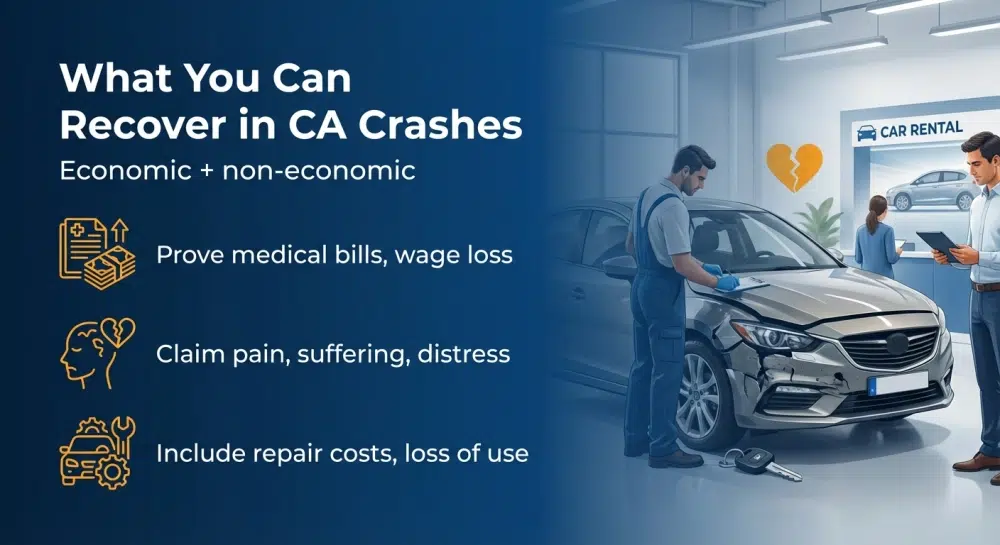
- Economic damages. Past and future medical expenses, lost wages, loss of earning capacity, property damage, rental and towing, and out-of-pocket costs. Itemized bills, employer wage verification, tax forms, and expert projections support these claims [6].
- Non-economic damages. Pain, suffering, inconvenience, emotional distress, and loss of enjoyment of life. Consistent treatment, therapist notes, and corroborating statements can help substantiate these harms within California’s legal framework [6].
- Property damage specifics. California allows claims for vehicle repair or total loss value, plus loss of use. Property damage claims may have a different filing deadline than bodily injury claims [14].
A thorough damages presentation often includes a medical timeline, summaries of treatment, and a well-organized binder of invoices and receipts. Be careful with social media while your claim is pending, since posts can be misinterpreted by insurers during evaluation.

How long do you have to file a lawsuit in California after a car accident?
Deadlines depend on the type of claim and defendant identity:
- Bodily injury. For most negligence cases involving personal injuries, California’s statute of limitations is two years from the date of injury [10].
- Property damage. Claims for damage to property generally have a three-year deadline [14].
- Claims against public entities. If a government agency or employee contributed to the crash, you generally must first file a written administrative claim within six months of the incident under the Government Claims Act, with strict content and service rules before you may sue [11].
Do not wait. Evidence can fade or be lost, and missing a deadline can extinguish your claim. Knowing which deadline applies to your situation is crucial, especially in cases involving public entities or minors.
How do pedestrian, cyclist, rideshare, and commercial vehicle crashes change the analysis?
Intersections like Harvard Ave and Michelson Dr often involve mixed users. Special contexts add layers of rules and evidence.
- Pedestrians and cyclists. Right-of-way rules, signal phases, and crosswalk markings matter. Helmet use for cyclists and lighting or reflectors after dark can factor into comparative fault assessments, but the duty of drivers to exercise reasonable care remains central [6].
- Rideshare vehicles. Coverage may vary depending on whether the app was on and whether a ride was accepted. Trip data, app logs, and telematics can become important evidence. Insurer response timelines still apply to covered claims [8].
- Commercial and delivery vehicles. Company safety policies, driver logs, vehicle maintenance, and compliance with state rules can expand discovery. Corporate defendants may have higher coverage limits, but the investigation is often more complex.
In each of these scenarios, document thoroughly and seek prompt records from the involved services or employers. Early data preservation letters can help secure crucial logs and recordings.
What if the at-fault driver is uninsured or flees the scene?
Hit-and-run and uninsured drivers require fast action:
- Call law enforcement immediately. Prompt reporting improves the chance of identifying the driver and creates contemporaneous documentation of the event.
- Uninsured and underinsured motorist coverage. California law allows policyholders to make UM or UIM claims to their own insurer when the at-fault driver has no or insufficient insurance. The timeline and proof requirements are set by statute and policy language [9].
- Medical payments coverage. Med-pay can help in the short term regardless of fault, subject to policy limits and coordination with health insurance.
Keep all communications and claim numbers. If a suspect driver is later identified, your insurer may pursue subrogation. Continue seeking medical care and documenting losses while coverage is evaluated.
What happens if a government vehicle or dangerous road condition contributed?
Some crashes involve government vehicles or roadway conditions, such as malfunctioning signals or improperly maintained surfaces. Claims against public entities follow special rules:
- Administrative claim first. Before filing a lawsuit for money damages against most California public entities, you must file a government claim, often within six months, specifying the facts and amount of damages. Missing this step can bar a later lawsuit [11].
- Evidence of a dangerous condition. Proving a dangerous condition often requires showing notice and that the condition created a reasonably foreseeable risk when the property was used with due care. Prompt photos, reports, and witness information are important.
- Coordination with other claims. If both a driver and a public entity are potentially at fault, you may need to pursue parallel tracks with different deadlines and procedures.
These cases are fact-intensive. Start gathering records early, including signal timing data, maintenance logs, and prior complaint histories when available under public records laws.
How do lawsuits proceed in Orange County Superior Court and what should you expect?
If settlement is not reached, a civil lawsuit may be filed in the Orange County Superior Court, which hears personal injury and property damage cases in its civil division [15]. Here is a general roadmap:
- Filing and service. A complaint states the legal claims and damages sought. The defendant is served and must respond within statutory deadlines.
- Discovery. Both sides exchange information through written discovery, depositions, medical examinations when authorized, and subpoenas to third parties. For intersection collisions, discovery often centers on visibility, reaction times, speed calculations, and medical causation.
- Motions. Parties may bring motions to narrow issues or exclude evidence. Summary judgment motions test whether a triable fact dispute exists.
- Mediation and settlement conferences. Courts commonly schedule early settlement conferences. Many cases resolve before trial with agreements that address medical liens and future care.
- Trial. If trial is necessary, a jury or judge weighs the evidence, applies California’s negligence and comparative fault rules, and assigns damages as supported by proof [6] [7].
Throughout, keep your records complete, respond to reasonable discovery, and continue necessary medical care. Clear, credible documentation from day one can shorten the path to a fair result.
How can an Irvine car accident lawyer help without delay?
After a crash at Harvard Ave and Michelson Dr, you face medical decisions, repair logistics, and complex insurance rules. Early legal help can organize evidence, preserve deadlines, and communicate with insurers under California’s claims handling regulations [8]. Local familiarity with Irvine traffic patterns and intersection dynamics can help frame liability with clarity.
When you consult Irvine car accident lawyers, you can delegate critical tasks, from obtaining the collision report and preserving dashcam footage to coordinating benefits and preparing a comprehensive demand. The right support allows you to focus on healing while your claim moves forward under California law and timelines [1] [2] [10].
If your case involves disputed fault, layered insurance, or potential public entity issues, early strategy can be the difference between delay and progress. Help with medical records, claim submissions, and negotiation can reduce stress and improve the quality of your presentation to insurers [8].
If you are evaluating representation, many people look for car accident lawyers who can handle both settlement and trial. Asking about trial experience, case management approach, and communication access can help you make an informed decision.
As you compare options, remember that car accident lawyers should communicate in plain language, give you realistic timelines, and keep you updated as your case evolves.

Who is GoSuits and how can technology-driven representation help after an Irvine crash?
GoSuits represents people injured in traffic collisions across California, including Orange County and Irvine. If your crash happened at Harvard Ave and Michelson Dr, a free consultation can help you understand claim steps, reporting requirements, and realistic timelines under California law without pressure or confusion.
- Technology-driven approach. GoSuits uses exclusive proprietary software to organize evidence, track deadlines, and model claim valuations faster and with greater clarity, while your attorney guides strategy at every stage.
- Attorney access, not case managers. Although we leverage technology to expedite work, every client has a designated attorney and unfettered access to that attorney. We do not route clients through case managers.
- Trial-ready focus. GoSuits prepares cases with trial in mind, which can strengthen negotiation positions and keep cases moving in Orange County Superior Court when litigation is necessary [15].
- Results and experience. With 30 years of combined experience, the team has obtained meaningful results for clients in vehicle collision cases. For a sampling of outcomes, see our prior cases.
- Full-service personal injury practice. GoSuits handles car, truck, motorcycle, pedestrian, premises liability, and catastrophic injury matters. Learn more about about us, meet our attorneys, and explore our practice areas.
From first notice of loss through potential trial, our team’s processes are designed to reduce friction while maintaining direct attorney communication. If you have questions about police reports, the DMV SR-1, comparative fault, UM or UIM claims, or filing in Orange County, we are ready to help you take the next step.
When comparing representation, consider the value of seamless data collection, accurate deadline tracking, and disciplined negotiation. With car accident lawyers who focus on organization and trial readiness, your claim can move with purpose and clarity.
References and Resources
- Accident Reporting Requirements and SR-1 – California DMV
- Vehicle Code section 20008 Police Reporting Requirement – California Legislature
- Traffic Collision Reports and Request Process – California Highway Patrol
- Emergency Department Services – UCI Health
- What To Do After a Crash – National Highway Traffic Safety Administration
- California Civil Jury Instructions, including CACI 400 Negligence – Judicial Council of California
- Li v. Yellow Cab Co. of California, 13 Cal.3d 804 – Google Scholar
- Fair Claims Settlement Practices Regulations, Title 10 CCR 2695.1 to 2695.17 – California Department of Insurance
- Insurance Code section 11580.2 Uninsured and Underinsured Motorist Coverage – California Legislature
- Code of Civil Procedure section 335.1 Two-Year Statute of Limitations – California Legislature
- Government Code section 911.2 Government Claims Act Six-Month Deadline – California Legislature
- City Crash Rankings and Traffic Safety Data – California Office of Traffic Safety
- 2023 Traffic Fatalities Early Estimates – National Highway Traffic Safety Administration
- Code of Civil Procedure section 338 Three-Year Property Damage Limitations – California Legislature
- Civil Division Information – Superior Court of California, County of Orange