- What happened at Barranca Pkwy and Harvard Ave in Irvine and why does this intersection matter?
- What should you do in the first 10 minutes after a car accident at Barranca and Harvard?
- How do you report a crash in Irvine to police and state agencies?
- What information and evidence should you gather at the scene?
- How does fault work in California and what is comparative negligence?
- What insurance coverages apply after an Irvine intersection crash?
- How does medical treatment affect your health and claim?
- How do you get a police or traffic collision report after an Irvine crash?
- What deadlines and statutes of limitations apply in California?
- How do property damage claims and rentals work after a collision?
- What if the crash was a hit and run at Barranca and Harvard?
- Who may be liable in an Irvine intersection collision?
- What should you expect from the insurance claim process?
- What common mistakes should you avoid after a crash in Irvine?
- What other FAQs come up after an intersection crash in Irvine?
- How can legal help in Irvine make a difference?
- Why choose GoSuits for help after a car accident in Irvine?
- References and resources
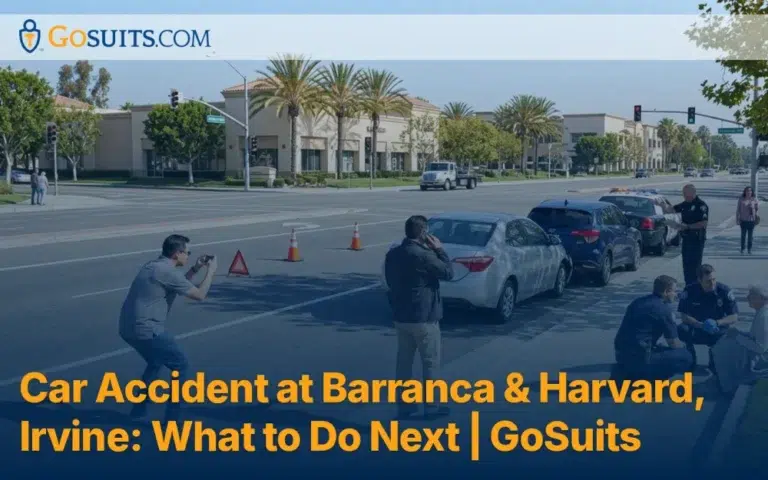
What happened at Barranca Pkwy and Harvard Ave in Irvine and why does this intersection matter?
If you or someone close to you was involved in a collision near Barranca Pkwy and Harvard Ave in Irvine, you are dealing with a busy corridor that connects neighborhoods, shopping centers, and commuter routes. Intersection crashes frequently involve turning conflicts, red light timing issues, visibility concerns, or lane changes. National research has long shown that a substantial share of traffic crashes occur at or are related to intersections, underscoring the need to proceed carefully and document events thoroughly [11].
Right now, the most important steps are safety, medical evaluation, reporting, and evidence preservation. The guidance below outlines what to do after a car accident, how California law affects your options, and how both plaintiffs and defendants can approach claims arising from an intersection crash in Irvine.
What should you do in the first 10 minutes after a car accident at Barranca and Harvard?
How do you prioritize safety at a signalized intersection?
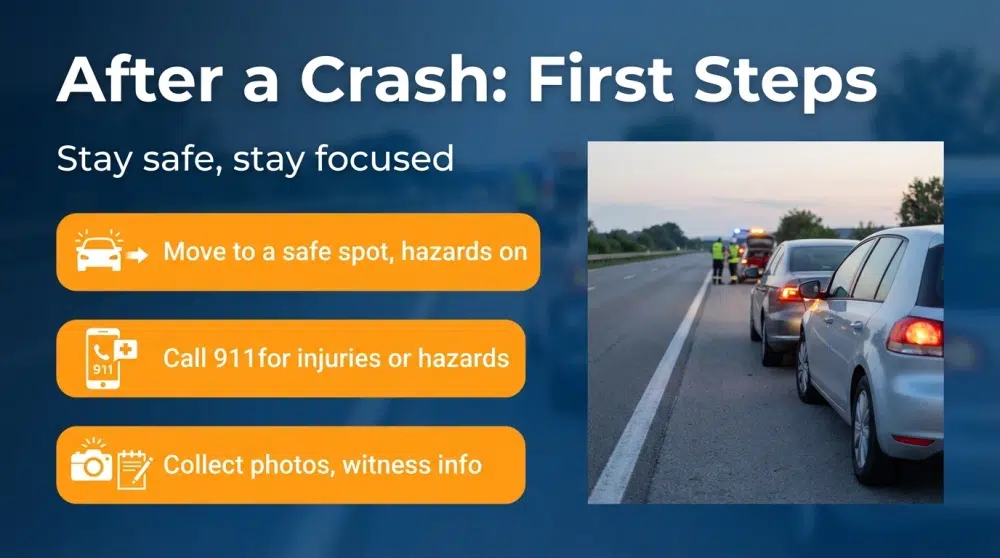
First, check yourself and others for injuries and call 911 if anyone may be hurt. If your vehicle is drivable, move it out of active lanes to a safe area such as a nearby parking lot or a shoulder, activate hazards, and place cones or triangles if available. California’s driver handbook instructs motorists involved in collisions to move vehicles out of traffic when safe to reduce the risk of secondary crashes [10].
When should you call 911 versus a non-emergency line?
In case of injuries, possible injuries, hazards, suspected impairment, or blocked lanes, call 911 for immediate help. Otherwise, for minor property-damage-only incidents without imminent danger, you can use the non-emergency line to notify Irvine Police Department and request assistance with exchange of information and traffic control. However, if an officer fails to respond, California law still necessitates reporting certain crashes involving injury or death to law enforcement within 24 hours as per [3] .
Why is it important to avoid discussing fault at the scene?
In the heat of adrenaline, confusion, and limited knowledge, it’s easy for misstatements to slip in. To avoid this, keep your conversation focused on essential safety measures, necessary medical care, and providing only the legally required information initially. Later, you can share your detailed account with solid evidence. It is crucial to understand that early admissions can easily be misconstrued or taken out of context.
What immediate documentation should you create?
- Images and videos can document the positions of vehicles involved, the state of traffic lights or other relevant signs, lane markers, skid marks, any debris on the road, the condition of the vehicles involved, the prevailing weather conditions, and the lighting at the time of the accident.
- Gather contact information from drivers and witnesses, such as their names, phone numbers, and addresses. Don’t forget to also jot down details about the vehicles involved, including their descriptions and license plate numbers. This information is crucial for a thorough investigation.
- It’s crucial to take note of any injuries, including even minor pains or discomfort. These seemingly insignificant feelings might actually indicate a deeper issue beneath the surface. Make sure to keep track of your symptoms and where you feel the pain, as it will be valuable information for seeking medical help when needed.
- Take note of the time, direction of travel, signal phases (if seen), and any uncommon road conditions during your scene observations.
How do you report a crash in Irvine to police and state agencies?
Do you have to report an Irvine crash to the police?
Yes, certain collisions must be reported to law enforcement. Under California Vehicle Code section 20008, when a crash involves injury or death and no officer investigates at the scene, a driver must report it to the local police department or California Highway Patrol within 24 hours [3]. You can report an accident Irvine Police Department through emergency or non-emergency channels depending on the circumstances. Additionally, for injury or fatal collisions, involved drivers have duties under sections 20001 and 20002 regarding stopping, rendering aid, and exchanging information [1][2].
What is the DMV SR-1 crash report and when is it required?
California requires that you file a DMV SR-1 report within 10 days if anyone was injured or killed, or if there was more than $1,000 in property damage, regardless of fault or whether the police responded [4]. Failure to file can affect your driving privileges even if the other driver was at fault.
What information must you exchange at the scene?
California Vehicle Code section 16025 requires exchanging your name, current residence address, driver’s license number, vehicle identification, and insurance information [5]. Photograph the other driver’s insurance card and driver’s license if permitted, and verify policy numbers and insurer names carefully before leaving.
What information and evidence should you gather at the scene?
What driver and vehicle details are essential to collect?
- Identity and insurance Full names, addresses, phone numbers, driver’s license numbers, and insurance details for all involved drivers [5].
- Kindly provide specific vehicle information such as make, model, color, license plate number, and Vehicle Identification Number (VIN) if accessible.
- Images of extensive vehicle damage on all sides, including deployment of airbags, presence of child seats and installation of any additional aftermarket equipment.
How do you document traffic controls and road conditions?
- Identify signal phases by photographing traffic signs and determine if left turns are controlled by arrows or protected turns.
- Lanes and markings are key features to consider when designing or evaluating a roadway. They help manage the flow of traffic by providing guidance for drivers and establishing boundaries that enable safer driving conditions. Some important elements that are included in lane and marking designs include: 1. Turn pockets: These are specialized areas designed to safely accommodate vehicles when they need to make a turn at an intersection or into a driveway, etc. They provide space for vehicles to maneuver without blocking through traffic. 2. Stop bars: These horizontal lines painted on the roadway indicate the stopping point for vehicles at traffic signals and stop signs. They help drivers know where they should stop and are essential in preventing collisions caused by improper stopping positions. 3. Crosswalks: Pedestrian crossings, or crosswalks, are designated areas within intersections or along roads where pedestrians can safely cross the street. These are marked with both pavement markings (often white) and, at certain locations, raised surfaces to make it more visible to drivers and provide a physical barrier for pedestrians. 4. Visibility obstructions: These refer to any objects or structures that may obstruct the line of sight for drivers, such as bushes, trees, signs, poles, etc. It’s crucial to minimize visibility obstructions around intersections, curves, and other points where good sight distance is essential for safe driving. By taking these elements into account when designing or managing a roadway, we can create a safer environment for both drivers and pedestrians alike.
- Environmental factors Record weather, sun angle, and nighttime lighting. Intersections can change quickly with time-of-day traffic patterns [11].
Why are independent witnesses important?
Neutral onlookers can provide clarity on whether someone had the right-of-way or not, as well as identify who was speeding or made an unsafe move. Always remember to collect their statements and contact information. If a witness has to leave immediately, ask them to text you a brief summary instead.
How does fault work in California and what is comparative negligence?
What is California’s rule for sharing fault in a crash?
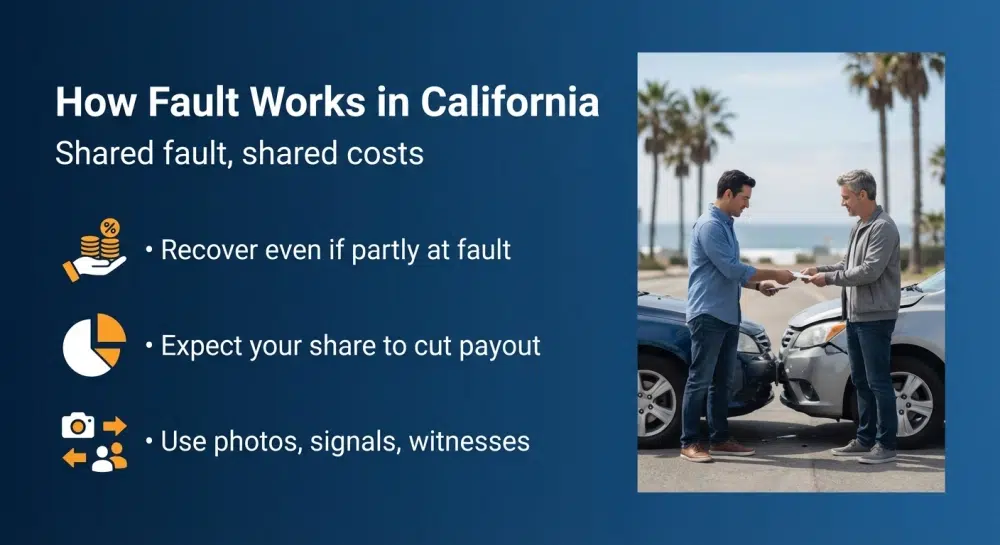
California follows pure comparative negligence, meaning each party’s recovery is reduced by their percentage of fault. This doctrine originated in California Supreme Court precedent, allowing injured people to recover even if they bear a substantial share of responsibility [8]. For example, a driver found 30 percent at fault can still pursue 70 percent of their provable damages from another responsible party.

How do common intersection violations play into fault?
- A crucial aspect of safe driving involves yielding when making a left turn. In such scenarios, the driver of the vehicle intending to turn left should always yield to any approaching vehicles until it becomes safe to proceed. This act of yielding is especially important for enhancing road safety and maintaining order on the roads. Furthermore, signaling your intentions to other drivers is a key aspect of road etiquette; it helps in avoiding accidents and promoting a smooth flow of traffic. So, always remember to use your turn signals whenever making a turn or changing lanes – not only for complying with the law but also as a gesture of responsible driving.
- When entering an intersection on a red light or rolling through a right turn, this can raise inferences of negligence if it’s backed up with convincing evidence.
- Dangerous Lane Changes: Abrupt lane changes near intersections often lead to conflicts with vehicles continuing straight or making a turn. This can result in accidents and pose risks for all road users. It is essential that drivers carefully consider their actions while maneuvering on the roads, especially at busy intersections where traffic conditions are constantly changing. Always use your signal lights when preparing to change lanes, and always ensure you have enough space and clear visibility before executing any lane changes. By being cautious and mindful of other road users, we can all contribute to safer driving conditions on our roads.
In order to properly assess a fault at an intersection, it is necessary to take into account various pieces of evidence, such as scene photographs, signal timing data if available, the pattern of damage sustained by involved vehicles, police observations, and credible witness accounts. It is also important to remember California’s general duty of ordinary care for all motorists when traveling through intersections, regardless of their method of transportation [8].
How can defendants respond to claims about fault?
In cases involving vehicular accidents, defendants might argue that the plaintiff contributed to the crash by driving recklessly, being inattentive behind the wheel or proceeding when a stale yellow signal indicated it was unsafe to do so. They may also challenge the medical evidence and documents used to establish damages, with the goal of reducing the sought-after amount. Having clear, consistent records and independent verification can be extremely helpful for both parties as they evaluate each other’s level of responsibility in the accident.
What insurance coverages apply after an Irvine intersection crash?
Which liability and first-party coverages may be involved?
- Bodily Injury Liability covers expenses related to injuries caused by you when you’re at fault in an accident, but it does have a limit on how much is covered.
- This policy covers any damages caused by you to other people’s cars or property, with limits on how much it will pay out.
- This type of optional insurance is specifically designed to help cover initial medical expenses that may arise, irrespective of who’s at fault. It provides a degree of financial security in the face of potential accidents or health-related issues.
- Collision insurance covers the cost of repairing your vehicle in case of an accident, up to the policy’s limit minus your deductible. This type of coverage is crucial when it comes to safeguarding your investment in a car, as unexpected collisions can happen at any time.
- UM/UIM coverage Uninsured and underinsured motorist coverage may apply if the at-fault driver lacks enough insurance; California statutes govern UM/UIM terms and arbitration procedures [9].
How do you protect your UM/UIM rights?
Report the crash promptly to your insurer, cooperate with reasonable requests, and preserve evidence of the other driver’s limited coverage. California Insurance Code section 11580.2 addresses UM/UIM coverage requirements and claim procedures, including time-sensitive steps if arbitration is needed to resolve disputes [9].
Why should you be cautious with recorded statements?
Insurance adjusters often request recorded statements at the beginning of a claim. These statements can be utilized to restrict or challenge insurance claims. It’s crucial to seek advice prior to providing any comprehensive recorded statement, especially when injuries or liability are uncertain, in order to ensure that your story is accurate and thorough.
How does medical treatment affect your health and claim?
Why seek prompt evaluation even if you feel okay?
Some injuries are not obvious at the scene. Concussions, soft tissue injuries, and internal issues can appear hours or days later. Early medical evaluation protects your health and documents the crash as a potential cause of your symptoms, which helps reduce disputes over causation. Recognizing signs of traumatic brain injury or concussion is important; credible government medical guidance highlights common symptoms such as headache, dizziness, nausea, and confusion [13].
How do medical records and treatment plans support your case?
- A consistent approach following your healthcare provider’s recommendations demonstrates that you truly value and take your recovery process seriously.
- Based on the provided information, it seems like there is a focus on discussing objective findings from imaging and exam notes that help confirm the presence of pain or limitations experienced by an individual. This could be particularly useful in medical settings where doctors are looking for evidence to support their diagnoses or treatment plans for patients who report such symptoms.
- When appropriate, prompt specialist referrals indicate a comprehensive level of patient care.
Should you stop using seat belts after a crash?
No, if your car is drivable and you need to move it, wear your seatbelt. According to federal safety data, wearing a seatbelt significantly reduces the risk of death and severe injury [12].
How do you get a police or traffic collision report after an Irvine crash?
Where do you request the report if Irvine PD responded?
Traffic collision reports are usually accessible through the responding law enforcement once they have been finalized. If it was Irvine Police Department that handled your accident, you may reach out to their records unit listed on their website for guidance on requesting the report. If the California Highway Patrol was present during the incident, you can use the CHP collision report request process and forms made available by the agency [3].
Why is the report important for insurance claims?
The report could contain various elements such as diagrams, details of those involved in the incident, eyewitness accounts, noted damages to vehicles observed, and police officers’ opinions on what may have contributed to the accident. Although this is not the ultimate decision on responsibility, insurers take these findings into account together with photos, cost estimates, and relevant medical documentation while making their assessment.
What deadlines and statutes of limitations apply in California?
How long do you have to file an injury claim in court?
In most cases involving personal injury claims arising from vehicle accidents in California, you have two years from the date of the incident to file your claim [6]. Failing to do so within this timeframe can result in being barred from bringing a lawsuit. Therefore, it’s crucial that you mark it on your calendar early and stay attentive to any potential extensions or tolling situations, such as if the injured party is a minor or the defendant resides out of state.
What is the deadline for property damage-only claims?
In California, typically there are three years allowed for filing lawsuits related to property damages, such as car repairs and diminishing values. This applies in most cases. Please see link: [7] for more information.
What if a public entity may be responsible?
When it comes to claims involving public entities, like roadway defects or accidents with government vehicles, you need to follow specific guidelines under the Government Claims Act [14]. One of these requirements is filing a written administrative claim within six months after the incident took place. If this claim gets rejected, then your deadline for filing a lawsuit can be as short as just six months after receiving the rejection notice [15] . With such strict procedures in place, prompt action is absolutely essential.
How do property damage claims and rentals work after a collision?
What if your car is repairable?
- When estimating the repair process for an insurer, they might require either an on-site inspection or photos of the damage. The choice is yours to decide whether you want your repairs done at a repair shop of your preference or in one of their preferred network locations. Going with their preferred networks can help simplify and streamline the billing process.
- Discussion on Parts and Procedures: When dealing with any repair or replacement of car parts, there will be a consideration between original equipment manufacturer (OEM) and aftermarket parts. It is crucial to discuss these options with your service provider and insurance agency to ensure the best possible outcome for you as a consumer. OEM parts are made by the same company that manufactured your vehicle, while aftermarket parts are produced by third-party manufacturers. While OEM parts may be more costly, they will typically adhere to the original design and specifications of your car, ensuring optimal performance and compatibility. On the other hand, aftermarket parts can often provide a cost-effective solution without compromising on quality or safety standards. It is essential to weigh these options carefully and make an informed decision based on your individual preferences and budget constraints.
- Rental coverage: The insurance policy of the at-fault party may cover a reasonable rental period if you need to rent a vehicle due to a covered incident; your personal auto insurance policy might also offer rental reimbursement benefits.
What if your car is totaled?
An insurance company will declare your car a total loss if repairing it plus its salvage value costs more than the actual cash value it holds. To help support this valuation, provide maintenance records, recent work done on the vehicle and any evidence of trim or options. Furthermore, you can negotiate with the insurer using comparable listings to get the most accurate total loss valuation.
Can you pursue diminished value in California?
Many claimants seek diminished value when a repaired vehicle is worth less than it was pre-crash. California law allows property damage recovery subject to proof and the three-year statute of limitations [7]. Document pre-loss condition and market comparables.
What if the crash was a hit and run at Barranca and Harvard?
What are your legal duties after a hit and run?
California law requires drivers involved in collisions to stop, exchange information, and provide aid when needed. Fleeing the scene of an injury collision is a serious offense under Vehicle Code section 20001, and failing to stop after a property-damage-only crash violates section 20002 [1][2]. If the other driver left, try to capture the license plate, vehicle description, and direction of travel, and report immediately.
How does UM coverage help when the at-fault driver flees?
Uninsured motorist coverage can step in when you cannot identify or recover from the at-fault driver. Report promptly to your insurer, cooperate with the investigation, and follow UM claim procedures under California Insurance Code section 11580.2 [9].
Who may be liable in an Irvine intersection collision?
Can multiple parties share liability in intersection crashes?
- Drivers Turning, red-light, or unsafe lane maneuvers can create joint liability when multiple drivers contribute to the sequence of events.
- Employers If a driver was on the job, vicarious liability may apply to the employer.
- Vehicle owners Permissive use can expose owners to claims through their coverage first.
- Public entities In rare cases, signal timing or sight-line issues may prompt investigation, but strict Government Claims Act procedures apply [14][15].
What evidence helps identify who is responsible?
Key sources include the police report, scene photos, damage patterns, event data recorder downloads when available, intersection camera footage where lawfully accessible, 911 audio timing, and credible witness statements. Independent reconstruction may be considered in severe cases to analyze angles, speeds, and timing.
What should you expect from the insurance claim process?
How do you open and manage a claim?
- Prompt notice Notify all potentially involved insurers and provide basic facts and contact information.
- Documentation Keep organized files with photos, medical records, bills, wage documentation, and repair estimates.
- Communications Confirm important conversations in writing and save claim numbers and adjuster details.
What damages can be sought in a civil claim?
Injury claims can include medical expenses, lost earnings, loss of earning capacity when supported, and pain and suffering damages. Property damage claims cover repair or total loss valuations, use loss or rental costs, and potentially diminished value with adequate proof. The comparative negligence framework allocates these amounts based on each party’s share of fault [8].
When do cases settle versus go to trial?
Most claims settle after evidence exchange and negotiations. Some proceed to mediation or arbitration by agreement. Cases may go to trial when liability or damages remain disputed. Trials require careful preparation, credible testimony, and expert-supported valuations, and can offer finality that negotiations cannot achieve.
Navigating these steps can be complex. car accident lawyers can help you evaluate liability evidence, preserve critical records, and pursue all avenues of recovery within California’s legal deadlines.
What common mistakes should you avoid after a crash in Irvine?
- Leaving the scene Always stop and exchange information as required by California law [1][2].
- Skipping the DMV SR-1 File when required for injuries or when property damage meets the threshold [4].
- Delaying medical care Gaps in treatment create room to dispute causation and severity [13].
- Posting on social media Public posts can be misconstrued and may appear in claim evaluations.
- Giving broad recorded statements Consider the timing and scope of any recorded interview.
- Missing deadlines Track statutes of limitations and administrative claim deadlines carefully [6][7][14][15].
What other FAQs come up after an intersection crash in Irvine?
Can you drive your car if it seems okay?
If the vehicle is safe to operate, move it out of traffic and drive cautiously to a secure location or repair facility. If safety systems are compromised, arrange towing. California’s handbook encourages moving vehicles from lanes when safe to do so [10].
Do you need to see a doctor the same day?
It is wise to be evaluated promptly. Many injuries manifest later, and early care helps document symptoms linked to the crash [13].
Should you accept the first settlement offer?
Early offers may not reflect full medical needs, future care, or wage impacts. Evaluate offers after you understand liability, treatment plans, and long-term effects.
Can you claim lost wages if you are self-employed?
Yes, with documentation such as tax returns, client invoices, appointment records, and statements from customers. A clear paper trail helps quantify losses.
How does a prior injury affect your claim?
You can still pursue compensation for aggravation of preexisting conditions. Accurate medical history and comparative diagnostic findings are key to distinguishing baseline issues from crash-related exacerbations.
What if the other driver had minimal insurance?
Underinsured motorist coverage can help bridge the gap between the other driver’s low limits and your provable damages, subject to policy terms and California law [9].
How can legal help in Irvine make a difference?
Why is it important not to go it alone?
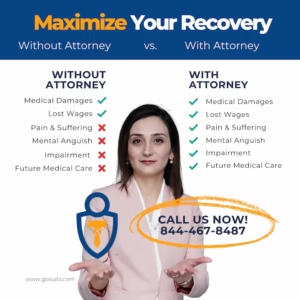
Intersection cases often turn on nuanced evidence like signal timing, vehicle angles, and partial fault assessments. An attorney can coordinate investigation, request and preserve critical records, and align your medical documentation with legal burdens of proof, which helps both settlement talks and potential litigation. If you are looking for guidance from Irvine car accident lawyers, ask about investigation capabilities, trial history, and client communication practices so you know exactly how your case will be handled.
How can a lawyer help with evidence and deadlines?
- Evidence preservation Request intersection camera footage promptly where available, and send preservation letters for vehicle data and records.
- Claims management Track SR-1 filings and calendar statutes under California law [4][6][7].
- Negotiations Present liability findings and damages in a structured, documented manner, using medical and wage support.
- Litigation readiness Identify witnesses early and prepare demonstratives for mediation, arbitration, or trial.
If you were involved in a Barranca and Harvard car accident Irvine residents face multi-lane traffic and signal timing that can complicate liability. Clear documentation and timely legal help can significantly improve how your claim is evaluated.
When you are deciding who should speak for you, consider both bedside manner and practical case management. car accident lawyers in Irvine can handle communications with insurers, seek key evidence from public agencies and private parties, and prepare claims strategically for resolution or trial.
Why choose GoSuits for help after a car accident in Irvine?
How does GoSuits align with your needs after an Irvine intersection crash?
Collisions at Barranca Pkwy and Harvard Ave often involve complex fact patterns and multiple insurers. GoSuits focuses on civil personal injury cases in California, including intersection crash claims in Orange County. A free consultation can help you understand the process, timelines, likely documentation needs, and how to approach both the injury and property damage sides of your claim without unnecessary delays.
Where does GoSuits practice and who will handle your case?
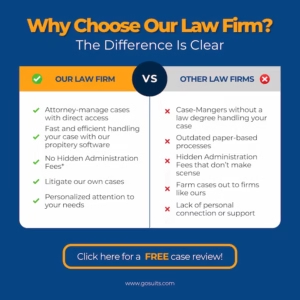
We handle personal injury and wrongful death matters throughout California, including Irvine and greater Orange County. Although our approach uses technology to expedite case milestones, you will work directly with a designated attorney. We do not use case managers to buffer communications. Every client has unfettered access to their attorney from intake through resolution.
What technology advantages does GoSuits provide?
- Proprietary case software Our exclusive software centralizes evidence, deadlines, and negotiations to move files faster and with fewer errors.
- Data-driven strategy We leverage analytics to evaluate claim value ranges and litigation risk while tailoring strategy to your facts.
- Seamless communication Real-time updates keep you informed and aligned with next steps.
What results and experience support our approach?
GoSuits has secured favorable outcomes for clients across a range of motor vehicle cases. Each case turns on its own facts and no result is guaranteed, but you can review a sampling of our prior cases and learn about our attorneys. Our team brings over 30 years of combined experience, including trial work that can be crucial when liability or damages are contested.
What are our practice areas and why does trial experience matter?
- Practice areas Explore our full list of practice areas, including motor vehicle collisions, pedestrian and bicycle incidents, premises liability, product-related injuries, and wrongful death.
- Trial readiness Preparation for trial often leads to stronger settlements. When needed, courtroom experience provides a direct path to verdict.
- About our firm Read more on our approach and values on the about us page.
References and resources
- California Vehicle Code section 20001 Duty to stop at scene of injury or death – California Legislature
- California Vehicle Code section 20002 Duty where property damaged – California Legislature
- California Vehicle Code section 20008 Reporting accident to CHP or police within 24 hours – California Legislature
- DMV SR-1 Accident Reporting Requirements – California DMV
- California Vehicle Code section 16025 Exchange of information – California Legislature
- California Code of Civil Procedure section 335.1 Two-year limitation for injury – California Legislature
- California Code of Civil Procedure section 338 Three-year limitation for property – California Legislature
- Li v. Yellow Cab Co. of California, 13 Cal.3d 804 – CourtListener
- California Insurance Code section 11580.2 Uninsured and underinsured motorist coverage – California Legislature
- Collision Involving Vehicles Guidance – California DMV Driver Handbook
- Crash Factors in Intersection-Related Crashes – NHTSA
- Seat Belts and Effectiveness Data – NHTSA
- Concussion Signs and Symptoms – CDC
- California Government Code section 911.2 Claim presentation within six months – California Legislature
- California Government Code section 945.6 Time to commence action after rejection – California Legislature