- What does California law actually say about driving barefoot?
- Is it legal to drive barefoot in California?
- Could barefoot driving lead to a ticket or civil liability after a crash?
- How can footwear affect negligence and insurance claims in California?
- What footwear is safest for driving and what do officials advise?
- How do police and insurers evaluate barefoot driving after a collision?
- What steps should you take if a crash involves barefoot or unsafe footwear?
- How do California juries evaluate barefoot driving in civil trials?
- How do California rules compare with federal principles and other states?
- Frequently asked questions about barefoot driving in California
- How GoSuits supports California crash victims
- References and resources
What does California law actually say about driving barefoot?
California has no statute that prohibits you from operating a motor vehicle without shoes. The California Vehicle Code does not contain any section that makes barefoot driving unlawful. Instead, California traffic law focuses on how safely you control the vehicle and whether your conduct violates general rules like the Basic Speed Law, reckless driving, or safe movement provisions [1] [2] [3] [4].
This means legality turns on behavior rather than footwear. If your footgear or lack of it contributes to unsafe operation or a violation of a safety statute, you can face citations for that underlying conduct. But there is no stand alone California prohibition on driving barefoot [1].
California’s driver education materials emphasize safe operation and control but do not impose a footwear requirement. The California Driver Handbook provides guidance on best practices for positioning, visibility, and vehicle control, but it does not require particular footwear as a condition to drive [8].
Is it legal to drive barefoot in California?
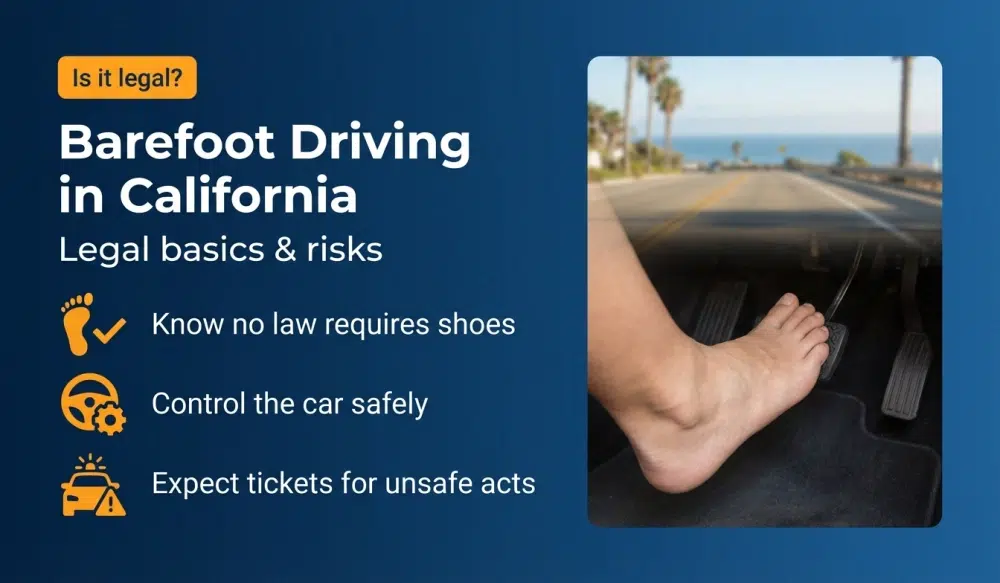
Yes. Driving barefoot is legal in California. There is no California Vehicle Code barefoot ban and no DMV rule that requires shoes for drivers. What matters is whether you can safely control the pedals, maintain proper braking and acceleration, and comply with general safety statutes like the Basic Speed Law in Vehicle Code section 22350 and rules governing safe movements such as section 22106 [2] [3].
Some drivers prefer bare feet over certain shoes because they feel better pedal feedback. Others find that going barefoot reduces the risk of a sandal or heel catching on a pedal. California law leaves that choice to you, while holding you responsible for operating safely at all times. If an officer determines that your driving is unsafe or reckless, you can be cited under the applicable statute regardless of footwear [4].

Could barefoot driving lead to a ticket or civil liability after a crash?
You cannot be ticketed simply for being barefoot. But if going barefoot contributes to behavior that violates a safety rule, an officer may cite you for that rule. Common examples include:
- Basic Speed Law Did your speed exceed what was safe for conditions because you could not modulate the pedals smoothly or stop in time [2]?
- Unsafe starting or backing Did your foot slip as you shifted from brake to accelerator, causing a sudden movement that was not reasonably safe [3]?
- Reckless driving In extreme cases where your conduct shows willful or wanton disregard for safety, officers can allege reckless driving under Vehicle Code section 23103 [4].
In a civil case after a collision, the question is whether a reasonably careful person would have acted differently in the same situation. California negligence law sets a general duty of ordinary care under Civil Code section 1714 and evaluates whether a breach of that duty caused harm [6]. If footwear choice contributed to a loss of control or delayed braking, a plaintiff may argue it was negligent. Conversely, if footwear played no role, the issue may be irrelevant.
California also applies comparative fault. If both drivers share blame, a jury can allocate percentages of responsibility and reduce damages accordingly. This framework is reflected in California’s civil jury instructions on negligence and comparative fault published by the Judicial Council [7].
How can footwear affect negligence and insurance claims in California?
In California, a plaintiff must prove duty, breach, causation, and damages. Footwear can come up at two stages:
- Breach Did the driver fail to use reasonable care in how they operated the vehicle and controlled the pedals when a reasonably careful driver would have done better under similar conditions [6] [7]?
- Causation Did the shoe or bare foot materially contribute to unintended acceleration, delayed braking, or slipping off a pedal?
Evidence in these disputes can include collision reconstruction, vehicle data, photographs of the footwell area, statements, and medical records documenting ankle or foot impairments. California juries are instructed on ordinary care and are asked to evaluate whether a driver acted reasonably. There is no automatic presumption that barefoot driving is negligent on its own.
Negligence per se sometimes applies if a driver violates a safety statute designed to prevent the type of harm that occurred, creating a presumption of negligence under Evidence Code section 669 [5]. Since there is no statute forbidding barefoot driving, negligence per se would not apply to being barefoot by itself. But it could apply to an underlying safety violation such as unsafe movement or speeding if the evidence shows the violation occurred and contributed to the crash [2] [3] [5].
California’s comparative fault rules permit insurers and juries to consider whether footwear choices contributed to the collision or injuries. If a driver’s flip flop snagged on a pedal and delayed braking, a fact finder might assign a portion of fault for that aspect of conduct, while still holding a speeding or distracted opposing driver primarily responsible under Civil Code section 1714 and standard negligence instructions [6] [7].
What footwear is safest for driving and what do officials advise?
California does not require a specific type of footwear, and there is no California Vehicle Code barefoot prohibition. However, state guidance emphasizes maintaining safe control at all times. The California Driver Handbook covers fundamentals of proper seating position, pedal control, and safe operation, which all point to the need for secure pedal contact and unhindered foot movement [8].
From a safety standpoint, many drivers find that closed toe shoes with firm soles provide consistent pedal feel and traction. Loose or backless footwear can sometimes slip or catch on a pedal. Very bulky soles can reduce pedal sensitivity. Bare feet can provide good tactile feedback for some drivers, yet may offer less grip if wet and can be uncomfortable in emergencies that require hard braking or evasive maneuvers. Regardless of what you wear, California law holds you responsible for choosing footwear that lets you keep full, safe control of the vehicle in traffic.
California records thousands of roadway deaths each year, reminding all of us that small choices about control and attention matter. The California Office of Traffic Safety reports that more than four thousand people are killed on California roads in a typical year, with many more injured, underscoring the importance of safe driving behavior in every trip [9]. Nationwide, traffic fatalities exceeded forty thousand in recent years, according to the National Highway Traffic Safety Administration, reflecting ongoing risk on U.S. roads and the need for prudent driving practices [10].

How do police and insurers evaluate barefoot driving after a collision?
Officers and insurance adjusters focus on whether a driver complied with safety statutes and maintained control, not on footwear alone. In practical terms, an investigation may consider:
- Scene evidence Debris patterns, skid marks, vehicle resting positions, and photos of the footwell and pedals.
- Statements Admissions by a driver about a foot slipping, a shoe catching, or confusion between pedals.
- Vehicle data Event data recorder information on throttle and brake application where available.
- Medical and impairment factors Fatigue, alcohol or drugs, or foot injuries that could affect control are typically separate issues from footwear choice and can carry their own legal consequences.
- Applicable statutes Whether the facts indicate violations like unsafe starting or backing, the Basic Speed Law, following too closely, or failing to yield, which are the operative legal questions under California law [2] [3].
Adjusters then apply California negligence and comparative fault principles to evaluate liability and damages, drawing on the general duty of care in Civil Code section 1714 and the jury instruction framework reflected in CACI [6] [7].
What steps should you take if a crash involves barefoot or unsafe footwear?
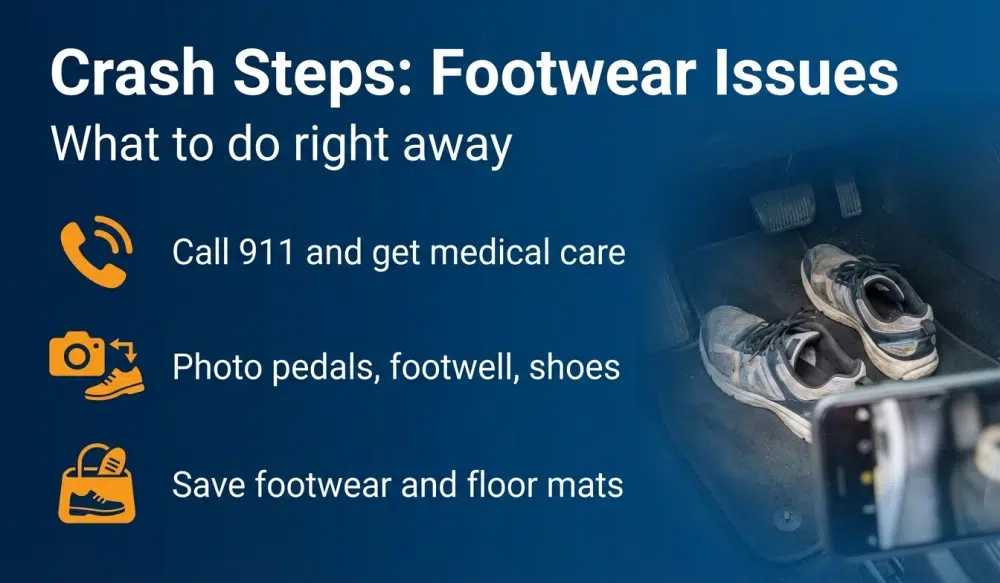
Your immediate priority is safety and documentation. After any collision in California:
- Call 911 Report injuries and request medical evaluation.
- Move to safety if possible Reduce further risk by moving vehicles out of traffic when safe to do so.
- Document the scene Photograph vehicle positions, damage, the driver footwell area, pedals, and any footwear involved. These photos can help resolve disputes about control and causation.
- Exchange information Collect names, contact information, driver’s license numbers, and insurance details.
- Identify witnesses Gather contact information from anyone who saw the incident.
- Seek medical care Even seemingly minor injuries can evolve. Prompt care supports health and creates records that link injuries to the crash.
- Notify your insurer promptly Cooperate with reasonable requests while being mindful that recorded statements can affect liability assessments.
- Preserve evidence Do not discard or alter footwear, floor mats, or pedal covers until claim issues are resolved.
California’s civil framework is fact intensive. Gathering detailed evidence about how the collision occurred usually matters far more than whether a driver was barefoot or wearing a particular shoe.
How do California juries evaluate barefoot driving in civil trials?
Juries receive instructions on the general duty of ordinary care, causation, and damages, as well as comparative fault where applicable. The Judicial Council’s California Civil Jury Instructions provide standardized language that trial courts use across the state [7]. Within this framework, jurors typically consider:
- Reasonableness Did the defendant act as a reasonably careful person would under similar circumstances, including their control of the vehicle and pedal use [6] [7]?
- Link to harm Is there reliable evidence that footwear contributed to the collision or the severity of injuries as opposed to other causes such as speed, distraction, or roadway conditions?
- Comparative responsibility If both sides were negligent, what share of the fault does each bear for the harm that resulted [6] [7]?
There is no instruction that presumes barefoot driving is negligent. The focus remains on whether the driver complied with California’s safety standards and whether any lapse caused the harm alleged.
How do California rules compare with federal principles and other states?
Federal traffic safety agencies publish research and national statistics, but driving rules such as footwear are determined by state law. California’s approach is consistent with the broader U.S. concept that safe vehicle control and compliance with general safety statutes are the primary legal requirements. National data from NHTSA underscore the public safety backdrop for state traffic rules and enforcement priorities, with more than forty thousand roadway deaths nationwide in 2021 [10].
Many U.S. jurisdictions focus, as California does, on safe operation rather than prescribing footwear. Because rules can change and local ordinances may address specific settings, it is wise to confirm the law where you drive. Within California, statewide statutes govern, and there is no California Vehicle Code barefoot prohibition [1].
How GoSuits supports California crash victims
If you were hurt in a California collision where footwear is being questioned, we can walk you through how state traffic laws, negligence standards, and comparative fault apply to your situation. We focus on injury and crash litigation across California and offer a free consultation so you can understand options and timelines without pressure.
- California focused practice We handle civil injury matters throughout the state, including cases involving disputed liability, serious injuries, and complex insurance issues. See our prior cases for examples of outcomes we have achieved.
- Technology driven process Our exclusive proprietary software organizes evidence, timelines, and medical records to move cases faster with better clarity. This helps surface key facts such as pedal application data, scene photos, and witness statements early in the process.
- Dedicated trial attorneys Although we use advanced tools to expedite work, every client has a designated attorney and direct access. We do not route clients through case managers. When trial becomes the best path, our courtroom experience benefits settlement leverage and verdict presentation.
- Proven results Our team has delivered strong recoveries for clients across a range of crash types. Explore prior cases to see resolved matters and case narratives.
- Experienced team With 30 years of combined experience, our attorneys prepare claims for litigation from day one, building the foundation for negotiation and trial. Read more about our attorneys and our about us page.
- Comprehensive practice areas We help Californians in motor vehicle cases and other civil injury matters. Review our full list of practice areas.
We invite you to reach out for a free consultation to discuss your collision, injury, and questions about California driving barefoot law and how insurers and courts evaluate these facts. The earlier we can gather and analyze evidence, the better we can position your claim within California’s civil framework.
References and resources
- California Vehicle Code Table of Contents – California Legislature
- Vehicle Code 22350 Basic Speed Law – California Legislature
- Vehicle Code 22106 Starting Parked Vehicle or Backing – California Legislature
- Vehicle Code 23103 Reckless Driving – California Legislature
- Evidence Code 669 Negligence Per Se – California Legislature
- Civil Code 1714 General Duty of Ordinary Care – California Legislature
- California Civil Jury Instructions CACI Overview – Judicial Council of California
- California Driver Handbook – California DMV
- Traffic Safety Facts and Statistics – California Office of Traffic Safety
- 2021 Traffic Fatalities Annual Report Highlights – NHTSA
- Negligence Per Se Overview – Cornell Law School Legal Information Institute
- Vehicle Code 24002 Unsafe Vehicle Operation – California Legislature