- What is California’s Three Foot Law CVC 21760?
- How does the 3 foot passing law apply on city streets and bike lanes?
- What counts as three feet and how should drivers pass safely?
- What exceptions or practical limits exist under CVC 21760?
- How do police reports and courts use the Three Foot Law in civil cases?
- What is negligence per se and how can CVC 21760 affect a case?
- How does comparative fault work for cyclists in California?
- What damages can you claim after a bicycle crash?
- What insurance coverage may apply after a bicycle collision?
- What should you do after a bike crash step by step?
- How do you document road defects or public entity liability in Orange County?
- How long do you have to file a bicycle injury claim in California?
- How can local evidence help prove a CVC 21760 violation?
- How do settlements account for a 3 foot passing violation?
- How do California jury instructions describe duties in bicycle passing cases?
- Where can you find official rules that cyclists must follow in California?
- What local infrastructure and planning choices affect cyclist safety?
- How can GoSuits help cyclists after a crash?
- References and Resources
What is California’s Three Foot Law CVC 21760?
California’s Three Foot Law is found in California Vehicle Code section 21760, often called the Three Feet for Safety Act. It requires a driver who passes a person riding a bicycle in the same direction to provide at least three feet of clearance, or slow to a reasonable speed and only pass when it is safe to do so [1].
In plain terms, if you are cycling, any motorist who overtakes you must either leave a minimum of three feet of space between the vehicle and your bicycle, or, if a next lane is available, move fully into that lane to pass [1]. The rule applies on city streets, county roads, and state highways throughout Orange County.
When a driver violates CVC 21760 and a crash occurs, that statutory violation can become important evidence in a negligence claim. The same is true if a cyclist violates a safety rule. California uses fault based rules for traffic collisions, including bike crashes, which means insurance adjusters, judges, and juries evaluate safety duties on both sides.
How does the 3-foot passing law apply on city streets and bike lanes?
California communities feature a mix of Class I off-street paths, Class II bike lanes, Class III bike routes, and Class IV separated bikeways, each defined in Caltrans guidance [4]. The Three Foot Law applies whenever a motorist passes a bicycle traveling in the same direction, whether the cyclist is in a travel lane or within a marked bike lane. On multilane roads, the safest choice is usually for drivers to change lanes entirely before overtaking, which aligns with the current text of CVC 21760 [1].
On streets with Class IV separated bikeways, passing conflicts are less frequent because the physical separation reduces close interactions. Where buffered or paint-only Class II lanes are used, three feet of lateral clearance still applies. If a lane is too narrow to share side by side, cyclists may lawfully take the lane for safety under other Vehicle Code rules, and drivers must wait to pass only when it is safe and legal to do so [7].
What counts as three feet, and how should drivers pass safely?
Three feet means a lateral cushion measured from the closest part of the passing vehicle, including mirrors, to the closest part of the bicycle or cyclist. The safest practice is to:
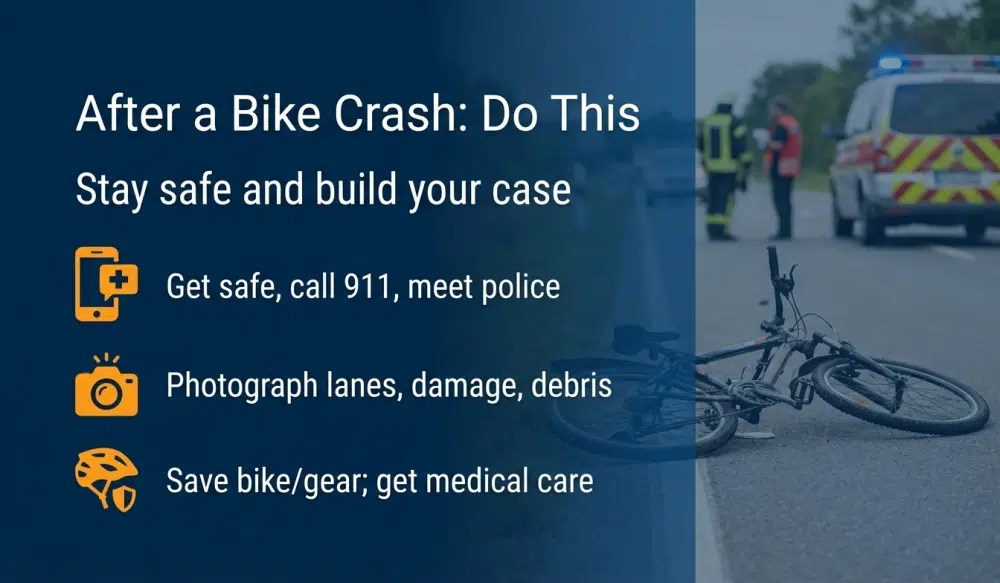
- Change lanes when possible to create more than three feet of clearance [1].
- Slow down and wait behind the cyclist if the lane is narrow or visibility is limited.
- Signal and pass with space, leaving well over three feet if traffic and road width allow, and then return to lane position only when safe.
- Anticipate door zones along parked cars, drain grates, debris, and surface defects that may require bicyclists to move laterally without warning [4].
For cyclists, holding a predictable line, scanning, and communicating with hand signals can reduce conflicts. Still, the legal duty to yield safe passing space rests primarily with the overtaking driver under CVC 21760 [1].
What exceptions or practical limits exist under CVC 21760?
The statute recognizes that not all roads allow immediate passing with three feet and requires drivers to pass only when it is reasonable and safe. If a lane is too narrow or there is oncoming traffic, a driver must wait. The law does not allow squeezing by a bicycle with less space. Where a second lane is available in the same direction, a lane change is required before passing a bicyclist [1].
On high-speed arterials, the safest option is to reduce speed significantly before passing. In school zones and near trail crossings, heightened caution supports safe clearance and visibility.

How do police reports and courts use the Three Foot Law in civil cases?
In a civil injury case, investigators and insurers consider whether a driver maintained the required minimum distance. A police collision report may record witness statements, measurements, mirror strikes, scuff marks, or camera footage indicating a close pass. While citations can help, a ticket is not required to bring a claim. Civil liability is determined on the totality of evidence and the standard of ordinary care under California law [8].
Violation of a safety statute like CVC 21760 can support a finding of negligence via the negligence per se doctrine, discussed below [5][6]. Defendants may argue they slowed appropriately, that three feet was provided, or that an emergency made compliance impossible. The analysis often turns on physical evidence, video, and expert reconstruction using location specific conditions such as lane widths, curb types, and bike lane markings.
What is negligence per se, and how can CVC 21760 affect a case?
Negligence per se allows a court to treat violation of a statute as a presumption of negligence if the statute was intended to protect the class of persons and type of harm suffered, unless the defendant shows a valid excuse. In California, this doctrine is codified in Evidence Code section 669 and explained in the Judicial Council’s CACI No. 418 jury instruction [5][6].
Application in bicycle cases. If a driver passed within three feet in violation of CVC 21760 and caused a sideswipe or loss of control, a plaintiff may ask the court to instruct the jury on negligence per se. The defense may contend that compliance was impossible under the circumstances or that the driver exercised reasonable care despite the apparent violation. Evidence of speed, lane position, traffic, and sightlines on specific corridors will be central.
How does comparative fault work for cyclists in California?
California follows pure comparative fault. A plaintiff’s recovery is reduced by the percentage of fault attributed to them. This principle applies to car accident claims, motorcycle accident claims, and bicycle collisions alike. The standard of ordinary care is codified in Civil Code section 1714 and elaborated in the CACI instructions on comparative negligence [8][6].
Examples of shared fault arguments include riding without lights at night, failing to yield where required, or unsafe lane positioning. Defendants may also raise counterclaims for property damage. Plaintiffs can point to safe passing duties, lane encroachments, and excessive speed by drivers. The goal in either stance is a fair apportionment of responsibility consistent with the facts.
What damages can you claim after a bicycle crash?
In a civil case, recoverable damages may include medical expenses, lost income, diminished earning capacity, pain and suffering, and property damage for the bicycle and gear. In severe impacts, injuries such as fractures and brain injury can require long-term care. If a collision results in a fatality, surviving family members may pursue a wrongful death claim under California law. The correct categories of damages and proof requirements depend on the facts and any comparative fault findings [8].
Related practice area overlaps are common. A sideswipe by a commercial vehicle may resemble a truck accident scenario, while roadway construction hazards can intersect with principles seen in a construction accident. Product failures like a steerer tube fracture, may involve product liability analysis if a component defect contributed to injury.
What insurance coverage may apply after a bicycle collision?
Multiple insurance sources can help pay losses after a crash:
- At fault driver’s liability insurance typically addresses bodily injury and property damage.
- Uninsured and underinsured motorist UM and UIM coverage on your own auto policy can protect you while cycling. California Insurance Code section 11580.2 extends UM to injuries caused by a motor vehicle even if you were a bicyclist [10].
- Medical payments med pay coverage on an auto policy may provide no fault medical benefits regardless of liability.
- Health insurance benefits can address treatment, with subrogation rights potentially affecting net recovery.
- Homeowner or renter policies may cover bike property damage depending on limits and exclusions.
If a government vehicle is involved, such as a transit bus, different claim presentation rules apply as discussed below [9].

What should you do after a bike crash, step by step?
After any crash, your safety comes first. Busy intersections and multi-use paths can be crowded, so take calm, deliberate steps.
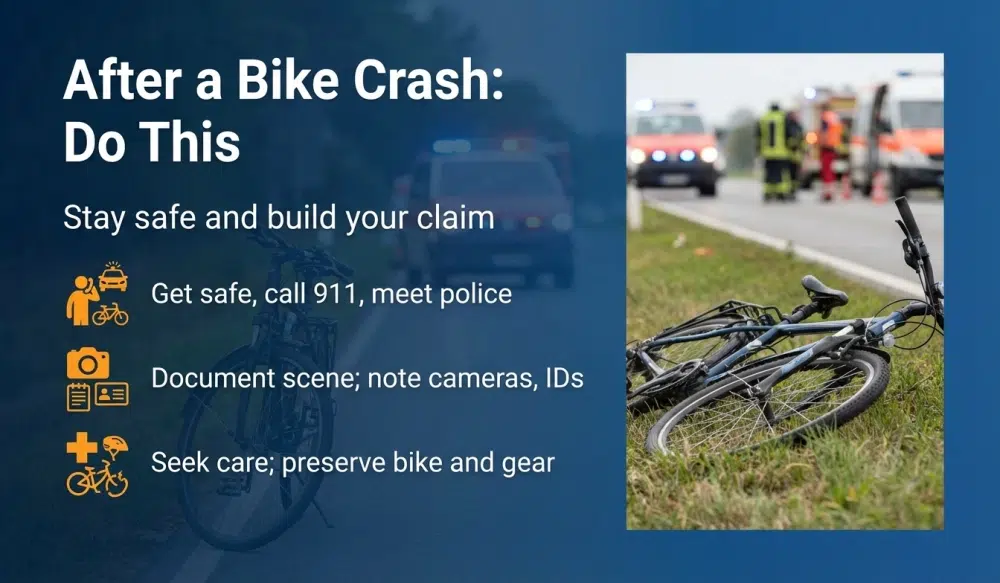
- Get to a safe location and call 911. Report the collision, request medical assistance, and wait for local police or California Highway Patrol to respond. California law requires drivers to stop and exchange information after injury crashes [12].
- Request a police report. Ask officers to document the passing distance concern under CVC 21760. Share any visible marks on the vehicle or your bike that suggest a close pass or contact.
- Document the scene thoroughly. Photograph lane markings, your resting position, skid or scuff marks, debris, parked cars, and roadway width. Capture the vehicle’s side mirror position and any damage.
- Identify witnesses and nearby cameras. Traffic signal cameras, business cameras in nearby shopping centers, and doorbell cameras can help. Note addresses and business names for later record requests.
- Seek timely medical care. Follow up for evaluation of head, neck, and orthopedic injuries. Early documentation can be vital in motorcycle accident and bicycle claims alike.
- Preserve your bicycle and gear. Do not repair or discard the bike, helmet, or lights. These are crucial evidence of impact angles and forces.
- Notify your insurers. Place carriers on notice for auto UM or med pay and health insurance benefits.
- Consider legal help promptly. Navigating liability, CVC 21760, and comparative fault disputes is complex. Early guidance helps protect deadlines and evidence.
How do you document road defects or public entity liability in Orange County?
Some collisions stem from surface hazards, missing signage, or faulty work zones. When roadway conditions contribute, claims may involve Caltrans, Orange County, or a city public works agency. Documenting defects requires attention to detail.
- Photograph and measure the hazard including width, depth, and location references such as distance to nearest intersection and lane markings [4].
- Identify jurisdiction by noting whether the route is state-maintained, county, or city. Caltrans route logs, city public works pages, and GIS layers can assist.
- Preserve notice evidence such as prior work orders, complaints, or maintenance logs when available.
- Use California Public Records Act tools to request maintenance and complaint records from the responsible agency [11].
- Calendar public entity deadlines. The Government Claims Act sets short timelines for claims against government bodies, often six months from the incident [9].
How long do you have to file a bicycle injury claim in California?
For most personal injury claims arising from a bicycle crash, the statute of limitations is two years from the date of injury under Code of Civil Procedure section 335.1 [8]. For claims against public entities, the California Government Claims Act requires a written claim to be presented to the public entity within six months for personal injury, subject to limited exceptions [9]. Minors and certain delayed discovery scenarios can extend or toll deadlines in specific circumstances.
How can local evidence help prove a CVC 21760 violation?
Evidence that commonly proves a close pass includes:
- Side mirror contact or scuffs on the bicycle’s bar end, pedal, or rider’s clothing consistent with less than three feet of clearance.
- On bike video or GPS data establishing speed and lane position.
- Third-party video from businesses, transit vehicles, or residences along busy corridors.
- Police diagrams and measurements, noting lane widths and distances.
- Caltrans and local design standards that show expected bike lane widths and buffer treatments where the crash occurred [4].
When a commercial vehicle is involved, preservation letters may also be directed to fleet owners. Similar practices are used in truck accident and car accident investigations.
How do settlements account for a 3-foot passing violation?
In negotiations, a documented CVC 21760 violation can strengthen a liability position. Insurers often evaluate crash type, roadway geometry, and the presence of negligence per se. Defendants may argue comparative negligence if a cyclist deviated suddenly or rode outside a bike lane without a lawful reason. Adjusters weigh medical bills, wage loss verification, and future care needs. Many of the same valuation methods used in slip and fall accident or motorcycle accident claims apply, but bicycle specific biomechanics and visibility analyses are common.
How do California jury instructions describe duties in bicycle passing cases?
California’s civil jury instructions explain that violation of a safety statute can establish a presumption of negligence if certain elements are met, and they outline how jurors assign percentages of responsibility when more than one person contributed to harm. See CACI No. 418 for negligence per se and CACI provisions on comparative negligence [6]. These instructions help juries apply CVC 21760, Evidence Code section 669, and Civil Code section 1714 to the facts presented [5][8].
Where can you find official rules that cyclists must follow in California?
California Vehicle Code sections 21200 and 21202 outline that bicyclists have the same rights and duties as drivers of vehicles, with specific positioning rules and exceptions for safety. Cyclists may take the lane when necessary for safety, to avoid hazards, or when the lane is too narrow for a bicycle and a vehicle to travel safely side by side [7][13]. The California Driver Handbook also reinforces the Three Foot Law and provides pragmatic guidance for sharing the road [3].
What local infrastructure and planning choices affect cyclist safety?
Many California jurisdictions continue to develop bikeway networks that include off-street Class I paths and on-street facilities. Caltrans design standards and local engineering deliver features like buffered bike lanes and protected intersections that create more operating space, which reduces close pass scenarios. Designs that widen curb lanes, add buffers, and reduce speed conflicts are consistent with state guidance and can lower crash severity risk for people who ride [4].
Even with engineering improvements, national data show that most fatal bicyclist crashes occur in urban areas and during evening hours when visibility challenges are greatest [14]. Using daytime running lights on bicycles, reflective gear, and following the right of way rules can improve conspicuity, yet the key safety obligation to provide a safe passing distance remains with the overtaking driver under CVC 21760 [1].

How can GoSuits help cyclists after a crash?
When a close pass leads to injury, the legal and insurance process can be overwhelming. Our team focuses on civil injury cases for people across Orange County and statewide California. A free consultation with a personal injury attorney can help you understand the next steps, the role of CVC 21760, and how to protect your claim timeline. If you prefer to talk by phone, you can call GoSuits at 844-467-8487.
- Local representation for Orange County and statewide California. We handle bicycle collisions, car accident claims, motorcycle accident cases, truck accident litigation, slip and fall accidents, construction accidents, product liability, brain injury, and wrongful death matters.
- Technology-driven, client-first approach. GoSuits uses exclusive proprietary software to organize evidence, accelerate claim development, and surface the right facts at the right time while keeping you informed in plain language throughout the case.
- Direct access to your lawyer. Although we use technology to expedite the case, we do not route clients to case managers. Every client has unfettered access to a designated attorney who knows the file.
- Proven results and trial readiness. Our attorneys have 30 years of combined experience and significant trial experience. We prepare every case as if it may go to trial, which often leads to better pretrial outcomes and stronger courtroom presentations. You can review prior cases, meet our attorneys, learn more about us, and explore our practice areas.
- Clear steps after a crash. We help you secure medical care, preserve evidence such as video and bike components, request police reports, and coordinate insurance benefits while we evaluate liability under CVC 21760.
References and Resources
- CVC 21760 Three Feet for Safety Act – California Legislative Information
- AB 1909 Bicycles 2022 Chaptered Bill Text – California Legislative Information
- Sharing the Road California Driver Handbook – California DMV
- Highway Design Manual Chapter 1000 Bikeway Planning and Design – Caltrans
- Evidence Code 669 Negligence Per Se – California Legislative Information
- California Civil Jury Instructions CACI including No. 418 Negligence Per Se – Judicial Council of California
- CVC 21200 Operation of Bicycles and Duties – California Legislative Information
- Civil Code 1714 Responsibility for Willful Acts and Negligence – California Legislative Information
- Government Code 911.2 Time for Presentation of Claims – California Legislative Information
- Insurance Code 11580.2 Uninsured Motorist Coverage – California Legislative Information
- California Public Records Act Overview – California Department of Justice
- CVC 20001 Duty to Stop at Scene of Injury Collision – California Legislative Information
- CVC 21202 Positioning of Bicycles on Roadway – California Legislative Information
- Bicyclists Safety and Facts – National Highway Traffic Safety Administration