
- What defines the best bicycle accident law firms?
- Which federal and state laws protect bicyclists after a car crash?
- How common and severe are bike and car collisions?
- Who can be held liable in a bicycle accident case?
- How does comparative negligence affect cyclist compensation?
- What damages can bicyclists claim in civil cases?
- What evidence helps prove fault and damages?
- What is the bicycle injury claim process from start to finish?
- How do statutes of limitations work in California, Texas, and Illinois?
- How do insurance investigations and negotiations typically play out?
- What defenses do drivers and insurers raise and how are they addressed?
- How do you choose a bicycle accident lawyer nationwide?
- What fee arrangements are common for bicycle injury cases?
- When do bicycle cases go to trial and what should you expect?
- How can GoSuits help bicyclists hit by cars?
- References and resources
What defines the best bicycle accident law firms?
You deserve a team that understands cycling, traffic safety, and injury law. The strongest firms combine meticulous investigation, strategic litigation, and compassionate client support. They also have infrastructure to operate nationwide so your case can move forward efficiently wherever the crash happened.
- Proven results with cyclist cases Firms should demonstrate a history of resolving claims for injured bicyclists through settlements or verdicts, documented by public case records where available.
- Deep knowledge of traffic and cycling laws The best teams apply state vehicle codes that govern bicyclist rights and duties, including passing, lane positioning, and right of way, and they track differences across states like California, Texas, and Illinois [4] [6] [7] [8].
- Mastery of civil procedure Effective bicycle injury litigation follows civil court timelines, discovery obligations, and pretrial rules that influence outcomes [2].
- Evidence-driven approach Bicycle cases are won with timely preservation and analysis of scene data, vehicle telematics, EDR, dashcam and traffic camera footage, and phone records, aligned with evidence rules for electronically stored information [15].
- Clear client communication Cyclists face medical recovery, lost income, and bike replacement at once. Leading firms keep you updated at each step and help organize medical care documentation without overburdening you.
- Trial readiness Even when most cases settle, being trial ready strengthens negotiation and protects your leverage if liability or damages are contested.
Which federal and state laws protect bicyclists after a car crash?
Cyclists are protected by general negligence principles and state vehicle codes that define how drivers and bicyclists must share the road. While there is no federal personal injury statute governing ordinary traffic crashes, federal rules can affect evidence and procedure in some courts.
What general civil rules apply to bicycle crash lawsuits?
In civil court, plaintiffs pursue damages for negligence by showing duty, breach, causation, and damages. The federal judiciary explains the stages of civil cases and how pleadings, motions, discovery, and trial unfold [2]. Negligence standards are interpreted under state law and local jury instructions.
What California vehicle code rules are important for bicyclists?
- Rights and duties A person riding a bicycle has the same rights and is subject to the same duties as a driver of a vehicle under California Vehicle Code section 21200 [4].
- Safe passing California requires drivers to provide at least three feet when overtaking a bicyclist, or to slow to a safe speed when three feet are not possible, under section 21760 [5].
What Texas transportation code rules are key?
- Rights and duties Texas Transportation Code section 551.101 gives bicyclists the rights and duties of a vehicle operator, with certain exceptions [6].
- Passing and due care Texas law requires safe passing and due care. Even without a statewide numeric passing distance, motorists must not move left to pass unless it can be done safely and must maintain a prudent distance based on conditions [6].
What Illinois rules protect bicyclists on the road?
- Rights and duties Illinois Vehicle Code section 11-1502 grants bicyclists the rights and duties applicable to drivers [7].
- Three-foot passing law Illinois requires drivers overtaking a bicycle to leave not less than three feet until safely past under section 11-703 [8].

How common and severe are bike and car collisions?
Crashes involving cars and bicycles are unfortunately common and often serious. National public health data show the human impact and underscore why careful legal work matters.
- Fatalities and injuries The Centers for Disease Control and Prevention reports that nearly 1,000 bicyclists die and over 130,000 are injured in crashes on roads in the United States each year [1].
- Cost burden The CDC notes that medical costs and productivity losses from bicycle injuries and deaths can reach billions of dollars annually, reflecting the heavy financial burden on families and communities [1].
These figures help courts and insurers understand the magnitude of losses in serious cycling collisions and frame damages for wage loss, medical treatment, and long-term care needs.
Who can be held liable in a bicycle accident case?
Responsibility in bicycle crash cases can involve multiple parties. Strong firms analyze each potential defendant and insurance policy to protect your full recovery.
- At-fault driver A motorist who violates traffic laws or fails to exercise reasonable care can be liable for the cyclist’s injuries.
- Employer of a driver If the driver was working at the time, an employer may face vicarious liability depending on scope-of-employment facts.
- Vehicle owner In some states, vehicle owners can be liable for permissive use or negligent entrustment when lending cars to unsafe drivers.
- Public entities Dangerous road conditions may lead to claims against public entities under specific notice and immunity rules. These cases involve short deadlines and procedural requirements and should be evaluated quickly.
- Product manufacturers Defective vehicle parts or bicycle components may open a products claim, often pursued together with negligence claims when evidence supports it.
How does comparative negligence affect cyclist compensation?
Comparative negligence allocates fault among the parties. Your recovery can be reduced by your percentage of fault. State law controls whether partial fault limits or bars recovery [3].
- California Uses pure comparative fault. A cyclist’s damages are reduced by their percentage of fault but not barred even at high percentages, guided by California jury instructions on comparative fault [14].
- Texas Uses modified comparative fault with a 51 percent bar. If a claimant is more than 50 percent responsible, recovery is barred under proportionate responsibility statutes [12].
- Illinois Uses modified comparative negligence. Recovery is barred at more than 50 percent fault; otherwise damages are reduced by the claimant’s percentage under section 2-1116 [13].
Insurers often argue a cyclist shared fault based on lane position, lighting, or signaling. The right legal team rebuts these claims with statute-specific rules on bicyclist rights and duties and objective evidence from the crash scene [4] [6] [7].
What damages can bicyclists claim in civil cases?
Damages compensate you for the losses caused by negligence. Bicycle cases commonly seek both economic and non-economic damages, and sometimes punitive damages where authorized by law.
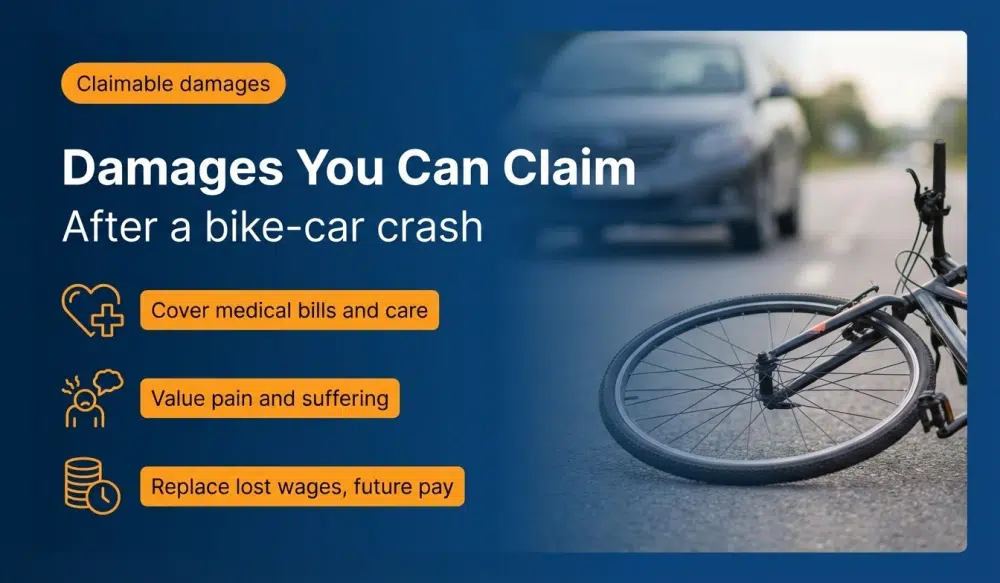
- Medical expenses Past bills and the cost of future care, including surgeries, rehabilitation, and assistive devices.
- Lost income and earning capacity Time missed from work and reduced ability to earn in the future.
- Non-economic losses Pain, suffering, inconvenience, and loss of enjoyment of life, as recognized in state tort law.
- Property damage Repair or replacement for your bicycle and gear.
- Punitive damages In limited cases involving egregious conduct, state statutes may allow punitive damages to deter similar conduct.
Documenting each component with medical records, wage documentation, and expert evaluations strengthens proof of damages during negotiations and at trial [2].
What evidence helps prove fault and damages?
Evidence is the backbone of your claim. Collecting and preserving it early helps demonstrate liability and quantify losses.
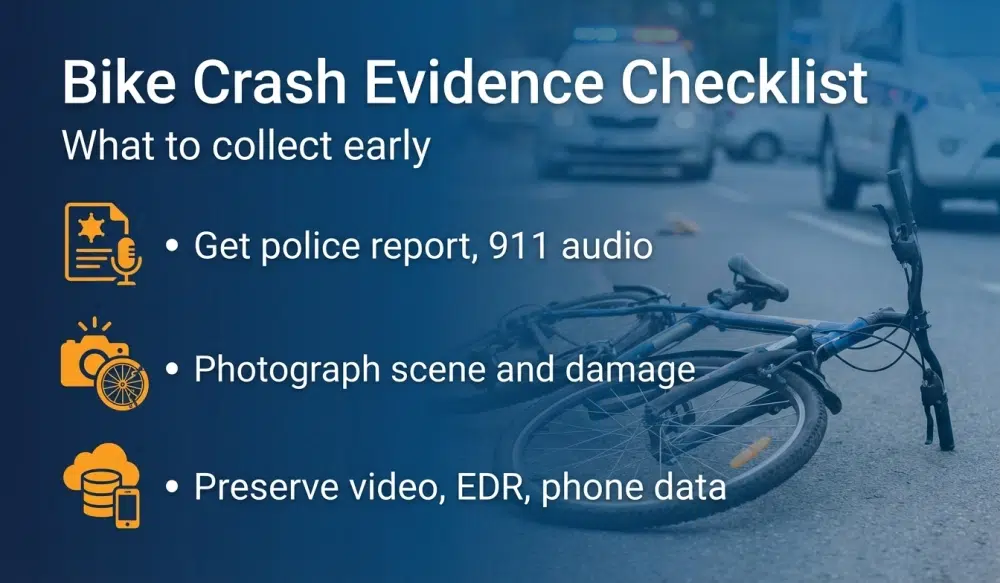
- Police report and 911 calls Identify parties, witnesses, and preliminary fault assessments.
- Scene photographs and measurements Capture final rest positions, skid and scuff marks, vehicle and bicycle damage, debris fields, and sightlines.
- Vehicle data Event data recorder information can show speed, braking, and steering inputs before impact when available.
- Video evidence Dashcams, traffic cameras, and business or residential security footage can resolve disputes about signals, positioning, and timing.
- Phone records May corroborate distraction if texting or calls occurred at the time of the crash.
- Medical documentation Diagnoses, treatment plans, and prognoses link the crash to injuries and future care needs.
- ESI preservation Electronic evidence should be preserved promptly to avoid loss and spoliation disputes under rules governing electronically stored information [15].
What is the bicycle injury claim process from start to finish?
Although every case is unique, most follow a similar path. Understanding the roadmap helps you plan treatment and next steps.

What happens in the first weeks after the crash?
- Medical care first Prioritize emergency care and follow-up with specialists so injuries are diagnosed and treated promptly.
- Notice to insurers A claim is opened with the at-fault party’s insurer and, when relevant, your own policy for med-pay or uninsured motorist coverage.
- Investigation and preservation Photographs, witness interviews, and preservation letters are sent to protect evidence such as vehicle data and video [15].
How does the pre-suit phase work?
- Liability analysis Statutes and local rules are applied to crash facts to assess fault [4] [6] [7] [8].
- Damages documentation Medical records, bills, wage data, and expert opinions are compiled.
- Demand package A comprehensive claim package is sent to the insurer outlining liability, damages, and legal support.
When is a lawsuit filed and what are the steps?
If an insurer disputes fault or damages or delay threatens your statute of limitations, filing preserves your rights. Civil cases proceed through pleadings, discovery, motions, settlement conferences, and trial as outlined by the federal judiciary and state courts [2].
What is discovery and why is it important?
Discovery exchanges the evidence needed for fair adjudication. Written discovery, depositions, medical examinations, and expert disclosures are common. Parties must preserve ESI, including vehicle and phone data, with potential sanctions for spoliation [15].
How do statutes of limitations work in California, Texas, and Illinois?
Deadlines vary by state and claim type. Missing the deadline can bar your claim. Confirm your jurisdiction immediately.
- California Generally two years for personal injury under Code of Civil Procedure section 335.1 [9].
- Texas Generally two years for personal injury under Civil Practice and Remedies Code section 16.003 [10].
- Illinois Generally two years for personal injury under 735 ILCS 5/13-202 [11].
Shorter deadlines may apply to public-entity claims, and exceptions can exist. Prompt legal help reduces the risk of a time-bar.
How do insurance investigations and negotiations typically play out?
Auto insurers assess liability quickly and often seek statements. You have the right to thoughtful review of any statement requests and to decline recorded statements to the other driver’s insurer when appropriate. Negotiations hinge on evidence and the ability to prove both fault and damages.
- Early contact Adjusters may ask about injury details and bike damage. Provide accurate, complete information only when you are ready and your medical picture is clearer.
- Liability theories Insurers compare your conduct to state laws on bicyclist rights and duties and evaluate comparative negligence claims [3] [4] [6] [7] [8].
- Value assessment Offers reflect medical expenses, wage loss, and non-economic damages. Serious injuries, long treatment, or permanent impairment increase case value.
- Leverage and litigation Filing suit and preparing for trial often increases leverage and can lead to better resolutions [2].
Some cyclists prefer working with car accident lawyers to manage insurer communications, develop the evidentiary record, and time negotiations appropriately.
What defenses do drivers and insurers raise and how are they addressed?
Defendants rarely concede without challenge. Anticipating common defenses keeps your case on track.
- Alleged cyclist visibility issues Claims about dark clothing or no lights are addressed with lighting analysis, reflectivity evidence, and statutes clarifying duties on both sides.
- Lane position disputes Many states allow cyclists full lane use when conditions require. Scene geometry, traffic flow, and statutes help rebut lane position arguments [4] [6] [7].
- Comparative fault assertions Even when some fault is assigned, recovery often remains available subject to state rules [3] [12] [13] [14].
- Preexisting injury arguments Medical records and treating provider opinions can distinguish new injuries from prior conditions.
- Low-speed impact claims Biomechanics and clinical findings can demonstrate legitimate injury even at modest speeds.
How do you choose a bicycle accident lawyer nationwide?
Selecting the right advocate matters. Look for capability, clarity, and care. Consider these practical criteria when evaluating the best bicycle injury law firms across the country.
- Focused case experience Ask whether the firm routinely handles car versus bicycle collisions, understands cycling dynamics, and litigates in the relevant courts.
- Trial readiness Trial capability supports stronger settlements and protects your options if a jury must decide liability or damages [2].
- Data-driven strategy Robust investigation, expert networks, and command of state statutes shape persuasive presentations [4] [6] [7] [8].
- Transparent communication You should have consistent access to your attorney, clear timelines, and regular updates.
- Fee clarity Understand contingency terms and litigation costs before signing.
If you are comparing nationwide bicycle accident lawyers, evaluate whether the firm can coordinate filings and discovery efficiently in your jurisdiction and navigate differences among California, Texas, and Illinois courts.
In larger claims, many injured cyclists prefer to work with personal injury lawyers rather than handling the case themselves, particularly where long-term medical care and lost earning capacity are at stake.
What fee arrangements are common for bicycle injury cases?
Most bicycle crash cases are handled on a contingency fee, meaning fees are paid out of a settlement or judgment. Contingent fees are widely used in personal injury matters and are subject to ethical rules and written agreement requirements. Legal encyclopedias describe contingent fee arrangements and how they align the lawyer’s compensation with the outcome [3].
- Contingency structure The lawyer receives a percentage of the recovery. Percentages can vary based on when the case resolves.
- Costs and expenses Filing fees, medical records, experts, and depositions are tracked. Agreements explain whether costs are deducted before or after the fee is calculated.
- No fee if no recovery In many agreements, legal fees are owed only if there is a recovery. Ask specifically how costs are handled if there is no recovery.
- Written agreement You should receive a clear, written fee agreement outlining all terms. State bar resources explain fee rules and client rights in your state.
When interviewing firms, you can ask about a contingency fee bike attorney model, how costs are managed, and what to expect at each phase.

When do bicycle cases go to trial and what should you expect?
Most claims settle, but some proceed to trial when liability is disputed or damages are contested. Trial preparation begins long before a court date and often improves settlement prospects. The court system describes civil trials, from jury selection to verdict, and the pretrial steps that shape what evidence the jury sees [2].
- Pretrial motions Motions in limine and summary judgment can limit issues or narrow disputes.
- Jury selection Voir dire helps identify jurors who can fairly evaluate bicyclist conduct and driver duties.
- Evidence presentation Exhibits may include scene diagrams, speed and time-distance analyses, medical illustrations, and testimony from treating providers and experts.
- Verdict and post-trial The jury considers negligence, comparative fault, and damages. Post-trial motions and appeals may follow in some cases.
How can GoSuits help bicyclists hit by cars?
We handle civil injury cases for cyclists nationwide, guiding you through the bicycle injury claim process with clear communication and careful documentation. A free consultation can help you understand timelines, evidence priorities, and next steps while you focus on medical care.
- Nationwide representation We practice across the United States and regularly work within California, Texas, and Illinois court systems and rules.
- Technology-driven approach Our exclusive proprietary software accelerates intake, evidence tracking, and litigation workflows so we can move faster and maintain accuracy.
- Designated attorneys, not case managers Every client has direct, unfettered access to a dedicated attorney from day one. We communicate on your schedule and keep you informed.
- Leadership in innovation We combine disciplined investigation with advanced data tools to streamline discovery and case preparation.
- Past results and trial experience We have secured favorable resolutions for injured clients and are prepared to try cases when necessary. Review our prior cases and meet our attorneys.
- Comprehensive practice areas Our practice areas include personal injury, vehicle crashes, wrongful death, and complex injury litigation, supported by 30 years of combined experience.
- Client-focused process We collaborate with your treating providers, organize records and bills, and prepare every file as if it could go to trial to strengthen negotiation outcomes.
Explore about us to learn more about how we serve cyclists and families after serious crashes.
References and resources
- Bicycle Safety Key Facts – Centers for Disease Control and Prevention
- Civil Cases Overview – United States Courts
- Comparative Negligence – Legal Information Institute
- Vehicle Code Section 21200 Rights and Duties – California Legislature
- Vehicle Code Section 21760 Three Feet for Safety – California Legislature
- Transportation Code Section 551.101 Rights and Duties – Texas Statutes
- 625 ILCS 5/11-1502 Rights and Duties – Illinois General Assembly
- 625 ILCS 5/11-703 Overtaking a Bicycle Three Feet – Illinois General Assembly
- Code of Civil Procedure Section 335.1 Two-Year Limit – California Legislature
- Civil Practice and Remedies Code Section 16.003 Two-Year Limitations – Texas Statutes
- 735 ILCS 5/13-202 Personal Injury Two-Year – Illinois General Assembly
- Civil Practice and Remedies Code Section 33.001 Proportionate Responsibility – Texas Statutes
- 735 ILCS 5/2-1116 Comparative Negligence – Illinois General Assembly
- Judicial Council of California Civil Jury Instructions CACI 2023 Edition – California Courts
- Federal Rule of Civil Procedure 37 ESI and Sanctions – Legal Information Institute