- What is an Assignment of Benefits (AOB) and how does it work in personal injury and car accident claims?
- How is an AOB different from a medical lien or letter of protection?
- How can AOB affect your medical bills, settlement, and negotiations?
- What does the law say about AOB in Texas, California, and Illinois?
- How does AOB interact with ERISA plans, Medicare, and Medicaid?
- How should you approach AOB documents at hospitals and clinics?
- What practical steps can help manage AOB, liens, and final distributions?
- How does AOB affect different claim scenarios in TX, CA, and IL?
- What should defendants and insurers know about AOB challenges?
- How can GoSuits help you navigate AOB, liens, and insurance in TX, CA, and IL?
- Resources and citations
What is an Assignment of Benefits (AOB) and how does it work in personal injury and car accident claims?
An Assignment of Benefits, often called AOB, is a written agreement where you transfer your right to receive certain insurance payments to a third party, usually a medical provider. In car accident claims, an AOB may let a clinic, hospital, or imaging center bill your auto policy’s Personal Injury Protection (PIP) or Medical Payments (MedPay) coverage directly, or bill your health plan directly under plan terms that allow assignments.
At its core, an assignment is a transfer of rights. The concept is recognized in American law generally, though states limit what can be assigned. For background on assignments as “rights in action,” see Cornell Law School’s Wex definition of assignment of rights and duties: Cornell LII: Assignment.
In a personal injury context, two distinct ideas often get mixed together:
- Assignment of insurance benefits to a provider for payment of covered medical charges (often permitted, subject to policy terms and state law), and
- Assignment of the personal injury claim itself against a negligent driver or other wrongdoer (generally prohibited in TX, CA, and IL, as explained below).
Practical example: After a crash in Houston or Dallas, a hospital might ask you to sign an AOB for your auto PIP benefits under Texas Insurance Code Chapter 1952 so it can submit claims directly. Or an imaging center in Los Angeles or San Diego may ask you to assign MedPay benefits under your auto policy so they can be paid without waiting for a settlement. In Chicago or Cook County, a treating provider may request an AOB to bill your health plan directly, especially if the plan permits assignment and does not enforce an anti-assignment clause.
Why this matters to you: AOBs can organize billing, but they can also affect what happens to your settlement and who must be paid from it. Managing AOBs carefully, along with liens and subrogation interests, is essential to protect your recovery and comply with your legal obligations.
How is an AOB different from a medical lien or letter of protection?
Think of these as different tools that providers use to get paid:
- Assignment of Benefits: You transfer your right to certain insurance payments directly to a provider. The provider then bills the insurer. The insurer may or may not honor an AOB depending on policy language and state law.
- Statutory medical liens: Some states give hospitals and certain providers a lien against your recovery. For example:
- Texas has a hospital lien statute covering accident-related care. See Texas Property Code Chapter 55.
- California caps certain provider liens under California Civil Code § 3040.
- Illinois uses the Health Care Services Lien Act, 770 ILCS 23.
- Letters of protection (LOP): A written document that defers the collection of medical payments to a later date. Not a statutory lien, not a contractual arrangement, but simply a request that acknowledges and accounts for outstanding medical bills at the time of settlement.
Bottom line: An AOB primarily targets insurance payments, while liens and LOPs target your settlement proceeds. Many cases involve both.
How can AOB affect your medical bills, settlement, and negotiations?
From first ER visit in Harris County to final settlement in Travis County, AOB can change who bills whom and when. Understanding the moving parts helps you plan for medical care and your net recovery.
Does an AOB allow providers to bill your auto insurance PIP or MedPay directly?
- Texas PIP: PIP is offered with every auto policy unless you reject it in writing. See Texas Insurance Code §§ 1952.151–1952.161. Providers commonly request an AOB to bill PIP directly. Texas also recognizes assignment of health benefits to providers in certain contexts. See Texas Insurance Code § 1204.053.
- California MedPay: California drivers may carry optional MedPay. Providers often request an AOB so the insurer pays them directly, subject to policy terms. California does not have PIP. MedPay availability and assignment compliance depend on your policy language.
- Illinois MedPay: Illinois is fault-based; MedPay is optional. Providers may use AOB forms to submit bills directly to auto insurers. Whether payment is made to the provider or insured depends on policy terms and whether the insurer recognizes the assignment.
In all three states, the details turn on the policy. If the policy contains an anti-assignment clause, the insurer may refuse to pay a non-contracted provider despite an AOB. Some insurers pay the insured directly even when a provider submits an AOB, leaving the provider to seek payment from settlement proceeds or from the insured.
Can an AOB impact your ability to control settlement decisions?
Generally, an AOB for insurance benefits does not transfer your right to decide whether to settle your injury claim against the at-fault driver. Most states, including TX, CA, and IL, prohibit assignment of the personal injury claim itself. That means the decision to settle the underlying tort claim usually remains yours. However, if you sign multiple AOBs, letters of protection, and encounter liens, the final settlement distribution must account for all valid claims. This can feel like it reduces your control over the net amount you take home, especially if billing is high.
What are the AOB pros and cons for injured people?
- Potential benefits:
- Care access without up-front payment, especially in emergency settings in San Antonio, Los Angeles, or Chicago.
- Provider can bill PIP or MedPay directly, speeding payment for covered charges.
- Reduced collection pressure if insurers pay providers promptly under an AOB.
- Potential risks:
- Anti-assignment clauses may lead insurers to reject direct payment, leaving balances unresolved.
- Multiple AOBs and liens can overlap, complicating distribution at settlement.
- Some AOBs include broad powers, fee-shifting provisions, or wage assignment language that you might not intend to grant.
How does AOB affect defendants and insurers?
- For at-fault defendants: AOBs do not typically increase your legal liability, but they can affect who asserts payment rights from a plaintiff’s settlement. Defendants should anticipate lien resolution and provider claims when structuring releases in Tarrant County, Bexar County, Orange County, or Cook County.
- For insurers: First-party insurers must read policy terms. Anti-assignment clauses are often enforced, particularly in ERISA-governed health plans and some auto policies. Insurers risk double payment if they ignore a valid assignment after acknowledging it.
What does the law say about AOB in Texas, California, and Illinois?

Is assigning a personal injury claim allowed in TX, CA, and IL?
Across these states, courts generally prohibit the assignment of personal injury claims on public policy grounds. You cannot transfer to a third party the right to sue for your bodily injury. However, assignment of certain benefits or proceeds is often permitted.
What is the Texas rule on assigning personal injury and what liens apply?
- Personal injury claim assignment: Texas courts have long limited assignments in tort. The Texas Supreme Court has scrutinized assignments of claims and related agreements where they conflict with public policy. See State Farm Fire & Cas. Co. v. Gandy, 925 S.W.2d 696 (Tex. 1996) (discussing restrictions on assignments and public policy). As a practical matter, assignment of a personal injury claim is not permitted in Texas.
- Hospital liens: Texas gives hospitals a statutory lien for reasonable charges for accident-related care. See Texas Property Code Chapter 55. The lien applies to judgments and settlements, subject to statutory limits and notice requirements.
- PIP and assignment to providers: Texas requires auto insurers to offer PIP unless properly rejected, and providers commonly use AOB to bill PIP. See Insurance Code Subchapter C on PIP. Texas also recognizes provider payment under assignment for health benefits. See Insurance Code § 1204.053.
What is the California rule on assigning personal injury and what liens apply?
- Personal injury claim assignment: California allows transfer of “things in action” generally but not personal injury causes of action. See California Civil Code § 954 and cases holding that personal injury claims are not assignable as a matter of public policy, such as Fifield Manor v. Finston, 54 Cal. 2d 632 (1960).
- Provider lien caps: California limits certain provider recovery from judgments or settlements under Civil Code § 3040, which sets formula-based caps depending on whether the patient had health coverage.
- MedPay and AOB: California does not have PIP, but many policies offer MedPay. Whether an AOB is honored depends on policy terms and insurer practices. Civil Code § 3040 still affects provider recovery from third-party settlements.
What is the Illinois rule on assigning personal injury and what liens apply?
- Personal injury claim assignment: Illinois courts do not allow assignment of personal injury claims on public policy grounds. While Illinois case law addresses various tort assignments, the rule remains that bodily-injury claims are not assignable.
- Provider liens: The Health Care Services Lien Act, 770 ILCS 23 governs liens of hospitals and certain providers on personal injury claims, including notice requirements and percentage limits to protect the injured person’s recovery.
- MedPay and AOB: MedPay is common. Whether an AOB is accepted by an auto insurer or health plan depends on policy or plan language and any anti-assignment provisions.
Can you assign benefits to providers for health plans or auto coverages in TX, CA, and IL?
Often yes, but it is policy- and plan-specific:
- Health plans: Many plans contain anti-assignment clauses. Federal courts frequently enforce anti-assignment clauses in ERISA plans unless waived by the plan’s conduct. See Physicians Multispecialty Group v. Health Care Plan of Horton Homes, Inc., 371 F.3d 1291 (11th Cir. 2004); see also Spinedex Physical Therapy USA Inc. v. United Healthcare of Arizona, Inc., 770 F.3d 1282 (9th Cir. 2014).
- Auto PIP/MedPay: Assignments are commonly used. Texas statutes expressly contemplate provider payment under assignment for health benefits and require PIP to be offered. See PIP provisions and § 1204.053. California and Illinois leave AOB largely to policy language.
How does AOB interact with ERISA plans, Medicare, and Medicaid?
Do anti-assignment clauses matter when providers try to bill your plan?
Yes. Many employer health plans are governed by ERISA. Courts routinely uphold anti-assignment clauses, which can bar a provider from suing an ERISA plan based on an AOB. Two important appellate decisions:
- Physicians Multispecialty Group: Anti-assignment clause enforced against provider’s claim under ERISA. See 371 F.3d 1291.
- Spinedex: Assignment recognized for providers when plan rights were assigned and anti-assignment was not enforced or was waived; but anti-assignment clauses are generally valid. See 770 F.3d 1282.
Practical takeaway: If your care in Austin, San Francisco, or Chicago is billed to an employer plan, your provider’s AOB might not give the provider standing to dispute denials unless the plan permits assignment or waives the clause.
What about Medicare and Medicaid billing and subrogation when there is a settlement?
- Medicare: Under the Medicare Secondary Payer Act, Medicare has a right to reimbursement from settlements that include payment for medical expenses. See 42 U.S.C. § 1395y(b)(2). Medicare’s recovery can affect final distributions even if providers used AOB to bill other coverage first.
- Medicaid: States must seek reimbursement for medical assistance from liable third parties. U.S. Supreme Court cases define the scope of recoverable amounts:
- Arkansas Dep’t of Health and Human Services v. Ahlborn, 547 U.S. 268 (2006) limited recovery to portions of settlement allocated to medical expenses at that time.
- Gallardo v. Marstiller, 596 U.S. ___ (2022) held that states may seek reimbursement from settlement amounts allocated to both past and some future medical expenses.
In practice, Medicare and Medicaid rights must be resolved before final disbursement, regardless of AOBs.
How should you approach AOB documents at hospitals and clinics?
What should you look for before you sign an auto accident AOB?
- Scope of assignment: Does it assign only PIP or MedPay benefits, or all insurance benefits including health, disability, and liability proceeds?
- Duration and revocation: Is there a clear end date or a method to revoke? Does it survive resolution of claims?
- Fee-shifting: Does the AOB require you to pay the provider’s attorney fees or collection costs?
- Authorization beyond billing: Does it authorize negotiations or settlements in your name? That is unusual and concerning.
- Interaction with liens: If a hospital lien applies in Harris County or Bexar County, the AOB may not eliminate lien rights.
If you are treated in Los Angeles, San Diego, San Francisco, or Sacramento, ask whether California Civil Code § 3040 caps will be honored. In Chicago or Cook County, verify compliance with the Illinois Health Care Services Lien Act limits.

Can you revoke an AOB once signed?
It depends on the contract language and whether the provider has relied on it. Some assignments are revocable before performance; others are irrevocable or have specific revocation procedures. Revocation does not erase statutory liens or contractual obligations already accrued. If a provider already rendered services based on an AOB and billed PIP, MedPay, or a health plan, revoking may not affect amounts already due.
What happens if multiple providers claim the same benefits?
Conflicting AOBs can arise when several providers treat you across Houston, Dallas, or Austin, or across Los Angeles County and Orange County. Insurers may pay in order of receipt or based on coordination of benefits rules. If there is a shortfall, unpaid balances may turn into lien or collection issues. Your legal team typically negotiates global resolution at settlement to avoid double payment and to coordinate with any Medicare or Medicaid interests.
What practical steps can help manage AOB, liens, and final distributions?
- Policy documents: Auto and health plan summaries, including PIP/MedPay and any anti-assignment clauses.
- All AOBs: Copies signed at ER, urgent care, imaging, chiropractic, and specialist offices in TX, CA, or IL.
- Lien notices: Hospital lien filings in Texas, provider lien notices in California, and Illinois lien notices under 770 ILCS 23.
- Bills and EOBs: Itemized statements and explanations of benefits to confirm what has been paid and by whom.
- Medicare/Medicaid status: Conditional payment summaries for Medicare; state Medicaid claim summaries.
How are AOB and liens resolved at settlement?
- Identification: Verify all claims against the settlement, including PIP/MedPay payments, health plan subrogation, ERISA plan recoveries, hospital liens, and provider contractual claims.
- Priorities: Statutes may set priority. For example, Texas hospital liens attach to settlement proceeds subject to statutory limits. California Civil Code § 3040 caps certain provider recoveries. Illinois limits the percentage of a settlement that health-care liens can claim.
- Negotiation: Reductions may be available based on policy limits, exhaustion, hardship, or fee-share rules. Medicare and Medicaid follow federal formulas and waiver protocols.
- Distribution: Final settlement statements must reflect all payments to lienholders and assignees to avoid later collection actions.
How do courts handle AOB disputes?
Courts examine the assignment language, policy provisions, and compliance with statutory lien requirements. In ERISA cases, courts scrutinize anti-assignment clauses. Texas courts evaluate hospital lien compliance with Chapter 55. California courts apply Civil Code § 3040 caps. Illinois courts apply 770 ILCS 23 limits and notice rules. Documentation and timely notice are critical for enforceability.
How does AOB affect different claim scenarios in TX, CA, and IL?
What should Texas drivers know about PIP/MedPay assignment and hospital liens?
- PIP availability: PIP is offered unless rejected in writing. Many Houstonians and Austinites carry modest PIP limits. See Texas Insurance Code §§ 1952.151–.161.
- Assignments to providers: Providers frequently obtain AOBs to bill PIP. Texas also recognizes provider payment under assignment for health benefits. See § 1204.053.
- Hospital liens: If treated in Harris County, Travis County, Tarrant County, or Bexar County, hospitals may file liens under Chapter 55. These liens attach to third-party settlements and must be addressed during distribution.
How does California MedPay assignment interact with Civil Code § 3040 caps?
- MedPay: Optional coverage. An AOB may allow a Los Angeles or San Diego provider to bill directly, subject to the insurer’s policy terms.
- Provider recovery limits: Regardless of AOBs, California Civil Code § 3040 can limit how much a provider may claim from a settlement, depending on whether there was health coverage and the provider type. See § 3040.
- Personal injury claim assignment: Not permitted. See Fifield Manor v. Finston.
How do Illinois liens and auto coverage coordinate with AOB?
- MedPay and AOB: Many Chicago-area policies include MedPay. Providers may accept an AOB to bill MedPay, but payment goes by policy language.
- Health Care Services Lien Act: Limits total lien claims and prescribes notice requirements. See 770 ILCS 23.
- Personal injury claim assignment: Not permitted as a matter of Illinois public policy.
What should defendants and insurers know about AOB challenges?
Can a defendant challenge an assignment or lien in TX, CA, or IL?
- Invalid or overbroad AOB: Courts may decline to enforce an assignment that goes beyond policy benefits or conflicts with public policy, especially if it resembles an assignment of the tort claim itself.
- Statutory compliance: Texas hospital liens must meet Chapter 55 requirements. California provider assertions must respect Civil Code § 3040 caps. Illinois liens must comply with 770 ILCS 23. Defendants sometimes raise compliance issues when negotiating settlements and releases.
- Priority disputes: If multiple AOBs and liens exist, defendants can request indemnity and lien resolution terms to avoid post-settlement exposure.
Does an AOB increase exposure for insurers or defendants?
Not usually. AOB reallocates who receives certain payments, not the amount a negligent party must pay. However, if a first-party insurer ignores a valid assignment after accepting it, disputes may arise about whether payment was properly directed to the provider rather than the insured.
Local crash context and why billing choices matter
Motor vehicle crashes create significant medical needs and insurance coordination from day one:
- Texas: The Texas Department of Transportation reports thousands of fatalities and over a quarter-million injuries annually in recent years. See TxDOT Crash Statistics.
- California: California recorded thousands of traffic fatalities statewide. See California OTS data.
- Illinois: Illinois Department of Transportation reports more than a thousand annual fatalities and many serious injury crashes. See IDOT Crash Data.
These numbers underscore why understanding AOB, PIP/MedPay, and lien rules in TX, CA, and IL can make a real difference in how fast providers are paid and how much of your settlement you keep.
Key takeaways
- AOB helps providers bill directly but may be limited by policy or plan anti-assignment clauses.
- You cannot assign your injury claim in TX, CA, or IL. You can often assign insurance benefits or proceeds, subject to law.
- Hospital and provider liens still apply even if you sign an AOB, and they must be resolved at settlement.
- Medicare and Medicaid have their own recovery rules that override some state provisions and must be addressed before disbursement.
- Early strategy on PIP/MedPay, health plan billing, AOBs, and liens helps protect your net recovery.
How can GoSuits help you navigate AOB, liens, and insurance in TX, CA, and IL?
If you were injured in a car crash in Texas, California, or Illinois and providers are asking you to sign an assignment of benefits, we can guide you through the decisions and paperwork. Understanding AOBs, hospital liens, ERISA plan rules, Medicare or Medicaid recovery, and insurer policy terms is critical to protecting your health care access and the value of your case.
How does a free consultation help you right now?
- Immediate answers: We are available 24/7 to talk through PIP, MedPay, and health plan coordination so you know who should pay first and what to sign at the hospital or clinic.
- Document review: We review proposed AOBs, LOPs, and lien notices and explain their impact on your settlement and net recovery in plain language.
- Claim strategy: We outline next steps for medical care, insurance submissions, and evidence gathering, so your case is built from day one across Houston, Dallas, Austin, San Antonio, Los Angeles, San Diego, San Francisco, Sacramento, Chicago, and surrounding counties.
Who is GoSuits and how do we add value to AOB-heavy cases?
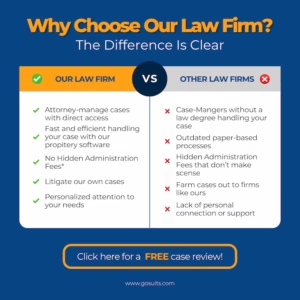
- Our practice and approach: We focus on injury cases and complex litigation, handling collisions ranging from rear-end impacts to 18-wheeler crashes and product cases. We are not a volume firm; cases receive hands-on attention from attorneys and staff in every location.
- Availability and communication: We are available 24/7, with immediate free consultations. We provide multilingual customer service, including 24/7 Spanish and Farsi speakers, and we adapt to your preferred communication method.
- Fee policies and transparency: We offer No win, No Attorney Fees. Learn more: No win, No Attorney Fees. There are no hidden administrative fees. You will receive clear, written explanations of costs, liens, and distributions.
- Tools and workflow: We developed proprietary personal injury software used only by our firm. It helps us move faster from investigation to demand, negotiation, filing suit, and discovery. The goal is to out-organize insurers by tracking medical bills, AOBs, lien caps, and subrogation across TX, CA, and IL, so nothing is missed.
- Experience and track record: We have 30 years of combined experience and have litigated more than a thousand cases. Settlement and verdict results are published here: GoSuits prior cases. In complex matters like product liability, 18-wheeler collisions, brain and spinal injuries, we hire qualified witnesses within the state to testify on liability and damages where needed. We litigate severe injury and complex cases in Texas, California, and Illinois.
- Awards:
- #1 settlements and verdicts across multiple U.S. counties according to TopVerdict
- Top 100 Settlement in Texas
- Sean Chalaki, Top 40 Under 40, National Trial Lawyers
- Recognized by Best Lawyers in 2023, 2024, 2025
- Selected to Super Lawyers since 2021
- Community involvement: We are active in local schools, chambers of commerce, and non-profit foundations, and serve on boards of trial lawyer organizations such as the Texas Trial Lawyers Association and consumer protection groups.
Where are we located and how do we help immediately?
- Texas: Support for cases in Houston, Dallas, Austin, San Antonio, Harris County, Travis County, Tarrant County, and Bexar County. Attorney and staff coverage is available 24/7 to coordinate care and manage PIP, AOBs, and hospital liens.
- California: Service across Los Angeles, San Diego, San Francisco, Sacramento, and Orange County. We help with MedPay claims, California Civil Code § 3040 lien caps, and settlement distributions.
- Illinois: Coverage for Chicago and Cook County, plus surrounding areas. We address MedPay AOB issues and the Health Care Services Lien Act limits to balance provider claims with your recovery.
From the first call, we can contact providers to request itemized bills, secure AOB copies, confirm lien filings, and coordinate with insurers to prevent missed deadlines. Our focus is to simplify the process and protect the value of your case while you focus on care.
Resources and citations
- Cornell Law School Legal Information Institute – Assignment
- Texas Insurance Code §§ 1952.151–1952.161 (PIP)
- Texas Insurance Code § 1204.053 (Assignment of benefits to providers)
- Texas Property Code Chapter 55 (Hospital liens)
- State Farm Fire & Cas. Co. v. Gandy, 925 S.W.2d 696 (Tex. 1996)
- California Civil Code § 954 (transferability of things in action)
- Fifield Manor v. Finston, 54 Cal. 2d 632 (1960)
- California Civil Code § 3040 (provider lien caps)
- Illinois Health Care Services Lien Act, 770 ILCS 23
- Medicare Secondary Payer Act, 42 U.S.C. § 1395y(b)(2)
- Arkansas Dep’t of Health and Human Services v. Ahlborn, 547 U.S. 268 (2006)
- Gallardo v. Marstiller, 596 U.S. ___ (2022)
- Physicians Multispecialty Group v. Health Care Plan of Horton Homes, Inc., 371 F.3d 1291 (11th Cir. 2004)
- Spinedex Physical Therapy USA Inc. v. United Healthcare of Arizona, Inc., 770 F.3d 1282 (9th Cir. 2014)
- Texas Department of Transportation – Crash Statistics (Texas reported thousands of annual traffic fatalities and serious injuries; see the latest Crash Facts reports)
- California Office of Traffic Safety – Data and Statistics (California statewide crash and fatality data)
- Illinois Department of Transportation – Crash Data