
- What is an advance on a settlement check and how does pre-settlement funding work?
- Is it legal to get a pre-settlement funding advance nationwide?
- Who is eligible for pre-settlement funding and how do companies decide?
- How much can you get and how long do settlement advances take?
- What rates and fees do lawsuit loans charge and how are they calculated?
- What are the main risks of lawsuit loans for plaintiffs and defendants?
- What are smart alternatives to a settlement cash advance while your case is pending?
- What is your attorney’s role in a settlement advance and why does it matter?
- How do liens, UCC filings, and repayment work when the case resolves?
- Do settlement advances affect taxes on your personal injury recovery?
- How do California, Texas, and Illinois treat legal funding and attorney client advances?
- Frequently asked questions about pre-settlement funding and settlement advances
- How GoSuits supports injury victims considering settlement advances
- References and resources
What is an advance on a settlement check and how does pre-settlement funding work?
If you were injured in a crash or fall and your case is still pending, you might hear terms like pre-settlement funding or non-recourse lawsuit loans. These let some plaintiffs access a portion of their potential recovery early, typically to cover urgent living or medical expenses while a claim moves forward. In most agreements, the advance is non-recourse, which means you only repay from a recovery on the case, and you do not owe repayment if you lose. Non-recourse funding is different from traditional loans and is often secured by your case proceeds rather than your personal assets [13].
Legal funding companies review your claim, communicate with your lawyer, and decide whether to purchase a contingent interest in your case proceeds. If approved, they wire funds to you. After a settlement or verdict, your attorney pays the funder from the case proceeds according to the contract, after case costs, liens, and attorney fees are resolved.
Because these advances attach to potential case proceeds, timing and repayment depend heavily on your case’s progress, the type of claim, the insurer’s process, and lien resolution. Civil cases can take time to resolve. The federal judiciary’s annual report shows civil caseload trends and timelines, and many matters proceed for months or longer, especially when discovery and motions are involved [5].
Is it legal to get a pre-settlement funding advance nationwide?
There is no single federal statute that bans or uniformly regulates pre-settlement funding across the United States. Instead, legal funding is largely addressed by state law and ethics rules for lawyers. Many states allow non-recourse legal funding under contract and consumer protection principles, while some states more specifically regulate disclosures, cancellations, and pricing. For example, Illinois enacted the Consumer Legal Funding Act, which regulates registration, disclosures, and certain practices of consumer legal funding companies [9].
Separately from private funding companies, lawyer conduct rules in every jurisdiction limit when attorneys may provide financial assistance to clients. These are designed to protect clients, safeguard independence, and avoid conflicts.
- California: The Rules of Professional Conduct address when attorneys may pay or advance costs and certain client expenses, and include detailed conditions for financial assistance in connection with litigation [7].
- Texas: The Texas Disciplinary Rules allow lawyers to advance court costs and expenses of litigation, repayment of which may be contingent on the outcome, but prohibit most other financial assistance [8].
- Illinois: Illinois regulates consumer legal funding transactions by statute and also follows professional conduct rules that are aligned with national standards for financial assistance to clients [9].
Who is eligible for pre-settlement funding and how do companies decide?
Funding companies typically evaluate:
- Liability strength: Clear negligence in a car accident, motorcycle accident, truck accident, slip and fall accident, construction accident, or product liability case is generally more favorable for funding review.
- Damages and documentation: Medical records, bills, wage loss evidence, and proof of injuries such as brain injury help quantify exposure and potential value.
- Insurance coverage and collectability: Limits and defendants that can pay matter to both plaintiffs and defendants in assessing risk.
- Case posture: Whether liability is disputed, discovery status, motions, and trial settings affect timing and risk.
- Attorney participation: Most funders require attorney cooperation and a signed acknowledgment. Attorneys cannot compromise privilege and must comply with confidentiality rules and court evidence rules like Federal Rule of Evidence 408 on settlement discussions [3].

How much can you get and how long do settlement advances take?
There is no universal formula, and companies vary. Many funders evaluate the likely net recovery after attorney fees, case costs, and liens. They may offer an amount that is smaller than the projected net to leave room for fees, vendor invoices, and uncertainty. The amount is often limited by internal underwriting guidelines tied to the case type and stage. For instance, commercial vehicle accident lawyers handling 18-wheeler accident cases may have matters with larger insurance limits than a typical automobile injury claim, which can affect underwriting.
Timelines also vary. Processing requires your attorney’s input and records, and the funder’s review. Some applications can resolve within days when documentation is ready, while others take longer if additional records, lien information, or updated reports are needed. Court schedules and settlement negotiations also influence timing. Civil case progression statistics show that litigation milestones, including discovery and motions, often span months [5].
What rates and fees do lawsuit loans charge and how are they calculated?
Legal funding companies charge fees for the risk of non-recourse advances. Pricing is typically expressed as a set fee schedule, a monthly charge, or a tiered amount that increases the longer a case remains unresolved. Some contracts use compounding calculations, while others use simple accrual. State consumer legal funding rules, where enacted, may require clear disclosures of these charges and of the non-recourse nature of the agreement [9].
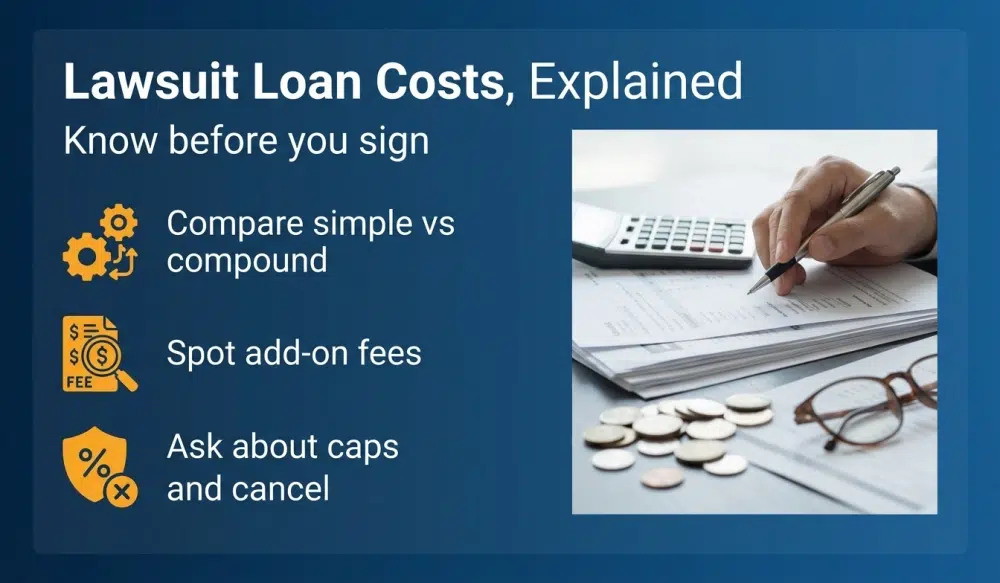
When comparing offers, ask your attorney to review:
- Simple vs compounding charges: Compounding increases costs over time.
- Added fees: Processing, application, or administrative fees can materially affect the payoff.
- Caps or maximums: Some contracts cap accrual after a period to avoid runaway costs.
- Right to cancel: Some statutes require a brief rescission period [9].
- Lien priority and acknowledgments: Most funders require an attorney acknowledgment and a payoff authorization at settlement.
Defendants and insurers may ask whether a plaintiff has taken an advance. Evidence rules and confidentiality obligations limit use of settlement communications to prove liability or damages in many circumstances [3]. Still, funding can affect a claimant’s urgency to settle. That is one reason defendants and plaintiffs alike should understand the financial pressures surrounding negotiation.
What are the main risks of lawsuit loans for plaintiffs and defendants?
Pre-settlement funding can help cover necessities, but there are tradeoffs for both sides.
- Reduced net recovery: Fees and charges reduce what the plaintiff takes home. If multiple transactions or compounding are involved, the total payoff can outweigh short-term benefits.
- Lien and payoff complexity: Payoffs from case proceeds are processed alongside medical liens and government claims such as Medicare conditional payments. Medicare has special recovery rights that can affect the timing and amount of final distribution [6][10].
- Disclosure disputes: Some defendants seek discovery into funding. Courts apply rules and case law to resolve whether and how such information is discoverable, and Federal Rule of Evidence 408 restricts settlement use at trial in many contexts [3].
- Settlement leverage: Advances can create pressure for earlier resolution. Defendants should understand that fees continue to accrue for the plaintiff, which may affect negotiation windows.
- Ethics boundaries: Lawyers must not relinquish control of litigation strategy to funders and must comply with state financial assistance rules [7][8].
What are smart alternatives to a settlement cash advance while your case is pending?
Before using pre-settlement funding, consider options that may cost less or preserve more of your recovery:
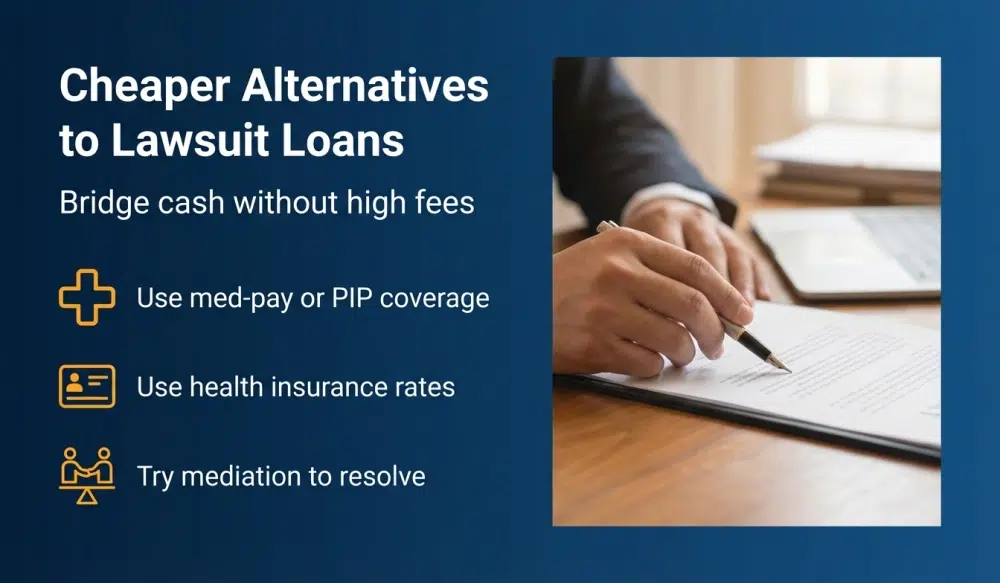
- Medical payments coverage or PIP: Auto policies often include med-pay or personal injury protection benefits that can help with immediate bills. Your car accident lawyers or motorcycle accident lawyers can help file these claims.
- Health insurance coordination: Using health coverage with negotiated rates may reduce treatment costs. Liens or subrogation claims are typically repaid at settlement, but can be negotiated.
- Short-term budgeting or community resources: Temporary assistance, payment plans, or deferrals can bridge a short gap without interest.
- Early mediation or ADR: Mediation can accelerate resolution without trial, often at lower cost [14].
- Rule 68 offer of judgment in federal court: In appropriate federal cases, a defendant can make a Rule 68 offer that may encourage earlier agreement and reduce litigation costs if the offer is accepted [4].
- Understand interest on judgments: Post-judgment interest rules can influence timing. California, Texas, and Illinois have statutes that address rates and accrual on judgments, which can affect whether it is better to settle earlier or proceed to judgment [10][11][12].
- Structured settlement planning: In some cases, periodic payments can meet long-term needs and balance tax considerations [15].
When you talk with personal injury lawyers, ask them to walk through these options. Experienced trial teams see how choices today can affect tomorrow’s recovery.

What is your attorney’s role in a settlement advance, and why does it matter?
Attorneys typically help by:
- Explaining contract terms: Your lawyer can flag compounding, fees, caps, and lien priority issues that change the real cost.
- Protecting privilege and confidentiality: Communications about settlement are guarded by evidence rules and ethics obligations. Your attorney will not disclose privileged strategy to a funder [3][7][8].
- Coordinating payoffs: At settlement, your attorney disburses from a client trust account, pays case costs, medical liens, Medicare, and funding payoffs before distributing the net to you [6].
- Negotiating medical and lien reductions: Reducing liens can put more in your pocket and may reduce the effective cost of an advance.
Funding companies usually require your attorney’s signed acknowledgment because the attorney must confirm the agreement exists and agree to honor the payoff from settlement proceeds. This is standard so that your semi-truck accident attorneys, product defect injury attorneys, or wrongful death lawyers can resolve all liens and claims on the proceeds at closing.
How do liens, UCC filings, and repayment work when the case resolves?
Most funders secure their interest in your case proceeds through contract provisions and, in some jurisdictions, by filing a UCC-1 financing statement that perfects a security interest in the proceeds of the claim under Article 9 of the Uniform Commercial Code [13]. Once your case settles or you obtain a judgment, your attorney:
- Deposits the funds into the client trust account.
- Pays case costs and court costs owed under your fee agreement and applicable rules [7][8].
- Resolves healthcare liens for Medicare, Medicaid, and private insurers. Medicare conditional payments must be verified and satisfied before final distribution [6].
- Pays the funding company according to its payoff letter, which includes principal and accrued charges.
- Distributes the net balance to you.
Because lien resolution can take time, even after agreement on the settlement amount, it is common for the final check to be delayed while your team confirms Medicare conditional payments or other claims. Knowing this can help you plan, whether you are working with truck accident lawyers, motorcycle wreck lawyers, or slip and fall injury attorneys.
Do settlement advances affect taxes on your personal injury recovery?
Under federal tax law, damages for personal physical injuries or physical sickness are generally excludable from gross income, except for amounts attributable to previously deducted medical expenses or for interest and punitive damages [2][1]. An advance itself is not taxable income if it is a non-recourse advance against anticipated case proceeds. However, when part of a settlement is taxable, such as interest or certain wage components, normal tax rules apply regardless of funding. IRS materials outline how different components of settlements are treated for federal income tax purposes [1].
If a funding contract separately charges interest that becomes part of a taxable component of a settlement, consult a tax professional to understand reporting obligations. The structure of the settlement, whether lump sum or structured settlement, can also influence tax treatment [15].
What does California allow attorneys to advance and how does this differ from private legal funding?
California’s Rules of Professional Conduct govern when lawyers may pay or advance client expenses. California Rule 1.8.5 addresses financial assistance to clients in connection with contemplated or pending litigation and sets conditions and limits. While private legal funding companies are not bound by attorney conduct rules, plaintiffs’ lawyers must follow the rule’s requirements before offering any client assistance. Attorneys remain responsible for independent judgment and for safeguarding privileged information regardless of any third-party funding request [7].
California also sets post-judgment interest on money judgments, which can influence settlement decisions. Understanding whether a judgment would accrue interest at the statutory rate can affect the timing and economics of negotiation versus trial [10].
How do Texas conduct rules treat client advances and litigation costs?
Texas Disciplinary Rules of Professional Conduct permit advancing court costs and litigation expenses, repayment of which may be contingent on the outcome. They otherwise prohibit providing financial assistance to clients. This means that while a lawyer can fund filing fees, expert costs, or depositions subject to the fee agreement, they generally cannot pay a client’s rent or living expenses. If you explore third-party pre-settlement funding, your Texas lawyer still must protect your confidences and maintain control of legal strategy [8]. Texas statutes on post-judgment interest can also influence settlement value calculations in state cases [11].
How does Illinois regulate consumer legal funding and attorney assistance?
Illinois specifically regulates consumer legal funding. The Illinois Consumer Legal Funding Act addresses registration, required disclosures to consumers, cancellation rights, and certain practices for funding companies. This framework clarifies that legal funding contracts are non-recourse and provides guidance on transparency in pricing and terms [9]. Separately, Illinois rules of professional conduct limit lawyer financial assistance to advancing litigation costs, with repayment possibly contingent on the outcome, similar to the national standard.
Illinois law also sets post-judgment interest rules that can inform negotiation strategies in civil cases such as product liability, construction accident, or wrongful death litigation [12].

How GoSuits supports injury victims considering settlement advances
If you are asking “Can I get an advance on my settlement?”, your focus is likely on immediate needs and long-term recovery. GoSuits represents injury clients nationwide in civil cases and helps you evaluate funding offers in the context of your unique case. We use an exclusive proprietary software platform to organize evidence, evaluate liability and damages, and streamline communication. That technology-driven approach helps move claims forward faster and with better clarity for decision-making. Even with advanced tools, every client has a designated trial attorney, not a case manager. You have unfettered access to your lawyer for strategy, negotiation, and court preparation.
Our team brings 30 years of combined experience in personal injury litigation. We prepare cases for trial, which often improves negotiation posture. We have secured meaningful results for clients across jurisdictions. You can review selected prior cases, meet our attorneys, learn more about us, and explore our practice areas.
When funding is on the table, we walk you through costs, lien resolution, and timing, and we coordinate with your healthcare providers and any legal funding company. Our goal is to protect your net recovery while meeting urgent needs.
We serve clients nationwide. If you want to understand how a pre-settlement loan or settlement advance could affect your claim, we can review options and alternatives so you can make informed decisions while your civil case proceeds.
References and resources
- Publication 4345, Settlements Taxability – Internal Revenue Service
- 26 U.S.C. 104, Compensation for injuries – Cornell Law School Legal Information Institute
- Federal Rule of Evidence 408, Compromise offers and negotiations – Cornell Law School Legal Information Institute
- Federal Rule of Civil Procedure 68, Offer of judgment – Cornell Law School Legal Information Institute
- Judicial Business 2023 – Administrative Office of the U.S. Courts
- Medicare Conditional Payment Information – Centers for Medicare and Medicaid Services
- Rule 1.8.5, Financial assistance to client – State Bar of California
- Texas Disciplinary Rules of Professional Conduct – Texas Courts
- 815 ILCS 121, Consumer Legal Funding Act – Illinois General Assembly
- Cal. Code Civ. Proc. 685.010, Interest on money judgments – California Legislative Information
- Texas Finance Code 304.003, Postjudgment Interest Rate – Texas Statutes
- 735 ILCS 5/2-1303, Interest on judgments – Illinois General Assembly
- UCC § 9-109, Scope – Cornell Law School Legal Information Institute
- Alternative Dispute Resolution Services – Administrative Office of the U.S. Courts
- Structured settlement – Cornell Law School Wex