- What we know about the Zion pedestrian collision on November 3
- Community context in Zion and Beach Park
- Why livestreaming and device use while driving are so dangerous
- Illinois laws that often matter in civil cases after a pedestrian crash
- Potential civil claims and damages after a fatal pedestrian collision
- Evidence and social media: preserving livestreams and digital proof lawfully
- Getting official records in Lake County
- Insurance issues that commonly arise, and why early legal guidance helps
- Key filing deadlines in Illinois civil cases
- Local safety considerations for drivers and pedestrians
- What to do now: practical steps for families and witnesses
- Commentary from Gosuits Zion, Illinois Personal Injury Attorney
What we know about the Zion pedestrian collision on November 3
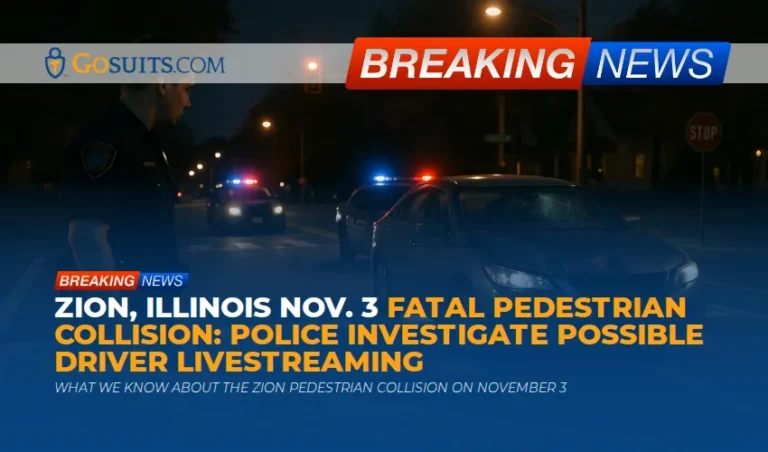
Authorities report that a pedestrian was struck at an intersection in Zion on November 3 and later pronounced dead at a hospital emergency department from blunt force injuries. Local police indicated that the driver remained at the scene and spoke with investigators. Days later, after investigators became aware of a video suggesting the driver had been livestreaming on a social media platform at the time of the crash, police scrutiny intensified. An arrest followed in connection with the fatal collision. The individual killed was a 59-year-old community member with ties to nearby Beach Park.
The incident has deeply affected neighbors along the Zion and Beach Park corridor, an area where many residents walk between homes, schools, parks, and shops. It also prompted wider discussion about the dangers of device use while driving, including livestreaming, which is prohibited by major platforms yet still occurs when users circumvent safety features.
Law enforcement’s early steps in these cases usually include securing the crash scene, collecting physical evidence such as vehicle position and roadway markings, interviewing witnesses, and canvassing for surveillance or cellphone video. Digital evidence can become central where there are indications of phone use, screen recording, or livestreaming around the time of impact.
Community context in Zion and Beach Park
For those who live in Zion, the route between Beach Park and the heart of town is familiar. Foot traffic increases near schools, neighborhood churches, and community spaces like Shiloh Park and along corridors that lead toward the lakefront and Illinois Beach State Park. Evening visibility and seasonal conditions can make crossings more hazardous, especially when lighting is poor or when winter conditions introduce early nightfall and slick surfaces.
Residents know the rhythm of local roads. Commuter flows shift around the Metra stations along the Union Pacific North line, and weekend traffic increases near the state park entrance. These are places where safe speeds, yielding to pedestrians in crosswalks, and distraction-free driving are critical. Lives depend on it. The aftermath of a high-profile pedestrian collision is not just a headline in Lake County. It is a jarring reminder that safe choices behind the wheel matter on every block, from Green Bay Road to Sheridan Road and the neighborhood streets where kids ride bikes and neighbors walk dogs.
Why livestreaming and device use while driving are so dangerous
Research from public health and traffic safety agencies has long connected device use to increased crash risk. The Centers for Disease Control and Prevention notes that nine people in the United States are killed every day in crashes that are reported to involve a distracted driver. Distraction comes in three forms: visual, manual, and cognitive. Livestreaming can combine all three. It pulls the eyes, hands, and attention away from driving. See CDC, Distracted Driving.
National data reflect the toll. The National Highway Traffic Safety Administration reports thousands of fatalities each year associated with distracted driving. NHTSA’s public safety materials consistently warn that texting, recording video, and other device interactions while driving significantly impair reaction time and situational awareness. See NHTSA, Distracted Driving.
Pedestrians are especially vulnerable. Without the protection of a vehicle frame, even a low-speed impact can cause catastrophic injuries, including severe head trauma, chest injuries, and internal bleeding. For those walking in crosswalks, at intersections, or near bus stops, the risk rises when drivers look away even for a moment. NHTSA’s pedestrian safety resources emphasize the need for drivers to scan for people on foot, slow down in neighborhoods, and stay focused at all times. See NHTSA, Pedestrian Safety.
Illinois laws that often matter in civil cases after a pedestrian crash
Use of electronic communication devices
Illinois law prohibits the operation of a motor vehicle while using an electronic communication device that is hand-held. The statute contains limited exceptions, and violations that lead to great bodily harm or death can be treated more severely. While criminal issues are separate from civil cases, the same conduct can be important evidence of negligence in a civil claim. See 625 ILCS 5/12-610.2.

Pedestrian right of way
Drivers approaching crosswalks and intersections must yield the right of way to pedestrians under various circumstances. Whether a pedestrian was in a crosswalk, had a walk signal, or was already in the roadway are facts that investigators examine. Illinois has multiple provisions that address pedestrian interactions and driver duties. A key provision addressing drivers’ duties to pedestrians in crosswalks is at 625 ILCS 5/11-1002.
How these laws fit into a civil case
In a civil wrongful death claim arising from a pedestrian collision, the central question is often whether the driver failed to use reasonable care. Evidence of prohibited phone use can support a negligence theory. If investigators recover data that shows device interaction around the time of the crash, that information can be significant when determining fault. Conversely, scene evidence, witness testimony, and available video can also clarify whether the pedestrian had entered the crosswalk and whether traffic control signals were followed. Each fact piece matters.
Potential civil claims and damages after a fatal pedestrian collision
Illinois recognizes claims that compensate families and preserve certain claims that belonged to the person who passed away.
Wrongful Death Act
The Illinois Wrongful Death Act allows an action for the benefit of the surviving spouse and next of kin when death is caused by the wrongful act, neglect, or default of another. Recoverable damages can include loss of financial support, loss of society, and grief. See 740 ILCS 180. Families sometimes hear the term wrongful death used broadly in the news. In practice, it refers to a specific statutory cause of action with procedural rules and deadlines.
Survival Act
Illinois also allows certain claims of the decedent to survive their death. Claims for pain and suffering experienced before death, medical expenses, and property damage can be pursued by the estate in a Survival Act count, depending on the facts. See 755 ILCS 5/27-6.
Common damages categories
- Final medical expenses associated with emergency response and hospital care.
- Funeral and burial costs supported by documentation.
- Loss of financial support that the decedent would have contributed to the household.
- Loss of society and companionship reflecting the unique relationship with family members.
- Pre-death pain and suffering when supported by evidence, pursued through a Survival Act claim.
Claims typically proceed against the at-fault driver’s auto liability insurance, and in some cases against other responsible parties such as a vehicle owner if different from the driver. Where a commercial platform or employer relationship is alleged, the specific facts are critical and the law is complex, so careful evaluation is important before drawing conclusions.
In public discussions, people sometimes ask whether a driver’s egregious behavior supports additional damages. Illinois law permits punitive damages in limited circumstances and under specific procedural requirements. Families should understand that punitive damages are not awarded in every case. Courts examine the conduct and the statutory framework very closely.
Evidence and social media: preserving livestreams and digital proof lawfully
When a collision may involve device use or streaming, digital evidence preservation can be decisive. That includes:
- On-scene recordings. Photos and videos of the vehicles, roadway, intersection controls, skid marks, and lighting conditions.
- Witness accounts. Names and numbers of bystanders or drivers who saw the impact or events just before it.
- Social media content. Screen recordings, timestamps, and links to any relevant livestreams or posts. If content is taken down later, these captures can help establish what existed and when.
- Device records. In some investigations, call logs, app usage logs, and telematics may be sought through lawful processes.
- Public and private cameras. Doorbell cameras, storefront cameras, and municipal cameras sometimes capture key angles.
It is important to preserve rather than alter. Save content in its original format when possible and keep track of when and how it was captured. Do not attempt to access private accounts without permission. There are lawful ways to request or subpoena materials during a civil case. Early consultation with a seasoned civil attorney helps align preservation with admissibility rules.
Getting official records in Lake County
Traffic crash report
Crash reports in Illinois are typically obtained from the investigating agency’s records division. If Zion Police Department investigated, requests usually go to its records unit. If the Illinois State Police investigated, you can request a copy through the ISP crash reports portal. See Illinois State Police Crash Reports. A certified copy is often needed for insurance and civil claims. Expect redactions while a case remains under active investigation.
Coroner and autopsy records
Zion is within Lake County. The Lake County Coroner’s Office manages medicolegal death investigations, autopsies, and related records. The office can guide next of kin on how to request autopsy and toxicology reports, along with timelines and any fees. See Lake County Coroner’s Office. Access to certain materials may depend on investigative status and statutory privacy protections.
911 audio, CAD logs, and investigative materials
Families sometimes seek 911 recordings, dispatch logs, and other documents. In Illinois, requests for public records are governed by the Freedom of Information Act. Agencies may withhold or redact materials during an active investigation, but it can still be helpful to submit a timely, targeted request. See Illinois Attorney General, FOIA. For collision scenes near intersections, consider a time-bounded request for traffic signal timing plans or maintenance records from the responsible public authority as well.
IDOT crash data and safety context
To better understand patterns, the Illinois Department of Transportation publishes crash data and safety resources. While these statewide datasets do not decide any single case, they provide context on pedestrian collisions, contributing factors, and seasonal trends. See IDOT Crash Data.
Insurance issues that commonly arise, and why early legal guidance helps
After a fatal pedestrian accident, a civil claim is generally pursued against the at-fault driver’s liability coverage. Additional layers can apply, including:
- Underinsured motorist coverage from the decedent’s own policy when the at-fault driver’s limits are not enough.
- Uninsured motorist coverage if the at-fault driver had no active policy.
- Umbrella or excess policies where available.
- Vicarious liability if the driver was acting within the scope of employment, which requires fact development.
Insurance adjusters may contact families quickly, sometimes before the full picture is known. Statements given early can be used later and may be taken out of context. Before speaking with any insurer, it is prudent to consult a qualified civil attorney, learn about rights, and understand the implications of recorded statements and releases. If a settlement is discussed, families should know that wrong amounts, tax wording, and release language can have lasting consequences. With the stakes this high, it is wise to slow down and get clarity first.
In a wrongful death matter, probate steps are often required to establish a representative of the estate. That representative then has authority to request records, engage experts, and negotiate claims. An early plan for evidence preservation, insurance notifications, and benefits coordination can reduce avoidable delays.
Key filing deadlines in Illinois civil cases
Every case is controlled by statutes of limitation and related notice rules. Missing a deadline can end a claim regardless of merit. Illinois law includes, among others:
- General personal injury limit. Two years from the date of injury for many negligence claims. See 735 ILCS 5/13-202.
- Wrongful death timeline. Generally two years from the date of death, with some exceptions. See 740 ILCS 180/2.
- Claims involving local public entities. The Local Governmental and Governmental Employees Tort Immunity Act sets a one-year statute for many injury claims against local public entities and employees, with additional limitations and defenses. See 745 ILCS 10/8-101.
There are important exceptions and special rules for minors, certain estates issues, and cases involving out-of-state defendants. These are general timeframes and not a substitute for legal guidance on a specific case.
Local safety considerations for drivers and pedestrians
North suburban roads near Zion and Beach Park can feel familiar, and familiarity can breed complacency. Consider these reminders that reflect conditions common to our area:
- Phone away, eyes up. Even short stretches along Sheridan Road or Green Bay Road demand full attention. Silence devices or use true hands-free, and if something needs your hands or eyes, pull over safely.
- Expect pedestrians at intersections. Crossing activity increases near parks, schools, and bus stops. Slow down well before crosswalks, especially at dusk and after nightfall.
- Adjust for seasons. Winter brings early darkness and glare from wet or icy pavement. Summer adds more people walking to the lakefront and state park. Adjust speed and scanning accordingly.
- Pedestrians should be visible. Reflective elements on jackets or bags help during evening walks. Make eye contact with drivers when possible and use marked crosswalks.
- Community vigilance. If you see habitual speeding or near-misses at a particular intersection, consider reporting concerns to local authorities. Data-driven safety improvements often begin with community input.

What to do now: practical steps for families and witnesses
This section is intended to help the community understand timely steps that can preserve options. It is not directed to any individual and is for general information.
- Preserve evidence immediately. Save photos, videos, and any screen recordings of relevant livestreams. Keep original files with timestamps. Do not alter or edit.
- Note witnesses and locations. Write down names, phone numbers, and where each person was standing or driving. Sketch a quick diagram while memories are fresh.
- Request official records. Obtain the traffic crash report from the investigating agency. If the Illinois State Police handled the scene, use the ISP portal at isp.illinois.gov/CrashReports. For autopsy or coroner records in Zion cases, contact the Lake County Coroner at lakecountyil.gov.
- Consider a FOIA request. For 911 calls, dispatch logs, or public camera footage, submit a focused FOIA request. Guidance is available at the Illinois Attorney General’s FOIA page at illinoisattorneygeneral.gov. Expect possible delays or redactions if an investigation is active.
- Document expenses and impacts. Keep receipts for funeral costs, memorial services, and related travel. Maintain a journal of day-to-day impacts, which can help convey loss of society and companionship in a civil claim.
- Avoid early insurance statements without advice. Before contacting or speaking with any insurer, consult a civil attorney for a free consultation. What is said to an adjuster can be used later and may affect the claim.
- Mind the deadlines. Calendar the potential two-year limit for wrongful death cases and the one-year limit for certain claims involving local public entities. Confirm the correct deadline for the specific facts.
Why act now. Early steps can prevent the loss of critical footage, allow for timely scene inspections, and reduce the risk of missed statutory deadlines. The most practical time to gather records is while memories are fresh and digital content still exists.
Commentary from Gosuits Zion, Illinois Personal Injury Attorney
Our thoughts are with the family and neighbors affected by this tragedy in Zion. The discussion below is for general educational purposes only. It reflects common civil law issues that surface after a fatal pedestrian collision and is not tailored to any single person’s situation.
Based on publicly reported details, investigators are examining whether device use and livestreaming coincided with the moment of impact. In civil terms, that kind of evidence can be powerful in evaluating fault. Illinois law prohibits hand-held device use while driving, and juries understand how even a short glance at a screen can erase the margin of safety a pedestrian needs. When a person walking is struck in or near an intersection, we look closely at the crosswalk, traffic signals, sightlines, and vehicle speed, then tie those facts to applicable statutes and right-of-way rules.
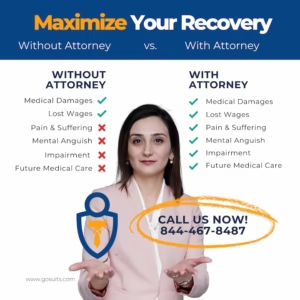
Insurance companies and corporate interests often move quickly to shape the narrative. They may request recorded statements before all facts are known, highlight uncertainty where video is incomplete, or suggest responsibility lies elsewhere. They also control policy language that can limit payouts unless claimants know how coverage layers interact, including underinsured motorist provisions and umbrella policies. Without guidance, people can unknowingly sign broad releases or accept a figure that does not reflect the full measure of loss under Illinois law.
A free consultation helps people understand timelines, evidence preservation, and how to approach insurance communications. It also clarifies the separate roles of the Wrongful Death Act and Survival Act, what documentation supports each category of damages, and how to coordinate with the Lake County Coroner and the investigating agency for records. No one should feel rushed. The goal is informed decisions, methodical evidence work, and respect for the family’s needs during a very difficult time.
References
- Centers for Disease Control and Prevention, Distracted Driving
- National Highway Traffic Safety Administration, Distracted Driving
- National Highway Traffic Safety Administration, Pedestrian Safety
- 625 ILCS 5/12-610.2, Electronic Communication Devices
- 625 ILCS 5/11-1002, Pedestrians’ Right-of-Way at Crosswalks
- 740 ILCS 180, Wrongful Death Act
- 755 ILCS 5/27-6, Survival of Actions
- 735 ILCS 5/13-202, Personal Injury Statute of Limitations
- 740 ILCS 180/2, Wrongful Death Limitation Period
- 745 ILCS 10/8-101, Local Public Entity Limitation
- Illinois State Police, Crash Reports
- Lake County Coroner’s Office
- Illinois Attorney General, FOIA Overview
- Illinois DOT, Crash Data