- What we know about the crash near 2nd Street and Texas Street in McAllen
- Why intersection crashes in this area are so dangerous
- Immediate steps after a serious crash on McAllen’s 2nd Street corridor
- Getting the official records: police reports, public information, and medical documentation
- Injury patterns when someone is “breathing but not alert”
- Potential civil liability considerations under Texas law
- Preserving crucial evidence around busy businesses and gyms
- Insurance and claims in Texas: practical considerations
- Common factors under investigation in intersection collisions
- Local traffic context around 2nd Street and Texas Street
- Timelines and deadlines that can affect a civil injury claim
- A plain-language overview for families after a severe injury
- Call-to-action: steps to protect health, rights, and evidence now
- Commentary from Gosuits McAllen, Texas Personal Injury Attorney
What we know about the crash near 2nd Street and Texas Street in McAllen
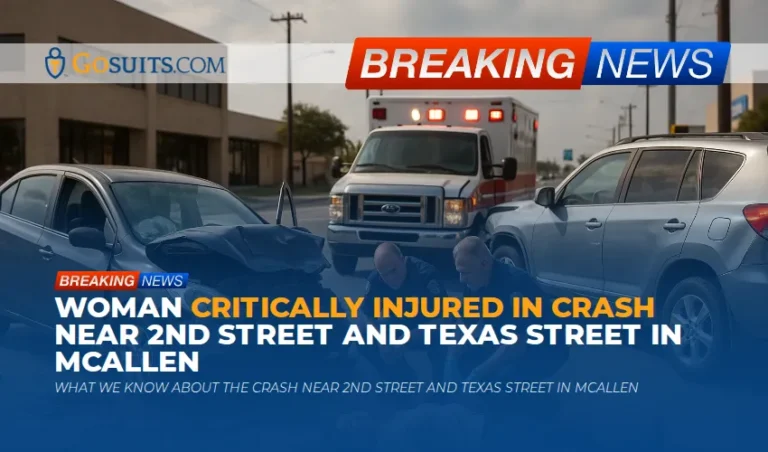
On Tuesday morning, December 2, first responders were dispatched just before 9:40 a.m. to a traffic incident reported near the main entrance of a gym by the intersection of 2nd Street and Texas Street in McAllen. A woman was located at or near that entrance in critical condition. Dispatch indicated she was breathing but not alert when emergency crews arrived. Medics began immediate care at the scene and coordinated further treatment. As of this writing, authorities haven’t released an update on her condition, nor have they confirmed exactly how the crash occurred, how many vehicles were involved, or whether others were hurt. The investigation remains active.
Even without full investigative findings, the location tells a story. This intersection runs through a busy commercial corridor where drivers make frequent turns in and out of parking lots and where morning traffic can be steady with commuters and gym-goers. When an injury is described as critical with reduced responsiveness, it raises concerns about potential head trauma or internal injuries. Timely EMS care can be decisive in those first minutes.
Why intersection crashes in this area are so dangerous
McAllen’s 2nd Street corridor is dotted with businesses, driveways, and pedestrian activity. Intersections like 2nd Street and Texas Street combine turning traffic, through lanes, and people crossing on foot. It’s a mix that can go wrong in seconds if someone is distracted, fails to yield, or misjudges speed or distance.
National and state safety data reinforce the risks of intersections. Federal roadway safety materials highlight that visibility, gap selection, and turn maneuvers are frequent contributors to intersection-related crashes, with a sizable share tied to driver decision errors or inattention. You’ll see public guidance emphasizing caution in high-conflict zones like these because minor lapses can have major consequences, especially when a vulnerable pedestrian is near a driveway or building entrance. For general intersection safety information, see NHTSA’s intersection safety page.
Immediate steps after a serious crash on McAllen’s 2nd Street corridor
There’s a lot to juggle in the moment. Focusing on safety and documentation helps protect health and future options. Here’s a practical sequence tailored to a busy commercial intersection like 2nd and Texas:
- Get to a safe location and call 911. If you can, move away from traffic and hazards. Emergency dispatch will coordinate police and EMS response.
- Accept on-site medical assessment. Even if symptoms seem mild, shock and adrenaline can mask injuries. Head, neck, or abdominal trauma may not be obvious at first.
- Note surroundings before vehicles move. If safe, take photos or brief video of vehicle positions, damage, debris, skid marks, and the precise area around the gym entrance or driveway. Capture signage, lane markings, and any obstructions.
- Identify potential cameras. Look for exterior business cameras, parking lot security, or nearby dashcams. Note store names and time stamps; footage can be overwritten within days.
- Exchange information, but be cautious with statements. Exchange insurance and contact details. Avoid speculation or assigning blame. Your words can be cited later.
- Request the incident number. Ask the responding officer for the incident or report number so you can locate the official crash report later.
- Seek follow-up medical care the same day. Document symptoms and keep all discharge papers and imaging results. Headaches, confusion, or abdominal pain can worsen after you leave the scene.
Getting the official records: police reports, public information, and medical documentation

Police crash report in Texas
In Texas, the official crash report is generally available to people listed in the report and certain other authorized parties under state law. The statute governing release is Texas Transportation Code § 550.065. Many reports can be purchased through the state’s Crash Records Information System (CRIS), administered by the Texas Department of Transportation. You can learn about the process through the TxDOT crash data and reports portal and the CRIS purchase system.
Having the official report helps clarify parties, vehicles, road conditions, and preliminary officer observations. If an error is discovered, there are limited procedures to request corrections, often requiring supplemental documentation.
Public information requests
Some materials, like 911 call logs, radio traffic, or certain scene photos, may be obtainable via a Texas Public Information Act request. There are exceptions for confidential information, open investigations, and privacy protections. The Texas Attorney General provides practical guidance on how to make a request and what to expect at this Public Information Act resource page.
When seeking time-sensitive items like security video held by public entities, acting quickly matters because many systems auto-delete after short retention periods.
Medical records and bills
Ask each treating provider for your records, including EMS run sheets, ER notes, imaging, and discharge instructions. Consistent documentation can be vital to understanding the trajectory of symptoms and the need for follow-up care, therapy, or specialist referrals.
In the event of a fatality: autopsy or inquest records
If a death occurs, fatality investigations in Texas are governed by inquest laws. Depending on the county’s structure, an inquest may be conducted by a medical examiner or a justice of the peace. See Texas Code of Criminal Procedure, Chapter 49 for an overview of inquests and autopsy authority. Families often request certified copies of findings for insurance and legal matters. Note that some records may be restricted pending investigations.
Injury patterns when someone is “breathing but not alert”
The description “breathing but not alert” can point to several serious conditions:
- Traumatic brain injury (TBI) or concussion. Altered consciousness, confusion, or inability to respond appropriately are red flags. The CDC’s TBI resources explain how even mild TBIs can disrupt brain function, and moderate to severe TBIs can be life-threatening.
- Internal bleeding or shock. Abdominal or chest trauma can cause internal hemorrhage with initially subtle signs.
- Hypoxia or airway issues. Compromised breathing after trauma requires rapid stabilization.
Why mention these possibilities? Because early care improves outcomes. Following discharge, watch for worsening headaches, vomiting, confusion, vision changes, numbness, or escalating pain, and return to the ER immediately if those appear. Keep a daily symptom journal; it’s surprisingly helpful for doctors tracking recovery.

Potential civil liability considerations under Texas law
While investigators haven’t shared fault details yet, intersection collisions often involve right-of-way questions, sight lines, and turn decisions. From a civil perspective, here are common issues attorneys evaluate:
- Right-of-way and traffic control devices. Did a driver proceed through a stop or signal improperly? Were there protected turn phases? Did someone fail to yield to a pedestrian at a driveway or crosswalk?
- Ingress/egress and driveway movements. When vehicles enter or exit businesses, they must ensure the path is clear. Sudden turns across lanes can be dangerous.
- Distraction. Phone use or in-vehicle distractions can delay reaction times and impair gap judgment.
- Comparative responsibility. Texas uses proportionate responsibility rules. A claimant’s recovery may be reduced by their percentage of responsibility, and recovery is barred if they are more than 50 percent responsible. See Texas Civil Practice and Remedies Code, Chapter 33.
- Commercial entities and premises considerations. In some scenarios, sight obstructions or poorly designed exits can factor in, though responsibility depends on specific facts and proof.
No two cases are alike. Responsibility determinations are evidence-driven and may shift as video, witness statements, and crash reconstruction develop.
Preserving crucial evidence around busy businesses and gyms
In a corridor with storefronts and a gym entrance, there’s often more evidence than people realize, but it can disappear fast:
- Business security video. Many systems overwrite footage in days. Identifying cameras and requesting preservation quickly can be pivotal.
- Vehicle telematics and event data recorders. Modern vehicles may store data about speed, braking, and seatbelt status, retrievable under proper conditions.
- Dashcams and bystander smartphones. Ask witnesses if they recorded the incident or took photos right after.
- 911 audio and CAD logs. Public information requests may capture timing, location, and dispatch notes, subject to legal exceptions. See the Texas AG guidance on public requests.
- Scene measurements and skid marks. Photographs with reference points (lane markings, curb lines) help reconstruction before traffic erases debris patterns.
Sending timely preservation letters is often recommended so footage isn’t overwritten and vehicles aren’t disposed of before documentation.
Insurance and claims in Texas: practical considerations
Texas is an at-fault state. The at-fault driver’s liability insurer typically handles claims for bodily injury and property damage, but claim pathways can involve multiple policies, including your own. A few practical points:
- Minimum liability requirements. Texas law requires drivers to carry at least 30/60/25 coverage limits. The Texas Department of Insurance explains basic auto coverage requirements and options on its consumer pages, including liability, PIP, and UM/UIM coverages. See TDI’s overview at this link.
- Collision, MedPay, PIP, and UM/UIM. Your policy may provide benefits regardless of fault (e.g., PIP or MedPay), and UM/UIM can be critical if the other driver is underinsured.
- Recorded statements. Statements given to insurers can be used later. It’s wise to understand your rights before providing a recorded interview.
- Healthcare on a lien. Some Texas providers will treat on a lien basis, to be paid from any future settlement, which can help maintain continuity of care.
If a claim is pursued, it’s generally advisable to speak with a seasoned injury attorney first. What someone says to an insurance company can be cited against them later, and coverage issues can be nuanced.
Common factors under investigation in intersection collisions
Even though we don’t yet know the cause of this particular crash, investigators commonly look at:
- Failure to yield during turns or at stop-controlled approaches.
- Distraction or inattention. Texting or looking away briefly can be enough to miss a pedestrian or a vehicle entering from a driveway.
- Speed selection for conditions. Approaching a driveway-laden corridor at an inappropriate speed reduces time to react.
- Visibility and sight obstructions. Parked vehicles, landscaping, or signage can alter sight distance at driveways.
To put the issue in context, Texas crash statistics reflect significant numbers of intersection and turning collisions every year. TxDOT publishes statewide crash data and summaries each year; see TxDOT’s crash statistics portal for the latest official figures. National road safety pages also emphasize caution and defensive driving in intersections due to the higher number of conflict points; see NHTSA’s guidance.
Local traffic context around 2nd Street and Texas Street
People in McAllen know the rhythm of 2nd Street on weekday mornings. Between school runs, office commutes, and gym traffic, the flow around business entrances can surge. In early December, sun glare can be sharp at certain angles, and occasional light showers or mist can make pavement slick. Drivers maneuvering in and out of lots may be focused on finding gaps, while through-traffic expects green lights to keep them rolling. That mismatch is where close calls happen.
The corridor also lies close to other busy routes like Bicentennial and close-in commercial areas. When a crash occurs just steps from a building entrance, pedestrians and customers are nearby, and EMS needs clear access to stage and transport. Cooperation from bystanders, moving vehicles, and businesses can speed care.
Timelines and deadlines that can affect a civil injury claim
Texas law imposes deadlines that can affect the ability to bring a civil injury claim. While specific situations vary, two timeframes often matter:
- General personal injury limitations period. Texas law generally provides two years from the date of injury to file a personal injury claim in court. See Texas Civil Practice and Remedies Code § 16.003.
- Notice issues for public entities. If a government vehicle or condition is involved, special notice provisions and shorter timelines under the Texas Tort Claims Act may apply. These are very fact-specific.
Evidence does not wait for deadlines. Businesses may routinely overwrite video within days or weeks. Vehicles may be repaired or salvaged. Prompt action to preserve and collect records reduces the risk of losing key proof.
A plain-language overview for families after a severe injury
After a serious crash, the day becomes a blur. Here’s a simple way to think about the next few days and weeks:
- Health first. Follow medical advice, complete recommended imaging and follow-ups, and write down changing symptoms. Keep every discharge paper and prescription.
- Get the report. Use the incident number to locate the official Texas crash report through authorized channels. See the state’s rules at Transportation Code § 550.065 and learn about access via TxDOT’s CRIS system through TxDOT’s site.
- Preserve video and witness contacts. Security and dashcam footage can vanish quickly. Write down business names and request that they preserve any video from the time of the crash.
- Be careful with insurance calls. Before giving recorded statements, understand your rights and coverage. In Texas, statements can be used later.
- Consider a consultation. A free consultation with a skilled injury attorney helps people understand liability, insurance layers, and timelines. That conversation is information, not a commitment.
Call-to-action: steps to protect health, rights, and evidence now
What should be done next, and why now?
- Request and review the official crash report. The sooner the report is obtained, the sooner inaccuracies can be addressed and involved insurers identified. It also helps coordinate medical billing and benefits. Reports are released under Texas Transportation Code § 550.065.
- Lock down time-sensitive evidence. Ask nearby businesses to preserve video from the date and time of the crash. Many systems overwrite within days. Preserving this now can clarify fault later.
- Document medical care and symptoms. Keep a running file of records, bills, and photos of visible injuries. Detailed documentation supports continuity of care and future decisions.
- Plan your insurance communications. Before contacting any insurer, get a free consultation to understand coverage, rights, and common pitfalls. Statements made early can shape the entire claim.
- Calendar important dates. Mark potential deadlines and follow up every one to two weeks on outstanding records requests. Acting steadily prevents last-minute scrambles that risk missing key items.
The benefit of acting now is clarity: clearer facts, preserved video, organized medical proof, and a better understanding of next steps. That clarity can reduce stress and prevent mistakes that are hard to undo later.

Commentary from Gosuits McAllen, Texas Personal Injury Attorney
Our hearts go out to the woman reported critically injured near 2nd Street and Texas Street and to those who care for her. This article is intended for education and general information. It’s normal to feel overwhelmed after a sudden crash, especially when first reports describe someone as breathing but not alert. Those words carry weight because they often point to serious trauma that needs immediate and attentive care.
From what’s been shared publicly, this incident occurred steps from a gym entrance in a high-activity corridor. That matters. Driveways and turning movements create complex traffic patterns, and small errors can have outsized consequences. In collisions like this, it’s important to identify reliable proof quickly: business security footage, witness names, and the precise layout at the driveway or intersection. Those details can clarify whether a turn was unsafe, a yield was missed, or sight lines were compromised.
Insurance companies and corporate defendants know the value of early control. Adjusters may request recorded statements while medical facts are still developing. They may ask broad questions that seem harmless, but answers can be used later to minimize injuries or shift responsibility. Corporations that might hold video sometimes have short retention policies and won’t keep footage unless asked promptly. In short, the system rewards those who move quickly and who understand how claims are evaluated.
That’s why a free consultation can be so important. It gives people a chance to understand Texas comparative responsibility rules, available insurance layers, and how to preserve the evidence that matters most before it disappears. It also helps people decide on the right timing and strategy for communications with insurers. Knowledge levels the playing field and helps prevent common missteps that can hurt a case down the road.
Where to turn for official information and assistance
- Texas crash reports: Learn how crash reports are released under Transportation Code § 550.065 and how to obtain reports through TxDOT’s systems at TxDOT’s crash data and reports page.
- Public information requests: For guidance on requesting public records (such as 911 logs), see the Texas Attorney General’s page on the Public Information Act at this link.
- Understanding injury patterns: The CDC provides approachable explanations of traumatic brain injury and symptoms at its TBI hub.
- Insurance basics in Texas: The Texas Department of Insurance offers consumer-friendly guidance on coverages and minimum limits at this TDI page.
- If the worst happens: In fatal incidents, inquest procedures are described in Texas Code of Criminal Procedure Chapter 49.
People in McAllen take care of one another. After a serious crash, that starts with prompt medical care and extends to preserving the facts, calmly navigating insurance conversations, and making informed choices about next steps. When done early and carefully, those actions can make all the difference.