- What happened on southbound Highway 101 near Ventura
- Where and when it happened
- Law enforcement statements and traffic status
- Early safety takeaways about wrong-way freeway crashes
- Legal context in California for wrong-way collisions
- Where families can get official documents and information
- For the Ford Transit and Mercedes drivers: care and documentation
- How multi-vehicle claims typically unfold after a freeway wrong-way crash
- Local roads, traffic patterns, and community context
- Data snapshot: Wrong-way crashes in California and nationwide
- Timelines and paperwork in California injury and wrongful death claims
- What to do next: Immediate practical steps
- Commentary from Gosuits Ventura, California Personal Injury Attorney
- References
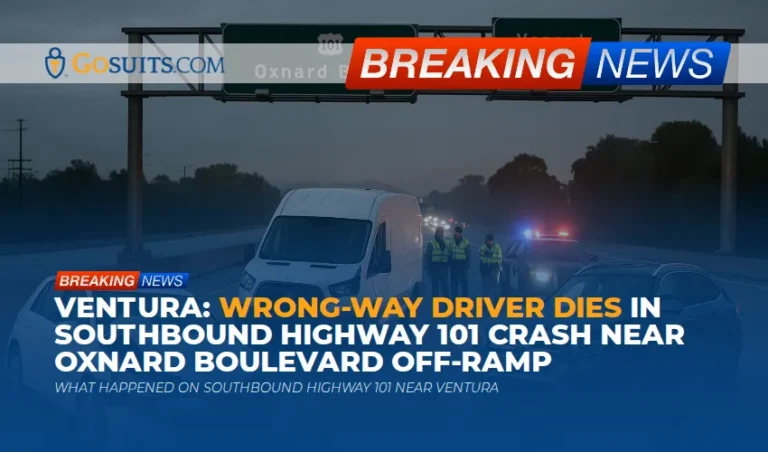
What happened on southbound Highway 101 near Ventura
In the early morning hours on January 31, 2026, a three-vehicle collision shut down southbound Highway 101 near Ventura as crews investigated a fatal crash. California Highway Patrol dispatch said calls came in at 5:05 a.m. about a collision near the Oxnard Boulevard off-ramp on the southbound side. A Volkswagen Golf, driven by a man traveling the wrong way after allegedly entering via the Oxnard Boulevard off-ramp, collided with a Ford Transit van. A Mercedes-Benz GLC SUV was also involved. The Volkswagen driver was pronounced dead at the scene. According to CHP dispatch, the other two drivers either were uninjured or had minor injuries. No passengers were reported in any of the three vehicles.
CHP diverted southbound traffic off Johnson Drive beginning at 5:14 a.m. while investigators and cleanup crews worked. By 8:56 a.m., all southbound lanes past the Johnson Drive area had reopened. CHP’s preliminary description indicates the sequence began with a wrong-way entry, but the full investigative findings, including detailed collision reconstruction and any contributing factors, typically take days or weeks to finalize.
Where and when it happened
Based on CHP’s early information, the collision took place on southbound Highway 101 near the Oxnard Boulevard off-ramp. The traffic diversion point was Johnson Drive, just south of downtown Ventura. For locals, that stretch of 101 threads together daily commutes between Ventura, Oxnard, and Camarillo. Many area residents know this zone well, whether you are heading to Ventura Harbor Village, the Pacific View Mall, Port Hueneme, RiverPark, or CSU Channel Islands down in Camarillo. The time of the crash, around 5 a.m., falls in the pre-commute window when truck traffic and early shift workers often share the roadway. CHP’s swift diversion at Johnson Drive helped prevent additional crashes during the response.
Law enforcement statements and traffic status
CHP Ventura dispatcher Virginia Block conveyed that initial reports began at 5:05 a.m., with a traffic diversion set at Johnson Drive by 5:14 a.m. The preliminary investigation suggested the Volkswagen traveled the wrong direction onto southbound 101 after entering via the Oxnard Boulevard off-ramp, then collided with a Ford Transit. The Mercedes GLC was the third vehicle involved. CHP confirmed all southbound lanes reopened by 8:56 a.m. CHP dispatch also noted there were no passengers in any vehicle and that the Ford and Mercedes drivers reported no injuries or minor injuries. At this stage, no further public information has been released.
Early safety takeaways about wrong-way freeway crashes
Wrong-way freeway collisions are relatively rare, but they tend to be severe. They often involve head-on impacts at highway speeds with little time for evasive maneuvers. National transportation safety research has documented the disproportionate lethality of wrong-way crashes on divided highways, and public agencies have studied countermeasures like enhanced signage, high-visibility wrong-way markers, and detection systems that alert law enforcement when a wrong-way entry occurs [1]. The Federal Highway Administration has also published technical guidance on roadway designs and systems to deter wrong-way entries and improve early detection [2].
While CHP’s investigation will determine specifics in this incident, early takeaways for drivers in our community include watching for wrong-way signage at ramps, reporting suspected wrong-way vehicles by pulling over safely and calling 911, and leaving ample following distance at night or during low-light hours so there is more time to react if something unexpected appears ahead.
Legal context in California for wrong-way collisions
California law requires drivers to travel in the lawful direction on divided highways. Vehicle Code section 21651 outlines rules about driving on divided highways and prohibits crossing medians or entering a roadway in the wrong direction [3]. In civil cases, violations of safety statutes can be used as evidence of negligence. In a wrong-way freeway crash, the core civil question often centers on whether a driver breached a duty of care by driving against traffic on a divided highway, leading to harm for others.
California also recognizes comparative fault, meaning a court or a claims process can allocate responsibility among multiple individuals if the evidence supports that more than one party contributed to the harm. California’s standard civil jury instructions address comparative fault and how jurors can weigh shared responsibility in a collision [4]. In a crash like this, investigators and insurance adjusters will examine roadway entry points, vehicle paths, skid marks and yaw marks, vehicle damage profiles, on-scene statements, and any available video or automated detection records.
Insurance can become complicated in wrong-way, multi-vehicle crashes. Liability coverage of the at-fault driver is typically the first line of recovery. But if that driver’s policy limits are insufficient for the injuries and property damage, injured people may need to explore uninsured or underinsured motorist coverage on their own policies, which the California Department of Insurance describes in its consumer materials [5]. California law also requires insurers to disclose policy limits upon reasonable request in certain situations, which helps people evaluate the practical path forward when multiple claims are involved [6].
Where families can get official documents and information
If you are trying to gather records after a fatal freeway crash, it helps to know which agencies hold what:
- Traffic collision reports. For crashes on state highways, CHP typically prepares the Traffic Collision Report. You can request it using CHP’s collision report request process and form CHP 190. While each area office has its own procedures for in-person or mail requests, the general framework for obtaining collision reports is set out by CHP. CHP also maintains a live incident log used during active responses, but the official collision report is the key evidentiary document [7] [8].
- Autopsy and coroner records. Ventura County’s Medical Examiner-Coroner handles examinations and reports in fatal incidents. Families can request certified copies of death certificates through the California Department of Public Health’s Vital Records if they need official documentation for estates and benefits [9]. Coroner investigative reports are typically available upon completion of the examination and the investigation; release timelines vary.
- Road closure and re-opening information. Caltrans QuickMap posts real-time highway closures, lane conditions, and detours for Highway 101 and other routes throughout the county [10].
- Insurance and benefit documentation. The California Department of Insurance publishes consumer resources on auto policies and coverage types, which can help clarify UM/UIM coverage and claims basics when policy paperwork is not immediately accessible [5].
For many families, the first days are about information. Ask for the collision report number from CHP, note the responding area office, and keep a file with dates, names of any officers you spoke with, and claim numbers if insurance carriers have already reached out.
For the Ford Transit and Mercedes drivers: care and documentation
CHP dispatch indicated the Ford Transit and Mercedes GLC drivers had no injuries or minor injuries. Even if symptoms seem modest at the scene, it is common for pain to increase later the same day or over the next several days. Soft tissue injuries, concussions, and back pain can be delayed. Consider a prompt medical evaluation so a professional can assess any developing symptoms, especially after a highway-speed impact.
On the practical side, it helps to create a folder or digital file and immediately begin documenting:
- Medical notes and treatment plans. Keep appointment summaries, imaging results, prescriptions, and out-of-pocket costs. If a provider recommends light duty or time off, keep those notes and any employer correspondence.
- Vehicle and property damage. Gather towing invoices, repair estimates, and photos of the vehicle from multiple angles. If personal items were damaged inside your vehicle, list those with receipts or replacement cost estimates.
- Work and daily life impacts. Track time missed from work, mileage to appointments, and any tasks you can no longer perform or must pay others to handle.
Before giving a recorded statement to any insurance adjuster, consider consulting with a qualified attorney first. In California, what you say to an insurer can be used later, and early statements sometimes get taken before all injuries or facts are known.
How multi-vehicle claims typically unfold after a freeway wrong-way crash
Multi-vehicle freeway crashes often involve several insurers and competing versions of what occurred. Evidence such as the CHP collision report, diagram, supplemental narratives, and any available video footage will be central. If the at-fault driver is deceased, claims are still made against the driver’s auto policy, and in some cases, against the estate depending on facts and coverage. Injured drivers or families may also need to tap uninsured or underinsured motorist benefits on their own auto policy when the at-fault driver’s coverage is insufficient [5].
Because discussions with insurers can get complex quickly, many people choose to speak with car accident lawyers prior to engaging with any carrier. Counsel can help preserve evidence, manage statements, and coordinate benefits so medical care does not stall while liability investigations continue. For a deeper dive into coverage order in multi-car scenarios, see Which Insurance Pays First After a Multi Car Crash.
In Ventura County, carriers know that head-on, wrong-way collisions tend to produce higher-damage profiles, even when one party reports only minor injuries at first. Medical trajectories can change. Policy limits disclosures in California can help claimants assess available coverage, but navigating those requests and the timing of disclosures is easier when guided by someone familiar with the process [6]. Many residents prefer working with Ventura car accident lawyers who understand local CHP report practices and the often-used tow yards and body shops along the 101 corridor between Ventura and Oxnard.
Local roads, traffic patterns, and community context
That Johnson Drive diversion point sits just south of downtown Ventura where the 101 feeds daily commuters toward Oxnard, Port Hueneme, and Camarillo. On busy weekdays, drivers merge from Oxnard Boulevard and Rose Avenue interchanges in quick succession. Locals know this area well from errands at The Collection at RiverPark or trips down to CSU Channel Islands. When something goes wrong on the freeway here, it ripples through surface streets like Johnson Drive, Telephone Road, and Victoria Avenue.
Statewide, agencies have pursued wrong-way countermeasures, including enhanced ramp signage and detection technologies that alert law enforcement more quickly when a wrong-way entry occurs. At the national level, FHWA has documented countermeasures and best practices for wrong-way prevention and response [2]. The goal is simple: reduce the chance that a wrong-way driver ever makes it onto the mainline lanes, and if they do, shorten the time before responders can intercept them.
Data snapshot: Wrong-way crashes in California and nationwide
Transportation safety agencies have highlighted wrong-way crashes as a persistent safety concern. National reviews describe how even though wrong-way events occur far less often than other crash types, they produce a greater share of severe and fatal outcomes, especially on divided highways where closing speeds are high [1]. The Federal Highway Administration has produced technical resources summarizing detection technologies, ramp design features, and signage systems that reduce wrong-way entries and speed up alerts to law enforcement [2].
Closer to home, the California Office of Traffic Safety maintains statewide traffic safety data to support local planning and enforcement priorities. Communities like Ventura and Oxnard can use these data sets to identify corridors for enhanced enforcement or engineering improvements, including freeway ramps with complex geometry or higher wrong-way entry risk [11]. Over time, improvements to lighting, sign placement height, and reflectorization on ramps have all been used to reduce the risk of someone entering in the wrong direction.
Timelines and paperwork in California injury and wrongful death claims
California’s statute of limitations for most personal injury and wrongful death cases is two years from the date of the incident. The controlling statute for these civil claims is California Code of Civil Procedure section 335.1 [12]. There are exceptions, including shorter deadlines when a public entity may be involved, such as potential roadway defect claims or claims involving a public employee driving a government-owned vehicle. Claims involving a state entity require a timely government claim filing before a lawsuit, generally within six months for personal injury or wrongful death. The California Department of General Services outlines how claims against the state are presented and processed [13].
Separate from lawsuits, California also requires drivers to submit a Report of Traffic Accident (SR-1) to the DMV within 10 days if anyone was injured or property damage reached the statutory threshold, regardless of fault [14]. This is a reporting obligation and not the same as a CHP collision report. Failing to file an SR-1 when required can affect driving privileges and potential insurance handling.
What to do next: Immediate practical steps
When a serious freeway crash happens, there is a lot to juggle. Acting sooner rather than later helps secure key evidence and can reduce delays in care and repairs.
- Prioritize medical care immediately. If anyone has new or worsening symptoms, seek a medical evaluation right away. Medical records created close in time to the crash are more informative and help guide treatment plans.
- Secure the CHP collision report information. Identify the CHP area office, the report number if available, and names of any responding officers. The report often drives insurance decisions. Ask when the report is likely to be ready.
- Preserve evidence from the scene. Save photos, dashcam footage, 911 call logs if you have them, and witness contact information. If you suspect nearby cameras might have captured the crash or the wrong-way entry, note the locations while they are fresh in your mind.
- Contact an attorney before speaking with insurance companies. Early statements to an insurer can be used in your claim later. Consulting a lawyer first helps you understand your rights, the scope of your coverage, and what to expect in recorded statements and medical authorizations.
- Document property damage and costs. Keep towing receipts, repair estimates, rental car invoices, and any receipts for damaged personal items from inside the vehicle.
- Track all time-sensitive filings. If the DMV SR-1 reporting requirement applies, calendar the 10-day deadline. For situations involving public entities, learn whether a six-month government claim deadline may be triggered.
Taking these steps early helps you avoid common pitfalls that slow down treatment, property repairs, or benefits like rental coverage. It also helps reduce the risk of critical evidence being lost or overwritten, such as deleted surveillance video or overwritten camera loops on nearby businesses or facilities along the 101 corridor.
Commentary from Gosuits Ventura, California Personal Injury Attorney
Our hearts go out to everyone affected by this crash on Highway 101. A wrong-way collision is every driver’s nightmare, and losing a life on our community’s main corridor is devastating. This article is offered for general information to help people understand the process and the types of decisions that often arise after a serious freeway crash.
Based on what CHP has shared so far, this appears to have begun with a wrong-way entry from the Oxnard Boulevard off-ramp onto southbound 101. In civil terms, driving the wrong way on a divided highway is a powerful indicator of negligence. Investigators will still examine the full picture, including whether any other factors played a role. For the uninjured or minimally injured drivers, it is common to feel fine at first yet develop symptoms later. If that happens, do not minimize your condition. Get evaluated and document what you experience day to day.
Insurance companies and large corporate carriers understand how to leverage information gaps. Adjusters may move quickly to take recorded statements or push for broad medical authorizations. People often do not realize that offhand comments in a first phone call or in a form can later be used to dispute the nature of injuries or the need for recommended care. It is prudent to speak with counsel before engaging with carriers so you understand the implications of each step and do not accidentally limit your options.
Many firms offer a free consultation. Speaking with a seasoned, local injury attorney can help clarify the next steps, whether that is securing the CHP report, coordinating rental coverage without unnecessary delays, or evaluating whether additional protections like uninsured or underinsured motorist benefits might apply. In a multi-vehicle freeway crash involving a wrong-way driver, having a clear plan early makes a difference.
References
- Wrong-Way Driving on Divided Highways: Safety Report – NTSB
- Wrong-Way Driving: Countermeasures and Resources – Federal Highway Administration
- California Vehicle Code § 21651 Driving on Divided Highways – California Legislature
- California Civil Jury Instructions CACI 405 Comparative Fault – California Courts
- Automobile Insurance Consumer Guides – California Department of Insurance
- Policy Limits Disclosure Requirements for Auto Insurers – California Department of Insurance
- Collision Reports and CHP 190 – California Highway Patrol
- Live Incident Information – California Highway Patrol
- Vital Records and Certified Copies of Death Certificates – California Department of Public Health
- QuickMap Road Conditions and Closures – Caltrans
- Traffic Safety Facts and Data – California Office of Traffic Safety
- California Code of Civil Procedure § 335.1 Statute of Limitations – California Legislature
- File a Claim Against the State of California – Department of General Services
- Report of Traffic Accident SR-1 – California DMV