- What happened on Westwood Boulevard and Rochester Avenue
- What is known and what remains unclear
- Immediate safety and traffic impacts in Westwood Village
- How investigations typically proceed after a vehicle-into-building crash
- Potential civil liability pathways under California law
- Evidence to preserve right away
- Where to request police, fire, coroner, and hospital records
- Medical care and trauma centers near Westwood
- Insurance and claims considerations after a Los Angeles storefront crash
- Wrongful death basics for California families
- Time limits that apply in California
- Practical, local steps the community can take now
- Action steps you can take now
- Commentary from Gosuits Los Angeles, California Personal Injury Attorney
What happened on Westwood Boulevard and Rochester Avenue
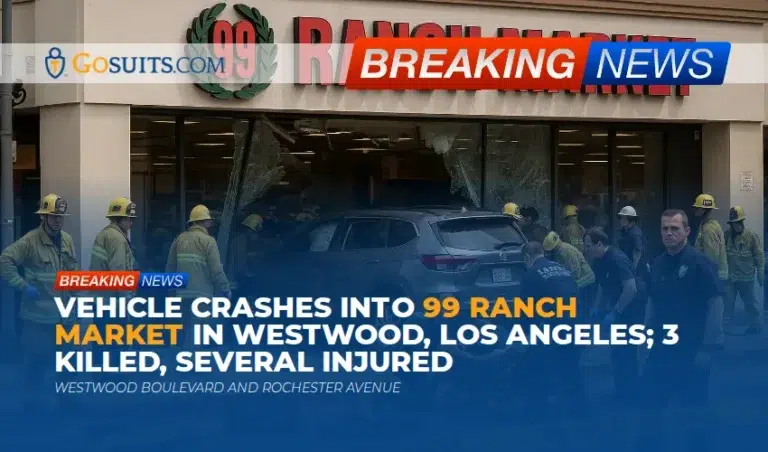
Just after the noon hour on Thursday, a vehicle reportedly crashed through the front of the 99 Ranch Market at 1350 S. Westwood Boulevard, on the corner of Rochester Avenue, in the Westwood neighborhood of Los Angeles. According to initial public safety reports relayed to media, three people were pronounced deceased at the scene and at least six others were transported to local hospitals for treatment. Authorities indicated the incident appeared to be an accidental traffic collision with no ill intent observed at the time. In response, a large rescue operation closed a stretch of Westwood Boulevard while firefighters and paramedics worked the scene.
Westwood Village is usually active at midday, especially around grocery stores, cafes, and the corridor between Wilshire Boulevard and the UCLA campus. A crash of this type is terrifying for shoppers, staff, and passersby. Our hearts are with everyone affected.
What is known and what remains unclear
What we know based on public reports shared with media
- Time and place: Just after noon on a weekday, at 99 Ranch Market, 1350 S. Westwood Blvd., at Rochester Avenue in Westwood.
- Casualties: Three fatalities reported at the scene; multiple additional people transported for hospital care.
- Initial characterization: Authorities described the crash as an accidental traffic collision with no indication of ill intent at that time.
- Response: A significant fire and EMS response, with part of Westwood Boulevard closed to traffic during rescue and investigation activities.
What we do not know yet
- Injury updates: Current conditions of hospitalized individuals have not been publicly released.
- Cause: The specific cause is under investigation, including whether driver error, a medical emergency, mechanical failure, or other factors were involved.
- Identity details: Names and ages of the deceased and injured are typically released later by the county medical examiner after family notifications.
Immediate safety and traffic impacts in Westwood Village
Any major medical response in Westwood quickly affects traffic on Westwood Boulevard, Rochester Avenue, and nearby connectors to Wilshire and Santa Monica Boulevard. With Westwood’s mix of pedestrians, scooters, and vehicles navigating narrow driveways and parking entrances, even a temporary closure ripples through side streets like Midvale or Glendon. Storefront structural assessments may also be required before a building reopens, which can keep sidewalks and traffic lanes restricted.
How investigations typically proceed after a vehicle-into-building crash
After a collision where a car enters a store or building, several agencies may be involved. Police investigate the crash dynamics and potential traffic violations, fire officials document the rescue and assess structural hazards, and building safety inspectors may evaluate damage to load-bearing elements. If there are fatalities, the county medical examiner takes jurisdiction for cause and manner of death determinations.
Investigators usually gather witness statements, driver statements, and surveillance video, inspect vehicle systems when appropriate, and document the scene with measurements and photographs. In incidents where driver health is suspected, medical records may be reviewed to determine whether a sudden medical event played a role. If a vehicle defect is alleged, federal regulators or manufacturer engineers could become involved. For example, national guidance recognizes that pedal error, in which a driver mistakenly presses the accelerator instead of the brake, is a known crash scenario that safety agencies have studied [1].
Potential civil liability pathways under California law
It can feel confusing when public statements characterize a catastrophe as an “accident.” In civil law, the word “accident” does not eliminate the possibility of fault or financial responsibility. California’s negligence law asks whether someone failed to use reasonable care and whether that failure caused harm. Several potential avenues may be examined in a vehicle-into-building case:
- Driver negligence: If the motorist failed to use reasonable care, such as by misapplying pedals, being distracted, or operating unsafely for the conditions, their auto liability insurance is typically the primary source of compensation for injuries and deaths. Even where a medical emergency is suspected, the facts must be scrutinized to determine what was reasonably foreseeable and preventable.
- Vehicle defect or malfunction: If a mechanical failure or defect contributed, product liability principles may apply, potentially involving the manufacturer or a repair facility.
- Premises liability and storefront protection: Property owners have duties to keep premises reasonably safe. In some cases, questions arise about the foreseeability of low-speed intrusions into high-foot-traffic storefronts and whether protective measures, like properly placed barriers, were warranted for that specific site. Any evaluation must be evidence-based and site-specific.
- Public entity exposure: If roadway design or signage is alleged to have contributed, claims against public entities may require special procedures and much shorter deadlines than standard civil suits [4].
While liability ultimately depends on detailed facts, families often need to act quickly to preserve evidence from surveillance systems, vehicles, and electronic control modules before data is lost.
Evidence to preserve right away
Robust evidence helps clarify exactly what happened. In Westwood, where many businesses and garages use cameras, preservation can make a decisive difference. Consider the following, recognizing that each case is unique:
- Video surveillance: Request that nearby businesses preserve relevant footage, including the store itself, neighboring storefronts on Westwood Boulevard and Rochester Avenue, and any residential buildings with external cameras facing the intersection. Time windows should include minutes before and after the impact.
- Vehicle data: Modern vehicles may record speed, pedal positions, and other parameters. Securing the vehicle promptly helps avoid inadvertent loss of electronic control module data.
- Scene photographs and measurements: Document vehicle resting positions, skid or scuff marks, curb heights, bollard placement if any, storefront layout, and debris patterns.
- Witness information: Identify and gather contact information for bystanders, store staff, delivery drivers, and rideshare drivers who were present.
- Medical documentation: For the injured, retain all treatment records, discharge paperwork, and imaging reports. For families, the medical examiner’s records and death certificates become foundational for any future legal process.
- Official reports: Police traffic collision reports, fire department incident reports, and any building safety assessments form the backbone of the factual record.
Families handling a fatal incident often benefit from a structured checklist to avoid missing crucial steps. One helpful primer is this Los Angeles wrongful death checklist.
Where to request police, fire, coroner, and hospital records
Locally, several agencies and offices may hold key documents. Processes and eligibility vary, and some records are only available to involved parties or next of kin.
- Police traffic collision report: Requests are typically made to the city police department that investigated the crash. In Los Angeles, these are commonly handled through the department’s traffic collision report process. California’s Public Records Act governs public access to many government records, though collision reports usually require proof of involvement or relationship [6].
- Fire department incident report: The responding fire agency documents the emergency response. These reports can help confirm timelines, patient counts, and initial observations. Procedures vary by agency and may require an authorization or proof of interest.
- LA County Department of Medical Examiner: For fatalities, the medical examiner maintains autopsy findings, cause and manner of death determinations, and related records. Next of kin can request these records through the department’s official channels [2].
- Death certificates: Certified copies are issued by the Los Angeles County Registrar-Recorder/County Clerk. These certificates are often required for insurance and estate matters [7].
- Hospital records: Injured individuals or their authorized representatives can request medical records from the hospital that provided care. In Westwood, many patients are transported to nearby trauma centers. HIPAA governs release and requires proper authorization.
- Traffic collision report to DMV: Any driver or owner involved in a crash that causes injury, death, or property damage above a threshold must typically submit a Report of Traffic Accident Occurring in California, known as the SR-1, to the DMV within 10 days, regardless of fault [3].
Medical care and trauma centers near Westwood
Westwood is adjacent to multiple high-acuity hospitals. Los Angeles County’s trauma system designates hospitals that handle severe injuries and multi-casualty incidents. County listings identify Level I and Level II trauma centers across the region, including facilities that regularly receive patients from Westside incidents [5]. If you are seeking updates on a hospitalized loved one, call the hospital’s main line and ask for the patient information desk. Hospitals share limited information to protect privacy, but consistent communication helps families coordinate care.
Insurance and claims considerations after a Los Angeles storefront crash
When a vehicle enters a store and strikes people inside, multiple insurance layers may be implicated. In many cases the driver’s auto liability coverage is primary for injuries and deaths. If a defect is alleged, the vehicle manufacturer’s product liability coverage could be in play. If premises conditions are at issue, a commercial general liability policy for the property may be involved.
Before speaking with any insurance adjuster about the facts or providing a recorded statement, it is prudent to consult with a qualified attorney. Anything said to an insurer can be used to limit or deny claims later. California’s Department of Insurance offers consumer guidance on auto claims and the pitfalls of recorded statements [8]. This is where Los Angeles car accident lawyers are often helpful in protecting rights and framing communications appropriately.
Large incidents often trigger insurance company rapid response teams. These teams can be on scene quickly, sometimes gathering photographs and statements before families even know where their loved one has been taken. If you receive calls from insurers in the hours or days after an event, consider pausing those conversations until you have clarity on your rights and a plan for preserving evidence. For many people, speaking first with car accident lawyers is the safest way to avoid inadvertent harm to a potential claim.
Wrongful death basics for California families
California law allows certain family members to bring a civil claim for wrongful death when a loved one’s life is lost because of another’s wrongful act or neglect. The statute defines who may bring the claim and the categories of recoverable damages, such as loss of financial support, companionship, and household services [10]. A separate but related claim, often called a survival action, may address harms the decedent suffered between injury and death.
Importantly, wrongful death claims are civil matters. They proceed independently of any criminal investigation and do not depend on criminal charges being filed. Families can pursue answers and accountability through the civil system even when an incident is described as an “accident.”
Time limits that apply in California
Time limits vary by claim type and the defendant involved. In general:
- Personal injury and wrongful death: California’s statute of limitations for personal injury and wrongful death is commonly two years from the date of injury or death [9].
- Claims against public entities: If a public entity may be responsible, a written claim often must be presented within six months, with specific rules that differ from ordinary lawsuits [4].
- Insurance notice requirements: Auto and commercial policies may require prompt notice of an occurrence or claim. Delays can complicate coverage.
Because exceptions and tolling rules exist, speak with a qualified attorney promptly to understand which deadlines apply to your situation. Acting early also improves the odds of preserving critical footage and data.
Practical, local steps the community can take now
In Westwood, neighbors and businesses often rally quickly. If you own or manage a storefront near Westwood Boulevard and Rochester Avenue and your cameras captured any portion of the incident, it is compassionate and community minded to preserve the footage. A simple step like saving a copy for at least 60 to 90 days, with the correct time stamp noted, can help investigators and families.
For those who were present inside the market or nearby, write down what you remember while it is fresh. Small details about engine sound, vehicle speed, or the direction from which the car approached can matter. If you gave a statement on scene, that is still helpful, but creating your own notes for your records is wise.
Finally, if you or a loved one were injured, try to keep all medical documentation together. Follow-up visits at Westside clinics or major hospitals should be kept on a single timeline along with receipts, prescriptions, and any doctor’s work restrictions. That organized record will support any benefits or claims process.
Action steps you can take now
This section is meant to help the community understand why timing matters and what actions generally make a difference after a major incident.
- Preserve video and data immediately: Surveillance footage and vehicle data can be overwritten quickly. Ask nearby businesses to save copies and hold them for requests.
- Request official records promptly: Police traffic collision reports, fire incident reports, and medical examiner documents form the backbone of the factual record. Initiate those requests early to avoid delays.
- Document medical care consistently: Keep a running log of appointments, imaging, medications, and symptoms. This continuity matters to both health outcomes and any claim.
- Consult an attorney before speaking to insurers: Recorded statements can be used against claimants. A free consultation can help clarify rights and strategy before you talk to adjusters [8].
- Calendar key deadlines: The standard two year civil window and the shorter six month public entity claims deadline are easy to miss during crisis. Put reminders on a calendar now [4][9].
Free consultation request Evidence preservation guidance
Commentary from Gosuits Los Angeles, California Personal Injury Attorney
We are deeply saddened by the loss of life and the injuries reported in this Westwood tragedy. Families and neighbors were going about an ordinary Thursday, and in an instant everything changed. This article is shared for educational and general informational purposes to help our community understand the process that follows and the options people may have.
Based on what has been reported so far, authorities have described the incident as an accidental traffic collision. In civil law, accidental does not necessarily resolve questions of responsibility. Investigators will look carefully at the vehicle, the driver’s actions and condition, the scene geometry, and any environmental or design factors. Those findings will inform which insurance policies apply and how claims are evaluated.
From experience, we know insurers and corporate stakeholders move swiftly to protect their interests. Adjusters may seek recorded statements in the first day or two, before injured people have had a chance to obtain records or speak with counsel. Corporations often have established protocols for large loss events. That imbalance of information is real, and it is one reason people find themselves at a disadvantage later.
Obtaining a free consultation early helps level the field. It allows impacted individuals to understand the types of losses that can be claimed, the evidence that most often decides outcomes, and the deadlines that cannot be missed. It also provides guidance on what to say and what not to say to insurers while the facts are still being gathered.
References
- Pedal Error – National Highway Traffic Safety Administration
- Los Angeles County Department of Medical Examiner
- Accident Reporting Requirements in California – California DMV
- Government Code Section 911.2 – California Legislative Information
- Trauma System in Los Angeles County – LA County Department of Health Services
- California Public Records Act Overview – California Department of Justice
- Death Records – Los Angeles County Registrar-Recorder/County Clerk
- What To Do After an Auto Accident – California Department of Insurance
- Code of Civil Procedure Section 335.1 – California Legislative Information
- Code of Civil Procedure Section 377.60 – California Legislative Information