- What Was Announced and Why It Matters in Central California
- What the New English-Only CDL Testing Policy Does
- What Federal Rules Already Require About English Proficiency
- Third-Party CDL Testing, School Closures, and State Oversight
- Fraudulent or “Chameleon” Carriers and Why Registration Rules Matter
- Electronic Logging Devices and Hours-of-Service Compliance
- Recent Fatal Crashes Cited by USDOT
- Safety and Legal Implications for Central California Roads
- If a Loved One Was Hurt or Killed: Who to Contact in Central California
- Civil Liability After a Truck or Bus Crash
- Insurance Layers in Commercial Vehicle Cases
- Evidence to Preserve After a Serious Collision
- How the English-Only Testing Change Could Affect Crash Litigation
- Step-by-Step After a Serious Truck or Bus Collision
- Before Speaking With Insurance Companies
- Why Acting Promptly Matters and What Action Looks Like
- References
- Commentary from Gosuits Central California Personal Injury Attorney
What Was Announced and Why It Matters in Central California
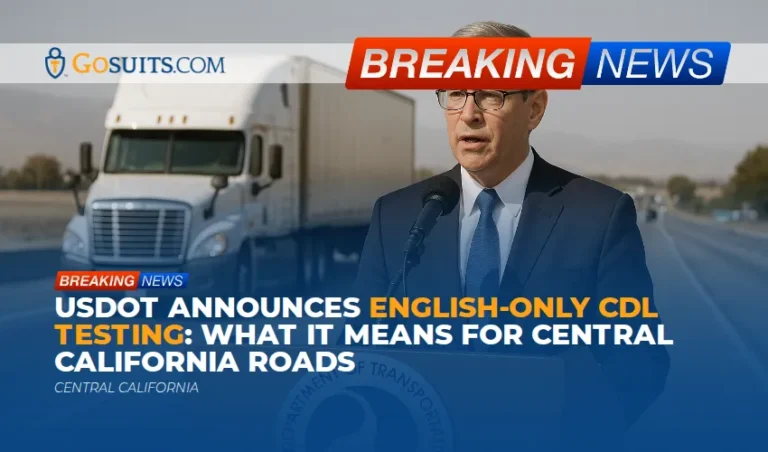
The U.S. Department of Transportation announced that all commercial driver’s license tests for truckers and bus drivers will be administered in English nationwide. Transportation Secretary Sean Duffy framed the change as part of a broader campaign to improve road safety by ensuring commercial drivers can read road signs and communicate with law enforcement. Florida has already begun administering tests in English, and the federal rollout aims to create consistency across states. The announcement comes as the Department also targets fraudulent licensing practices, questionable driving schools, and the registration tactics of trucking companies that repeatedly rebrand after violations.
Why does this matter here at home. Central California lives with heavy truck traffic every day. Along State Route 99 from Bakersfield through Tulare and Fresno up to Madera, on Interstate 5 across the west side, and on State Routes 41 and 180 around Fresno and Clovis, residents share the road with big rigs hauling produce, dairy, and distribution freight. The combination of high volumes of commercial vehicles, seasonal Tule fog, and frequent work zones means any incremental improvement in driver qualification and oversight can reduce catastrophic risk.
What the New English-Only CDL Testing Policy Does
Based on the announcement, states will administer commercial driver’s license written and skills tests in English only. The stated objective is to ensure consistency with federal requirements that drivers can read and speak English sufficiently to understand highway signs and communicate during safety inspections and traffic stops. Some states had allowed non-English test options while separately requiring proof of English proficiency. Now the testing format itself will be standardized in English to better align with the underlying proficiency rules.
The federal initiative was described alongside efforts to close unsafe or noncompliant driving schools, tighten oversight of third-party test providers that states use to deliver CDL exams, and strengthen the registration and audit requirements for trucking companies. The Federal Motor Carrier Safety Administration is also focused on verifying the accuracy of electronic logging devices and monitoring state compliance with qualification standards.
What Federal Rules Already Require About English Proficiency
Federal safety rules have long required that a commercial motor vehicle driver be able to read and speak the English language sufficiently to converse with the general public, understand highway traffic signs and signals, respond to official inquiries, and make entries on reports and records. This is codified at 49 CFR 391.11(b)(2) [1]. The English-only testing change is meant to reinforce that standard at the licensing stage so states and third-party examiners are not applying inconsistent methods.
Third-Party CDL Testing, School Closures, and State Oversight
Under federal rules, states can use third-party testers to administer CDL skills exams, but those third-party arrangements have to meet strict requirements that are set out in the commercial driver’s license standards at 49 CFR Part 383, including specific oversight provisions in 49 CFR 383.75 [2][3]. When oversight lapses, unqualified drivers can slip through the system. The Department’s announcement noted that the federal government will increase spot checks of CDL schools and testing providers and seek to decertify operations that do not meet minimum standards.
For Central California residents, this has practical meaning. If a crash on SR 99 involves a truck driver whose CDL exam or school training fell short of federal requirements, those facts can become important evidence in a civil claim. Plaintiffs can request school records, third-party testing contracts, examiner logs, and state audit materials through the civil discovery process, subject to the court’s rules.

Fraudulent or “Chameleon” Carriers and Why Registration Rules Matter
Federal and state officials are also addressing trucking companies that try to evade accountability by repeatedly re-registering under new names and DOT numbers after crashes or violations. These are often called chameleon carriers. The Government Accountability Office has reported on the safety risks posed by new applicants that may be closely related to prior unsafe carriers and described federal screening tools to identify them [4]. The FMCSA’s New Entrant Safety Assurance Program also provides for early audits and monitoring of new carriers to ensure they comply with safety regulations [5].
In collision litigation here in the Valley, identifying corporate relationships and linked registrations can uncover additional insurance, reveal patterns of safety problems, and show whether a company tried to shed its record. That can affect who is named in a lawsuit and how insurance coverage issues unfold.
Electronic Logging Devices and Hours-of-Service Compliance
The Department also highlighted the need to ensure electronic logging devices are accurate. ELDs are the federally required technology that records drivers’ hours to enforce hours-of-service rules. The ELD requirement is a central component of 49 CFR Part 395 and is explained by FMCSA’s guidance on ELDs [6]. Accurate logs help prevent fatigue, which is a known factor in serious crashes. If ELD data is not reliable, it undermines a key safety control.
For victims of a crash in Fresno, Clovis, Visalia, or along the I-5 corridor, ELD data can be among the most important records to secure quickly. In many cases, ELDs, truck engine control module data, and carrier telematics are overwritten or recycled within short windows. That makes early preservation steps critical.
Recent Fatal Crashes Cited by USDOT
The Department referenced recent fatal crashes, including a Florida collision in which officials said an unauthorized driver made an illegal U-turn, and a crash in Indiana that killed four people. Following the Indiana wreck, FMCSA reportedly ordered the employing company out of service and disqualified related entities, while the driving school tied to the trucker lost certification. These references are part of the government’s case for stricter, more uniform vetting and oversight. While each crash will have unique facts, the thread connecting them is the focus on qualification, testing integrity, and carrier compliance.
For families here in Central California, the headline takeaway is simple. When regulators see patterns of fraud or lax standards, they adjust enforcement. Those changes can influence how we prove negligence in civil court, what records are available, and how quickly a company’s safety problems come to light.
Safety and Legal Implications for Central California Roads
Central California drivers know the rhythms of truck traffic. Harvest seasons refill SR 99 with reefers and flatbeds. I-5 funnels long-haul interstate rigs day and night. Weekday mornings bring commuter buses and regional shuttles to downtown Fresno and the airport. Winter brings Tule fog, which can turn a safe following distance into a life-saving margin in seconds. In this setting, the quality of commercial driver training and the rigor of licensing are not abstract policy points. They are felt on Shaw Avenue, Jensen Avenue, Herndon Avenue, and the long stretches between Kerman and Madera.
Legally, uniform English testing could reduce disputes about whether a driver understood posted restrictions, weight limits, temporary work-zone signs, or detour notices. If a civil case hinges on whether a driver could interpret a chain control sign on CA-41 or a lane closure on CA-180, the existence of a documented English exam at the licensing stage gives courts and juries a clearer starting point. More robust oversight of schools and testers may also make it easier to trace responsibility if a program cut corners.
If a Loved One Was Hurt or Killed: Who to Contact in Central California
After a serious truck or bus crash in Fresno, Madera, Kings, or Tulare County, there are several agencies and offices that hold key records. These records are vital for insurance claims and civil cases. Here is where families can start.
- For the collision report: If the California Highway Patrol investigated, request the CHP collision report and any supplemental information directly from the CHP Area Office that handled the scene. CHP provides a process for obtaining collision reports and can guide you to the correct office for SR 99, I-5, or rural county roads [7]. If a municipal agency responded, such as the Fresno Police Department, contact the Records Unit for a copy of the police report and any available photographs or 911 audio [8].
- For autopsy and coroner records: In a wrongful death, the county Sheriff-Coroner will maintain the autopsy report, cause and manner of death findings, and next-of-kin notifications. In Fresno County, the Sheriff-Coroner provides public information and record request procedures [9]. Tulare County Sheriff-Coroner maintains similar records for incidents within its jurisdiction [10].
- For death certificates: California Department of Public Health Vital Records issues certified copies of death certificates, which are often required for estate and insurance claims [11].
- For carrier and driver safety histories: The FMCSA’s SAFER Company Snapshot can provide public carrier profiles, DOT numbers, and basic safety information to help identify related entities and insurance filings [12].
- For federal crash investigations: In rare, major events, the National Transportation Safety Board may investigate and publish findings. Its highway investigations archive is public [13].
When requesting records, write down the incident number, the exact date, time, and location, and the names of responding agencies. If the crash involved multiple agencies, you may need to request separate records from each.
Civil Liability After a Truck or Bus Crash
Civil personal injury and wrongful death claims focus on whether one or more parties breached a duty of care, and whether that breach caused harm. In commercial vehicle cases, potential defendants can include the driver, the motor carrier, a parent or affiliated company, a broker that arranged the haul, a maintenance contractor, or a loading facility. The facts will dictate who bears responsibility, which is why early investigation matters.
Regulatory compliance is not the end of the story, but it is a key piece. Hours-of-service violations revealed by ELD data, maintenance lapses shown by inspection records, and inadequate training or supervision tied to a driving school’s records can all form part of a negligence theory in civil court. Plaintiffs can also explore whether a carrier had actual or constructive knowledge of safety problems that made a crash foreseeable.
Insurance Layers in Commercial Vehicle Cases
Interstate motor carriers must maintain minimum financial responsibility under 49 CFR Part 387. For most carriers transporting nonhazardous property in interstate commerce, the minimum is 750,000 per occurrence, though many carriers carry higher limits or additional umbrella policies [14]. Some carriers also have MCS-90 endorsements, which can affect coverage disputes in certain scenarios. Identifying all applicable policies, endorsements, and potentially responsible entities is crucial in serious injury and wrongful death cases.
Evidence to Preserve After a Serious Collision
Evidence tends to disappear quickly after a crash. The sooner key information is preserved, the stronger the factual foundation for any claim. Consider these categories.
- Electronic data: ELD logs, engine control module data, GPS and telematics, dashcam video, and driver mobile device records. These can be overwritten on short cycles.
- Company records: Driver qualification file, prior incident reports, drug and alcohol testing records as required by federal rules, maintenance logs, bills of lading, dispatch communications, and training materials.
- Physical evidence: Vehicle inspections, photos of damage, debris fields, skid marks, gouge marks, tire condition, and load securement.
- Government records: Police reports, coroner findings, and Caltrans or city traffic signal timing data for the intersection if applicable.
- Witness information: Names, contact details, and any contemporaneous statements from motorists, occupants, or first responders.
For a deeper look at timelines, records, and common pressure points in California heavy vehicle cases, see our Legal Overview for Truck Accident Victims in California. It walks through the practical decisions that can preserve your rights in the days and weeks after a collision.
How the English-Only Testing Change Could Affect Crash Litigation
Most truck and bus crash lawsuits turn on conduct at or before the incident, not just on licensing. That said, the English-only testing standard could influence several aspects of civil cases.
- Discovery clarity: Plaintiffs may find it simpler to obtain a single, English-based testing record rather than navigate a patchwork of non-English testing formats with separate proficiency confirmations.
- Examiner accountability: If third-party testing oversight tightens, there may be more robust audit trails and examiner documentation, which helps both sides evaluate claims.
- Training alignment: Driving schools may adjust curricula to emphasize and document comprehension of English-language signage and reporting, which could reduce disputes later.
This policy does not change the civil burden of proof. Plaintiffs still need to demonstrate negligence and causation. But a clearer licensing and testing record can reduce side battles, move discovery along, and sharpen the focus on the facts of the crash.
Step-by-Step After a Serious Truck or Bus Collision
Every situation is different, but the following steps are commonly helpful after a severe crash on SR 99, I-5, or city streets around Fresno, Clovis, Madera, and Visalia.
- Get medical care immediately: Even if symptoms seem minor, delayed injuries are common after high-energy impacts.
- Document the scene: Photos and video of vehicles, road markings, signage, lane closures, and weather conditions such as fog or glare can be critical.
- Identify the carrier: Photograph the truck’s cab and trailer, DOT number, license plates, and any visible company names.
- Preserve your vehicle: Do not authorize premature repairs or disposal. Your vehicle is evidence.
- Track expenses: Keep medical bills, pharmacy receipts, lost wage records, and repair estimates organized from day one.
Many people look for truck accident lawyers to help coordinate preservation letters, identify all potentially liable parties, and manage insurance communications in the first 72 hours. Early action often prevents key data from being lost.
Before Speaking With Insurance Companies
It is common for adjusters to request recorded statements and signed medical authorizations quickly. Those statements can be used later to challenge fault, minimize injuries, or contest damages. It is wise to speak with a seasoned attorney first, at no cost, to understand your rights and the scope of information you are required to provide. If a statement must be given, having counsel prepare and attend can prevent misunderstandings.
For those seeking local context, California truck accident lawyers can also advise on how state law interacts with federal motor carrier rules, how comparative fault works in multi-vehicle pileups, and which agencies to contact for records in Fresno County and neighboring jurisdictions.
Why Acting Promptly Matters and What Action Looks Like
Timing affects evidence, coverage, and options. Acting promptly is about clarity and preservation, not rushing.
- What to do: Identify the investigating agency, request the police or CHP collision report when available, and ask your attorney to send preservation letters to the carrier and any known third parties for ELD data, ECM downloads, dashcam footage, and driver qualification files.
- Why it matters: ELD and telematics data may be overwritten. Surveillance video from nearby warehouses or businesses is often kept only days. Witnesses become harder to locate as time passes.
- When to act: As soon as medically safe, often within days. If a wrongful death is involved, coroner records and death certificates can take time, so begin those requests early.
- Where to focus: Prioritize health, then evidence. Get specialist evaluations for head, spine, and internal injuries, and ensure imaging and referrals are documented.
- How it helps: Early clarity on fault, injuries, and coverage helps set expectations and avoids missteps that can limit future options.
Insurance companies and large transportation corporations are sophisticated. They document early, coordinate internally, and may attempt to narrow or shape the record. Understanding this dynamic and moving with purpose helps level the field.
References
- Qualifications of drivers, including English language requirement – eCFR
- Commercial Driver’s License Standards, Requirements, and Penalties – eCFR
- Third party testing – eCFR
- Motor Carrier Safety: New Applicant Screening Can Be Strengthened – U.S. GAO
- New Entrant Safety Assurance Program – FMCSA
- Electronic Logging Devices Overview – FMCSA
- Request a Collision Report – California Highway Patrol
- Records Unit, Police Department – City of Fresno
- Sheriff-Coroner – County of Fresno
- Sheriff-Coroner – County of Tulare
- Vital Records, Birth and Death Certificates – California Department of Public Health
- SAFER Company Snapshot – FMCSA
- Highway Accident Investigations – NTSB
- Minimum levels of financial responsibility for motor carriers – eCFR
Commentary from Gosuits Central California Personal Injury Attorney
First, our hearts go out to the families affected by the tragic crashes highlighted by the federal announcement, and to every neighbor in our Valley who lives with the daily risks of sharing the road with heavy vehicles. This article is for general information and education. Every situation is different, and thoughtful guidance depends on the specific facts.
In our view, tying English-only CDL testing to existing federal proficiency rules aims to reduce confusion and strengthen the paper trail that courts and families rely on after a crash. Coupled with tighter scrutiny of driving schools and third-party testers, it should make it harder for unqualified drivers to enter the industry and easier to hold bad actors accountable. The focus on chameleon carriers and ELD accuracy is also overdue. Our region sees high volumes of freight on SR 99 and I-5, and anything that raises the floor on safety and documentation helps Central California families.
We have seen how insurance companies and large corporations move quickly after a serious collision. Adjusters ask for recordings, broad medical releases, and early statements. Carriers and brokers coordinate internally, sometimes before a police report is even finalized. None of that is surprising, but it can disadvantage people who are still in pain, grieving, or unsure of their rights. What someone says in that first phone call can be used later to limit recovery or dispute medical causation.
That is why obtaining a free consultation before speaking at length with any insurer is so important. A confidential conversation can clarify who may be responsible, what evidence must be preserved now, and how to avoid missteps that insurance companies often rely on. The right guidance early on is not about filing a lawsuit on day one. It is about protecting health, preserving truth, and making sure the record reflects what really happened.