- What we know about the Cathedral City two vehicle crash on Landau Boulevard
- Local context, traffic patterns, and conditions along Landau Boulevard
- Common causes under investigation in two vehicle collisions
- What rights injured people have after a Riverside County traffic crash
- Getting the records you need
- Insurance and property damage claims after a wall impact
- Practical steps for those affected
- Potential civil liability questions this crash may raise
- How weather and visibility intersect with liability
- Index of local agencies and community contacts
- Call to Action: Steps people can take next
- Commentary from Gosuits Cathedral City, California Personal Injury Attorney
- References
What we know about the Cathedral City two vehicle crash on Landau Boulevard
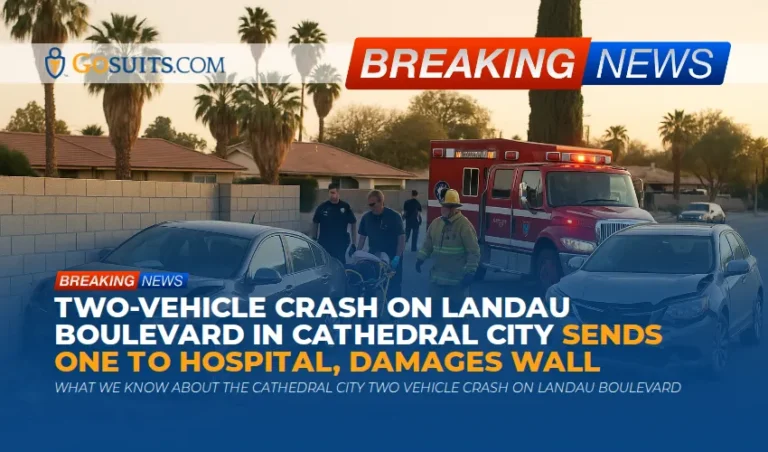
According to local reporting, a two vehicle collision in Cathedral City sent one person to the hospital with moderate injuries on Tuesday evening. Police said it happened just before 6:30 p.m. near the 30600 block of Landau Boulevard, in a residential area. After the initial impact, both vehicles continued forward and struck a nearby wall. Emergency crews evaluated multiple people at the scene. One person was transported to a local hospital, and others were treated for minor injuries on site. The cause remains under investigation, and officers have not released details about contributing factors at this time.
Landau Boulevard is a familiar north south spine for many families in Cathedral City and the broader Coachella Valley, connecting neighborhoods and schools to main east west routes like Ramon Road and Vista Chino. An evening crash in this corridor affects not just those involved but nearby households who heard the impact and saw the emergency response. When a wall is damaged, it can also create follow on concerns for property owners about safety and repairs while the scene is being cleared.
Because the collision is under investigation, it is normal for Cathedral City Police Department to withhold certain details while officers collect statements, diagram the scene, and review any available video. Injured people, passengers, and nearby residents can expect updates as the process moves forward.
Local context, traffic patterns, and conditions along Landau Boulevard
Evening traffic along Landau typically includes local residents returning home, parents heading to and from youth practices, and drivers cutting over to Date Palm Drive or Dinah Shore. Street parking and neighborhood driveways can mean more vehicles entering and exiting the flow, which makes attentive driving essential.
This crash occurred during a period of lingering Santa Ana winds in the region. Those winds can produce gusty crosswinds and blow dust in the Coachella Valley, which reduce visibility and make vehicle control more challenging for drivers, particularly on open stretches or near washes where sand can move quickly. The National Weather Service notes that Santa Ana events can bring strong, dry winds that affect travel and driving conditions in Southern California [1]. There is no confirmation that winds played any role in this incident, but it is fair to acknowledge the conditions many drivers were experiencing around the valley this week.
Intersections, residential feeders, and mid block driveways along Landau require extra caution as drivers turn into and out of neighborhoods. Federal Highway Administration guidance highlights that complex decision making at and near intersections contributes to a significant portion of roadway conflict points and crash risk, underscoring why speed control and clear scanning are so important in places like this [2].
Common causes under investigation in two vehicle collisions
When investigators reconstruct a two vehicle crash where both vehicles traveled into a wall, they often analyze a set of familiar factors. These are general considerations, not findings in this case.
Speed and stopping distance. Even modest increases in speed lengthen stopping distance and reduce the time available to avoid a secondary impact. National data show speed as a frequent contributor to crash severity [3].
Right of way and turns. Failure to yield while turning or entering traffic is a common source of conflict on residential corridors. Investigators look at approach angles, turn signals, and sight lines.
Distraction. Glances away from the roadway, even for a moment, can prevent a driver from seeing braking vehicles or pedestrians crossing to a sidewalk. Phone use and in vehicle distractions are frequent scrutiny points.
Following distance. Tailgating reduces the margin to brake or swerve safely. In corridors like Landau, where driveways and side streets are frequent, conservative spacing is critical.
Visibility and roadway environment. Glare at dusk, dust, or low lighting can complicate a driver’s view of hazards. Investigators may ask about headlights, street lighting, and environmental conditions at the time.
Mechanical condition and roadway surface. Tire condition, braking systems, and even loose sand on the roadway can affect stopping and steering. Skid marks and vehicle event data recorders, when available, help reconstruct what happened.
Because officers reported multiple people were evaluated, they may also gather consistent statements about the sequence of events to help determine fault. This can include diagramming rest positions, wall damage patterns, and collecting any nearby camera footage.
What rights injured people have after a Riverside County traffic crash
California uses a fault based auto insurance system. In general, an injured person may pursue claims against the at fault driver for medical expenses, lost income, pain and suffering, and other damages allowed by law. All drivers are required to maintain financial responsibility that meets minimum limits, though many carry higher coverage [4]. The California Courts’ Self Help Center provides an overview of how personal injury cases work, including the basic elements of proving negligence and proof of damages [5].
Even when one driver appears more responsible, California’s comparative negligence framework allows for shared fault. If both drivers contributed to the crash, each party’s recovery can be reduced by their percentage of responsibility. Passengers are typically not at fault and may bring claims against one or both drivers, depending on the facts.
If the at fault driver’s insurance is limited, underinsured or uninsured motorist coverage on your own policy can help fill the gap. Med Pay coverage, if purchased, can assist with out of pocket medical bills regardless of fault. People in Cathedral City often ask whether they should speak to the other driver’s insurer first. It is generally wise to consult with an attorney before providing recorded statements to any insurer. What someone says can be used later to dispute liability or minimize injuries. This is why many residents choose to speak with seasoned car accident lawyers in Cathedral City to understand options before engaging with claims representatives.
Getting the records you need
Key documents and records can make a significant difference in how an insurance claim is evaluated. For a crash near Landau Boulevard, here are the most relevant sources and how they typically work in California.

Cathedral City Police Department traffic collision report
When a Cathedral City officer responds to a crash with injuries, the department ordinarily generates a traffic collision report. This report can include a diagram, statements, the officer’s observations, and any cited violations. The City’s Police Department Records Unit handles report requests. Public records practices are guided by state law and local policy. If the report is not released immediately, it may be because the investigation is still open or involves sensitive information. The City of Cathedral City’s official website provides information on department services and public records processes for residents and involved parties.
California Highway Patrol reports in other situations
If a collision occurs on a state route or freeway, the California Highway Patrol typically handles the report. Requests for CHP collision reports are made using the agency’s process, which includes verifying your interest in the case and providing details like the date, location, and parties involved [6].
DMV SR 1 report by involved drivers
Under California law, any driver involved in a collision that results in injury or death, or property damage of 1000 dollars or more, must submit a DMV Form SR 1 within 10 days, regardless of who was at fault or whether the incident was reported to police [7]. Failing to file may lead to license consequences. It is a separate requirement from a police report.
Public records and supplemental materials
California’s Public Records Act allows people to request non exempt records from government agencies, including incident logs, 911 audio, and sometimes body worn camera footage. Certain records can be withheld for investigative needs or privacy. The act is codified in Government Code and provides a framework for how agencies process requests [8].
Medical records and EMS run sheets
If an ambulance responded, the responding agency’s medical run report documents observations, vital signs, and care provided. Hospitals maintain emergency room records and imaging. These are protected by privacy laws and can be requested by the patient or an authorized representative.

Coroner and autopsy records in fatal cases
This Cathedral City crash was reported as non fatal. In fatal crashes, however, the county coroner handles examinations and next of kin notifications. Families can request autopsy reports and cause of death determinations according to county procedures and state law.
Neighborhood and roadway cameras
Footage from nearby doorbell cameras, HOA systems, and business security cameras can be pivotal when reconstructing what happened. In residential corridors like Landau Boulevard, neighbors often have motion activated cameras. If you believe a camera captured the incident, move quickly. Many systems overwrite video within days. Asking politely and offering the exact time window can help a neighbor locate and preserve the clip. For a deeper look at how to go about this in California, see Request CCTV Footage After a California Car Accident.
Insurance and property damage claims after a wall impact
Because both vehicles reportedly struck a wall after the initial collision, there are usually two distinct property questions to sort out.
Vehicle damage. Each driver will handle auto repairs through collision coverage or a liability claim against the at fault party. California Department of Insurance consumer materials explain how insurers evaluate auto claims, what estimates may be required, and timelines for fair claims handling [9].
Wall or fence damage. The property owner whose wall was struck has a property claim. If liability is clear, that owner typically submits a claim to the liable driver’s auto carrier for the cost to repair, replace, or rebuild the wall, including cleanup and debris removal. If fault is disputed or shared, multiple insurers may apportion repair costs. When a wall is owned or maintained by a public entity, like a city, there can be additional notice requirements if the owner intends to seek reimbursement or if the city alleges damage by a private party.
Subrogation and coordination. When an auto insurer pays for a homeowner’s wall after a crash, it may later pursue reimbursement from the liable driver’s auto carrier. Documentation matters. Clear photos of the wall damage, contractor estimates, and a timeline of repairs can streamline recovery.
Practical steps for those affected
In the hours and days after a two vehicle crash, small steps can protect health and preserve rights. The following are practical and grounded in California procedures.
- Get medical care, then follow through. Even moderate injuries can evolve. If new symptoms appear, return to a provider. Consistent care documents what is related to the crash.
- Preserve evidence early. Save photos of the scene, vehicle positions, skid marks, and wall damage. Back up phone photos to a secure folder.
- Collect names and contacts. Gather the names of involved drivers, passengers, responding officers, and any neighbors or workers who saw the crash or heard the impact.
- Note the environment. Write down lighting, visibility, wind, and traffic flow as you remember them. If dust or debris was present, note where and approximately how much.
- Request the police report. Track the report number and which officer handled the scene. Contact the Cathedral City Police Department Records Unit to learn when it will be available.
- Mind the DMV SR 1 rule. If your crash qualifies, submit the DMV SR 1 within 10 days. It is required even if a police report exists [7].
- Be cautious with insurers. Before giving a recorded statement, talk with an attorney about your rights. What you say can be used later to challenge fault or injuries.
- Keep a symptom diary. Note sleep changes, pain levels, missed work, and activities you cannot do. This helps explain real life impact.
- Track bills and receipts. Save ER bills, co pays, prescriptions, tow and storage fees, rental car receipts, and contractor estimates for the wall or fence.
Potential civil liability questions this crash may raise
Every collision is unique, but a crash where two vehicles collide and then strike a wall raises recurring civil questions in Riverside County and across California.
Was one driver primarily at fault for the initial collision. Fault analysis usually starts with who had the right of way, whether a lane change or turn was made safely, and how speed and following distance affected the outcome.
Did either driver fail to maintain control after the initial impact. Investigators sometimes distinguish between damages caused by the first collision and those caused by the continuation into a fixed object like a wall.
Are passengers entitled to claims against one or both drivers. Passengers commonly present bodily injury claims to the at fault driver’s insurer. If responsibility is shared, a passenger may pursue both carriers.
What about the property owner whose wall was damaged. The owner has a property claim. If a public entity’s structure was damaged, claims rules can be stricter. California’s Government Claims Act generally requires a written claim to a public entity within six months for claims relating to property damage or personal injury [10].
How do weather and visibility factor into negligence. Weather alone does not excuse careless driving. Drivers are expected to adjust speed and following distance to conditions. Federal guidance emphasizes that adverse weather increases stopping distances and reduces visibility, so safe speed selection is a driver responsibility [11]. The California Driver Handbook reinforces adjusting driving behavior for special conditions [12].
How weather and visibility intersect with liability
In the Coachella Valley, Santa Ana events can push dust across open corridors, with gusts that catch high profile vehicles and even smaller sedans at awkward angles. Federal resources explain that weather affects friction, visibility, and vehicle stability, which is why drivers are urged to slow down and increase following distance when winds pick up or dust reduces sight distance [11]. The state driver handbook applies the same principles, urging caution in high wind areas and during special situations that call for slower speeds and greater space cushions [12].
From a civil negligence perspective, the core question is whether a driver used reasonable care under the conditions. Reasonable care on Landau Boulevard during gusty conditions may mean reducing speed below the posted limit, leaving extra room for braking, and scanning for neighbors backing out of driveways. It can also mean turning on headlights near dusk to increase visibility, making complete stops before turns, and waiting that extra beat for a clear gap. When drivers do not adjust to the conditions, they can be found negligent even if the weather was a contributing factor.
Index of local agencies and community contacts
People in Cathedral City and neighboring communities often want to know where to start. Here is a practical rundown of who to contact and for what, tailored to a two vehicle crash with a wall impact.
- Cathedral City Police Department. Request the traffic collision report from the Records Unit, ask about the report number and availability, and inquire about supplemental records such as incident logs or 911 call times. The City’s official website provides department information and records request guidance.
- California Department of Motor Vehicles. File the SR 1 crash report if required within 10 days, and contact the DMV for questions about financial responsibility and potential license impacts if insurance information is incomplete [7].
- California Highway Patrol. If you are unsure which agency handled the report or if a state route was involved, CHP has a collision report request process for incidents they investigated [6].
- Treating hospital or clinic. Obtain ER records, imaging, and discharge instructions. Request a copy of the ambulance run sheet if transported.
- Property owner or HOA for the damaged wall. Coordinate on safety, temporary shoring, and estimates. The owner will need documentation for repairs and any insurer communications.
- Insurance carriers. Report the loss and open a claim once you have spoken with an attorney about your rights and the best sequence for communications. Keep claim numbers handy for both auto and property damage files.
- County coroner, in fatal cases. For crashes involving a fatality, the county coroner handles examinations and reports according to state law. Families can request copies once available.
- Weather information. The National Weather Service office serving the Coachella Valley provides updates on strong winds, dust advisories, and visibility impacts that can help document conditions around the time of the crash [1].
Call to Action: Steps people can take next
When a neighborhood crash injures someone and damages a wall, uncertainty is common. Acting steadily and in the right order can reduce stress and prevent avoidable mistakes. Here is what should be done, why it matters, and why timing counts.
- Prioritize health, then documentation. Seek medical care, then gather photos, witness names, and any video. Early documentation preserves details that fade quickly.
- Secure video evidence fast. Many home cameras overwrite footage within days. Politely ask neighbors on or near Landau Boulevard who may have captured the impact or its aftermath. Moving quickly prevents key clips from being lost.
- Request the police report and track the file. Getting the report number and confirming the Records Unit timeline ensures you are ready to respond when insurers request documentation. Reports often anchor fault discussions.
- Protect yourself in insurance talks. Consider advice from an attorney before recorded statements. Early statements can be misinterpreted, especially while injured or on medication. Knowing what to say, and what to avoid, prevents unintentional harm to a claim.
- File required forms on time. The DMV SR 1 has a 10 day window in qualifying crashes. Missing that window risks license consequences and can complicate insurance handling [7].
- Coordinate wall repairs thoughtfully. Temporary shoring and prompt estimates help restore safety and support a smooth property claim. Keep all invoices and correspondence organized to avoid delays.

Commentary from Gosuits Cathedral City, California Personal Injury Attorney
Our thoughts are with everyone hurt and shaken by the collision along Landau Boulevard. An evening crash in a residential area can rattle a whole block. Please know that what follows is educational and general. Every case is different, and people should get guidance tailored to their situation.
From what has been shared publicly, this was a two vehicle impact followed by a secondary strike into a wall. That sequence raises familiar questions about right of way, speed, spacing, and control after impact. Investigators will look for consistent witness accounts and video, if any exists. In our view, preserving nearby camera footage and promptly obtaining the police report are two of the most important steps after an incident like this.
Insurance companies and large corporations often hold the informational upper hand. They know how recorded statements get used later, what documents matter most, and how to frame fault discussions to their advantage. Many people do not realize that a simple off the cuff comment about not seeing the other car can be turned into an argument that they were inattentive, even if that is not the full story. We see carriers request broad medical authorizations that go far beyond the injuries at issue, or try to get quick signatures on property settlements before the full scope of the damage is documented.
That is why getting a free consultation before engaging with insurers is so beneficial. A quick conversation helps people understand their rights, the order of operations, and how to avoid avoidable pitfalls. Speaking with an attorney before making claims calls can also help ensure that required forms like the DMV SR 1 are handled properly and that statements do not get misused.
References
- Santa Ana Winds – National Weather Service San Diego
- Intersection Safety – Federal Highway Administration
- Speeding – National Highway Traffic Safety Administration
- Insurance Requirements – California DMV
- Personal Injury Basics – California Courts
- Collision Report Request – California Highway Patrol
- Accident Reporting Requirements, Form SR 1 – California DMV
- Government Code 7920.000, California Public Records Act – California Legislature
- Automobile Claims Guide – California Department of Insurance
- Government Code 911.2, Claims Presentation Deadline – California Legislature
- Weather Impacts on Safety and Mobility – Federal Highway Administration
- Handling Accidents and Special Situations – California Driver Handbook, DMV
- City Services and Police Department Information – City of Cathedral City