- What we know about the Highland and Del Rosa crash in San Bernardino
- Emergency response and what investigators will assess
- Why multi-vehicle crashes can lead to vehicle fires
- What families and survivors can do now in San Bernardino
- Getting key records in San Bernardino County
- Civil liability after a fatal crash in California
- Insurance coverage in multi-vehicle collisions
- Local safety context around Highland Avenue and Del Rosa Avenue
- How California civil claims unfold after a fatal crash
- Important next steps and timing considerations
- Commentary from Gosuits San Bernardino, California Personal Injury Attorney
- References
What we know about the Highland and Del Rosa crash in San Bernardino
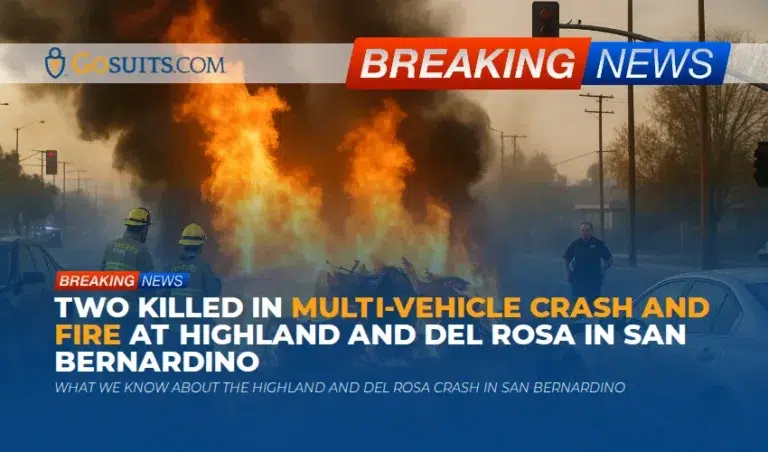
On Wednesday morning, January 14, 2026, a multi-vehicle crash at the intersection of Highland Avenue and Del Rosa Avenue in San Bernardino turned deadly. According to the San Bernardino County Fire Department, crews arrived around 7:15 a.m. to find three vehicles with active fire and occupants trapped. Two people, each in separate vehicles, were pronounced dead at the scene. A woman was transported to a hospital with minor injuries. Authorities closed the intersection in all directions while the investigation continued. The cause has not yet been determined.
This intersection sits on a busy east-west corridor that parallels the 210 Freeway and connects neighborhoods near Perris Hill and Del Rosa to workplaces and schools across the city. Around 7:15 a.m., traffic is often dense with commuters and school drop-offs. The nearby foothills can also cast a shifting morning glare across Highland Avenue in winter. Investigators will look at all environmental factors, but as of now, no official cause has been released.
When an incident like this happens so close to neighborhoods under the Del Rosa banner and just a few minutes’ drive from San Bernardino International Airport, it resonates deeply. Many locals know this crossroads, whether driving up to the 210, heading toward Pacific High School to the west, or connecting to residential streets that run north into the foothills. The community impact is felt immediately, especially when fire is involved and the road remains shut for hours.
Emergency response and what investigators will assess
The first moments after a crash with fire are about life safety: extinguishing flames, extricating occupants, and stabilizing the scene so paramedics and firefighters can work quickly. County fire crews reported the difficult combination of active fire and trapped occupants. In these situations, fire conditions can rapidly change, and responders balance suppression with rescue operations.
Once a scene is secure, law enforcement typically assumes the lead for crash investigation. On city streets, that may be the San Bernardino Police Department’s Traffic Unit, with support from specialized reconstruction personnel if needed. Investigators often consider:
- Sequence of impacts. Which vehicle struck first and where, and whether secondary impacts occurred.
- Signal timing and right-of-way. Whether any driver proceeded against a red light or failed to yield.
- Speed, visibility, and roadway conditions. Lighting at 7:15 a.m., weather, surface conditions, and potential obstructions.
- Mechanical issues. Braking systems, fuel system integrity, and whether any pre-impact defect contributed.
- Driver factors. Distraction, impairment indicators, or fatigue, based on evidence gathered.
- Physical evidence. Skid marks, fluid trails, debris fields, and vehicle resting positions to reconstruct dynamics.
- Data and video. Event data recorders, nearby business or traffic cameras, and witness statements.
Intersection safety and conflict points are well studied, and many serious injuries occur at signalized crossings, especially during peak travel windows. The Federal Highway Administration’s guidance on intersection safety provides context on the heightened risk of crashes where crossing traffic flows meet [7].
Why multi-vehicle crashes can lead to vehicle fires
Vehicle fires after a collision are not common relative to all crashes, but when they occur, outcomes can be catastrophic. Multi-vehicle incidents increase the chance of post-impact fuel leaks or electrical short circuits that ignite under-hood or fuel tank areas. A secondary impact can compromise fuel lines or battery housings, especially when one vehicle is forced into another at awkward angles.
National data summarized by the U.S. Fire Administration shows that highway vehicle fires frequently involve component failures or malfunctions and can escalate rapidly, limiting escape time for occupants and complicating rescue operations [6]. Even when initial injuries might be survivable, superheated smoke and toxic gases can be fatal within minutes. That is why first arriving units often attack fire while also forcing entry for extrication. In a three-vehicle scenario, multiple fire sources and fuel exposures can exist, making suppression more complex.
What families and survivors can do now in San Bernardino
No one expects to navigate records requests or insurance calls in the middle of grief. Still, certain early steps can protect access to information and preserve rights in the weeks ahead. Locally focused actions include:

Notify insurance, but consult counsel first
If a vehicle was involved, a claim must usually be reported to the insurance carrier within a short period. However, it is generally wise to speak with a qualified attorney before giving any recorded statement. What someone says to an insurer can be used against them later if fault is disputed. Many families in San Bernardino choose to consult with Los Angeles car accident lawyers to understand their rights before engaging with claim adjusters. An initial consultation can clarify coverage layers, claim timelines, and how to avoid common pitfalls without committing to any decision.
Request the collision report when available
Police or traffic collision reports are often released after the initial investigation is completed and approved. On city streets, the San Bernardino Police Department typically manages report distribution. If a state route were involved, the California Highway Patrol would handle it, but this crash occurred on local roads. In any California crash with injury or death, a separate DMV form called SR-1 must be submitted within 10 days by drivers or their representatives, regardless of fault. The DMV explains this requirement and how to file the report [1]. If a driver is deceased, an authorized representative can complete the SR-1 on their behalf.
Coordinate with the San Bernardino County Sheriff Coroner
When a death occurs, the county coroner investigates cause and manner of death. California law outlines the coroner’s duties to inquire into sudden or unusual deaths and those resulting from crashes [12]. Next of kin typically have the right to request certain reports and arrange for the release of remains once permitted. While families often work through a funeral home, contacting the San Bernardino County Sheriff Coroner’s Division can help clarify timelines and request procedures. Coroner protocols and timing vary based on investigative needs.
Preserve vehicles and personal effects
After a major collision with fire, vehicles may be moved to an impound or storage yard. If a civil claim is possible, vehicle preservation matters. Physical inspection can reveal key evidence such as fuel system rupture points, airbag module data, and the direction and magnitude of forces. Where possible, avoid authorizing disposal or salvage until counsel can evaluate the need for an inspection by qualified investigators. In California civil cases, courts can instruct juries on spoliation if evidence is destroyed, which can affect how a case is viewed. Maintaining the condition of critical items helps ensure a fair evaluation of what happened.
Gather medical records and bills
Survivors treated at area hospitals have a right to access their medical records. Federal rules protect the right of patients to obtain copies of their health information in a reasonably prompt manner, often within 30 days, with limited exceptions [11]. Keeping organized copies of ambulance records, emergency department notes, imaging, and discharge papers will help when insurance reviews begin.
Identify witnesses and potential video
Highland Avenue is lined with businesses and multifamily residences. Witnesses may have seen pre-impact driving behavior or signal phases, and some storefronts may have exterior cameras. The California Public Records Act can sometimes be used to request certain traffic camera or city-held recordings that pertain to the incident, subject to exemptions and retention policies [2][10]. Private camera footage can disappear when owners overwrite recordings, so timely requests are crucial.
Getting key records in San Bernardino County
Families often ask where to start for official documentation. Here are the typical record sources connected to a fatal multi-vehicle crash in San Bernardino:
- Traffic collision report. Usually through the San Bernardino Police Department’s Records Division once the report is finalized. If another agency assisted or took the lead, that agency would be the point of contact.
- DMV SR-1 accident report. Required for crashes involving injury, death, or specified property damage. Instructions are on the DMV site [1].
- Coroner records. The San Bernardino County Sheriff Coroner handles death investigations and maintains coroner case files according to state law [12].
- Medical records. Obtainable directly from hospitals and clinics by the patient or an authorized representative, consistent with federal access rights [11].
- Public records requests. Depending on the item, a request under the California Public Records Act may help obtain certain city or county-held materials, subject to exemptions and retention schedules [2][10].
- Roadway and signal data. If relevant, traffic engineering data and signal timing plans may be requested from the city. For state routes, Caltrans often maintains records, and current closures appear on QuickMap [9].
Civil liability after a fatal crash in California
It is too early to say what caused this crash. Investigators will determine whether any driver error, mechanical defect, or other hazard played a role. From a civil perspective, several pathways may exist in serious intersection collisions, depending on the facts:
- Negligent driving by one or more motorists. Running a red light, speeding for conditions, or failing to yield can support a claim by injured parties or families of those who died.
- Employer liability. If a driver was on the job during the crash, a claim could reach an employer under respondeat superior, if supported by the facts.
- Defective parts or maintenance. Brake failures, fuel system defects, or faulty repairs may trigger product liability or negligent maintenance claims if evidence supports it.
- Public entity liability. Only if a dangerous condition on public property contributed and legal prerequisites are met. Claims against public entities follow strict, earlier deadlines than typical lawsuits [5].
California allows certain family members to bring a wrongful death claim when a person’s death is caused by the wrongful act or neglect of another. Those rights and eligible claimants are described in the Code of Civil Procedure [3]. A separate survival action can sometimes allow the decedent’s estate to recover certain damages the person incurred between injury and death. These and other claims can run in parallel with probate steps if needed, which the California Courts self-help materials explain in general terms [14].
Insurance coverage in multi-vehicle collisions
With three vehicles and multiple victims, insurance coverage can be complex. Several coverages may be in play at once:
- Liability insurance of at-fault driver(s). Covers injuries and wrongful death claims up to policy limits, if fault is established.
- Uninsured or underinsured motorist coverage. Can apply when at-fault limits are too low relative to losses.
- Medical payments coverage. Sometimes available to cover initial medical costs regardless of fault.
- Employer and commercial policies. If any vehicle was used for work, business policies could be involved.
Insurers allocate limited policy limits among multiple claimants based on negotiations and, at times, interpleader actions. Understanding sequencing is important, especially when stacking is limited by policy language and state rules. The California Department of Insurance maintains consumer-facing guidance and rules against unfair claims practices that can affect how adjusters must handle communications and settlement negotiations [13]. Families sometimes consult car accident lawyers to help map coverage layers, protect statements, and manage competing deadlines.
For a plain-language overview about whether professional help is appropriate in this area, many readers find this guide useful: do i need a personal injury lawyer in san bernardino. It walks through common decision points without assuming a particular outcome.
Local safety context around Highland Avenue and Del Rosa Avenue
Highland Avenue serves as a major arterial in north San Bernardino, paralleling the 210 and connecting residential streets like Del Rosa Avenue to retail, schools, and freeway on-ramps. Morning traffic can be brisk with drivers filtering to and from University Parkway, Base Line Street, and 210 access points. Intersections like Highland and Del Rosa manage crossing flows, left turns, pedestrian crossings, and buses, which increases conflict points. FHWA materials note that the combination of turning movements and through traffic at intersections often correlates with more severe crashes, particularly during peak hours [7].
Locals know the area’s rhythm. The sun can sit low in winter, fog can settle some mornings, and school zones are active across the Highland corridor. Investigators will consider the signal timing, recent road work, and the pattern of prior incidents in the area. If road closures persist, Caltrans QuickMap is a reliable resource for travelers to check mainline freeway impacts and state-route conditions, though city-street closures sometimes require local advisories [9].
How California civil claims unfold after a fatal crash
Understanding the general pathway can lower anxiety and help families plan next steps. While every case is different, common threads include:
- Claim setup and investigation. Notices to insurers, obtaining collision reports, and preserving evidence. If a public entity may be involved, a Government Claims Act filing is due within six months of the incident in many cases [5].
- Identifying claimants and damages. In a wrongful death claim, California law specifies who can file and what damages may be pursued [3]. Separate estate-related steps may involve the probate court [14].
- Settlement efforts. Once liability and damages are assessed, parties may negotiate. If policy limits are insufficient and multiple claimants exist, allocation becomes central.
- Filing suit if necessary. California’s general statute of limitations for personal injury is two years from the date of injury or death, with exceptions that can alter the timeline [4]. Public entity cases have earlier claim deadlines as noted above [5].
- Comparative fault considerations. California applies comparative fault principles, meaning a claimant’s damages may be reduced by any percentage of fault assigned to them. How that interacts with multi-vehicle facts is often a key issue at intersections.
Separately, accurate traffic records and crash data help case assessments and policy decisions. NHTSA provides national frameworks for traffic records and data that local agencies use to improve safety and understand crash circumstances [8].
Important next steps and timing considerations
In the wake of a fatal or serious intersection crash, there are practical actions that help protect rights and improve clarity for everyone involved. Acting sooner rather than later can make a meaningful difference because evidence and memories fade quickly.
- Document everything promptly. Keep a timeline of events, collect medical bills and records, and save photos of injuries and property damage.
- Request key records early. Collision reports, coroner findings, and any available video should be requested as soon as feasible. Public agency records may require time to process under the California Public Records Act [2][10].
- Preserve vehicles before disposal. Fire-damaged vehicles can still hold critical clues. Arranging inspections before salvage can be pivotal in understanding causation.
- Avoid recorded statements before guidance. Insurers move quickly. Statements can affect liability determinations and settlement posture later.
- Track legal deadlines. The general two-year window for personal injury or wrongful death, and the six-month Government Claims Act deadline when a public entity is implicated, are key timers [4][5].
- Consider knowledgeable guidance. Multi-vehicle fires and intersection dynamics raise complex fault and coverage issues. Consulting car accident lawyers can help clarify options and reduce the risk of missed deadlines or incomplete documentation.
Another reason to act sooner is practical: businesses often overwrite security video within days, and potential witnesses who pass through the Highland and Del Rosa corridor may be hard to locate later. Caltrans QuickMap is useful for immediate travel planning, but for evidence preservation the window is much shorter [9].
Commentary from Gosuits San Bernardino, California Personal Injury Attorney
Our hearts are with everyone touched by this tragic crash at Highland and Del Rosa. Losing loved ones at a neighborhood intersection is a shock no family can prepare for. This article shares general information to help the community understand what happens next and where key answers may come from.
Based on what has been reported so far, investigators are facing a complex scene: three vehicles, active fire, trapped occupants, and two lives lost before they could be transported. In multi-vehicle intersection cases, a careful reconstruction is essential to determine the sequence of impacts, who had the right-of-way, and whether any defect or environmental factor played a role. The presence of fire adds urgency because it can obscure physical evidence and accelerate timelines for vehicle preservation.
Insurance companies and large corporations know the rules, and they know how to use timelines and technicalities to their advantage. Adjusters may reach out quickly, request recorded statements, and push for broad authorizations or fast releases. Most people are not thinking about long-term consequences when they are still processing shock and grief. That is exactly when statements can be used in ways that later limit recovery or complicate fault analysis. Understanding policy limits, priority of payments, and how multiple claimants are treated is not intuitive. Having a seasoned advocate on your side can level the field.
When in doubt, it is prudent to obtain a free consultation before engaging with insurers. A conversation focused on preserving evidence, protecting statements, and tracking statutory deadlines can prevent avoidable problems. It also gives space to ask questions about wrongful death rights, survival claims, and how coroner and collision reports fit together in the civil process.
References
- Accident Reporting Requirements – California DMV
- California Public Records Act, Government Code §6250 – California Legislature
- Wrongful Death Statute, CCP §377.60 – California Legislature
- Statute of Limitations for Personal Injury, CCP §335.1 – California Legislature
- Government Claims Act Deadline, Gov. Code §911.2 – California Legislature
- Highway Vehicle Fires – U.S. Fire Administration
- Intersection Safety – Federal Highway Administration
- Traffic Records and Crash Data – National Highway Traffic Safety Administration
- Caltrans QuickMap – California Department of Transportation
- Public Records Act Overview – California Department of Justice
- Right of Access to Health Information – U.S. Department of Health and Human Services
- Coroner Duties, Gov. Code §27491 – California Legislature
- Unfair Insurance Practices, Ins. Code §790.03 – California Department of Insurance
- Probate and Estates Overview – California Courts