- What happened on the Kennedy near Damen Avenue
- Why rollovers and multi-vehicle crashes happen on I-90/94
- Rights of injured passengers and drivers after a Chicago car accident
- Immediate safety, medical, and documentation steps
- How to get official records in Chicago and Cook County
- Common injuries in rollovers and multi-vehicle collisions
- Potential liability issues unique to interstate crashes
- Illinois data and safety context for interstate crashes
- What to do in the next 48 hours after a Chicago interstate crash
- Commentary from Gosuits Chicago, Illinois Personal Injury Attorney
What happened on the Kennedy near Damen Avenue
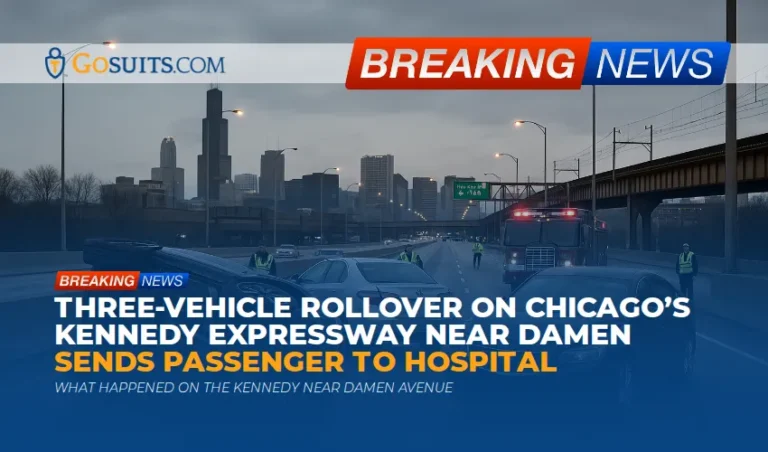
In the early morning hours, just before 5 a.m., Illinois State Police reported a three vehicle crash on the outbound Kennedy Expressway, I-90/94, near Damen Avenue. According to the information released, a black Chevrolet, a silver Toyota, and a black Infiniti were involved. One of the vehicles rolled onto its side. A passenger from one of the cars was transported to a nearby hospital in an unspecified condition. Multiple outbound lanes were closed during the response and investigation, and all lanes reopened later that morning. The investigation remained active in the hours that followed.
If you drive this corridor, the location is familiar. Damen Avenue runs adjacent to Wicker Park and Bucktown, just northwest of downtown. The Damen Blue Line station and the series of tight merges and exit ramps nearby can create complicated traffic patterns, especially during pre-dawn hours when speeds vary and visibility can be challenging in winter. This crash underscores how quickly a routine early commute through West Town can change.
At this stage, officials have not publicly identified who may have been at fault, nor have they released specific details about the cause. As with many Chicago car accident incidents on the Kennedy, investigators typically examine vehicle movements, lane changes, speed, lighting, roadway conditions, and possible driver impairment or distraction before reaching conclusions.
Location and timing
The reported time of 4:51 a.m. places the incident in reduced natural light and before the peak rush. In late December, road surfaces can be cold, and intermittent precipitation or residual moisture from overnight can create slick spots. While no specific weather factor has been confirmed, early morning conditions can heighten risk on elevated stretches of the Kennedy through Goose Island and West Town.
Vehicles involved and rollover
Three passenger vehicles were involved, with one rollover onto its side. Rollover dynamics often involve abrupt steering inputs, multi vehicle impacts, striking barriers, or tripping on curbs or debris. On expressways with narrow shoulders, once a vehicle is destabilized, it may tip and slide, making secondary impacts possible.
Injuries and response
One passenger was hospitalized. Chicago OEMC typically coordinates fire and EMS dispatch to interstate incidents, while Illinois State Police lead the crash investigation on I-90/94. Emergency Traffic Patrol units and IDOT HELP trucks often help set up traffic control, clear vehicles, and reduce secondary crashes while lanes are closed.
Traffic impact
Lanes were closed during the response. The Federal Highway Administration notes that rapid, coordinated Traffic Incident Management is vital to reduce secondary collisions and minimize total closures on urban interstates. You can read more about federal TIM practices through the FHWA Operations program at ops.fhwa.dot.gov.
Why rollovers and multi-vehicle crashes happen on I-90/94
Drivers who use the Kennedy know how quickly speeds and spacing can change, especially where exits and merges cluster close together. Although the specific cause of this collision has not been publicly determined, a few common factors often play roles in similar events.
Rollover mechanics in brief
NHTSA explains that rollovers can occur when a vehicle’s lateral motion is suddenly redirected, when a vehicle trips on a guardrail or curb, or when a multi vehicle impact changes a car’s trajectory. Top heavy vehicles have higher rollover propensity, but any vehicle can roll under certain conditions. For foundational safety guidance on rollovers and restraint use, see NHTSA’s overview at nhtsa.gov/rollover and seat belt information at nhtsa.gov/risky-driving/seat-belts.
Early morning and winter specifics in Chicago
In December, overnight lows, light freezing drizzle, and black ice can show up without much warning on elevated and shaded sections of I-90/94. Even when the pavement looks dry near Noble Square, a patch under a viaduct or over a bridge deck can be slick. Headlights reflecting off the roadway can mask thin ice. While weather for this crash has not been specified, recognizing these seasonal realities helps drivers understand why pre dawn Kennedy travel can be unforgiving.
Complex merge areas around Damen
Just south and north of Damen, drivers encounter short on ramps, off ramps, and shifting queues, especially when construction or lane closures are in play. Lane changes under pressure create conflict points. Small timing errors, like glancing away or misjudging gap size, can quickly escalate into a multi vehicle collision.
Rights of injured passengers and drivers after a Chicago car accident
When a passenger is hurt in a Chicago car accident on the Kennedy, several legal and insurance pathways may be available. Every case turns on specific facts, but a general framework can help people understand the process while they gather records and consider next steps.

Fault and comparative negligence in Illinois
Illinois follows modified comparative negligence. Under 735 ILCS 5/2 1116, a claimant’s recovery is reduced by their percentage of fault, and recovery is barred if that fault exceeds 50 percent. You can review the statute on the Illinois General Assembly site at ilga.gov. For passengers, comparative fault is often minimal, but there can be disputes about seat belt use or actions that might have contributed to injury severity. Evidence is key.
Passenger claims against one or more drivers
In a three vehicle crash, responsibility can rest with a single driver or be apportioned among multiple drivers. An injured passenger may pursue claims against the at fault driver of their own vehicle, another driver, or both, depending on investigative findings. Each driver’s liability insurer may conduct separate evaluations, and coordination becomes important to avoid inconsistent statements.
Insurance coverage layers
Illinois is a fault state for auto insurance. Liability insurance pays for injuries and property damage the insured causes. The Illinois Department of Insurance provides consumer facing guidance on auto policies and coverages at insurance.illinois.gov. Potential coverages that may come into play include the following.
- Liability coverage of at fault drivers for medical bills, lost income, and other legally recoverable damages.
- Uninsured and underinsured motorist coverage if the at fault driver lacks insurance or lacks enough coverage.
- Medical payments coverage on a policy that can help pay initial medical costs regardless of fault.
Minimum required limits in Illinois are relatively modest, so in serious injury cases, underinsured motorist claims may become important. Every policy is different, so reading the declarations and endorsements matters.
Time limits to file
For many personal injury claims in Illinois, a two year statute of limitations applies under 735 ILCS 5/13 202. The statute is posted at ilga.gov. There are exceptions and special rules for claims involving certain public entities or minors, which is why documenting the date and nature of the injury early is so important.
Immediate safety, medical, and documentation steps
Right after a collision, it is hard to think clearly. Even when injuries seem minor, following a few grounded steps can protect health and preserve important information.
Medical care and symptom tracking
- Get checked promptly. Adrenaline can mask pain. Concussions, internal injuries, or spinal issues may not show symptoms immediately. The CDC provides practical guidance on concussion symptoms and when to seek care at cdc.gov/traumaticbraininjury.
- Save discharge papers. Keep hospital wristbands, discharge instructions, imaging CDs, and any referrals for follow up.
- Track symptoms. Note headaches, dizziness, sleep changes, numbness, or anxiety. These details matter for both treatment and any future claim.
Scene and vehicle documentation
- Photos and video. If safe, capture the vehicle resting positions, debris fields, skid marks, and damage points. Include signage or landmarks like the Damen exit boards, the Blue Line viaducts, or nearby mile markers.
- Witness details. Independent witnesses can clarify sequence in a multi vehicle crash. Names and contact details are often lost if not gathered immediately.
- Preserve the vehicle. Do not authorize disposal. Significant vehicle damage can be vital evidence of force and direction of impacts.
Insurance and recorded statements
Before reaching out to any insurer, consider consulting a seasoned attorney first. Insurance adjusters may request recorded statements quickly. What is said to an insurance company can be used later to limit or deny claims. A brief consultation can help clarify rights and obligations, including when and how to notify carriers.
How to get official records in Chicago and Cook County
Collecting official documents helps establish what happened and supports any insurance or personal injury claim after a Chicago car accident. For interstate incidents like those on I-90/94, state and city agencies both may hold relevant records.
Illinois State Police traffic crash report
For crashes on the Kennedy Expressway, Illinois State Police prepare the traffic crash report. ISP provides a public crash report portal and instructions at isp.illinois.gov/CrashReports. You will typically need the date, approximate time, location, and names of drivers or the report number once assigned.
Illinois Motorist Report to IDOT if required
Illinois may require motorists to file an Illinois Motorist Report in certain circumstances if a police report was not filed at the scene or for property damage above statutory thresholds. IDOT’s information and online portal are available at idot.illinois.gov. Always verify whether your situation requires this report and pay attention to deadlines.

911 event numbers and OEMC records
Chicago’s Office of Emergency Management and Communications manages 911 call taking and dispatch. For records such as 911 call logs or CAD event information, see OEMC’s public resources and FOIA instructions at chicago.gov. Retention periods can be short, so request records promptly.
Traffic camera and expressway video
Some IDOT or OEMC traffic cameras capture live feeds. Storage and retention vary, and many cameras do not archive footage. For potential availability, consider a timely FOIA request to IDOT or OEMC. Visit idot.illinois.gov for agency contacts and FOIA procedures, and chicago.gov for OEMC.
Towed vehicle location and release
Expressway tows within the city may end up at a City Auto Pound. The City’s towed vehicle portal and information hub can be accessed through chicago.gov. Have the license plate, VIN, or location and date of the crash ready.
Hospital and medical records
Patients generally have a right to obtain their medical records. The U.S. Department of Health and Human Services explains individual access rights under HIPAA at hhs.gov. Hospitals will typically require a signed authorization and may charge reasonable copying fees.
In fatal cases, Cook County Medical Examiner
While this particular crash involved an injured passenger and no reported fatality, families dealing with other incidents can seek information from the Cook County Medical Examiner regarding autopsy reports and cause of death findings. See the Medical Examiner’s office at cookcountyil.gov. Requests should be made quickly due to high volumes and processing times.
Common injuries in rollovers and multi-vehicle collisions
Vehicle rollovers and chain reaction impacts can transmit complex forces through occupants’ bodies. Even with airbags and belts, occupants may experience twisting, side loading, and secondary strikes inside the cabin.
Head and brain injuries
Concussions and other traumatic brain injuries can occur without loss of consciousness. Symptoms may include headaches, light sensitivity, memory lapses, irritability, and sleep disruptions. The CDC offers readable guides on TBI signs and recovery at cdc.gov. Timely evaluation and follow up are important, even when CT scans are normal, because symptoms can evolve.
Spinal, neck, and back trauma
Whiplash type injuries are common in multi vehicle crashes, particularly with side impacts or when a vehicle rolls. More serious cases involve herniated discs or fractures. Early conservative care, physical therapy, and imaging can guide recovery and reduce the risk of chronic pain.
Fractures, chest, and internal injuries
Seat belts save lives, yet they can contribute to bruising or rib injuries in high force impacts. Side curtain airbags help in rollovers, but limbs may still be injured when the vehicle tips. Abdominal pain, shortness of breath, or dizziness later in the day can signal internal injury and should prompt medical evaluation.
Psychological injuries
Anxiety, insomnia, and driving avoidance are common after a serious crash. Documenting these symptoms and seeking counseling when needed is a reasonable part of recovery. They are real injuries that can affect work, family, and quality of life.
Potential liability issues unique to interstate crashes
Urban interstates create unique dynamics that can complicate how liability is evaluated in a crash investigation and in subsequent insurance handling.
Multiple drivers and comparative fault
In a three vehicle collision, different drivers may assert that another’s sudden lane change, abrupt braking, or failure to maintain lane control caused the crash. Under Illinois’ modified comparative negligence framework, adjusters and courts may assign percentages of fault to each party. Witness statements, dashcam footage, EDR data from vehicles, and physical evidence like scrape marks on barriers can be decisive.
Commercial vehicles and layered responsibility
While this reported incident involved passenger cars, the Kennedy routinely carries semis and 18 wheelers. In other crashes involving a tractor trailer or big rig, additional parties may be implicated, such as the motor carrier, a shipping broker, or a maintenance contractor. Federal regulations, driver hours of service, and equipment inspections can become part of the evidence picture on I-90/94.
Roadway conditions and third party claims
If debris, a spill, or a roadway defect contributed, timely notice to IDOT may be important. Document the hazard with photos and exact location information. Some claims against public entities have additional requirements and shorter deadlines, so early consultation can help clarify options.
Passengers and rideshares
When a passenger is injured in a rideshare situation or in a friend’s car, coverage coordination matters. Claims may involve the driver’s liability insurer and, if another driver caused the crash, that driver’s policy too. In certain pedestrian accident or bike related incidents on or near ramps, different liability questions arise, particularly if a pedestrian is struck during a stop on the shoulder or during post crash movements.
Illinois data and safety context for interstate crashes
Illinois Department of Transportation publishes annual Crash Facts and statistics that break down crashes by roadway type, crash type, injury severity, and location. Those publications provide a data backbone for safety planning and show that urban interstate corridors in and around Cook County are frequent sites of injury producing crashes due to traffic volumes and speed differentials. For the latest Crash Facts and yearbooks, visit idot.illinois.gov.
The Federal Highway Administration also highlights the importance of incident clearance on busy corridors to prevent secondary crashes, which can account for a meaningful portion of total incidents during peak congestion. More on Traffic Incident Management is available at ops.fhwa.dot.gov.

What to do in the next 48 hours after a Chicago interstate crash
Time matters after a Kennedy Expressway collision. The following steps are practical, time sensitive, and focused on health and documentation. They are educational in nature.
- Seek a clinical evaluation. Even if EMTs cleared everyone at the scene, schedule a same day or next day visit. Document all symptoms, including headaches, neck pain, and dizziness.
- Preserve vehicles and parts. Do not authorize repairs or disposal until after photos and, if appropriate, an independent inspection. Save broken parts, detached panels, or seat belt components if accessible.
- Collect official records. Request the Illinois State Police crash report through isp.illinois.gov. If applicable, check whether an Illinois Motorist Report filing is required through idot.illinois.gov.
- Note the tow destination. Use the City’s towed vehicle portal at chicago.gov to locate a vehicle if it left the scene with a tow operator.
- Start a symptom and expense log. Keep a simple notebook or digital log of symptoms, missed work, co pays, prescriptions, rides to medical appointments, and out of pocket costs.
- Talk with a qualified attorney before insurers. An initial case review can help determine what to report, to whom, and when. Statements given to insurance adjusters can be used later, so preparation matters.
Commentary from Gosuits Chicago, Illinois Personal Injury Attorney
Our hearts go out to everyone affected by this early morning Kennedy Expressway crash near Damen. A rollover and multi vehicle event is frightening at any hour, and even more so in winter when visibility and traction can change by the minute. This discussion is for educational purposes and general information only.
From a civil injury perspective, three vehicle collisions raise familiar questions. How did the sequence start, and where did each vehicle end up. Were there abrupt lane changes, a sudden stop, or a tripping event that led to the rollover. Independent witnesses, dashcam footage, and the eventual Illinois State Police crash report can help resolve those questions. On the Kennedy, tight merges and uneven speeds often turn a small mistake into a significant collision, so carefully reconstructing the moments before impact is crucial.
Insurance companies and large corporations build their processes to minimize payouts. Early recorded statements are often requested when people are still in shock. Descriptions of pain are discounted if not documented in the first medical visit. Property damage photos may be framed to suggest minor impacts even when internal vehicle structures took significant force. Without guidance, many people unknowingly give up leverage by authorizing broad medical releases or by agreeing to quick, insufficient settlements before the full extent of injuries is known.
That is why a free consultation can be so important. It allows a person to understand the claims landscape, the coverage layers that might apply, and how Illinois’ comparative negligence rules work in practice, all before speaking to insurers. Knowing which documents to request, how to preserve electronic evidence, and when to seek specialist medical follow up can change outcomes. This is not legal advice, but it is a reminder that informed steps taken early often protect both health and rights after a Chicago car accident on I-90/94.
Additional local context and practical tips
People who live and work in West Town, Wicker Park, Bucktown, and Logan Square know the Kennedy’s rhythms. In winter, watch for shaded spots near overpasses and along the viaducts close to the Damen and Division exits. If traffic suddenly slows as you crest a rise, leave wide following distances. If a crash occurs ahead, do not brake hard in the middle lane if an exit is within reach, and avoid abrupt lane changes that can trigger secondary collisions.
If you must stop, position the vehicle as far to the right as safely possible, turn on hazard lights, and stay inside with seat belts fastened if there is active traffic around. The FHWA’s guidance on incident scene safety emphasizes limiting exposure to passing vehicles and using upstream warnings whenever possible. Chicago’s Emergency Traffic Patrol units are out there to help. Patience and predictable movements reduce risk for everyone until first responders clear the scene.
How common legal issues connect to real life after a crash
When someone is injured in a collision, they may have a personal injury claim to pursue medical expenses, lost income, and other legally recognized damages. On crowded urban interstates, securing fair consideration often hinges on timely evidence. In some situations, crashes involve a semi or an 18 wheeler, and claims can expand to include the motor carrier. In others, a motorcycle accident in a lane split scenario, or a pedestrian accident near a shoulder or ramp, raises unique duty and visibility questions. Each has its own evidence priorities and insurance questions. The common denominator is early, organized action and care with insurer communications.
Verified resources cited
- Illinois State Police Traffic Crash Reports
- Illinois Motorist Report, IDOT
- IDOT Illinois Roadway Crash Data and Crash Facts
- FHWA Operations, Traffic Incident Management
- NHTSA Rollover Information
- NHTSA Seat Belt Safety
- CDC Traumatic Brain Injury Resources
- Illinois Department of Insurance, Auto Insurance
- 735 ILCS 5/2-1116, Comparative Negligence
- 735 ILCS 5/13-202, Statute of Limitations for Injury
- Chicago OEMC
- City of Chicago Towed Vehicles
- Cook County Medical Examiner
- HHS HIPAA Individual Rights