- What we know about the I-94 rollover crash near Libertyville
- Time and location details
- Vehicles and people involved
- Early findings from Illinois State Police
- Legal and safety takeaways for Illinois drivers
- How multi-vehicle tollway crashes are typically investigated
- Insurance basics after a three-vehicle crash
- What to do next if you were injured
- Who to call in Lake County for official records and help
- Common injuries in rollovers and truck-involved collisions
- Preserving evidence along the I-94 corridor
- Call to action: time-sensitive steps that protect a potential claim
- Commentary from Gosuits Libertyville, Illinois Personal Injury Attorney
What we know about the I-94 rollover crash near Libertyville
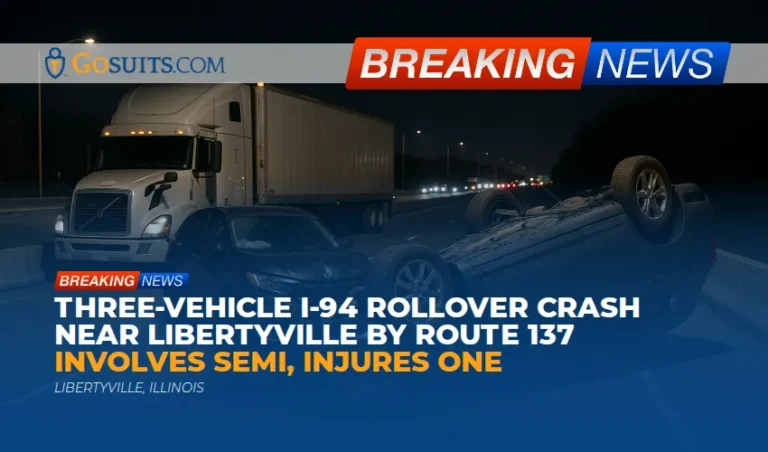
A three-vehicle collision just after midnight on Interstate 94 near Libertyville left one driver seriously hurt and a compact SUV rolled over. According to initial reports, a 34-year-old Park City man in a 2006 Toyota RAV4 sideswiped a 2025 Honda HR-V while traveling westbound, which is also signed as the northbound lanes in that stretch of I-94. The Toyota overturned, the Honda spun, and then struck both a semi-tractor-trailer and the center median. This crash occurred at milepost 14, near the Route 137 interchange, a spot familiar to Lake County commuters heading toward the Tri State Tollway’s Lake Forest area and the nearby oasis. Illinois State Police Troop 3 and Libertyville Fire Department responded at approximately 12:25 a.m. The Toyota driver was taken to Advocate Condell Medical Center in Libertyville with serious but non-life-threatening injuries. The Honda’s driver and two passengers from Antioch, and the semi driver, were reported uninjured at the scene. Crashes like this resonate with our community because many of us regularly drive this corridor to and from Libertyville’s downtown, the Libertyville Sports Complex, Independence Grove Forest Preserve, and neighboring towns like Gurnee and Lake Forest. Late-night traffic, changing lighting, and lane merges around interchanges can be a tricky mix.
Time and location details
The collision was reported around 12:25 a.m. on April 4. It happened on I-94 westbound at milepost 14 near the Route 137 area that feeds Libertyville and Green Oaks. In this section, drivers often think of I-94 as westbound, although the roadway is also signed as northbound. That dual orientation can be confusing for out-of-area motorists. Nighttime conditions can reduce depth perception and reaction time. Even at normal highway speeds, a sudden lane deviation or sideswipe can set off a chain reaction that is hard to correct in the dark.
Vehicles and people involved
Three vehicles were part of the incident: – A 2006 Toyota RAV4 driven by a 34-year-old man from Park City. – A 2025 Honda HR-V driven by a 25-year-old man from Antioch, with two passengers from Antioch onboard. – A semi-tractor-trailer. Only the Toyota driver was reported injured seriously. The Honda’s occupants and the semi driver were uninjured. The Honda and Toyota were directly involved in the sideswipe and rollover sequence, while the semi suffered impact when the Honda spun into it and the median.
Early findings from Illinois State Police
Illinois State Police Troop 3 conducted the preliminary investigation. Early indications are that the Toyota, traveling westbound, sideswiped the Honda. The Toyota then rolled over and the Honda spun, striking the semi and center median. Troopers cited the Toyota driver for failure to reduce speed to avoid a crash. Under Illinois law, drivers must always control their speed to avoid colliding with any person or vehicle, having due regard for traffic and roadway conditions [1]. A basic citation is not the end of the inquiry. Crash reconstruction, vehicle inspections, dashcam reviews, and witness statements can all factor into final findings. But at the earliest stage, the failure-to-reduce-speed ticket signals an initial assessment that speed or speed control was not adequate for the circumstances.

Legal and safety takeaways for Illinois drivers
– Speed must be reasonable and proper at all times. Illinois law requires drivers to regulate speed according to conditions and to control it to avoid collisions [1]. At night on I-94, that can mean easing off the accelerator, increasing following distance, and being deliberate with lane changes near interchanges like Route 137. – Comparative negligence may apply. Illinois follows modified comparative negligence with a 51 percent bar. A claimant whose fault exceeds 50 percent is barred from recovery, and any compensation is reduced by their percentage of fault if it is 50 percent or less [2]. In multi-vehicle chain reactions, responsibility can be apportioned among more than one driver depending on the evidence. – There are time limits. In most Illinois personal injury cases, the statute of limitations is two years from the date of injury, though there are exceptions that can shorten or extend deadlines [3]. Preserving evidence early often affects outcomes months later. – Trucks bring unique hazards and data. When a semi is involved, investigators and insurers often look at blind spots, lane position, and whether the truck had any evasive options. Federal rules also shape how motor carriers keep post-crash records, which can matter in evidence preservation [12].
How multi-vehicle tollway crashes are typically investigated
When Illinois State Police handle a multi-vehicle crash on the Tri State Tollway, several steps typically occur: – Troopers secure the scene, often closing lanes briefly. They note skid marks, debris fields, final rest positions, and vehicle damage. – Photo documentation and measurements are taken. If there is a rollover, roof crush, glass ejection paths, and tire condition may be documented. – Vehicle inspections might follow, especially if a mechanical failure is suspected. For trucks, compliance and condition logs can be relevant. – Witness statements and any available dashcam or in-cab video are sought early. Modern vehicles and commercial trucks may also store electronic data about speed and brake application shortly before impact. – A written crash report is generated, which can later be requested through the Illinois State Police crash records process [4].
Insurance basics after a three-vehicle crash
Chain-reaction crashes raise immediate questions: Which insurer pays first? How do property damage and bodily injury claims get sorted when multiple vehicles and a commercial truck are involved? The usual path is that the at-fault driver’s liability coverage is primary for injuries and property damage they caused. But apportioning responsibility might require a deeper look at all drivers’ actions and the sequence of impacts. Many people call car accident lawyers after a three-vehicle chain reaction because multiple carriers may try to shift blame, and early recorded statements can be used strategically by insurers. Before calling any adjuster, consider speaking with a lawyer in a free consultation to understand your rights and the risks of going it alone. In collisions that involve both passenger vehicles and a semi, it is common to have separate adjusters for each policy, which can lead to delays. Medical payments coverage or personal health insurance might help with immediate bills, subject to later reimbursement rules. Uninsured or underinsured motorist coverage can also come into play if a negligent driver’s policy is insufficient, and Illinois law requires proof of insurance coverage for drivers [7]. For a deeper primer on claim priority, see Which insurance pays first after a multi car crash. When dealing with multi-vehicle injuries along I-94, car accident lawyers in Chicago are often familiar with the tug-of-war that can happen between carriers when there is a rollover, a sideswipe, and a commercial vehicle in the mix. That local familiarity with tollway patterns and common dispute points can help keep the claim focused on facts and documentation rather than speculation.
What to do next if you were injured
Not every injury is obvious at the scene, especially after a rollover or seatbelt load. Adrenaline, shock, and late-night disorientation can mask symptoms. If you or someone you know was involved in a similar crash in the Libertyville area, these steps can help protect health and a potential civil claim: – Seek prompt medical evaluation. Even if you walked away, get checked. Concussions and soft-tissue injuries often show clearer symptoms in the days that follow. Documenting complaints early creates a reliable medical timeline [5]. – Preserve your photos and notes. If you took pictures or short video clips of the scene, vehicles, and roadway, back them up. Write down how the crash unfolded in your own words while details are fresh. – Do not repair or dispose of the car yet. If your vehicle was towed to a yard near Libertyville or Gurnee, hold off on repairs until you have clarified your next steps. Vehicle damage photos and on-car data can be crucial. – Contact an attorney before you speak to any insurer. What you say in an early phone call can be used to minimize or deny parts of your claim later. A free consultation can help you understand how to report the claim accurately without hurting your own case. – Request the official crash report. Illinois State Police provide crash reports through their records system; get the report number if possible and follow ISP’s instructions to obtain a copy [4]. – Let your own insurer know, carefully. Most policies require prompt notice. Keep your statement factual and brief until you have legal guidance.

Who to call in Lake County for official records and help
– Illinois State Police crash report. If Troop 3 handled the scene, you can request the official report through the Illinois State Police crash records portal. You may need the date, location, milepost, and involved names to search [4]. – Medical records. Advocate Condell Medical Center and any clinics or physical therapy providers will have visit summaries and imaging records. Keep all discharge instructions and prescriptions. While these aren’t government records, they are part of the proof of injury. – Lake County FOIA for certain public records. For county-held documents, including some emergency communications records, you can use the county’s Freedom of Information Act process. Note that some 911 recordings or dispatch logs may be exempt or partially redacted for privacy or ongoing investigations [10]. – Lake County Coroner. In crashes with fatalities, the Coroner’s Office manages death investigations and, when appropriate, autopsies. Families can call to understand next steps and how reports are released. For this Libertyville crash, authorities reported no fatalities, but the Coroner’s Office information is included here for families who may face other, similar situations [8]. – IDOT crash data and safety resources. The Illinois Department of Transportation publishes traffic safety and crash data that can help contextualize roadway risks statewide [6]. While not specific to one incident, these resources help explain broader safety patterns.
Common injuries in rollovers and truck-involved collisions
Rollover dynamics differ from typical rear-end or intersection crashes. Occupants may experience abrupt changes in direction, roof crush, side airbag deployment, and multiple secondary impacts. Common injuries include: – Head and brain injuries such as concussions, dizziness, headaches, or memory issues that can appear hours or days later. – Neck and back trauma, including sprain-strain injuries and, in some cases, disc involvement due to sudden rotational forces. – Seatbelt and torso injuries, with bruising or rib strains from restraint systems that did their job during the rollover. – Lacerations and contusions from broken glass and interior contact. NHTSA’s rollover safety guidance underscores just how unforgiving rollovers can be and why thorough evaluation after such crashes matters, even if you feel fine at first [5]. When a semi is involved, differences in height, mass, and stopping distance can amplify forces for occupants of smaller vehicles. That mismatch is one reason multi-vehicle crashes involving large trucks often require careful reconstruction and medical follow-up [6].
Preserving evidence along the I-94 corridor
In Lake County, timely evidence collection can be the difference between a clear claim and a contested one. Consider the following: – Vehicle EDR data. Many modern vehicles record speed, brake application, and throttle in the seconds before a crash. Ask your attorney about preserving this data before the car is repaired or totaled. – Truck records. Federal regulations require motor carriers to maintain certain post-crash records. Preserving relevant logs, any in-cab video, and post-crash inspection notes often requires sending a prompt preservation letter [12]. – Scene photographs and mapping. Nighttime lighting, lane markings near Route 137, and shoulder conditions can all be relevant. Photos from the same time of night are especially helpful to show visibility. – Witness contact information. If you or a passenger collected names or numbers, safeguard that list. Independent witnesses are often key in sideswipe and lane-change disputes. – Medical timeline. Keep a running log of symptoms, missed work, and activity limitations. This timeline helps connect the dots between the crash and its impact on daily life.
Call to action: time-sensitive steps that protect a potential claim
Here is what should be done promptly after a serious crash on I-94 near Libertyville, and why timing matters: – Secure the ISP crash report. The official report anchors the claim narrative. Waiting months can make it harder to correct errors or locate witnesses [4]. – Get medical follow-up within days. Early care helps your health and creates contemporaneous documentation that insurers often demand to see [5]. – Consult an attorney before speaking with insurance. In multi-vehicle collisions, multiple insurers may call for recorded statements. Without guidance, a simple phrasing mistake can be used to limit or deny parts of a claim. A free consultation helps set a safe course. – Preserve physical and digital evidence. Tow yards move vehicles quickly. Data can be overwritten. Swift preservation requests keep crucial proof from disappearing. – Watch the legal clock. The general two-year limitation for Illinois injury claims can pass faster than expected when treatment and vehicle issues take center stage [3]. Acting early keeps more options open.
Commentary from Gosuits Libertyville, Illinois Personal Injury Attorney
Our thoughts are with everyone affected by this overnight rollover on I-94. Crashes at that hour can be disorienting and frightening, even for uninjured occupants. This commentary is for general information and education only. From what officials have shared so far, the initial citation for failure to reduce speed to avoid a crash points toward the Toyota’s lane position and speed control as likely contributors. In chain-reaction events, responsibility can be shared if the evidence supports it, but early indications here align with a sideswipe that set the sequence in motion. A thorough review of physical evidence, vehicle data, and witness accounts would be needed to confirm final civil liability. Insurance carriers and large corporations know how to control the narrative early. They often seek recorded statements quickly, ask broad medical authorization questions, and sometimes nudge people toward accepting early, incomplete assessments of fault. Without context, answers given in those first calls can be used to narrow or weaken a claim later. A free consultation can be important before any insurance discussion. It helps level the playing field, clarifies which documents to gather first, and outlines how to protect the claim while you focus on medical care. No one should have to guess their way through multi-vehicle insurance issues after a rollover on a tollway in the middle of the night.
Additional local context that matters
Nighttime driving patterns near Libertyville are unique. The stretch around Route 137 sees a mix of long-haul trucking and local traffic returning from late shifts in Lake Forest, Vernon Hills, and Gurnee. Lighting transitions near interchanges and the curve alignments can complicate lane changes. As the community heads into spring with more evening activities at places like Cook Park and Independence Grove, keeping extra space and scanning ahead on I-94 is as practical as it is lawful.

Rights and next steps
If injuries appear in the days after a crash like this, document symptoms, request the ISP report, and line up medical follow-up. Before giving any recorded statement, consider getting clear guidance on what to share and what to hold until the full picture is known. The law expects all drivers to control speed to avoid collisions, and evidence gathered early is what ultimately shows how each driver measured up to that duty [1].
References
- 625 ILCS 5/11-601: General speed restrictions – Illinois General Assembly
- 735 ILCS 5/2-1116: Comparative fault – Illinois General Assembly
- 735 ILCS 5/13-202: Personal actions – Statute of limitations – Illinois General Assembly
- Traffic Crash Reports – Illinois State Police
- Rollover – National Highway Traffic Safety Administration
- Large Truck Crash Causation Study – Federal Motor Carrier Safety Administration
- Mandatory Insurance – Illinois Secretary of State
- Coroner – Lake County, Illinois
- Scott’s Law Move Over – Illinois State Police
- FOIA: Freedom of Information Act – Lake County, Illinois
- Traffic Safety Facts and Data – NHTSA
- 49 CFR 390.15: Assistance in investigations and special studies – eCFR