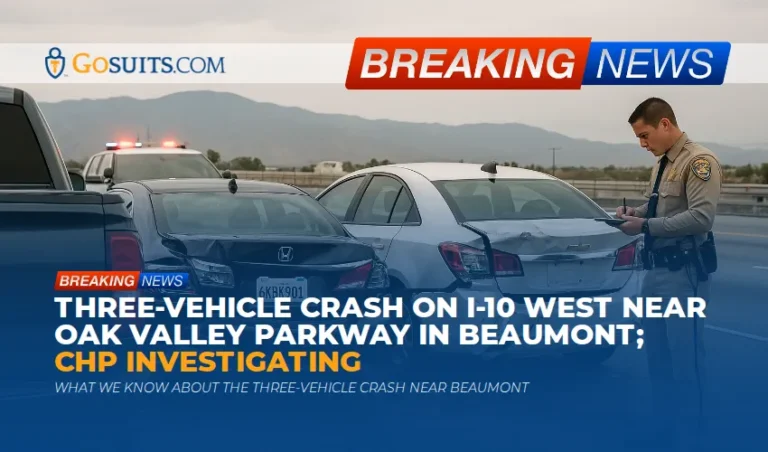
- What we know about the three-vehicle crash near Beaumont
- Local context on I-10 westbound near Oak Valley Parkway
- Immediate health and safety steps after a freeway crash
- How CHP investigates multi-vehicle freeway collisions
- Evidence to preserve early in a three-vehicle crash
- How to get the collision report, DMV filings, and medical records
- Liability and insurance in multi-vehicle freeway crashes
- Riverside County and state resources you can contact
- Filing insurance and potential government-related claims: timing matters
- Community notes and local care options
- What to do now and why timing matters
- Commentary from Gosuits Beaumont, California Personal Injury Attorney
- References
What we know about the three-vehicle crash near Beaumont
California Highway Patrol reported a three-vehicle crash on the westbound Redlands 10 Freeway near Oak Valley Parkway around 12:30 p.m. on Sunday. At least one person was transported to a hospital. As of the initial report, the total number of occupants and injuries had not been confirmed, and the cause remained under investigation. The number one and number two lanes were blocked for a time, with westbound traffic backing up toward Pennsylvania Avenue while first responders worked at the scene.
That stretch of I-10 serves residents of Beaumont and Banning and a steady stream of pass-through traffic headed toward the Inland Empire and the Coachella Valley. When incidents occur there on a weekend afternoon, backups can grow quickly while CHP secures the scene and tow operators clear vehicles.
Local context on I-10 westbound near Oak Valley Parkway
Locals know the San Gorgonio Pass can feel unforgiving. Winds funnel through the pass, visibility can vary, and heavy commuter and freight traffic frequently shares the same corridor. The Oak Valley Parkway interchange is a familiar landmark for Beaumont and nearby communities. Midday incidents on westbound I-10 can ripple into neighborhood arteries and on-ramps, especially near Pennsylvania Avenue and Cherry Valley Boulevard as drivers try to reroute.
Caltrans District 8 manages this corridor for both Riverside and San Bernardino counties, coordinating with CHP during incidents and using traffic management tools to post lane closure updates and controlled traffic breaks when needed [5]. For those stuck in backups, patience is difficult but critical for keeping secondary crashes from happening in the queue behind an initial collision.
Immediate health and safety steps after a freeway crash
After a freeway collision, health comes first. Even if you feel steady at the scene, the adrenaline can mask symptoms. A mild headache or stiffness in the shoulder can evolve into something more serious in the hours and days that follow. National safety guidance encourages people involved in a crash to seek medical evaluation and to monitor for delayed symptoms, especially head, neck, or back pain, dizziness, nausea, confusion, or new numbness or weakness [8] [9].
Here are practical safety reminders many people find helpful right after a freeway incident:
- Move to safety if you can. On high-speed roads, getting to the shoulder or off the freeway reduces the risk of a secondary impact. Use hazard lights if the vehicle is drivable [8].
- Do not stand between vehicles. Even in a minor crash, vehicles can shift. Keep a safe buffer from moving traffic.
- Document basic details. Photos of vehicle positions, lane markings, debris fields, and any visible injuries can be extremely helpful later.
- Collect and share only essential information at the scene. Exchange insurance and driver identification details. Save detailed descriptions for your written notes and for your own insurer.
- Get medical care promptly. Follow up with urgent care or an emergency department if you have symptoms, and keep all discharge instructions and imaging results.
How CHP investigates multi-vehicle freeway collisions
CHP’s first priority is scene safety and preventing additional crashes. Troopers secure lanes, request fire and EMS support, and coordinate towing. For a three-vehicle chain collision, they typically document:
- Vehicle positions and damage profiles to help reconstruct the sequence of impacts.
- Skid, yaw, and debris patterns along the lane lines and shoulders.
- Driver statements and witness accounts gathered at the scene when possible.
- Roadway and environmental factors, including visibility, surface conditions, and nearby work zones [1].
Once the scene is cleared, an official collision report is prepared. This report, requested through the appropriate CHP Area Office using a specific form, becomes a key document for insurance claims and any civil case that might follow [2]. If a commercial vehicle is involved, inspectors may also review compliance items like hours of service and maintenance records, though nothing reported so far confirms a commercial vehicle in this crash. The cause will remain “under investigation” until the reporting officer finalizes their findings.

Evidence to preserve early in a three-vehicle crash
Three-vehicle incidents can involve multiple points of impact and different narratives about what happened first. Preserving evidence early helps promote an accurate reconstruction:
- Scene photos and video. Capture wide shots for context and close-ups of crush damage, bumper height transfers, airbag deployment, and any roadway gouges or fluid trails.
- Dashcam footage. Save raw files and note the date and time. Back up to cloud or a second device immediately.
- Witness information. Names, phone numbers, and a one-sentence description of what they saw. Independent witnesses are particularly valuable.
- Vehicle data. Many modern vehicles store pre-crash data in event data recorders. That information may require professional retrieval to preserve correctly.
- Medical documentation. Keep every visit summary, imaging disc, physical therapy plan, and receipts for out-of-pocket costs. Organized files reduce disputes later.
Traffic management cameras sometimes capture incidents or the moments leading up to them. Availability and retention vary across agencies and systems. Because some feeds are not retained for long, timely requests are essential. Caltrans operates regional traffic management centers and publishes live traffic conditions and lane closures through QuickMap and district channels [5]. If you believe a public agency may have relevant video, act quickly to preserve it.
How to get the collision report, DMV filings, and medical records
Requesting the CHP collision report
Collision reports for freeway crashes are maintained by the CHP Area Office that handled the investigation. To request a report, use the CHP’s standardized process and form. You will need details like the date, time, location, and the names of involved parties if known [2]. If you are unsure which office responded, you can locate the correct Area Office through the CHP “Find an Office” directory and confirm the report number and availability window before sending your request [1].
California DMV accident reporting requirement
Separate from the police report, California requires drivers to submit the SR 1 form within 10 days when a crash involves injury, death, or property damage over a specified threshold. Completing the SR 1 is a driver’s responsibility and applies even if law enforcement also filed a report. The form and instructions are hosted by the California DMV [3]. Be accurate and concise, and keep a copy for your records.
Coroner information if a fatality occurs
If a loss of life occurs in a motor vehicle collision in Riverside County, the Coroner division of the Riverside County Sheriff’s Office provides information on investigations, identification, and how next of kin can request reports [4]. While the crash near Oak Valley Parkway was reported with at least one person hospitalized and no fatalities confirmed at the time of reporting, families often ask where to turn if the worst happens. That resource is included here for awareness.
Obtaining your medical records
Individuals have a right under federal law to access their own medical records, including emergency department notes, imaging, and billing ledgers. Hospitals and clinics provide these upon request, often through health information management portals. The U.S. Department of Health and Human Services outlines these rights and typical timelines for fulfillment [10]. If you plan to make an insurance claim, keep records organized from day one.
Liability and insurance in multi-vehicle freeway crashes
Common liability patterns in three-vehicle crashes
Three-vehicle collisions on a freeway can occur in many ways. One common pattern involves a rear impact that pushes a vehicle forward into another, creating two impact points. Another pattern is a sudden lane change into slower traffic, triggering abrupt braking and multiple rear-end impacts. Weather, visibility, and road design also play roles. Investigators look at impact geometry, crush patterns, and statements to sort out whether one driver’s negligence set off a chain reaction or whether multiple drivers share responsibility. National safety authorities advise careful documentation of the scene because multi-vehicle crashes can involve complex causal chains that are not apparent at first glance [8].
In California, civil responsibility for a collision is governed by comparative fault. That means more than one party can be assigned a percentage of responsibility, and damages are allocated accordingly. When the crash involves a public roadway feature or a government vehicle, specialized rules and timelines may apply, which are discussed later in this article [6] [7].
Insurance coverages that may apply
Multi-vehicle incidents can implicate several layers of coverage:
- Liability coverage. Pays for damage and injuries the at-fault driver legally owes.
- Medical payments coverage. May cover initial medical costs regardless of fault, depending on your policy.
- Uninsured and underinsured motorist. If an at-fault driver lacks adequate insurance, your UM or UIM can step in.
- Collision coverage. Repairs or replaces your own vehicle subject to your deductible.
When multiple insurers are involved, questions arise about sequencing and primary versus excess coverage. For a practical overview tailored to a three-vehicle scenario, see Which insurance pays first after a multi car crash.
Insurance carriers sometimes move quickly to record statements or propose early resolutions. Before speaking with any insurer, it is wise to consult a qualified attorney to understand your rights and obligations. What someone says in an early phone call can be used to dispute liability or downplay injuries later. Many look to car accident lawyers for guidance on how to protect their claims while the facts are still being gathered.
Those in the Pass area may prefer to talk with Beaumont car accident lawyers who know the local roadway patterns and agencies. Local familiarity helps when coordinating with the CHP Area Office, Caltrans District 8, or nearby hospitals that treated the injuries.
Riverside County and state resources you can contact
Here are public agencies and offices that routinely assist after freeway crashes in the Beaumont and Banning region:
- California Highway Patrol Area Offices. Use the CHP directory to find the Area Office that investigated the collision and request the report or confirm availability windows [1] [2].
- California DMV. Access the SR 1 accident reporting form and instructions for injury or property-damage crashes meeting the reporting criteria [3].
- Riverside County Sheriff Coroner. For families facing a fatality, the Coroner’s webpage explains report requests and next steps [4].
- Caltrans QuickMap and District 8. Check official updates about lane closures, incidents, and traffic conditions for the I-10 corridor [5].
- California Department of Insurance. If coverage issues arise or a claim is mishandled, consumer assistance and complaint processes are available [11].
Filing insurance and potential government-related claims: timing matters
Most auto claims start with notifying the liable driver’s insurer and your own carrier. Even then, it is prudent to speak with counsel first so you understand what to say and what not to say. California’s general statute of limitations for personal injury is two years from the date of injury, with different rules for minors and other exceptions that may toll or shorten deadlines. The law is codified at Code of Civil Procedure section 335.1 [6].
If a roadway condition, construction-zone layout, or a government vehicle is potentially implicated, California’s Government Claims Act imposes a much shorter timeline for presenting a claim to a public entity before any lawsuit can be filed, commonly as short as six months from the date of the incident in many cases. Caltrans provides public information about how to present a claim related to its roadways and operations [7]. These government claims deadlines are strict, so do not wait to investigate that angle if it may apply.
When multiple insurers are involved in a three-vehicle collision, coordinating property damage and bodily-injury claims can become a juggling act. Some people prefer to have car accident lawyers organize communications to reduce the chance of inconsistent statements between carriers and to keep medical billing and lien issues in order. Keeping a single, coherent timeline of care and a clear record of expenses can save months of back-and-forth later.
You can also review practical guidance on preserving and organizing documentation in multi-vehicle cases in our resource on Which insurance pays first after a multi car crash. It explains how liability findings and policy language influence the order in which insurers pay.
If you prefer to handle early steps yourself, consider writing out a brief, factual incident summary with the date, time, exact location near Oak Valley Parkway, lane positions, and all known contact and policy numbers. Share that same summary consistently if you must talk to insurers, and avoid speculating about fault while the official report is pending.
Community notes and local care options
Residents of Beaumont and Banning know that serious injuries are often treated within the Inland Empire’s trauma network. Depending on the severity and transport decisions by EMS, patients may be treated at regional trauma centers or nearby hospitals. California’s Emergency Medical Services Authority oversees local trauma systems and the designation of trauma centers [12]. In this corridor, it is common for responders to consider facilities in Riverside or San Bernardino counties based on patient condition and travel time.
For non-emergency follow-up, local clinics and primary-care providers can help coordinate imaging, referrals, and physical therapy. Keep copies of all referrals and imaging discs, and bring them to follow-up appointments so treating providers can see the same information your emergency team used on day one.
What to do now and why timing matters
Here is a practical, time-sensitive roadmap that many people use after a freeway collision in the Pass area:
- Secure key documents in the first 48 hours. Save scene photos, witness contacts, the tow yard’s information, and any hospital discharge paperwork. Create a single digital folder so nothing gets lost.
- Request the collision report at the right time. CHP reports are not always available immediately. Call the Area Office listed for the incident and ask when to submit your request [1] [2].
- Calendar your DMV SR 1 deadline. If the statutory criteria apply, submit the SR 1 within 10 days to avoid penalties or license complications [3].
- Speak with an attorney before you speak with insurers. A brief consultation can help you avoid statements that later get used to dispute fault or minimize injuries.
- Track medical care and time missed. Start a simple log of symptoms, appointments, receipts, and lost workdays. These details matter when insurers evaluate claims.
- Act quickly if a public entity may be involved. Government claim deadlines often run in months, not years. Early investigation preserves your options [7].
The benefit of acting now is clarity. Evidence is fresher, memories are sharper, and official records can be requested while agencies still have them readily at hand. That often shortens the total time it takes to resolve property damage and medical billing issues down the road.
People who plan to seek guidance sometimes prefer to start with car accident lawyers who will review the police report, medical timeline, and insurance layers. An early conversation can help set a safe course before claim adjusters begin asking detailed questions.
Commentary from Gosuits Beaumont, California Personal Injury Attorney
Our hearts are with everyone affected by this three-vehicle crash on westbound I-10 near Oak Valley Parkway. Freeway collisions can upend ordinary Sundays in an instant. This note is offered for general information to help the community understand the process and resources available while the investigation continues.
In a three-car freeway incident, it is common for the first hours and days to feel confusing. Vehicles may have sustained multiple impacts, statements can differ, and injuries sometimes appear late. That is why the official collision report, photos, and medical documentation become so important. They help anchor the facts and reduce disagreements about what happened and when.
Insurance companies and large corporations are trained to move fast after a crash. Adjusters may reach out early to get recorded statements or to suggest a quick property or injury resolution before the full extent of the harm is known. Those early conversations can shape how a claim is evaluated later, and they can be used to question credibility or to dispute liability. It is not unusual for people to feel overwhelmed by multiple carriers calling from different angles in a three-vehicle crash.
A free consultation can make a real difference. It gives people a chance to understand their rights and obligations before they speak with any insurer. It also creates a plan for gathering the right records and dealing with medical billing so nothing falls through the cracks. Knowledge is power, and having a clear roadmap early on tends to prevent avoidable mistakes later.
References
- Find an Office – California Highway Patrol
- Collision Report Request CHP 190 – California Highway Patrol
- Report of Traffic Accident Occurring in California (SR 1) – California DMV
- Coroner – Riverside County Sheriff’s Office
- QuickMap – California Department of Transportation
- Code of Civil Procedure § 335.1 – California Legislative Information
- Claims Against Caltrans – California Department of Transportation
- What to Do After a Crash – National Highway Traffic Safety Administration
- TBI Signs and Symptoms – Centers for Disease Control and Prevention
- Your Rights to Your Medical Records – U.S. Department of Health and Human Services
- Consumer Services and Complaints – California Department of Insurance
- Trauma System – California Emergency Medical Services Authority