- What we know about the I-290 and I-355 fatal rollover in Itasca
- Why crashes into bridge support columns are so deadly
- What investigators will examine and the typical timeline
- Key civil legal considerations after a single vehicle fatal crash
- How to obtain official records — police report, autopsy, death certificate, roadway data
- Support services in DuPage County and statewide
- Insurance issues that arise after a fatal highway crash
- Preserving evidence from the scene and vehicles
- Safety notes for the community along the I-290 corridor
- Commentary from Gosuits Itasca, Illinois Personal Injury Attorney
- Call to Action — What to do next and why timing matters
What we know about the I-290 and I-355 fatal rollover in Itasca
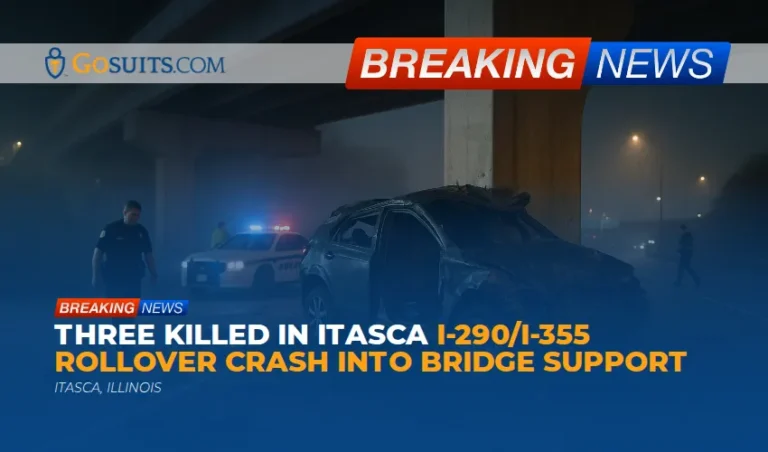
Overnight, near the interchange where I-290 westbound meets I-355 southbound in Itasca, a westbound vehicle reportedly lost control, rolled, and struck a bridge support column. Illinois State Police confirmed three occupants were pronounced deceased on scene. All westbound lanes were shut down for several hours, reopening around 4:15 a.m. according to officials. Investigators documented debris around the bridge pier and a severely damaged vehicle. Other identifying details have not yet been released publicly.
Residents in and around Itasca know that stretch well. It’s a high-speed corridor flanked by the Hamilton Lakes business park and commuter routes feeding O’Hare, Elk Grove Village, Schaumburg, and the Medinah area. When a serious collision happens at that interchange, it affects overnight workers, early commuters, and families heading across the western suburbs. The scale of the response and the length of the closure underscore both the severity of the crash and the care investigators take to determine what happened.
As more information becomes available from law enforcement and county officials, families often need guidance on how to obtain reports, what to expect from the investigation, and which civil options may exist. The sections below offer practical, fact-based steps and resources.
Why crashes into bridge support columns are so deadly
Impacts with rigid roadside structures, like bridge support columns, are unforgiving. There’s little to absorb energy, so occupants experience extreme forces in a fraction of a second. When a rollover is involved before or during impact, the risk of catastrophic injury climbs further. National data consistently show that rollovers, while a smaller share of crashes, account for a disproportionate share of fatalities.
According to federal roadway safety materials, rollovers are strongly associated with speed, loss of control, and tripping mechanisms like curbs or soft shoulders. NHTSA emphasizes that seat belt use dramatically reduces the risk of ejection and death in rollovers, and that stability control technology has reduced rollover crashes, though they remain a major source of fatal injuries nationwide. See NHTSA’s rollover safety overview here: NHTSA — Rollover.
Bridge piers are typically protected by barriers when practical, but not every location can be fully shielded due to geometry and drainage. The Federal Highway Administration provides research and guidance on roadside safety hardware, barriers, and clear zone principles designed to reduce the severity of run-off-road crashes. You can review FHWA’s materials here: FHWA — Roadside Safety.
That said, every site is different. Investigators will look at whether roadway design, signage, lighting, surface conditions, vehicle condition, and dynamics at the moment of loss of control played a role.
What investigators will examine and the typical timeline
In DuPage County, a fatal interstate crash draws a coordinated response. Illinois State Police typically lead on-scene crash reconstruction for incidents on I-290 and I-355. Depending on the hour and location, respondents may include local fire departments from Itasca or nearby communities, county agencies, and the DuPage County Coroner’s Office.
Here’s what a thorough investigation often includes:
- Scene documentation — Scaled measurements, roadway gouge marks, yaw marks, debris fields, impact points, and vehicle final rest positions. Investigators may use total stations or 3D laser scanning.
- Vehicle inspection — Examination of tire condition, steering and suspension components, brakes, restraint systems, and airbag modules. Event Data Recorders, when present and recoverable, may be downloaded for pre-crash speed, throttle, braking, and other parameters.
- Environmental factors — Pavement condition, weather, lighting, signage, and friction testing. High-speed interchanges like this can be affected by sudden lane changes, wet pavement, or micro-grade changes.
- Human factors — Interviews of witnesses, assessment of possible fatigue, distraction, and impairment indicators. The coroner may conduct toxicology where applicable.
Families should expect core reports to take weeks and full reconstruction and toxicology findings to take longer. Autopsy and toxicology reports often require additional laboratory time. Patience is difficult but important, since final determinations can shape insurance coverage and any civil claims.
Key civil legal considerations after a single vehicle fatal crash
Even in a single vehicle crash, possible civil claims can be complex. Without speculating about this specific event, here are categories that sometimes arise in similar tragedies:
- Third-party negligence — Another driver’s sudden unsafe maneuver, debris spilled from a commercial vehicle, or a cut-off that led to evasive action may not leave obvious evidence without a careful review of witness accounts or camera footage.
- Roadway design and maintenance — Claims may involve questions about barrier placement, signage, lighting, drainage, or pavement condition. State and local immunity laws, claim notice requirements, and engineering standards are all specialized issues that must be evaluated case by case. FHWA provides general standards resources linked above.
- Product liability — Tire failures, steering component defects, seat belt failures, or airbag non-deployments can be implicated in some cases. This requires preservation and expert examination of components.
- Employer or commercial liability — If occupants were in the course of employment, workers’ compensation or third-party claims may be triggered.
In Illinois, two statutes often frame fatal crash claims. The Wrongful Death Act allows recovery for the benefit of next of kin, while the Survival Act preserves the decedent’s own claims that existed before death. You can read the statutes here:
- Illinois Wrongful Death Act — 740 ILCS 180
- Illinois Survival Act — 755 ILCS 5/27-6
Illinois also follows a modified comparative fault rule in civil cases, found at 735 ILCS 5/2-1116. Generally, recovery is barred if a plaintiff is more than 50 percent at fault. The statute is here: 735 ILCS 5/2-1116. How these rules apply depends on detailed facts and should be evaluated carefully.
Timelines matter in civil cases. Illinois law sets filing deadlines that can be short, with some exceptions and special notice rules when government entities are implicated. The precise deadline varies with the claim type, the parties involved, and the facts, so early evaluation is prudent.

How to obtain official records — police report, autopsy, death certificate, roadway data
Official documents help families understand what happened and can be essential to insurance and civil claims. Here are the primary sources for records related to a fatal interstate crash in DuPage County.
Illinois State Police traffic crash reports
For crashes investigated by Illinois State Police, certified crash reports are typically available online once approved. Use the ISP portal: Illinois State Police — Traffic Crash Reports. You may need the report number, date, and location. Fatal crash supplements and reconstruction reports can take longer to finalize.
DuPage County Coroner — autopsy and records
The coroner investigates deaths resulting from motor vehicle crashes and can provide autopsy and toxicology results to the legal next of kin when complete. Visit the office page for contact information and procedural guidance: DuPage County Coroner.
If you need broader records, the county’s Freedom of Information Act portal can direct requests to the right office: DuPage County FOIA. Keep in mind that certain materials may be exempt or withheld while investigations are open.
Death certificates
Certified death certificates are usually obtained through the county clerk where the death occurred. For DuPage County, see: DuPage County Clerk — Vital Records. Statewide information from the Illinois Department of Public Health is here: IDPH — Death Records.
Roadway crash data and safety context
For context about crash frequencies and roadway safety in Illinois, IDOT publishes crash data tools and summaries here: IDOT — Illinois Roadway Crash Data. While this will not speak to any single crash, it can help families understand trends and regional risks on high-speed corridors like I-290 and I-355.
Support services in DuPage County and statewide
Grief after a sudden loss is heavy and disorienting. Balanced with necessities like funeral planning and documents, it can be overwhelming. Public resources can help, even if only to provide a starting point.
- County-level assistance — The DuPage County Coroner can answer process questions about autopsy status and release. For certified copies of death records, the DuPage County Clerk handles vital records.
- Public health guidance — Coping with grief, managing stress, and supporting children after a loss are addressed in resources from CDC: CDC — Grief and Loss.
- Crash data and safety outreach — IDOT’s safety pages offer statewide initiatives and data that can be useful for community understanding: IDOT — Safety and Crash Data.
Apart from official sources, many families also lean on local support networks. In Itasca and nearby communities like Wood Dale, Addison, and Elk Grove Village, faith centers, civic groups, and neighborhood associations often organize practical help in the days following a tragedy.
Insurance issues that arise after a fatal highway crash
Insurance coverage after a fatal crash at an interchange like I-290 and I-355 can involve multiple layers. Without drawing conclusions about this specific event, these are common issues that arise:
- Liability coverage — This is the policy of a driver or owner whose negligence caused harm. If another driver contributed, their liability policy may be at issue even in a single vehicle impact scenario.
- Uninsured and underinsured motorist coverage — UM or UIM may apply when a responsible third party is unidentified or lacks sufficient insurance. These claims are made under the decedent’s or a household family member’s policy.
- Medical payments coverage — Some policies include MedPay that can assist with funeral expenses and related costs, regardless of fault, subject to policy terms.
- Commercial and employer policies — If the trip was work related or involved a commercial vehicle, different policy structures and reporting rules apply.
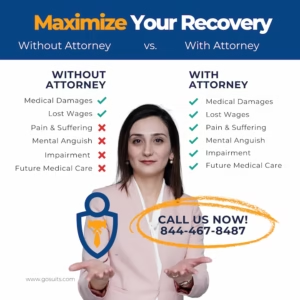
Insurance companies often ask for recorded statements, medical authorizations, or quick settlements. What someone says to an insurer can be used to limit or deny claims later. Before speaking with any insurance adjuster or signing forms, it’s wise to consult an attorney to understand rights and obligations. A free consultation helps clarify coverage, deadlines, and next steps.
Preserving evidence from the scene and vehicles
Evidence can fade quickly on a high-speed corridor like the Eisenhower Extension near Itasca, where maintenance crews clear debris and traffic returns before sunrise. Preserving evidence early can make a substantial difference in determining how and why a crash occurred. Consider these practical measures:
- Secure vehicle access — Ensure the vehicle is not destroyed or salvaged until it can be inspected. Request that the storage facility preserve the vehicle and its components.
- Protect electronic data — Many vehicles contain Event Data Recorders. Prompt notice to involved parties helps avoid data loss during battery disconnects or storage.
- Document the scene — If safe and lawful, collect photos of the area, skid marks, barrier conditions, signage, and lighting. Weather and lighting shortly after the crash can matter.
- Identify witnesses — Night shift drivers, ride-share operators, and nearby maintenance workers sometimes see critical moments. Note names and contact details when possible.
- Preserve personal items — Phones, GPS devices, and dashcams can hold location and video data that may help piece together the minutes before the crash.
Because the Illinois State Police and the DuPage County Coroner manage sensitive evidence in fatal cases, coordinate respectful requests through the appropriate channels. Families should avoid direct interference with official investigations while ensuring their own preservation steps are timely.
Safety notes for the community along the I-290 corridor
Community members in the western suburbs know that the I-290 and I-355 interchange is a fast-moving, multilane area. Weather can change quickly near the open fields around Medinah Country Club and the wooded areas near Salt Creek. Overnight and early morning traffic may include commercial trucks, airport-bound drivers, and shift workers. Small misjudgments can have outsized consequences on a curved, elevated approach to a bridge structure.
National guidance offers several reminders that, while familiar, remain lifesaving:
- Always wear seat belts — NHTSA emphasizes that seat belts greatly reduce the risk of ejection and death in rollovers. See NHTSA — Rollover.
- Reduce speed on curves and merges — High-speed merges and lane transitions near interchanges are a common setting for loss-of-control events.
- Keep tires and brakes maintained — Tire condition, inflation, and brake performance affect stopping distances and vehicle stability.
- Leave extra space around large vehicles — Trucks have longer stopping distances and wider off-tracking on curves.
Neighboring communities can also engage IDOT’s safety resources to advocate for data-driven improvements where needed. State crash data tools can help visualize patterns and support conversations with local leaders. See IDOT — Illinois Roadway Crash Data.
Commentary from Gosuits Itasca, Illinois Personal Injury Attorney
We extend our heartfelt sympathy to everyone affected by this crash. Losing three lives at a familiar interchange shakes the entire Itasca and DuPage County community. The information provided here is for general education to help people understand the process and the resources available after a tragedy.
From a civil injury perspective, a rollover into a bridge support column raises tough questions that only a complete investigation can answer. Investigators will look at vehicle dynamics, possible contributing maneuvers by other motorists, roadway conditions, and vehicle integrity. Families deserve clarity about those factors, and that clarity usually depends on prompt evidence preservation and full access to official records once they are released.
Insurance companies and large corporations understand the claims process inside and out. They know how to use recorded statements, medical authorizations, and partial information to narrow what is paid. When grief is fresh and details are scarce, it’s easy to feel pressured. That’s one reason an early, no-cost consultation with a skilled attorney helps level the playing field. It provides a confidential place to understand coverage, responsibilities, and time limits before speaking with an insurer.
In short, careful information gathering and timely guidance protect rights while the official investigation continues.

Call to Action — What to do next and why timing matters
Here is what should be done in the near term and why it matters. These steps are general and not directed to any specific person or family, but they reflect the practical realities after a fatal highway crash.
- Pause before giving insurance statements — Written or recorded statements can shape the entire claim. Waiting until there is clarity on coverage and legal rights can prevent inadvertent harm to a claim later on.
- Lock down evidence immediately — Vehicles, components, and electronic data can be lost or altered within days. Written preservation requests to storage yards, insurers, and involved parties reduce the risk of spoliation.
- Request official records as they become available — Start a file with the ISP crash report, coroner documentation, and death certificates. These documents are foundational for insurance, benefits, and any civil evaluation. See the official links for ISP crash reports, the DuPage County Coroner, and vital records.
- Map coverage early — Identify potential policies, including auto, umbrella, uninsured-underinsured motorist, and any employer-related coverage. Clarifying coverage in the first weeks avoids missed deadlines and helps coordinate benefits.
- Mark critical deadlines — Civil filing deadlines and special notice requirements can be short, especially if a public entity might be involved. Calendaring potential dates now preserves options later.
- Consider a free legal consultation before contacting insurers — A no-cost evaluation can provide an overview of rights and next steps. Statements to insurers can be used against claimants, and early advice helps avoid missteps.
Urgency exists because evidence dissipates, vehicles are released, and deadlines approach quietly. Acting methodically in the first few weeks provides the best chance to secure answers and protect legal options while honoring those lost.
Official sources cited
- Illinois State Police — Traffic Crash Reports
- DuPage County Coroner
- DuPage County FOIA
- DuPage County Clerk — Vital Records
- IDPH — Death Records
- IDOT — Illinois Roadway Crash Data
- NHTSA — Rollover
- FHWA — Roadside Safety
- Illinois Wrongful Death Act — 740 ILCS 180
- Illinois Survival Act — 755 ILCS 5/27-6
- Illinois Comparative Fault — 735 ILCS 5/2-1116