- What we know about the U.S. 77 crash north of Chilton
- Local context along U.S. 77 between Chilton and Waco
- Why tire failures can lead to cross-lane crashes
- Evidence that matters early in a suspected tire-failure crash
- How liability might be evaluated in this kind of collision
- Insurance considerations after a Falls County highway crash
- Where to get official records and updates
- Steps community members commonly take after a serious roadway injury
- Recent crash trends and rural highway safety in Texas
- A plain-language timeline for what happens next in the investigation
- Community safety reminders for U.S. 77 drivers
- Why timely action matters and what to do next
- Commentary from Gosuits Chilton, Texas Personal Injury Attorney
- References
What we know about the U.S. 77 crash north of Chilton
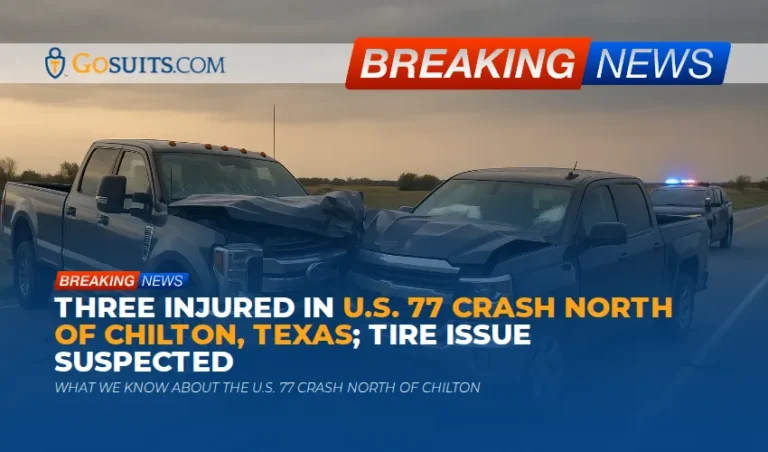
Texas Department of Public Safety troopers are investigating a two-vehicle crash that happened on U.S. 77 near County Road 430, just north of Chilton, on Thursday, February 19, 2026, at approximately 4:45 p.m. Preliminary information shared publicly indicates a southbound Ford F-350 experienced a tire issue, crossed into the northbound lane, and was struck by an oncoming Chevrolet Silverado. The Ford’s driver and passenger, as well as the Silverado’s driver, were transported to surrounding hospitals for treatment. Officials have noted the investigation is ongoing, and no further determinations have been announced at this time.
When and where the collision happened
The wreck occurred on the U.S. 77 corridor north of Chilton in Falls County, an area where weekday afternoon traffic can include commuters heading between Waco and small communities such as Chilton, Marlin, and Lott. U.S. 77 in this stretch includes long straightaways, farm-to-market road connections, and county road intersections like CR 430.
Vehicles involved and preliminary cause under review
Authorities have stated the southbound Ford F-350 suffered a tire problem before crossing the center line into oncoming traffic. A Chevrolet Silverado traveling northbound then impacted the Ford. It is not yet known whether the tire issue was a sudden failure, progressive loss of pressure, or another mechanical matter. That will be assessed as the investigation develops. Agencies often evaluate vehicle condition, roadway evidence, and witness accounts before reaching conclusions.
Injuries reported and medical response
All three individuals identified publicly as involved drivers and passengers were taken to area hospitals. In Central Texas, emergency transports after highway crashes frequently go to facilities in Waco such as Baylor Scott and White Hillcrest Medical Center or Ascension Providence, depending on injury severity and availability. HIPAA privacy laws limit what hospitals can disclose without patient authorization, so official patient status updates typically come from families or law enforcement, if appropriate.

Local context along U.S. 77 between Chilton and Waco
U.S. 77 is a key north-south route linking Falls County residents with jobs, schools, and services in Waco. Afternoon traffic around 4:45 p.m. can be a mix of pickups, service vehicles, and passenger cars. Drivers are accustomed to seeing farm equipment enter at county roads and to navigating stretches where passing zones and sightlines matter. Even when the weather is clear, rural highways can turn unforgiving when a vehicle loses control or crosses the center line.
Locals know the landmarks: the Chilton ISD campus on U.S. 77, the Brazos River corridor as you approach McLennan County, and the straight but busy approach as U.S. 77 feeds toward the Waco area. A tire emergency on that type of roadway leaves very little time or room to correct.
Why tire failures can lead to cross-lane crashes
When a tire rapidly loses pressure or the tread separates, a driver may feel a hard pull to one side, loud flapping, or a sudden drop in ride height. At highway speeds, underinflated or overloaded tires can overheat and degrade more quickly, increasing the risk of failure. National guidance emphasizes that proper inflation, routine inspections for tread wear or sidewall damage, and load limits are critical to reduce risk [3]. Drivers can also check for open recalls that may affect tire safety using federal resources [9].
In suspected tire-failure crashes, investigators typically look for physical evidence on the roadway like gouge marks, scuffs, and debris fields that reveal a vehicle’s path, as well as the condition of the tire carcass and rim. Event Data Recorder information, if available for the vehicles involved, can sometimes help reconstruct speed, throttle, and braking inputs just before impact [4].
Evidence that matters early in a suspected tire-failure crash
From a civil-injury perspective, preserving key evidence can shape what is ultimately provable about causation and liability. Items that often matter include:
- The failed tire and wheel assembly. The tire carcass, tread, and rim condition may show cuts, punctures, impact damage, belt separation, bead issues, or signs of chronic underinflation. Safekeeping and storing these parts can be vital.
- Service and maintenance records. Receipts for recent rotations, alignments, pressure checks, or tire purchases may identify dates, mileage, and any technician notes that bear on tire condition.
- Telematics and EDR data. Many modern vehicles capture pre-crash data points such as speed and brake application that can help explain lane departure dynamics [4].
- Scene documentation. Photos or videos of the final rest positions, skid or yaw marks, debris, and any roadway defects offer important context, especially on two-lane rural highways.
- Recall checks. A VIN or tire DOT code can be run through federal databases to see whether a known defect or recall notice applies [9].
When evidence control is unclear, civil attorneys often send preservation notices to involved parties urging them not to dispose of vehicle components. Acting sooner rather than later tends to produce better results because vehicles are often repaired, salvaged, or scrapped quickly after a wreck.
How liability might be evaluated in this kind of collision
Every case turns on specific facts, and investigators have not finished their work. Generally, though, potential civil-liability questions in a lane-crossing collision after a reported tire issue include:
- Driver maintenance and inspection duties. Whether the vehicle owner reasonably maintained and inspected tires relative to mileage, load, and manufacturer guidance may be examined [3].
- Product defect theories. If the tire or wheel component failed absent misuse or neglect, investigators may consider whether a manufacturing or design defect is implicated. That analysis is technical and often requires expert input.
- Comparative responsibility. Texas applies proportionate responsibility rules that can reduce or bar recovery if a claimant’s responsibility exceeds 50 percent [6]. In head-on or cross-center-line collisions, the focus is usually on who created the hazard and whether reasonable avoidance was possible.
Because evidence can point in multiple directions, seasoned counsel often conduct their own inquiries parallel to the official investigation, particularly when tire integrity or component failure is at issue.

Insurance considerations after a Falls County highway crash
Texas law requires drivers to show financial responsibility, typically through liability insurance that meets at least 30/60/25 limits. Optional coverages include Personal Injury Protection, Medical Payments, and Uninsured or Underinsured Motorist coverage, each of which serves a different purpose in the aftermath of a wreck [8]. Policies and adjuster processes can vary significantly across carriers.
Before opening an insurance claim or giving a recorded statement, it is prudent for an injured person to speak with a qualified attorney to understand rights and obligations. Anything said to an insurer may later be used to challenge fault or the extent of injuries. Skilled car accident lawyers can also help coordinate liability and first-party claims, sort medical billing questions, and flag coverage issues unique to rural highway collisions.
Locals sometimes search for Chilton car accident lawyers after a serious crash because coordination between multiple insurers and medical providers can be overwhelming, especially if hospitalization occurs in Waco while the wreck was investigated by troopers in Falls County.
For a practical walk-through of immediate post-crash steps tailored to Texas drivers, this guide can help: What should you do right after a car accident in Texas.
Where to get official records and updates
Crash report. In Texas, the official crash report is maintained in the state system and can be purchased through the Crash Records Information System. To retrieve a report, requesters typically need at least two of the following: the involved person’s name, the driver’s license number, vehicle VIN, date of crash, or the TxDOT crash ID. Eligibility rules and identification requirements apply under state law [1] [5].
Law enforcement updates. Because DPS troopers responded, inquiries about public updates often go through the Texas DPS regional communications or public information offices. However, while the investigation is active, details may be limited.
Falls County Sheriff’s Office. The Sheriff’s Office often assists with traffic control and scene safety on county segments of U.S. 77. They may not be the custodian of the primary crash report if DPS is the investigating agency, but they can sometimes confirm basic roadway closures or reopenings.
Hospital and EMS records. Medical records are protected. Patients or authorized representatives can request hospital records, radiology, and EMS run sheets by signing the provider’s HIPAA-compliant authorization forms. Ambulance services operating in the area and receiving hospitals in Waco will each have their own release process.
In the event of a fatality. If an involved person later passes, Texas law provides that a Justice of the Peace conducts inquests in counties without a medical examiner system. That includes responsibilities related to certifying the cause of death and, when needed, ordering an autopsy under Chapter 49 of the Texas Code of Criminal Procedure [10].
Steps community members commonly take after a serious roadway injury
Crashes on rural highways like U.S. 77 bring a mix of medical, legal, and logistical tasks. People in Central Texas often take the following steps to protect their health and their rights:
- Prioritize medical care. Follow through with emergency and follow-up visits. Many injuries evolve over days. Keep discharge paperwork, imaging disks, and prescriptions together.
- Preserve vehicles and parts. If a tire failure is suspected, retain the failed tire and wheel and note where the vehicles are stored. Avoid authorizing disposal or salvage until counsel advises.
- Document everything. Save photos, dashcam clips, and witness names and numbers. Jot down weather, traffic, and what you recall about the moments before and after the impact.
- Organize expenses. Track out-of-pocket costs, mileage to medical appointments, and lost time from work. Good records help substantiate claims.
- Be cautious with insurers. If a claim may be filed, contact an attorney first. Recorded statements can be used later to narrow fault or minimize injuries. In Texas, different coverages apply differently to medical bills and wage loss [8].
For a Texas-focused checklist of immediate do’s and don’ts, see the plain-English resource linked above on what to do right after a crash in Texas.
Recent crash trends and rural highway safety in Texas
State reports have consistently noted severe injury and fatal crashes on rural, two-lane highways where lane departures occur. Factors include speed, fatigue, distraction, and mechanical issues. Texas’ annual crash facts provide a window into head-on and roadway-departure trends statewide and underscore why centerline crossings are often catastrophic [11]. While every event is unique, the policy takeaway is the same: lane discipline, vehicle maintenance, and response to early signs of mechanical trouble are essential on undivided highways.
A plain-language timeline for what happens next in the investigation
Initial response. Troopers secure the scene, coordinate medical transport, and document visible evidence. If a tire failure is suspected, they may photograph and collect relevant parts.
Follow-up investigation. Investigators can gather statements, review vehicle damage, and, where available, analyze EDR data. They may consult with specialized units or reconstructionists for complex events.
Report finalization. A formal crash report is filed to the state system. Supplements can be added later if new information develops. Access rules and timing vary, and not all narrative details are immediately public under Texas Transportation Code restrictions [5].
Civil review. Separately, injured parties may retain counsel to conduct an independent evidence review, obtain records, and assess potential insurance claims while the official investigation progresses.
Community safety reminders for U.S. 77 drivers
Simple habits can lower risk on the Chilton to Waco stretch of U.S. 77:
- Check tire pressure and condition. Do this monthly and before longer drives. Underinflation drives heat buildup and can accelerate failure [3].
- Mind the load. Overloading a pickup or cargo area can overstress tires. Consult vehicle and tire ratings.
- React smoothly to a blowout. NHTSA guidance emphasizes maintaining a firm grip, easing off the accelerator, and gently correcting steering. Sudden braking can worsen loss of control [3].
- Give extra room. On undivided highways, sightlines and passing judgment are critical. Space buys time.
- Check recalls. Use federal tools to look up tire and vehicle recalls by VIN or DOT code [9].
Why timely action matters and what to do next
What to do. Preserve vehicle components and records, obtain the official crash report when available, keep thorough medical and expense documentation, and consult an attorney before opening claims or giving recorded statements.
Why it matters. Tires and vehicle components can be discarded quickly. Early steps to secure the tire carcass, rim, and related parts can determine whether a maintenance issue, roadway hazard, or product defect is provable. Insurance adjusters start building files immediately. Statements given early, before injuries are fully understood, may be cited later to challenge the scope of treatment or causation.
Timing considerations. Texas law sets a general two-year period to bring most personal injury claims, measured from the crash date, though specific circumstances can affect the calculation [7]. That clock moves fast when medical care, vehicle storage, and work interruptions compete for attention. Acting promptly helps ensure evidence is preserved and options remain open.

Commentary from Gosuits Chilton, Texas Personal Injury Attorney
Our hearts go out to those injured north of Chilton and to their loved ones. We recognize this is a difficult moment for families in Falls County and the greater Waco community. The information here is for general education, not tailored to any person’s circumstances.
Based on what has been publicly shared, a suspected tire problem preceded a lane crossing and a violent impact on U.S. 77. Tire-related incidents raise complex questions. Sometimes maintenance history or load conditions explain a failure. Other times, a component defect or road hazard is involved. Pinning that down requires careful preservation and examination of the tire and wheel parts and a methodical review of vehicle and scene data.
Insurance companies, and at times large manufacturers, move quickly to shape the narrative after a serious crash. Adjusters may ask for recorded statements or broad medical authorizations before injuries are fully understood. Corporations may assert that critical parts are unavailable or were damaged beyond analysis. These are familiar playbooks that can disadvantage ordinary people who are simply trying to recover and make sense of what happened.
A free consultation can help clarify rights, responsibilities, and next steps without pressure. It is an opportunity to understand how evidence should be preserved, how different coverages apply, and how to avoid common pitfalls in early communications with insurers and other entities involved.
References
- Crash Records Information System Purchase – Texas Department of Transportation
- Crash Records and Reports – Texas Department of Transportation
- Tire Safety Resources – National Highway Traffic Safety Administration
- Event Data Recorders – National Highway Traffic Safety Administration
- Texas Transportation Code § 550.065 Release of Accident Report
- Texas Civil Practice and Remedies Code § 33.001 Proportionate Responsibility
- Texas Civil Practice and Remedies Code § 16.003 Limitations
- Auto Insurance Guide – Texas Department of Insurance
- Recall Lookup by VIN and Tires – National Highway Traffic Safety Administration
- Texas Code of Criminal Procedure Chapter 49 Inquests
- Texas Motor Vehicle Crash Facts 2023 – Texas Department of Transportation