- What We Know About the Head-on Crash South of Bells
- Why Head-on Collisions With Semi-Trucks Are So Dangerous
- Where to Get Official Records and Reports in Texas
- Practical Steps After a Serious Truck Crash in Grayson County
- Potential Civil Liability Issues in a Semi vs. SUV Head-on
- Insurance Coverages That May Apply
- Local Context: Highway 69 South of Bells
- Data Snapshot and Safety Reminders for North Texas Drivers
- Why Acting Now Matters
- Commentary from Gosuits Bells, Texas Personal Injury Attorney
- References
What We Know About the Head-on Crash South of Bells
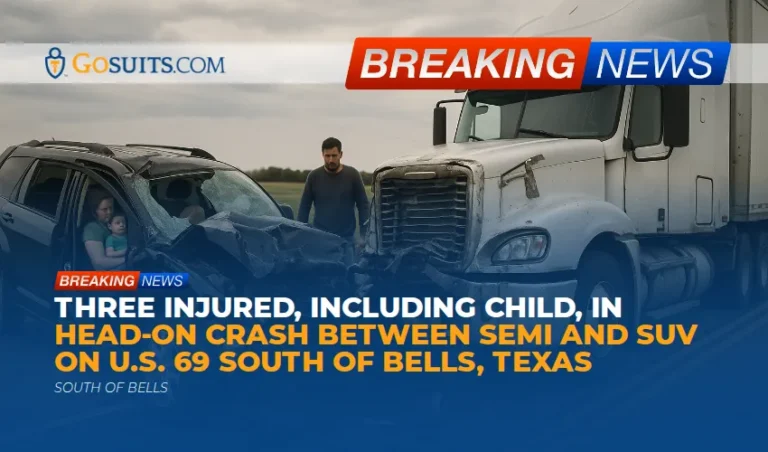
Authorities are investigating a head-on collision on Highway 69 south of Bells in Grayson County. Early reports indicate the crash involved a semi-truck and an SUV, with three people injured: a man, a woman, and a child. The Texas Department of Public Safety is commonly the agency that handles serious crashes on state and U.S. highways in this part of North Texas, and investigators typically document contributing factors and vehicle dynamics before releasing a formal crash report through the statewide system used in Texas [1].
Local residents know this stretch of Highway 69 well. It is a primary corridor linking Bells to communities like Whitewright and on toward Collin County, and north to Denison and the Red River. The area has a mix of local traffic, regional goods movement, and seasonal farm and ranch activity, which can increase conflicts between heavy trucks and smaller vehicles, especially during peak commuting times or when weather complicates visibility and stopping distances.
Details such as precise cause, speeds involved, or specific citations are not yet publicly available. In the meantime, families often want to know where to find official information, how fault is generally analyzed in head-on collisions, and what steps can help protect health and legal rights. The sections below walk through those points in plain language, using Texas-specific resources where possible.
Why Head-on Collisions With Semi-Trucks Are So Dangerous
Tractor-trailers require far longer stopping distances
Compared with passenger cars, large commercial trucks take more distance to stop due to greater mass and braking system differences. Federal safety guidance emphasizes that heavy trucks need significantly more space to slow down, which is why drivers are urged to give them additional room and avoid abrupt maneuvers in front of them [2]. Those physics are magnified in a head-on scenario where closing speeds compound crash energy.
Driver fatigue and hours-of-service limits matter
Fatigue is a known risk in long-haul trucking. That is why federal hours-of-service rules limit how many hours a commercial driver can operate before taking required breaks. These regulations set daily and weekly driving maximums, require off-duty time, and are enforced with electronic logging devices, especially for interstate carriers [3][4]. While no public details about fatigue are known in this particular crash, hours-of-service compliance is part of many serious truck crash investigations.
Injury patterns in frontal impacts can be severe
National safety data show that frontal impacts are among the most dangerous kinds of crashes because they concentrate force on the passenger compartment and occupants. Even with seatbelts and airbags, the combination of vehicle speeds and mass can create significant trauma. National crash fact reports detail how impact configuration influences outcomes in serious injury collisions [5]. The presence of a child among the injured underscores the importance of proper child restraint use, positioning, and post-crash medical evaluation [6].
Where to Get Official Records and Reports in Texas
Texas Peace Officer’s Crash Report (CR-3)
For injury crashes on state and U.S. highways, the investigating agency’s report is typically filed on the Texas Peace Officer’s Crash Report form. In Texas, you can request this official crash report through the Texas Department of Transportation’s Crash Records Information System. Reports are released to eligible requestors such as involved parties, their insurers, or legal representatives [1].

Supplemental records and public information
Texas has a statewide Public Information Act that gives the public the right to request certain government records. Not every item connected to a crash is automatically public, and some sensitive information is protected. However, understanding your rights under the Act can help families request non-exempt records from relevant agencies when appropriate [7].
If a fatality occurs in similar crashes
While current reports indicate injuries in this incident, families dealing with fatal crashes should know that, in Texas, either a county medical examiner or a justice of the peace conducts inquests. Chapter 49 of the Texas Code of Criminal Procedure explains the inquest process, including when autopsies may be ordered. The responsible office varies by county and local arrangements [8].
Practical Steps After a Serious Truck Crash in Grayson County
Prioritize medical care and documentation
Even if you feel stable, seek prompt medical evaluation. Adrenaline can mask injuries, and head-on impacts frequently involve forces that cause soft-tissue damage, concussions, or internal injuries that are not obvious at the scene. Keep copies of discharge instructions, imaging results, and prescriptions. Consistent follow-up care both improves recovery odds and provides a clear medical timeline.
Preserve available evidence early
Cars and trucks today can hold valuable data. For commercial motor vehicles, that may include electronic logging device data and engine control module data. If you are an involved party, preserving photos, dashcam clips, and witness contact information can make a real difference later. When a crash involves a semi, early attention to preserving driver logs, dispatch notes, bills of lading, pre-trip inspection records, and truck maintenance records can be critical. Federal rules require electronic logging for most interstate carriers, which can aid reconstruction in some cases [4].
Be cautious with insurance communications
Insurance adjusters may call quickly and ask for recorded statements. What someone says early can be used against them later. Before giving any recorded statement to any insurer, it is wise to consult an attorney so you understand your rights and obligations. If a statement is given, sticking to concise, factual answers is key.
For a step-by-step walk-through of immediate tasks that protect health and claims in Texas, see what should you do right after a car accident in texas.
Expect trucking companies to move quickly
Motor carriers and their insurers often deploy rapid-response teams after serious crashes. Those teams may visit the scene, inspect vehicles, and collect statements. That early activity can shape how evidence is later framed. In complex collisions, some families consult truck accident lawyers who understand how to identify and preserve the types of evidence unique to commercial trucking.

Keep a simple recovery file
Organize medical bills, paystubs or proof of missed work, rental car receipts, and mileage to appointments. Keeping everything in one place avoids gaps later. Notes on pain levels, physical limitations, and how injuries affect daily tasks can also help your medical providers fine-tune treatment plans.
Potential Civil Liability Issues in a Semi vs. SUV Head-on
How fault is commonly analyzed
Investigators look at lane position, skid marks, point of impact, vehicle damage profiles, roadway geometry, and driver statements. With heavy trucks, analysis may also include load securement, brake condition, pre-trip inspection compliance, and hours-of-service. If a mechanical failure is suspected, maintenance records and manufacturer service bulletins can become relevant.
Possible responsible parties
Depending on the facts, liability can extend beyond the drivers. Potentially responsible entities can include the motor carrier, a truck’s maintenance contractor, the shipper or loader if cargo contributed to instability, or others tied to the vehicle’s operation. Identifying all potentially responsible parties is part of a thorough civil investigation.
Comparative responsibility in Texas
Texas uses a proportionate responsibility system. If a civil claim is later brought, a finder of fact can assign percentages of fault among parties. Under Texas law, a claimant found more than 50 percent responsible cannot recover damages. When responsibility is 50 percent or less, recoverable damages are reduced by that percentage [9].
Time limits to bring a civil claim
Generally, the Texas statute of limitations for personal injury is two years from the date of the incident [10]. For minors, Texas law provides tolling that can extend timeframes in certain situations [11]. Calculating deadlines can be nuanced, so many people confirm timelines as early as possible.
In serious collisions that involve multiple vehicles or complex evidence questions, some people reach out to truck accident lawyers in Bells who regularly navigate trucking rules, electronic logging records, and coordinated insurer responses.
Insurance Coverages That May Apply
Texas auto policies can include several coverages that may help after a crash. Policy terms vary, but common components include:
- Liability coverage pays for others’ injuries and property damage if a driver is legally responsible, subject to policy limits.
- Personal Injury Protection may cover medical expenses and a portion of lost wages regardless of fault, if purchased.
- Medical Payments coverage is another optional benefit that can help with medical bills.
- Uninsured or Underinsured Motorist coverage may apply if the at-fault driver’s insurance is insufficient or absent.
- Collision coverage can help with vehicle repair or total loss costs, minus your deductible.
The Texas Department of Insurance provides consumer guides that explain these coverages in plain language and outline claim basics for Texas policyholders [12].
Local Context: Highway 69 South of Bells
Neighbors in Bells understand that U.S. Highway 69 is a lifeline through eastern Grayson County. Southbound from town, it transitions toward Whitewright and beyond, with stretches where drivers share two-way traffic, enter from side roads, or slow to make turns into driveways and farm entrances. During certain seasons, ranch and agricultural equipment may appear on the shoulder or enter the roadway at lower speeds. Add a passing maneuver at the wrong time, darkness, or wet pavement, and the margin for error gets thin.
Community members often do simple, practical things to reduce risk along this corridor. Slowing slightly around hill crests, maintaining a generous following distance behind tankers or grain haulers, and resisting the urge to pass unless there is a wide, clear view can all help. It is also helpful to remember that commercial trucks may swing wider on turns and have significant blind zones alongside the trailer.
Data Snapshot and Safety Reminders for North Texas Drivers
Serious head-on collisions are relatively less common than rear-end or angle crashes, but the severity of injuries can be higher because the forces are concentrated at the front of both vehicles. National safety summaries underscore how impact configuration affects injury severity, as well as the role that restraint systems and speed play in survivability [5]. In crashes involving a child, NHTSA guidance emphasizes correct child-restraint use by age, weight, and height, and the importance of ensuring restraints are replaced after certain types of collisions [6].
For drivers sharing the road with commercial vehicles in our region:
- Leave more space than you think. Heavy trucks require more time and distance to stop. Cutting in close or braking suddenly in front of a trailer creates significant risk [2].
- Watch for wide turns and blind spots. If you cannot see the truck driver’s mirrors, the driver may not see your vehicle.
- Anticipate limited escape options. On two-lane stretches, oncoming traffic may leave little room to maneuver if a hazard appears ahead.
- Mind fatigue and distraction. Long rural drives and routine commutes can invite inattention. Building in quick rest stops and silencing notifications can help.
Why Acting Now Matters
What to do
- Request the official Texas crash report through the statewide system when it becomes available, and save all medical and repair documents.
- Preserve evidence by saving photos, dashcam video, and witness information. Ask involved towing yards not to dispose of vehicles until documentation can occur.
- Consult an attorney before talking to insurers. Early recorded statements can be used later, and guidance helps avoid common pitfalls.
- Follow medical advice and keep consistent appointments to support recovery and maintain a clear treatment record.

Why timing matters
- Evidence can disappear fast. Skid marks fade, video systems overwrite, and vehicles are repaired or salvaged. Prompt preservation helps establish what really happened.
- Insurance timelines start quickly. Claim deadlines and policy notice provisions can come up sooner than expected.
- Texas law has firm filing deadlines, and even though some claims have tolling or exceptions, confirming the applicable timeline early reduces risk [10][11].
Commentary from Gosuits Bells, Texas Personal Injury Attorney
Our hearts are with the three people hurt in this head-on crash south of town. When a semi and an SUV collide on a familiar road like Highway 69, it shakes the whole community. This overview is meant for education and general information so neighbors understand the practical steps that often help after a serious roadway incident.
From a civil standpoint, head-on collisions between a commercial truck and a passenger vehicle raise immediate questions about lane position, visibility, speed, and truck-specific compliance like hours-of-service and pre-trip inspections. Preserving the right evidence early is crucial, especially when a child is among the injured.
Insurance carriers and corporate representatives often reach out quickly, sometimes with friendly tones and quick offers. The problem is that early statements or sign-offs can limit later options, often before the full picture is known or all injuries are understood. Larger companies also tend to have seasoned teams who understand how to shape a record from day one, and that imbalance can make it hard for regular families to navigate.
A free consultation can be an important moment to understand rights, timelines, and the types of evidence that should be preserved before it goes missing. That conversation helps set expectations, clarifies the role of insurance, and provides a clearer plan for the next steps, whether someone chooses to handle matters on their own or seek representation.
References
- Crash Records and Reports in Texas – Texas Department of Transportation
- Sharing the Road with Large Trucks and Buses: Tips for Drivers – FMCSA
- Summary of Hours of Service Regulations – FMCSA
- Electronic Logging Devices (ELDs) – FMCSA
- Traffic Safety Facts 2021: A Compilation of Motor Vehicle Crash Data – NHTSA
- Child Passenger Safety Overview – NHTSA
- What Information Is Public – Office of the Texas Attorney General
- Code of Criminal Procedure Chapter 49: Inquests Upon Dead Bodies – Texas Statutes
- Civil Practice and Remedies Code Chapter 33: Proportionate Responsibility – Texas Statutes
- Civil Practice and Remedies Code Section 16.003: Limitations for Personal Injury – Texas Statutes
- Civil Practice and Remedies Code Section 16.001: Legal Disability and Tolling – Texas Statutes
- Auto Insurance Consumer Guide – Texas Department of Insurance