- What We Know About the Texas 6 Crash in Grimes County
- Where It Happened and Why This Stretch of Texas 6 Sees Heavy Truck Traffic
- Which Agencies Handle These Investigations and How to Get Official Records
- Rights of Families After a Fatal Crash in Texas and Key Timelines
- Potential Civil Liability in a Pickup and 18-wheeler Collision
- Insurance and Claims After a Fatal Truck Crash
- Preserving Evidence in a Trucking Case
- Community Safety Notes Along the Texas 6 Corridor
- What To Do Next: Practical Steps for Those Impacted
- Why Timely Action Matters
- References
- Commentary from Gosuits Grimes County, Texas Personal Injury Attorney
What We Know About the Texas 6 Crash in Grimes County
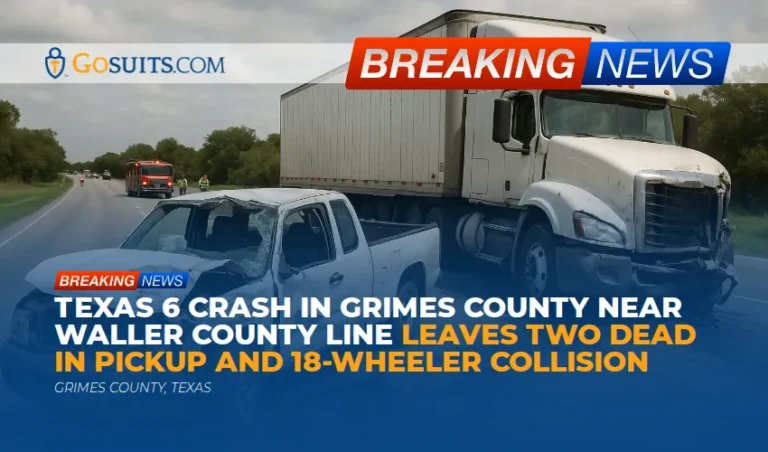
On Thursday at approximately 12:50 p.m., a small pickup collided with an 18-wheeler on Texas 6 in Grimes County near the Waller County line. Two people were killed in the crash, according to early reports. As of now, publicly available details are limited. In serious crashes on state highways, the Texas Department of Public Safety’s Highway Patrol typically leads the investigation, with local fire and EMS supporting traffic control and medical response. If the collision occurred close to the county line, it is not uncommon for both counties’ dispatch centers to coordinate lane closures and detours until investigators complete on-scene work.
We are not identifying the individuals involved here. Notifications usually occur through law enforcement and next-of-kin procedures. Formal crash reports and inquest documents often take days to weeks before they are finalized and released to eligible requestors.
Where It Happened and Why This Stretch of Texas 6 Sees Heavy Truck Traffic
Texas 6 is a major north-south artery linking the Bryan and College Station area with Houston and the Gulf Coast. South of Navasota, toward Hempstead and the Waller County line, traffic frequently includes heavy commercial vehicles. Many drivers use this corridor to reach distribution centers, ports, and oilfield service routes. Midday traffic can be brisk, and the mix of passenger vehicles and 80,000-pound tractor-trailers leaves little room for error.
Locals know the feel of this road. If you live in Navasota, Plantersville, or Todd Mission, you have probably seen DPS and county units working significant crashes along this stretch. On weekends and during events or university move-in around the Texas A&M campus, volumes can spike. Bright winter sun at midday can create glare, and rural intersections may have longer sight lines but faster approach speeds. While the cause here has not been publicly determined, the physics of a pickup versus an 18-wheeler often mean catastrophic damage and severe injuries.
Which Agencies Handle These Investigations and How to Get Official Records
Crash report (CR-3) and investigative documents
In Texas, the primary crash report is the CR-3, generated by the investigating agency. For state highways, Texas DPS Highway Patrol commonly completes the CR-3. Under Texas Transportation Code Chapter 550, crash reports are restricted to certain requestors and are generally obtained through the Texas Department of Transportation’s Crash Records Information System, often called CRIS [1]. TxDOT’s CRIS portal provides the official channel to purchase eligible crash reports online [2]. Access is limited by statute to involved parties, their representatives, insurers, and other defined interests [1].

Autopsy or inquest records
For fatal collisions, Texas law governs inquests and autopsies through the Code of Criminal Procedure Chapter 49. In counties without a full medical examiner’s office, a Justice of the Peace conducts inquests and may order an autopsy [3]. Families seeking inquest or autopsy findings can often start by contacting the appropriate Justice of the Peace office in the county where the death occurred. If a regional medical examiner performs the autopsy, that office typically maintains reports following completion and release rules under Texas law [3].
Death certificates
Certified death certificates are issued by the Texas Department of State Health Services Vital Statistics Section. Eligible family members may request copies through the state process outlined by DSHS [4].
Public information requests
Some documents, such as dispatch logs, certain photos, or communications, may be subject to the Texas Public Information Act, with exceptions for protected investigative materials. Guidance from the Texas Attorney General describes the public records process and what to expect after filing a request [9]. When making requests to DPS or a sheriff’s office, be as specific as possible about date, time, location, and report numbers. Be aware that some portions may be redacted or withheld by law.
Rights of Families After a Fatal Crash in Texas and Key Timelines
After a fatal collision, Texas law allows certain surviving family members or an estate representative to bring civil claims arising from a death caused by another’s wrongful act or negligence. Without speculating about fault here, it can help to know your general rights and the timeline that applies statewide.
- Wrongful death and survival claims generally seek accountability for the loss of life and, in survival actions, harms the loved one suffered between injury and death. These claims are civil, separate from any criminal proceedings that may occur.
- Statute of limitations: In most Texas wrongful death and personal injury matters, the general filing deadline is two years from the date of injury or death, though various exceptions can apply. The statute appears in Chapter 16 of the Texas Civil Practice and Remedies Code [5].
- Crash reports and inquest documents often take time. Families should gather what is available while preserving other evidence, including vehicle data and trucking company records, which can be critical in later civil proceedings.
It is common for people to feel unsure about next steps during the first days and weeks after a loss. Even as grief is new, evidence and deadlines do not wait. Many seek guidance on what to request, what to preserve, and when to act.
Potential Civil Liability in a Pickup and 18-wheeler Collision
Every crash is unique, and fault determinations depend on evidence. That said, collisions involving passenger vehicles and commercial trucks often require close review of both drivers’ actions and the trucking company’s safety practices.
- Driver behavior: Investigators look at speed, lane position, distraction, impairment indicators, compliance with traffic controls, and right-of-way rules. The CR-3 and any reconstruction work can address these points [1].
- Commercial motor carrier compliance: Federal rules govern hours of service, vehicle maintenance, load securement, and driver qualification files. Violations can bear on negligence and causation in civil cases [6] [7].
- Vehicle condition: Brakes, tires, lighting, underride guards, and electronic control module data can be crucial. Maintenance records and inspection reports may reveal recurring issues. Preservation steps are key to ensure this evidence is not lost.
- Company policies and supervision: Training, dispatch pressure, and route planning can figure into a negligence claim, including negligent entrustment or supervision theories.
- Comparative fault: Texas follows proportionate responsibility rules, which can reduce recoveries if multiple parties share blame. The details matter, and they hinge on the evidence.
Because large trucks have greater stopping distances and mass, even minor misjudgments can be devastating. National data consistently reflects the high severity associated with large-truck crashes [6].

Insurance and Claims After a Fatal Truck Crash
Commercial carriers generally carry higher liability insurance limits than standard auto policies. Federal rules establish minimums based on cargo and operation type, though policies can be higher depending on contracts and risk profiles [8]. Wrongful death and survival claims may involve several insurance layers, including the truck’s liability policy, potential excess or umbrella coverage, and uninsured or underinsured motorist coverage on the decedent’s personal policy, if applicable.
When considering any insurance claim:
- Speak with an attorney before giving recorded statements. What someone says to an insurer can be used against them later. Early statements made under stress may be incomplete or misinterpreted.
- Know the carrier’s role. Insurance adjusters work for the insurer, not for claimants. They will investigate liability and damages, but their interests may not align with a family’s long-term needs.
- Expect data requests. In trucking incidents, insurers move fast to collect dashcam footage, ECM data, and driver logs. Ensuring preservation parity is essential so critical evidence does not vanish.
Many families seek a one-on-one conversation with seasoned counsel to understand where to start. Some consult with truck accident lawyers to map out an investigation plan and understand potential coverage sources without rushing into decisions about recorded statements or releases.
Preserving Evidence in a Trucking Case
Time-sensitive steps can protect the truth of what happened:
- Spoliation or preservation letter: Prompt written notice instructing the trucking company and its insurer to preserve logs, ELD data, maintenance files, dashcam and outward-facing camera footage, ECM downloads, bills of lading, and driver qualification files.
- Scene and vehicle documentation: Photographs, measurements, skid marks, gouge marks, and debris fields. If vehicles are stored in a yard, request non-destruction until inspections are complete.
- Third-party data: Requests for 911 recordings and CAD logs via the Public Information Act, subject to legal exemptions and timetables [9].
- Medical and inquest records: Work with the proper county office or regional medical examiner under Chapter 49 procedures [3].
In Texas, it is common practice to act quickly so evidence from electronic logging devices and telematics is not overwritten. Private carriers frequently cycle video and ELD data if no legal hold is in place.
Community Safety Notes Along the Texas 6 Corridor
Locally, drivers know the Texas 6 pulse between the Brazos Valley and Waller County. It is a fast corridor that can feel rural one minute and freight-heavy the next. A few community-minded reminders, especially relevant on this highway:
- Leave buffer space: Large trucks require longer stopping distances. Cutting closely in front of a rig can be catastrophic.
- Watch approach speeds: Rural intersections can surprise drivers with quick merges and slow-moving equipment.
- Mind midday glare: Particularly in winter, bright sun can wash out signal visibility near open fields.
- Respect work zones: Temporary closures after a crash protect responders and preserve evidence.
National traffic safety materials highlight how crashes with large trucks carry disproportionate severity, reinforcing the need for safe following distances, patient merges, and attentive driving around heavy vehicles [6].
What To Do Next: Practical Steps for Those Impacted
Feeling overwhelmed after a sudden loss or serious injury is normal. Here is a practical path forward that many in the Brazos Valley and surrounding counties follow after a major crash:
- Confirm which agency investigated: For Texas 6, DPS Highway Patrol is often primary. Write down the crash date, time, nearest mile markers, and any report number shared at the scene. This helps when requesting records through TxDOT’s CRIS system [2].
- Identify the inquest authority: In many Texas counties, a Justice of the Peace manages inquests. Ask which JP precinct handled the case and whether an autopsy was ordered under Chapter 49 [3].
- Request death certificates: Use the state’s Vital Statistics process for certified copies [4].
- Preserve vehicles and data: Avoid repairs or disposal until all inspections are complete and data is downloaded by qualified professionals.
- Avoid early insurance statements: Speak with counsel first. Recorded statements can affect future claims and may be used to narrow or dispute liability.
- Write everything down: Note calls received, names of adjusters, and any offers to move vehicles or provide quick payments in exchange for releases.
For an overview of what families often face in the weeks following a fatal motor vehicle collision, see What Happens If Someone Is Killed in a Car Accident?
When the time comes to consider civil options, some families look for Texas truck accident lawyers to level the playing field with commercial insurers who start their investigations immediately.
Why Timely Action Matters
What should be done next?
- Obtain official records: Request the CR-3 crash report through TxDOT’s CRIS portal when available, and seek inquest findings under Chapter 49 if applicable [2] [3].
- Secure and preserve evidence: Send a written preservation request to the trucking company and its insurer. Arrange for expert inspection of involved vehicles when feasible.
- Map the insurance picture: Identify all potential policies involved, including commercial liability, excess coverage, and any UM/UIM coverage on household policies [8].
- Track medical and funeral documentation: Keep invoices, programs, and correspondence, which can be important for later damages proof.
- Consult before you claim: Speak with an attorney before contacting any insurer about recorded statements or releases. What is said early can be used later.
What is the benefit of acting soon?
- Evidence retention: Dashcam and ELD data can be overwritten quickly without a legal hold in place.
- Accurate reconstruction: Skid marks fade and vehicles are moved. Early expert access preserves the clearest picture of what happened.
- Clarity on coverage: Knowing available insurance and limits sooner helps families plan and avoid surprises.
Why now?
- Legal deadlines run from the date of the incident: The general two-year time limit for Texas wrongful death and injury cases means waiting can narrow options [5].
- Corporate response is immediate: Trucking carriers often deploy adjusters and defense teams right away. Taking early steps helps maintain balance in the process.
If someone decides to move forward with a claim, many start by seeking a no-cost, no-obligation consultation to understand rights, obligations, and the risks of early insurer contact. It is wise to consult counsel before speaking to any insurance representative.

References
- Texas Transportation Code Chapter 550, Accidents and Accident Reports – Texas Statutes
- Crash Report Purchase System – Texas Department of Transportation (CRIS)
- Texas Code of Criminal Procedure Chapter 49, Inquests upon Dead Bodies – Texas Statutes
- Death Records and Certificates – Texas Department of State Health Services
- Texas Civil Practice and Remedies Code Sec. 16.003 – Limitations
- Large Trucks Safety Overview – National Highway Traffic Safety Administration
- Summary of Hours of Service Regulations – Federal Motor Carrier Safety Administration
- Motor Carrier Insurance Requirements – Federal Motor Carrier Safety Administration
- What to Expect After You Submit a Public Information Request – Office of the Texas Attorney General
Commentary from Gosuits Grimes County, Texas Personal Injury Attorney
Our hearts are with everyone affected by the fatal crash on Texas 6 near the Waller County line. Two lives lost on a familiar stretch of highway is a blow to the entire Brazos Valley community. This commentary is shared for general educational purposes to help neighbors understand the process that typically follows a serious truck collision.
From a civil perspective, a collision between a small pickup and an 18-wheeler often raises questions about driver behavior, visibility, speed, and the commercial carrier’s safety practices, including hours-of-service compliance, maintenance, and driver supervision. A careful, evidence-based approach matters. ECM downloads, dashcam footage, ELD logs, and the CR-3 report are the building blocks for determining how and why a crash occurred.
It is also important to acknowledge the power imbalance that often follows a fatal highway crash. Trucking corporations and their insurers generally respond within hours, deploying investigators and adjusters to protect their interests. Families, still in shock, may feel pressured to provide recorded statements or accept quick resolutions. Insurers understand that early conversations can shape the entire claim. That is why consulting with a qualified lawyer before speaking to an insurance company is so often recommended. What someone says on day one can be cited against them months later.
Finally, there is value in a free consultation. It allows people to ask questions about records, evidence preservation, and timelines without committing to decisions they are not ready to make. A conversation can clarify the role of the crash report, how to pursue inquest and autopsy findings, and what preservation steps ensure critical vehicle and corporate records are not lost. The goal is information and clarity so the next steps are thoughtful, not rushed.