- Texas truck crashes, enforcement slowdowns, and why it matters now
- What we know about the recent Texas crashes described
- Why Texas construction zones and freight corridors see severe truck crashes
- Texas civil rights after a truck crash and potential liability paths
- Critical evidence in truck cases and how it is preserved
- First 7–14 days after a serious truck crash in Texas
- Where to get official records in Texas: police, medical examiner, and vital records
- How trucking companies and insurers try to limit accountability
- Data and safety context from government sources
- Local context Texans recognize on I‑20, I‑35, and the Permian Basin
- Commentary from Gosuits Terrell, Texas Personal Injury Attorney
- Why acting promptly matters
Texas truck crashes, enforcement slowdowns, and why it matters now
Across Texas this year, families have been grappling with devastating tractor trailer crashes while concerns grow about weakened safety enforcement. According to recent published accounts, federal actions to remove dangerous carriers from the road have slowed, even as catastrophic incidents in construction zones and high‑traffic freight corridors continue to take lives. When enforcement lags, unsafe operators can stay on the road longer, and the consequences play out on I‑20 near Terrell, across the I‑35 corridor in Austin and Fort Worth, and on rural oil‑patch routes that were never built to carry today’s heavy loads.
Government safety rules do exist, and they matter. The Federal Motor Carrier Safety Administration’s hours‑of‑service rules are designed to prevent fatigue at the wheel by limiting driving hours and requiring rest breaks. You can read the current federal hours‑of‑service regulations on the FMCSA’s site at fmcsa.dot.gov/regulations/hours-service. Trucking companies must also keep their vehicles in safe condition under federal maintenance rules, and carriers must only put qualified drivers on the road who are fit for duty. Those obligations come straight from federal law, including the maintenance standards in 49 CFR Part 396, driver qualification rules in 49 CFR Part 391, and drug and alcohol testing rules in 49 CFR Part 382.
When those safety obligations are ignored, the results aren’t abstract numbers. They’re families who suddenly face funeral planning, medical bills, time off work, and the maze of insurance contacts and official reports. If you’re reading this from Terrell, the Dallas area, Austin, or Fort Worth, the place names in these recent Texas crashes feel painfully close to home.
What we know about the recent Texas crashes described
Based on the story above, several Texas tractor trailer crashes in 2025 resulted in multiple fatalities:
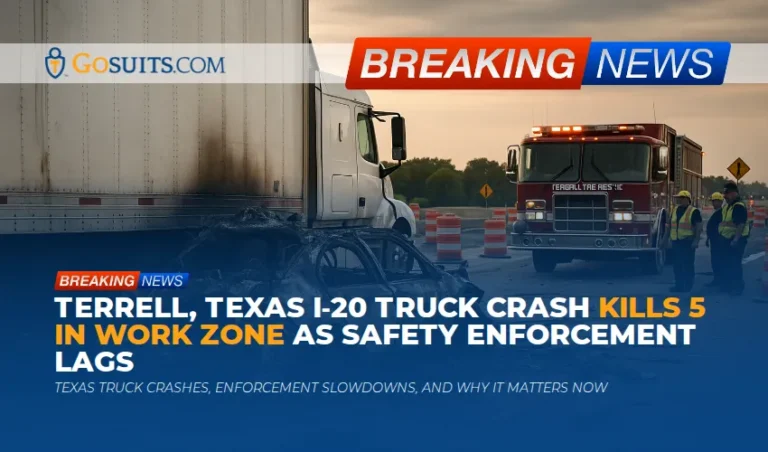
- Interstate 20 near Terrell, June 2025: A tractor trailer subcontracted to haul U.S. mail allegedly entered a construction zone and caused a chain‑reaction crash that killed five people, including four members of one family. According to police reports referenced in published accounts, the driver fell asleep and did not brake before impact. Investigators reportedly found a history of hours‑of‑service falsification, maintenance neglect, and registration irregularities at the operator level.
- Construction zone near Austin, March 2025: A tractor trailer hauling an e‑commerce shipment allegedly triggered a 17‑vehicle pileup in a construction area, killing five people, including two children.
- Fort Worth on I‑35, February 2023: In icy conditions, an undertrained driver hauling an unauthorized trailer allegedly contributed to a chain‑reaction crash that caused multiple deaths.
These incidents share common themes Texas communities know too well: fatigue and hours‑of‑service issues, heavy trucks entering active work zones at speed, and carriers that fall short on training, supervision, or maintenance. Each of those themes intersects directly with federal safety rules and the duty of motor carriers to operate safely on our roads.
Why Texas construction zones and freight corridors see severe truck crashes
If you drive I‑20 east of Dallas toward Terrell, you’ve seen long, shifting work zones, bright orange barrels a few feet off the lane, and traffic slowing abruptly as lanes narrow. On I‑35 through Austin, nighttime lane closures and temporary barriers can turn a routine stretch into a sudden stop. In the Permian Basin, two‑lane highways meet surge traffic from oilfield operations, leaving little room for error when an 80,000‑pound combination rig approaches a choke point.
Here’s why these settings are particularly dangerous:
- Short sight lines and sudden slowdowns: Work zones compress lanes and add heavy equipment or crews near traffic. Drivers need to reduce speed earlier and maintain longer following distances, and truck drivers must brake progressively to prevent a rear‑end chain reaction. TxDOT provides public safety guidance on navigating work zones at txdot.gov.
- Driver fatigue interacts with construction timing: Many Texas work zones do intense lane changes at night to reduce daytime congestion. That timing collides with circadian lows that make fatigue more likely. NHTSA highlights how drowsy driving degrades reaction time and decision making, especially in the early morning hours, at nhtsa.gov/risky-driving/drowsy-driving.
- Heavy freight volumes and mixed traffic: Texas routes funnel interstate freight, local commuters, visitors, and work crews into the same narrow spaces. When a fully loaded tractor trailer can’t stop in time, the weight and momentum make multi‑vehicle crashes more likely.
None of this is inevitable. Federal and state rules require carriers to adapt to conditions by adjusting speed, maintaining vehicles properly, and keeping fatigued or unqualified drivers off the road. When they don’t, Texas families pay the price.

Texas civil rights after a truck crash and potential liability paths
In the civil system, people injured or the surviving family in a wrongful death case may bring claims under Texas law. While every case turns on specific facts and evidence, these are common pathways examined in major truck crashes:
- Negligence by the driver: Speeding in a work zone, following too closely, distracted driving, or driving while fatigued can be the basis for negligence. Federal hours‑of‑service violations can be powerful evidence of fatigue risk under FMCSA regulations.
- Vicarious liability of the motor carrier: Employers are typically responsible for the negligence of drivers acting in the scope of employment.
- Negligent hiring, training, supervision, or retention: Carriers must check and maintain driver qualification files and ensure training and monitoring are adequate. See 49 CFR Part 391.
- Negligent maintenance: Brakes, tires, lights, and steering must meet inspection and maintenance standards under 49 CFR Part 396.
- Broker or shipper issues in limited scenarios: Depending on the facts, others involved in arranging or controlling the shipment can come under scrutiny, though these theories are fact‑specific and complex.
Texas provides specific civil routes for families after a fatal crash. The Texas Wrongful Death and Survival statutes identify who may bring claims and what categories of damages the law permits. You can review those statutes at Texas Civil Practice and Remedies Code, Chapter 71. Texas also recognizes exemplary damages in certain cases when there’s proof of fraud, malice, or gross negligence under Chapter 41. And there are deadlines. Most Texas personal injury and wrongful death claims must be filed within two years of the incident under Section 16.003. These references are provided for general information so you can see the governing law in black and white.
Commercial motor carriers are required to carry minimum liability insurance. Federal rules set the floor for interstate operations in 49 CFR Part 387, and the FMCSA summarizes insurance requirements at fmcsa.dot.gov/registration/insurance-requirements. The “MCS‑90” endorsement you may hear about is part of that federal scheme. Depending on the cargo and scope of operations, higher coverage can apply.
Critical evidence in truck cases and how it is preserved
Evidence moves quickly after a crash. Some data overwrites itself within days if no one secures it. Here is what lawyers typically look for and why early action matters:
- Electronic Logging Devices (ELDs): ELDs record driving time, duty status, and sometimes more. They’re central to fatigue and hours‑of‑service analysis. ELD use is required in most interstate operations per FMCSA’s ELD rule at fmcsa.dot.gov/hours-service/elds.
- Engine Control Module (ECM) and telematics: “Black box” data can show vehicle speed, throttle, braking, and diagnostic codes seconds before impact. Retrieval requires swift preservation steps.
- Driver Qualification File (DQF): Carriers must maintain a DQF with the driver’s application, medical certification, prior employer checks, and more under 49 CFR Part 391.
- Inspection and maintenance records: Under Part 396, carriers must document inspections and repairs. Brake and tire condition matter in rear‑end crashes and work zones.
- Dashcam and outward‑facing video: Many fleets run cameras. The overwrite window can be short unless someone preserves the files.
- Bill of lading, dispatch notes, and load/route assignments: These can reveal pressure to meet schedules that conflict with safe routing through work zones.
- Drug and alcohol post‑crash testing: Federal rules in 49 CFR Part 382 may require testing after certain crashes. The timing is critical.
Families often hear the phrase “spoliation letter” or “preservation notice.” The goal is straightforward: notify the carrier and its insurer in writing to preserve all relevant evidence, including electronic data, before it’s altered or lost. Given how quickly ELD and camera data can recycle, delays can close doors that can’t be reopened later.
First 7–14 days after a serious truck crash in Texas
These steps are practical, and they help protect rights while the facts are still fresh. When insurance is involved, it’s important to get informed before giving any statement.
- Prioritize medical care and documentation: Save discharge summaries, prescription lists, imaging results, and follow‑up instructions.
- Request the Texas crash report: Texas law enforcement agencies submit crash reports to TxDOT. You can search and purchase a CR‑3 report through TxDOT’s portal at cris.dot.state.tx.us/public/Purchase/crash-report-search.
- Preserve photographs and video: Save scene photos, vehicle damage, skid marks, work zone signage, and weather conditions. Label dates and locations.
- Identify all involved agencies: In addition to local police, Texas DPS Commercial Vehicle Enforcement may assist with commercial inspections. Learn more about DPS CVE at dps.texas.gov/section/commercial-vehicle-enforcement.
- Do not speak with trucking company insurers before getting legal guidance: Statements can be recorded and used later to minimize claims. Consult with a seasoned attorney first. What someone says to an insurer can be used against them later.
- Track all expenses and losses: Out‑of‑pocket costs, time missed from work, mileage to medical visits, and invoices connected to the crash can matter.
- Consider a preservation notice quickly: An early preservation letter can help secure ELD, ECM, dashcam, and maintenance records before they’re overwritten.
Where to get official records in Texas: police, medical examiner, and vital records
Official documents help establish what happened and why. Depending on where the crash occurred and whether it involved fatalities, you may need to contact several agencies.

Crash and investigative records
- Texas crash report (CR‑3): Most reportable crashes are available through TxDOT’s portal at cris.dot.state.tx.us/public/Purchase/crash-report-search. If your crash occurred near Terrell, Austin, or Fort Worth, the investigating agency could be a city police department, a county sheriff’s office, or Texas DPS.
- Supplemental investigative materials: Body‑worn camera, dashcam, 911 audio, and scene diagrams may be requested under the Texas Public Information Act. See the Attorney General’s public guidance at texasattorneygeneral.gov/open-government. Some materials can be withheld under law, but it’s often still worth requesting.
Medical examiner and inquest records
- Autopsy and inquest records: In Texas, counties use either a medical examiner system or the justice of the peace for inquests in deaths within their jurisdiction. The governing law is in the Texas Code of Criminal Procedure, Chapter 49, available at statutes.capitol.texas.gov. Families can contact the relevant county to determine whether a medical examiner or a justice of the peace is handling the case and request available records.
- Death certificates: Certified copies are issued through the Texas Department of State Health Services Vital Statistics Section, which provides instructions at dshs.texas.gov/vital-statistics/death-records.
If you’re unsure which county office to contact for an autopsy or inquest in the Terrell area, know that Kaufman County uses a justice of the peace in some circumstances, while major metro areas like Dallas and Tarrant Counties operate medical examiner offices. Procedures and timelines vary by county, so checking the county website or calling the county seat can save time.
How trucking companies and insurers try to limit accountability
It’s common for multiple corporate players to be involved in a single load: the motor carrier, a broker, a shipper, and sometimes a subcontracted carrier. That web can create confusion that benefits insurers, not families. Here are frequent tactics to watch for:
- Rapid response teams: Carriers often dispatch investigators to the scene within hours. Their goal is to build a defense and control information.
- Early recorded statements: Adjusters may call quickly and ask for details before medical conditions stabilize or official reports are complete.
- Partial document dumps: Offering a small slice of records while holding back key ELD, ECM, or camera data unless formally requested.
- Shifting fault to roadway conditions: Blaming work zones, weather, or “sudden stops” when the core issue may be speed, fatigue, or maintenance.
- Complex corporate structures: Using shell entities or layers of contractors to argue that the wrong company was sued or insured.
Because statements can be used later, it’s wise to speak with a qualified attorney before contacting any insurer. A free consultation can clarify rights and help avoid missteps at a sensitive time.
Data and safety context from government sources
To put the larger picture in context, here are government resources that help explain the risk and the rules:
- Large Truck and Bus Crash Facts: FMCSA publishes annual reports on national and state‑level crash trends involving large trucks. See FMCSA’s summary page at fmcsa.dot.gov/safety/data-and-statistics/large-truck-and-bus-crash-facts.
- FARS crash data: NHTSA’s Fatality Analysis Reporting System provides state‑level fatality data, including crashes involving large trucks. Explore the data system at nhtsa.gov/crash-data-systems/fatality-analysis-reporting-system.
- Work zone safety: TxDOT’s public safety resources for work zones are at txdot.gov.
- Hours‑of‑service, maintenance, and qualification rules: FMCSA regulations referenced above are the backbone of safe operations on Texas roads.
- Company safety snapshots: FMCSA’s SAFER system provides public carrier snapshots, including inspections and crashes, at safer.fmcsa.dot.gov.
These sources won’t answer every question about a specific crash, but they show how policy and practice intersect in the real world, particularly in a state that carries as much freight as Texas.
Local context Texans recognize on I‑20, I‑35, and the Permian Basin
In North Texas, the stretch of I‑20 between Forney and Terrell has been a long‑running work zone with traffic shifting around median projects. Commuters from Kaufman County merge with heavy trucks headed to the distribution centers near the I‑20/I‑635 interchange. One hard brake can ripple backward into a pileup when a tractor trailer is too close at speed.
In Austin, the I‑35 Capital Express construction has meant overnight closures, unusual lane patterns, and temporary barriers. Locals know that from Riverside up through 51st Street, timing and spacing matter. It’s also common to see out‑of‑state rigs unfamiliar with the area weave late to make an exit, which is a dangerous mix next to a concrete barrier.
West of Odessa and Midland, oilfield traffic surges on two‑lane routes like US‑285 and SH‑302, where narrow shoulders and soft edges leave little room to recover if a truck drifts. When a fatigued driver enters a work zone out there, there’s often no safe shoulder to use for correction, and the nearest EMS unit could be miles away.
Closer to Fort Worth, winter weather brings its own hazards on I‑35 and elevated ramps connecting I‑30 and I‑820. Icy bridges turn into black ice with little warning. In those conditions, federal safety rules still require carriers to reduce speed for the conditions and, if necessary, halt operations until it’s safe.

Commentary from Gosuits Terrell, Texas Personal Injury Attorney
Our hearts are with the families affected by the crashes described near Terrell, across Austin’s work zones, and on Fort Worth’s icy stretches. This article is meant for education and general information only. We’re sharing it to help the community understand what the rules require, what evidence matters, and where to find official records.
From a lawyer’s perspective, the themes are tragically familiar. Hours‑of‑service issues point toward fatigue risk. Construction zones demand earlier braking and longer following distances. Carriers are responsible for training, supervising, and maintaining their fleets before they place 80,000‑pound vehicles into tight work areas. When a company’s records show weak maintenance or a pattern of duty‑hour violations, those are red flags that deserve hard scrutiny.
Insurance companies and corporate defendants move fast after a serious crash. They deploy adjusters and investigators, gather statements, and frame the narrative around weather, road design, or “sudden stops.” Without guidance, people may unknowingly give recorded statements or accept selective disclosures that omit ELD downloads or dashcam video. It’s not personal; it’s a playbook designed to reduce responsibility and minimize payouts.
A free consultation matters because there’s a lot to navigate—multiple corporate layers, federal safety rules, fast‑overwriting electronic data, and county‑by‑county procedures for official documents. Speaking with a seasoned attorney before dealing with insurers can help protect rights, set preservation steps in motion, and make sure all the key records are requested while they still exist.
Why acting promptly matters
What to do: Secure the official Texas crash report, gather medical documentation, and initiate evidence preservation steps for ELD, ECM, camera footage, and maintenance files before they are lost. Obtain death certificates or medical examiner records where applicable. Seek a free consultation with a qualified attorney before speaking to any insurance company.
Why it matters: Key electronic evidence can overwrite in days. Work zone configurations change weekly. Witnesses’ memories fade, and vehicles are repaired or salvaged. Early action improves the chances of capturing the full picture—how fast the truck was going, whether the driver had exceeded hours‑of‑service, and whether the carrier’s maintenance or supervision contributed to the crash. Understanding insurance coverage and responsible entities up front also prevents delays that can jeopardize recovery.
Timing and Texas specifics: The general two‑year deadline for Texas injury and wrongful death claims under Section 16.003 may seem far away, but critical ELD and dashcam files don’t wait. Public records requests under the Texas Public Information Act can also take time. Starting now helps ensure that requests to TxDOT for a CR‑3 crash report, to a county medical examiner or justice of the peace for inquest records, and to involved agencies for 911 or video evidence are all underway while parallel preservation notices protect the motor carrier data.