- What we know so far about the Southwest ISD bus rollover
- Where and when it happened on San Antonio’s Southwest Side
- Injuries reported and current status
- What investigators will likely examine
- How to get official records and information, step by step
- Medical follow up after a rollover: what symptoms to watch
- Texas legal context for public school bus crashes
- Insurance and claims considerations, including government entities
- School transportation safety in Texas and community takeaways
- What to do in the next 24 to 72 hours
- Why timely action matters right now
- Commentary from Gosuits San Antonio, Texas Personal Injury Attorney
- Resources
What we know so far about the Southwest ISD bus rollover
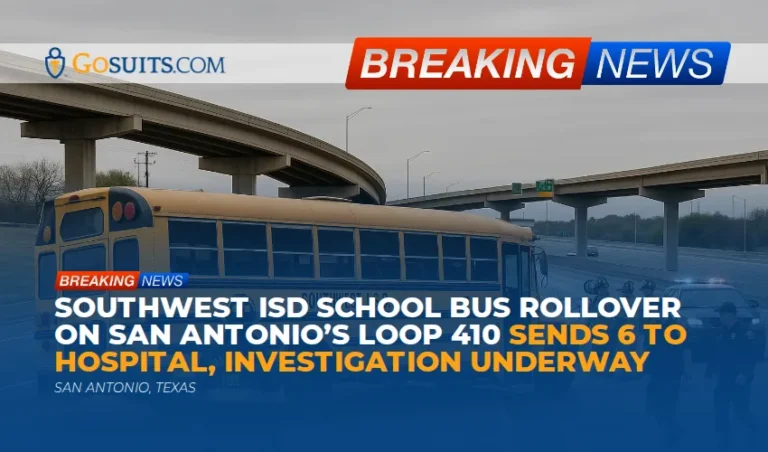
Early Tuesday morning, a Southwest Independent School District bus overturned on the way to school with about 33 students on board. The incident occurred just before 8 a.m., and students were headed to Legacy High School. According to initial information provided on scene, the bus struck a curb while entering the highway, rolled onto its left side, and slid a short distance before coming to a stop. Students were able to self-evacuate. The driver, a 63-year-old woman, reported difficulty seeing as she entered the ramp and was initially trapped until first responders freed her. Several lanes were blocked during cleanup and the investigation later that morning.
Authorities indicated there are no expected criminal charges associated with this event. Southwest ISD stated publicly that student safety is its top priority and expressed relief that there were no serious student injuries in early assessments, while also asking the community to keep the bus driver in their thoughts.
Where and when it happened on San Antonio’s Southwest Side
The rollover happened along Southwest Loop 410 near Old Pearsall Road on the Southwest Side of San Antonio, just as morning rush was building. If you drive that corridor, you know the merge zones and on-ramps can get congested around school start times. The area sits a short drive from Pearsall Park and several neighborhood communities that feed into Legacy High School. Morning light, traffic flow, and the turn geometry on the ramp can all influence visibility and timing, which is why investigators typically reconstruct the scene to understand the sequence.
Injuries reported and current status
Five students and the bus driver were transported to the hospital following the crash. Initial updates described the driver as in serious condition. Later in the day, district officials shared that three of the five students had been released from the hospital, and that the remaining two students and the driver were hospitalized with non-life-threatening injuries. Uninjured students were placed on another bus and taken to school.
If any student begins to experience new or worsening symptoms later, that does not necessarily contradict the early hospital evaluation. Delayed-onset symptoms are common after crashes, especially those involving a rollover. Families may want to monitor for headaches, nausea, confusion, dizziness, neck or back pain, or changes in mood and sleep, and check in with a physician if anything seems off [2].
What investigators will likely examine
Investigators said the district will provide interior bus video. That video, along with exterior scene photos, skid and scrape marks, and data from the bus’s onboard systems, often provides an objective timeline. Here are typical focus areas in a crash like this, based on common investigative practices:
- Roadway and environmental conditions such as lane design, pavement condition, lighting, glare, and weather at the time of the crash.
- Vehicle condition and maintenance including steering, braking, tires, suspension, and any recent service history relevant to handling on ramps.
- Driver inputs and decisions as reflected by pedal use, steering angle, and speed when entering the ramp. Investigators will compare the driver’s description of limited visibility with objective evidence.
- Occupant seating and safety protocols including how students were seated, whether any belts were present on that model, and evacuation conduct after the rollover [1].
- Operational practices such as route timing, dispatch communications, and whether any unusual route hazards were reported that morning.
This review is designed to answer a straightforward question: what combination of factors most likely caused the curb strike and rollover? An evidence-based answer helps the district improve training and operations and informs any insurance review or civil claims.

How to get official records and information, step by step
Families often want documentation for school and medical absence reasons, for peace of mind, or to preserve evidence for potential insurance claims. Here is how to locate the key records associated with a crash in San Antonio and Bexar County.
Police crash report and scene documentation
- Texas crash report (CR-3): Police crash reports in Texas are released under Transportation Code Section 550.065 to involved parties, their insurers, and certain others with a proper interest [5]. In San Antonio, SAPD reports can typically be requested through the City’s records portal or the police records unit [7].
- Evidence to have ready: date and time of crash, location (Southwest Loop 410 at Old Pearsall Road), bus number if known, and the names of the driver or involved students.
- Supplemental materials: Photographs, 911 audio, and CAD logs may be requested separately via the City of San Antonio open records process, subject to applicable privacy and law enforcement exceptions [6].
School district video and internal incident records
- Bus interior video: Investigators have already requested district video. Families may also submit a Texas Public Information Act request to Southwest ISD for crash-related records. Some items could be withheld under student privacy laws, but there are ways to request footage that masks other students’ identities [6][9].
- Student privacy: Video that directly relates to a specific student can be considered part of that student’s education record under FERPA, which affects how and to whom it can be released. The U.S. Department of Education provides guidance on videos and photos under FERPA [9].
EMS and medical documentation
- EMS run reports: If a student was evaluated or transported, the family can typically request EMS reports through the City’s records process. These records are protected health information and are released to patients or their authorized representatives.
- Hospital records: Request from the treating hospital’s medical records department. Parents and legal guardians can request records for minors with proper identification.

Other helpful points of contact
- San Antonio Police Department Records Unit for crash reports and scene documentation [7].
- Southwest ISD Transportation or Administration for district statements and process updates. Public information requests are governed by the Texas Public Information Act through the Texas Attorney General’s guidance [6].
- Bexar County Medical Examiner information typically applies when a fatality occurs. While not applicable here, families sometimes ask about it; in non-fatal events, the medical examiner is not involved.
Medical follow up after a rollover: what symptoms to watch
Even when early imaging is clear, some injuries reveal themselves over days. For students and adults alike, concussive symptoms can include headaches, dizziness, difficulty concentrating, sensitivity to light and noise, sleep changes, and irritability. The CDC outlines common signs and when to seek care [2]. After a rollover, also be mindful of neck and back pain, abdominal pain, or unusual bruising that could signal deeper soft-tissue or internal injury.
Practical tips families in Legacy High School’s community have found helpful after a crash like this include:
- Keep a simple symptom journal for the first 7 to 10 days. Note pain levels, headaches, nausea, and changes in concentration or mood by time of day.
- Limit high-intensity activity early and get physician guidance on returning to sports or PE. Schools often accommodate short-term academic adjustments.
- Save receipts and notes from medical visits, over-the-counter medications, and transportation costs related to care. These small items are often overlooked in insurance reviews.
Texas legal context for public school bus crashes
When a crash involves a public school district vehicle, Texas law handles responsibility differently than a typical private vehicle collision. The Texas Tort Claims Act allows claims against governmental units for property damage, personal injury, and death caused by the operation or use of a motor-driven vehicle by an employee acting in the scope of employment, subject to strict limits and exceptions [3].
Key concepts to understand, without getting too deep into legalese:
- Governmental immunity is partially waived for motor-vehicle incidents, but damage caps apply. For school districts and many local governmental units, the cap is generally $100,000 per person and $300,000 per occurrence for bodily injury, and $100,000 for property damage [3].
- Notice deadlines can be short. Texas law requires that a governmental unit receive notice of a claim within six months of the incident in most cases, describing the incident and the damages claimed. Local rules can vary for municipalities, though school districts typically follow the statute’s six-month notice standard [3].
- Two-year general limitations period. In Texas, the general deadline to file a personal-injury lawsuit is two years, and special rules apply to minors and to claims against government entities [4].
- Comparative responsibility may be evaluated if multiple causes are identified, such as roadway factors, maintenance, or driver decision-making. Investigative findings and video matter a great deal here.
Because this rollover occurred within San Antonio city limits and involves a public school bus, it is the kind of event where families often want clarity from seasoned counsel before making insurance statements or submitting forms. It is not uncommon for insurers to request recorded statements quickly. What is said early can shape the entire claim record later. Families sometimes search for car accident lawyers in these situations to help them understand their options and obligations before speaking with insurers.
For additional background on how Texas is approaching school safety requirements, including transportation implications, see this discussion of the impact of new school safety law on texas school districts.
Insurance and claims considerations, including government entities
School districts generally carry liability coverage or self-insurance programs tailored to the Tort Claims Act’s limits. Here are practical points that tend to come up after a district bus crash:
- Which insurance applies: Claims for injuries often go through the district’s liability program, but a family’s personal auto policy medical payments or PIP coverage can also help with immediate medical bills, regardless of fault. Review coverage before filing claims.
- Recorded statements: Insurers may request them soon after an incident. It is prudent to consult an attorney first so you understand the scope of your obligations and the potential use of your words later in the process. Statements made in good faith can still be misinterpreted.
- Documentation is critical: Maintain medical records, school absence notes, receipts, and a daily log of symptoms and limitations. This helps establish the full impact of the rollover, particularly for soft-tissue and concussion-related issues that are less visible.
- Caps and claim valuation: Governmental caps may limit the total recovery available through the district, which can affect how claims are valued and negotiated even when injuries are real and documented.
In the San Antonio area, many families choose to speak with car accident lawyers in San Antonio who are familiar with governmental immunity and local procedures, simply to avoid common missteps at the outset. A brief consultation can clarify which insurance pays what and when, and how best to present medical documentation without oversharing irrelevant history.
School transportation safety in Texas and community takeaways
Crashes involving student transportation can rattle a community, even when injuries are limited. It helps to keep perspective alongside the understandable concern. NHTSA has long emphasized that school buses are among the safest modes of roadway travel for children, with vehicle design that protects the passenger compartment and driver training focused on safety [1]. Still, rollovers demand attention.
Community-level takeaways grounded in state and federal guidance include:
- Visibility matters: Sun angle and glare during morning commutes on Loop 410 and nearby ramps can change quickly with the season. Adjusting route timing by a few minutes, using visors effectively, and reducing speed during ramp transitions can reduce risk.
- Vehicle maintenance: Tire condition and alignment influence how a bus reacts to a curb strike or sudden maneuver. Scheduled inspections and prompt correction of steering or suspension issues are essential.
- Driver training and refreshers: Texas districts operate under state oversight that ties funding to student transportation programs and expects safe operations and compliance. Refreshers on ramp approach speeds and hazard scanning are routine topics [8].
- Interior cameras and protocols: Cameras support accountability and continuous improvement. If video confirms a visibility issue, the district can target the hazard through routing or training changes.
Parents often ask about seat belts on buses. NHTSA supports lap and shoulder belts on large school buses and provides technical guidance; deployment varies by district and bus fleet age. Where belts exist, consistent usage helps reduce movement during a rollover and may limit minor injuries [1].
What to do in the next 24 to 72 hours
Here is a practical, locally grounded checklist families in the Southwest Side can use this week. Pace yourselves. The goal is steady progress without overwhelm.
- Medical first: Schedule a follow-up with your pediatrician or primary care provider, even if the ER cleared you. Share any new headaches, dizziness, or neck and back pain. The CDC’s symptom list is a helpful guide for what to monitor at home [2].
- Document the impact: Note missed school days, sports restrictions, and any tutoring or academic accommodations. Keep receipts for co-pays, prescriptions, braces, or imaging.
- Collect official records: Set a reminder to request the police crash report once available, and any EMS paperwork if transport occurred. The City’s records portal and procedures are the place to start [7].
- Preserve photos and clothes: Save any photos of the scene or visible bruising. Keep damaged items like backpacks or glasses in a bag with a simple note on when and where they were damaged.
- Be careful with insurance calls: If an insurer phones for a statement, consider pausing until you have guidance. Simple phrasing can carry unintended meanings in claims files.
- Request district information: If desired, prepare a Texas Public Information Act request to Southwest ISD asking for the incident report and any non-exempt materials. The Attorney General’s site explains how the law works and what to expect in response timelines [6].
Why timely action matters right now
There are two reasons to take measured steps soon rather than later.
- Deadlines and preservation: Government-related claims carry notice requirements measured in months, not years. Evidence like bus video and exterior camera footage may be overwritten on a set schedule if not preserved. Early requests put a hold on these materials.
- Accurate medical picture: Insurance decisions often hinge on the first 30 to 60 days of medical documentation. Prompt follow-up ensures any concussion, whiplash, or soft-tissue injury is recorded and treated, rather than dismissed as minor.
Taking these concrete steps enhances clarity for everyone involved, from the district to insurers to treating physicians. It also reduces the stress that comes from uncertainty. If a claim will be made, it is best to contact an attorney first before contacting the insurance company to understand rights and obligations, since what is said to an insurer can be used later in the process.

Commentary from Gosuits San Antonio, Texas Personal Injury Attorney
Our hearts are with the students, families, and the driver involved in this rollover on the Southwest Side. We are grateful early reports indicate no life-threatening injuries for the students, and we wish the driver a full recovery. This write-up is intended for general information and education for our neighbors who are processing what happened and what comes next.
From a personal injury perspective, the factors described publicly so far point to a curb strike during a ramp merge, followed by a rollover onto the driver’s side. Onboard video and the physical evidence at the scene will guide any liability assessment. In Texas, public school bus incidents involve special rules under the Tort Claims Act, so details like the driver’s visibility, approach speed, ramp geometry, and the bus’s maintenance condition can take on added significance once insurers and district administrators review the file.
We have seen, time and again, how insurance carriers and large institutions leverage process knowledge that ordinary families do not have. Requests for recorded statements may arrive quickly, and forms can be phrased in ways that invite minimizing language. Minor symptoms get dismissed as stress, and later medical developments are called unrelated. Without a clear plan, people can unintentionally undercut their own claims.
That is why a free consultation matters. It allows a family to understand deadlines, the role of governmental caps, and what documents to request before making any recorded statements. Even if no claim is pursued, that conversation often brings clarity and some peace of mind.
Resources
- School Bus Safety – National Highway Traffic Safety Administration
- Concussion Signs and Symptoms – Centers for Disease Control and Prevention
- Texas Tort Claims Act, Chapter 101 – Texas Civil Practice and Remedies Code
- Limitations and Tolling, Chapter 16 – Texas Civil Practice and Remedies Code
- Accidents and Reports, Chapter 550 – Texas Transportation Code
- Overview of the Public Information Act – Texas Attorney General
- Police Records and Reports – City of San Antonio
- Student Transportation Funding – Texas Education Agency
- Videos and Photos Under FERPA – U.S. Department of Education