- What we know about the semi-truck crash near Maple and American Avenues in Fresno County
- Timeline and scene conditions overnight and into the morning
- Location context and local risk factors at Maple and American
- Immediate safety guidance for downed power lines, brush fires, and outages
- Legal context: missed stop sign, commercial trucking duties, and potential civil liability
- Injuries after a “minor” crash and why medical follow-up matters
- Documentation to gather and who to call for official records
- Property damage and business losses from the outage: documenting and pursuing claims
- How insurers typically respond to multi-vehicle truck crashes and outages
- Community notes: traffic recovery and repairs in south Fresno County
- Key deadlines and notice requirements in California
- What to expect in the civil claims process after a semi-truck collision
- Commentary from Gosuits Fresno County, California Personal Injury Attorney
- Call-to-Action Insights: Why acting promptly matters after a truck collision and power outage event
What we know about the semi-truck crash near Maple and American Avenues in Fresno County
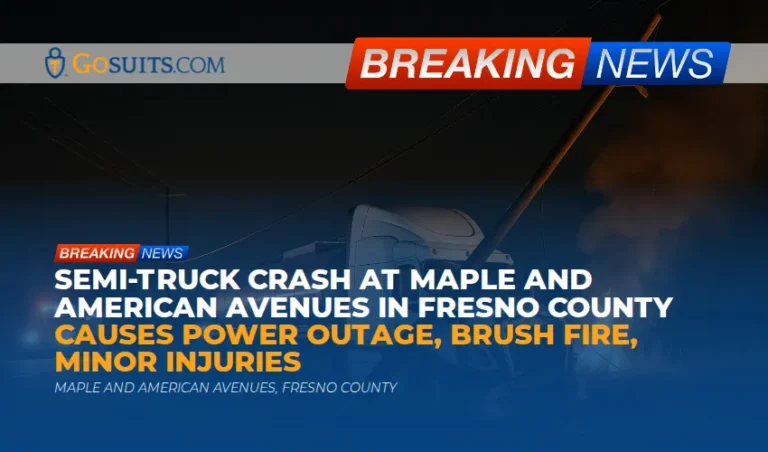
In the early morning hours, just after 2:30 a.m., two semi-trucks collided at the intersection of Maple and American Avenues in Fresno County. According to initial information from the California Highway Patrol, the driver of a trailer traveling east reportedly missed a stop sign. The collision sent at least one of the trucks into a power pole. The impact knocked a live wire to the ground, sparking a small brush fire nearby. Roughly 300 customers in the area lost power. Utility crews worked through the morning, and service was restored for nearly all affected customers soon after. Both truck drivers sustained minor injuries. One driver was transported to Community Regional Medical Center in Fresno for treatment. Drivers using that corridor were advised to expect slower traffic while utility and cleanup operations continued. If you live or work around south Fresno County, you know how that Maple–American grid connects farms, packing houses, and commuter routes toward Easton, Malaga, and the southern edge of the City of Fresno. When a power pole goes down there, it can interrupt both residential and agricultural operations quickly.
Timeline and scene conditions overnight and into the morning
Reports indicate the crash occurred shortly after 2:30 a.m., a time when visibility can be challenging in the Valley and fatigue can be a factor for overnight drivers. The collision damaged a power pole, dropped a live line, and ignited dry brush next to the roadway. First responders arrived to treat injuries, secure the scene from electrical hazards, and manage fire risk. Fire crews addressed the small brush fire while utilities isolated the line and began repairs. CHP managed traffic while debris and damaged equipment were cleared. By mid to late morning, power had been restored for nearly all impacted customers. One of the truck drivers was taken to Community Regional Medical Center, the central Fresno hospital that routinely receives trauma patients from around the county. Both drivers’ injuries were described as minor, but the scene remained active due to utility repair work.
Location context and local risk factors at Maple and American
Maple and American Avenues sit in a rural, agricultural area of Fresno County. These are wide, straight roads with long stretches of fields, dairies, and orchards. Intersections are often controlled by stop signs rather than signals. At night and in the early morning, speed can feel higher and approach angles deceptive, especially when a driver unfamiliar with the area expects a four-way stop or misses a single stop sign. Seasonal context matters, too. In the late fall and winter, the central San Joaquin Valley experiences periods of thick tule fog. While fog wasn’t confirmed at the scene, drivers in this area understand how quickly visibility can change before sunrise. Additionally, the 2 a.m. to 6 a.m. window is a known high-risk period for drowsy driving; national safety data identifies the overnight hours as a prime time for fatigue-related crashes. See the National Highway Traffic Safety Administration’s guidance on drowsy driving risk and warning signs at NHTSA. Agricultural trucking adds to traffic complexity around harvest and shipping schedules. Even in the off-peak months, tractor trailers, reefers, and farm support vehicles use these routes to move goods in and out of storage and processing facilities. A missed stop at one of these intersections can have serious consequences, as we saw with the power pole strike and resulting outage.

Immediate safety guidance for downed power lines, brush fires, and outages
When power poles are damaged and lines come down, bystanders face electrical and fire hazards. Authorities consistently emphasize the following safety measures: – Treat every downed line as energized. Stay at least 35 feet away. Do not touch the line or anything it contacts, including fences and vehicles. CAL FIRE’s safety guidance reinforces keeping a wide distance and calling 911 immediately. Review CAL FIRE’s materials on downed power lines at CAL FIRE. – Report immediately and keep others back. Call 911 to report a downed line and any fire. If you’re in a vehicle with a line on it, remain inside if safe to do so and wait for emergency responders. – During outages, use generators and grills safely outdoors. Carbon monoxide is odorless and deadly. The Centers for Disease Control and Prevention provides clear safety steps for power outages and generator use at CDC Power Outages and explains carbon monoxide risks at CDC CO Poisoning. – Protect refrigerated medications and food. Keep refrigerator and freezer doors closed to preserve cold temperatures. Public health officials advise discarding perishable foods held above 40°F for more than two hours. See general outage preparedness guidance at Ready.gov. – Watch for flare-ups in dry vegetation. Even a small brush fire can spread under windy or dry conditions. Report flare-ups immediately and avoid driving over or near downed lines, which can spark additional fires. These basics matter in our region. Rural rights-of-way often have dry weeds near poles and ditches, so a downed energized line can ignite brush rapidly.
Legal context: missed stop sign, commercial trucking duties, and potential civil liability
Traffic control violations are central to many intersection collisions. In California, drivers must stop at stop signs as required by law. California Vehicle Code section 22450 sets the duty to stop at a limit line, crosswalk, or point nearest the intersecting roadway. The statutory requirement is published by the Legislature at California Vehicle Code 22450. When a driver fails to obey a stop sign and a crash results, civil liability may arise under negligence principles. In some situations, violating a safety statute can support a finding of negligence based on the concept often referred to as negligence per se. Whether that applies depends on the facts, including causation and whether the statute was intended to prevent the type of harm that occurred. Commercial trucks also operate under federal safety rules. The Federal Motor Carrier Safety Administration regulates hours-of-service, vehicle inspections, and minimum financial responsibility for motor carriers. You can review the federal hours-of-service framework at FMCSA Hours-of-Service and the minimum liability insurance requirements in 49 CFR 387.9. These rules help ensure that drivers are rested and that carriers have resources to cover injuries and property damage. California follows pure comparative negligence, meaning that if more than one party’s conduct contributed to a crash, fault can be allocated by percentage, and a claimant’s recoverable damages are reduced by their share of responsibility. The California Supreme Court recognized this framework in Li v. Yellow Cab Co. of California. How fault is ultimately apportioned depends on a careful evaluation of evidence like traffic control placement, sight lines, approach speeds, lighting and reflectivity, and the conduct of each driver. Power infrastructure damage adds layers. If a driver’s conduct knocks down a pole and causes a brush fire or outage that harms others, those injuries and losses may be part of the civil damages landscape. Documentation becomes crucial so individuals and businesses can prove what was lost.
Injuries after a “minor” crash and why medical follow-up matters
Initial reports describe the drivers’ injuries as minor, and that’s welcome news. Still, people involved in similar collisions can experience delayed-onset symptoms. Adrenaline masks pain. Soft tissue injuries, concussion symptoms, or back strain may emerge over days. Getting evaluated, following discharge instructions, and tracking symptoms can make a meaningful difference in recovery and in any potential claim that hinges on medical documentation. Pain that worsens, headaches, dizziness, or numbness should prompt prompt medical attention. Keeping all records and bills organized from the start helps later, especially if multiple providers are involved.
Documentation to gather and who to call for official records
In the aftermath of a semi-truck crash with utility damage, official records tell the story. Here’s how people typically locate them in Fresno County: – CHP collision report. CHP investigates many crashes on county roadways. To request a copy of a collision report, CHP provides a statewide request process through the CHP 190 form, with instructions at CHP Collision Reports. For questions or in-person assistance, the Fresno Area CHP office information is listed at CHP Fresno Area Office. Be ready to provide the date, time, location, and parties involved. – Fire incident information. When a brush fire is involved, there may be an incident record from the responding agency. In this part of the county, CAL FIRE units and local fire districts often respond. You can start with CAL FIRE resources at CAL FIRE, then ask about public records or incident numbers tied to the date and intersection. – Emergency medical records. Hospital records from Community Regional Medical Center or EMS transport documentation help establish injuries and treatment timelines. Hospitals have Health Information Management departments that process requests for patient records with proper authorizations. – Utility restoration and line damage notes. While utilities may not release internal documents, outage timeframes are sometimes publicly available. Keep photos of clocks, thermostats, and appliance displays that show times, as well as any messages received about restoration. – Coroner or autopsy records. These do not apply to this nonfatal incident. However, in fatal collisions, families typically work with the Fresno County Sheriff-Coroner’s Office for next-of-kin notifications and reports. Those records have specific release rules and timelines. – Personal documentation. Save photos of vehicle damage, the intersection, skid marks, debris fields, and the damaged power pole if it can be done safely and lawfully. Keep receipts for towing, temporary transport, lodging if stranded, and any forced purchases due to the outage.
Property damage and business losses from the outage: documenting and pursuing claims
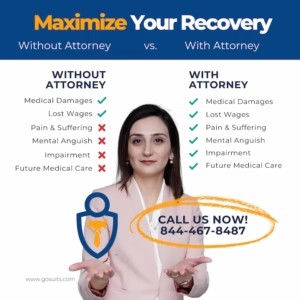
Downed lines and outages can cause more than inconvenience. For households, you may be dealing with spoiled food or refrigerated medications. For small businesses on the rural roads around Maple and American, outages can halt cold storage, packing, irrigation timers, or early shift operations. – Document everything. Take photos of refrigerators, freezers, and any items discarded. Note the time the power went out and when it returned. Keep receipts from the days before the outage to show what was on hand. – Medication losses. For temperature-sensitive medications, ask your pharmacist for written guidance on stability after an outage. Obtain a letter confirming replacement needs and cost. – Business interruption. Keep payroll records, shift schedules, and order logs to show when operations stopped and resumed. Photograph control panels or alarms that indicate power loss timing. – Insurance and claims. In incidents where a third party’s conduct causes the outage, claims may be directed toward that at-fault party’s insurer, rather than a utility. Before contacting any insurer, it’s generally wise to speak with an attorney so you understand how a recorded statement or partial disclosure could affect your rights later. What you say to an insurance company can be used to reduce or deny a claim. Not every loss will be compensable in every situation, but careful documentation gives any claim a clearer factual foundation.
How insurers typically respond to multi-vehicle truck crashes and outages
Commercial carriers and their insurers often move quickly after a crash. It’s common to see: – Early outreach with recorded statements. Adjusters sometimes call within hours, seeking details that can later be used to argue the event was minor or that symptoms aren’t related. – Requests for broad medical authorizations. A sweeping records request may capture years of medical history, which can then be used to argue preexisting conditions. – Minimizing outage-related losses. Insurers may say perishable losses are speculative without detailed proof. That’s why time-stamped photos, receipts, and logs matter. – Disputes over fault allocation. In a stop-sign crash, an insurer might still argue comparative fault based on speed, lighting, or lane position. California’s comparative negligence system allows these arguments to reduce payout exposure. See the pure comparative framework recognized in Li v. Yellow Cab. – Delays in producing critical trucking records. Electronic logging device data, driver qualification files, maintenance logs, and dashcam footage can clarify what happened. Preservation letters are often necessary to ensure nothing is lost. Given these dynamics, many people consult a lawyer first, then decide whether to engage with insurance directly or have communications routed through counsel.
Community notes: traffic recovery and repairs in south Fresno County
Repair work on rural power infrastructure takes time, especially when a pole must be replaced and lines restrung across fields and irrigation rights-of-way. Around Maple and American, drivers may cut over to Clovis Avenue, Chestnut, or Jensen depending on detours. Farm and dairy operations also need early access, so you may see slow-moving equipment during morning cleanup. If you commute toward industrial employers near Malaga or head north into downtown Fresno before sunrise, monitor traffic advisories and give utility trucks extra space. Crews are often staged along ditches and canal banks where visibility is limited.
Key deadlines and notice requirements in California
Civil claims have deadlines. In California, most personal injury claims must be filed within two years of the injury. See Code of Civil Procedure section 335.1 at CCP 335.1. If a public entity is potentially involved in a claim, special notice rules can apply, often requiring a written claim within six months. See Government Code section 911.2 at Gov. Code 911.2. Even when it appears to be a straightforward crash, confirming the correct defendants, insurance carriers, and claim procedures takes time. It’s prudent to identify the timeline early so rights are preserved.
What to expect in the civil claims process after a semi-truck collision
Every case is unique, but many truck-collision claims share a common rhythm: – Investigation and preservation. Scene photos, vehicle inspections, electronic logging device data, event data recorders, dashcam footage, and utility repair logs should be identified and preserved. Prompt letters to the trucking companies can help prevent loss of crucial evidence. – Medical documentation. Consistent treatment, specialist referrals when needed, and clear record-keeping help link injuries to the crash. Missed appointments and gaps in care are often used by insurers to downplay claims. – Liability analysis. Attorneys review vehicle codes, signage placement, lighting, speed estimations, and witness statements to understand how and why the crash occurred. Cited violations such as a missed stop sign can be significant. See the statutory duty at Vehicle Code 22450. – Damages assessment. This includes medical bills, wage loss, property damage, and documented outage-related losses. For businesses, profit-and-loss statements and inventory logs may be relevant. – Insurance communications. It’s common to route all communications through counsel to avoid inadvertent admissions. Recorded statements without preparation are risky. – Settlement or litigation. Some matters resolve through claims submissions and negotiation. Others require filing a lawsuit to compel full disclosure and preserve rights before deadlines expire.
Commentary from Gosuits Fresno County, California Personal Injury Attorney
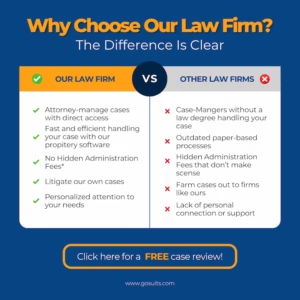
First, our thoughts are with the drivers, responders, and neighbors affected by the outage and brush fire. This article is intended for educational and general information purposes only. Early-morning highway work is hard, and collisions like this create ripple effects for families starting their day and for small farms and businesses relying on power and safe roads. From the details shared so far, a missed stop sign at Maple and American appears to be a key factor. In civil cases, a failure to stop at a posted sign under California law can support liability when it leads to a crash. When heavy trucks are involved, the margin for error is small. A pole strike adds secondary hazards that can injure bystanders or damage property in a wide radius. That is why thorough investigation matters: scene measurements, signage verification, approach lighting, vehicle speeds, and electronic logs help establish what was foreseeable and preventable. We also see how large insurers and corporate carriers respond after incidents like this. Adjusters often reach out immediately for recorded statements. They may suggest early, low settlements before the full scope of harm is known, particularly with outage-related losses that are easy to minimize if not carefully documented. Without guidance on trucking regulations and comparative negligence, people can underestimate their rights or waive them unknowingly. A free consultation with a seasoned injury attorney can help anyone understand the playing field before engaging with insurers. It levels the informational gap, clarifies what to preserve, and helps avoid missteps that can limit recovery later. Speaking with counsel first is especially important in collisions involving commercial carriers, where evidence like ELD data and dashcam footage can be lost if not promptly requested.
Call-to-Action Insights: Why acting promptly matters after a truck collision and power outage event
– Identify and preserve critical evidence now. Scene conditions change quickly. Utility repairs, brush cleanup, and normal traffic will erase key details. Acting promptly allows measurements, photos, and preservation letters to secure data from trucks, carriers, and third parties before it’s overwritten. – Get a clear plan before speaking with insurers. Insurance outreach can be fast and friendly, but recorded statements and broad medical releases can harm a claim later. Having a plan first prevents avoidable mistakes. – Document outage-related losses while memories are fresh. Photos, time logs, receipts, and inventory notes are far easier to assemble in the first days. Waiting weeks makes proof harder, giving insurers room to dispute or discount losses. – Confirm the correct claim targets and timelines. Multi-vehicle incidents can involve multiple insurers. If a public entity may be implicated, special notices may be required in a short window. Early clarity on who is responsible and which deadlines apply prevents rights from slipping away. – Protect health and recovery. Symptoms can evolve after a crash. Timely medical evaluation, consistent follow-up, and secure record-keeping support both recovery and any future claim built on accurate documentation. – Stabilize transportation and work needs. Arrange interim transportation, keep employers informed with documentation, and track any wage impacts as they occur. Immediate organization reduces stress and strengthens any wage-related claim. – Anticipate comparative fault arguments. Expect insurers to argue for shared responsibility. Early attention to signage, visibility, and approach paths helps counter incomplete narratives that shift blame. – Act while witnesses and digital records are accessible. Witness recall fades. Electronic logs cycle. Prompt outreach preserves testimony and data that can make a decisive difference later.
Sources and references
– California Vehicle Code section 22450 Stop Requirements: leginfo.legislature.ca.gov
– Pure comparative negligence recognized in Li v. Yellow Cab Co. of California: scocal.stanford.edu
– FMCSA hours-of-service overview: fmcsa.dot.gov
– Federal minimum financial responsibility for motor carriers, 49 CFR 387.9: ecfr.gov
– CHP collision report request process: chp.ca.gov
– CHP Fresno Area Office: chp.ca.gov
– CAL FIRE power line and fire safety resources: fire.ca.gov
– CDC guidance for power outages and generator safety: cdc.gov and cdc.gov
– Ready.gov power outage preparedness: ready.gov
– NHTSA drowsy driving safety information: nhtsa.gov
– California Code of Civil Procedure 335.1 two-year personal injury limitation: leginfo.legislature.ca.gov
– California Government Code 911.2 public entity claim deadline: leginfo.legislature.ca.gov