- What happened at Bunny Avenue and Blosser Road
- Immediate steps investigators and families can take after a fatal hit-and-run
- Where to obtain police, coroner, and vital records in California
- Civil liability issues in California pedestrian fatality cases
- Local roadway and pedestrian safety context in Santa Maria and the Central Coast
- How insurance companies typically handle fatal hit-and-run claims
- Support resources and practical community contacts
- Key timelines and preservation reminders under California law
- What to do next and why timing matters
- Commentary from Gosuits Santa Maria, California Personal Injury Attorney
- References
What happened at Bunny Avenue and Blosser Road
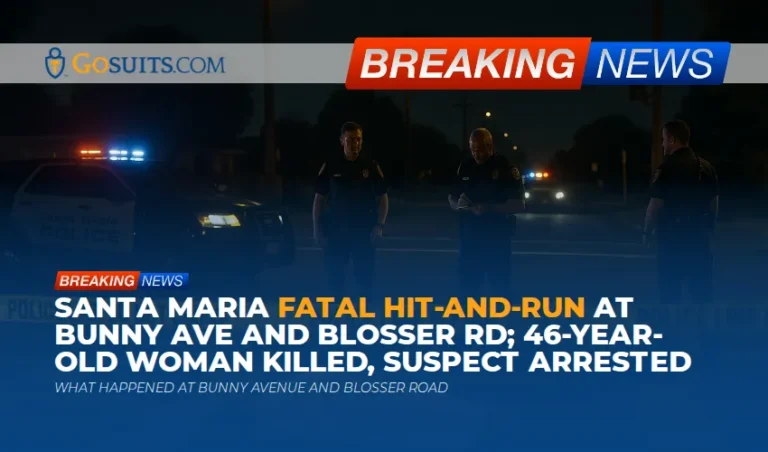
Late on Saturday night, February 21, 2026, at approximately 11:54 p.m., Santa Maria Police officers responded to a vehicle versus pedestrian collision at the intersection of Bunny Avenue and Blosser Road on the city’s west side. Emergency personnel rendered aid to a 46-year-old woman from Nipomo, but she was pronounced deceased at the scene. According to information released by Santa Maria Police and shared publicly, the driver left the scene immediately after the impact. Officers later located the suspected vehicle and made contact with a 30-year-old Santa Maria resident who was arrested and booked into the Santa Barbara County Jail on multiple felony charges.
If anyone in the community saw anything unusual near Bunny Avenue and Blosser Road around that time, even small details may help investigators connect the dots. Santa Maria Police asked that information be directed to Officer Nick Barton at 805-928-3781, ext. 1358.
For those who know the intersection, Bunny Avenue crosses residential blocks west of Blosser, with traffic heading toward recreational spaces and neighborhood pockets that can feel very dark at night. Many locals use Blosser as a north-south alternative to Broadway, and on weekend nights traffic can be surprisingly steady as people return from gatherings, late shifts, or errands near Marian Regional Medical Center, Allan Hancock College, or the Santa Maria Town Center area.
Immediate steps investigators and families can take after a fatal hit-and-run
In the hours and days after a fatal collision, it’s hard to know what to do first. The following steps focus on protecting safety, preserving evidence, and respecting the legal processes that will unfold, both criminal and civil.
Priorities in the first 48 hours
- Document what you know, while it’s fresh. Write down dates, times, locations, any vehicle descriptions, and interactions with bystanders or first responders. Even small memory details can become decisive corroboration later.
- Preserve nearby camera footage. Doorbell cameras, business CCTV, and traffic cameras can overwrite quickly. If you or neighbors have footage near Blosser Road, save full clips, not just snippets, and note exact timestamps. Where feasible, request nearby businesses to retain their recordings. California’s public records framework can also help obtain recordings from public agencies when applicable [6].
- Collect and secure physical evidence. Shoes, clothing, or vehicle debris found at or near the scene should be stored in a clean, dry place. Photograph items before moving them, and keep a chain-of-custody note of who handled what and when.
- Obtain official reports promptly. A traffic collision report and, in due course, the coroner’s findings and death certificate will frame much of the factual record. We outline how to request each below.
- Avoid recorded statements to insurance carriers before getting legal guidance. What a person says early on, even when grieving, can be used against them later. A brief consultation with a seasoned attorney can help set boundaries and protect rights.
Why evidence moves fast in hit-and-run cases
In collisions where the driver leaves the scene, evidence beyond eyewitness testimony becomes especially important. California law imposes duties on drivers to remain at the scene and render aid when a collision causes injury or death [1]. When that duty is breached, the timeline to capture third-party evidence becomes urgent. Some private systems overwrite within 24 to 72 hours, and even municipal systems can have short retention windows depending on agency policy. A clear, early preservation request to potential custodians reduces the risk of losing critical context.
Where to obtain police, coroner, and vital records in California
Families often need three types of records after a fatal crash: the traffic collision report, the coroner or autopsy report, and certified copies of the death certificate. Each serves a different purpose.
Santa Maria Police traffic collision report
California law makes traffic collision reports generally available to the parties of interest, which typically includes the decedent’s legal representatives or heirs, insureds, and certain other stakeholders under Vehicle Code section 20012 [2]. Reports are not typically immediately available; they are released after initial investigation steps conclude. The department will advise when and how to request a copy and what identification or proof of interest is required. Keep the incident date, time, and location handy: February 21, 2026, approximately 11:54 p.m., Bunny Avenue at Blosser Road.

Coroner and autopsy records
California counties investigate certain types of deaths through the coroner, including those arising from accidents and suspected criminal acts, consistent with Government Code section 27491 [7]. Families can usually request the autopsy report and related findings once the investigation permits release. In many cases, next of kin may receive these materials directly; some portions may be redacted if they implicate ongoing investigations or privacy considerations entrenched in California law.
It’s also common for law enforcement to coordinate with the coroner on toxicology, cause and manner of death, and identification. Ask for estimated timelines so you know when to follow up. Maintain a log of each inquiry and any file or case number assigned.
Death certificate
Certified death certificates in California are issued through the California Department of Public Health or the county vital records office. These documents are used for insurance, probate, and other legal purposes. The state outlines eligibility and steps to order copies on its website [3]. Request multiple certified copies; different institutions often require originals.
911 audio and dispatch logs
Depending on agency policy and investigative status, 911 recordings and CAD logs may be obtainable through California’s Public Records Act, now codified in Government Code Title 1. These requests can be directed to the appropriate agency custodian. While certain exemptions apply, the Act favors disclosure where possible [6].
Civil liability issues in California pedestrian fatality cases
When a driver strikes a pedestrian, civil liability analysis focuses on duties, breach, causation, and damages. Several California statutes and standard jury instructions frame these duties.
Driver duties to pedestrians
Drivers must exercise due care for the safety of pedestrians at all times. California Vehicle Code section 21950 sets right-of-way rules at crosswalks and requires drivers to reduce speed or take other actions to safeguard pedestrians. Even when a pedestrian is outside a crosswalk, Vehicle Code section 21954 still requires drivers to exercise due care to avoid collisions [4] [5]. A driver’s decision to leave the scene after a collision with injury or death violates Vehicle Code section 20001, a serious breach of duty that reverberates in both criminal and civil arenas [1].
Comparative fault in California
California applies pure comparative negligence, which means a fact finder can assign percentages of fault among involved parties, and a claimant’s recovery is reduced by their percentage of fault rather than barred. The concept is reflected in California Civil Jury Instructions on comparative fault, which courts use to explain these principles to juries [8]. Evidence about lighting, speed, driver attentiveness, roadway design, and pedestrian behavior can all inform these allocations.

Wrongful death and survival actions
Two civil pathways are common after a fatal collision:
- Wrongful death. Certain family members can bring claims for the loss of their loved one under California Code of Civil Procedure section 377.60. Damages can include lost financial support, loss of companionship, and related harms recognized by statute [9].
- Survival action. The decedent’s estate may pursue claims the decedent could have brought had they lived, including economic losses before death, under Code of Civil Procedure sections 377.30 and 377.34 [10].
For a deeper, plain-language walk-through of what families often face after a roadway fatality, this resource may help: what happens if someone is killed in a car accident.
Uninsured and underinsured motorist coverage in hit-and-run scenarios
California’s Insurance Code section 11580.2 governs uninsured motorist coverage, including claims arising from hit-and-run incidents. While policy language varies, many UM claims require prompt notice and sometimes proof of physical contact or independent corroboration when the at-fault vehicle is unidentified. Reviewing the household’s auto policies, even if the decedent was a pedestrian, is important because UM coverage can extend to insured family members injured by vehicles as pedestrians [11].
Local roadway and pedestrian safety context in Santa Maria and the Central Coast
Residents know Santa Maria’s grid has several corridors where speed and nighttime visibility interact in risky ways. Blosser Road serves as a practical north-south route connecting residential neighborhoods with shopping areas and city parks. Lighting and sightlines vary, and traffic can surge around shift changes at industrial sites or late evening returns from the Santa Maria Public Airport and nearby dining spots along Broadway and Betteravia.
State and national data put context around the hazards pedestrians face at night and near higher-speed roads:
- Nighttime risk is higher. National roadway safety analyses consistently show a higher proportion of fatal pedestrian crashes occurring in dark conditions. NHTSA’s reporting reinforces the overrepresentation of nighttime fatalities and the influence of speed and impairment on severity [12].
- California’s pedestrian safety challenge. California Office of Traffic Safety dashboards and annual reports track pedestrian fatalities statewide and by county, underscoring persistent risks in urbanized corridors and at multi-lane crossings [13].
Seasonal and local conditions can make things worse. On the Central Coast, winter and early spring can bring patchy coastal fog that reduces reaction time. Agricultural traffic around the Santa Maria Valley during peak strawberry harvest adds larger vehicles and new sightline challenges. A simple take-away for drivers and pedestrians alike: slower is safer, and planning crossings where lighting is best improves survivability.
How insurance companies typically handle fatal hit-and-run claims
When a collision is severe and a driver flees, insurers move quickly to shape the narrative, often before families can gather their bearings. Adjusters may seek recorded statements that probe for ambiguity, ask leading questions about visibility, or imply comparative fault based on clothing color, crossing location, or alleged distraction. Before engaging with any insurer, it’s prudent to get a brief consultation with a qualified professional so conversations and disclosures align with your rights. This is where car accident lawyers can help families safeguard the record and establish a methodical plan for evidence preservation and benefits coordination.
On the liability carrier side, defenses can include disputing causation, claiming lack of notice, or minimizing damages by pointing to gaps in documentation. For households tapping into their own UM or UIM coverage, policies can be complex, with notice provisions and corroboration requirements that must be met. If coverage questions arise, Santa Maria car accident lawyers can help interpret policy terms, coordinate with law enforcement on witness or evidence corroboration, and ensure deadlines are met under Insurance Code and policy language.
Support resources and practical community contacts
Information moves quickly in the days after a tragedy. Here are practical places to request help and records, along with context to know what each can provide.
Law enforcement
- Santa Maria Police Department. To share information related to this investigation, call Officer Nick Barton at 805-928-3781, ext. 1358. For collision reports, the department will advise when the report is available and how to request it based on eligibility under Vehicle Code section 20012 [2].
Coroner and vital records
- County coroner. For autopsy and coroner inquiry status, request the case number and expected timelines. The authority for coroner investigations comes from Government Code section 27491 and related provisions [7].
- California Department of Public Health. Order certified death certificates via CDPH or the county vital records office. CDPH explains who may order and which identification is required [3].
Victim compensation and practical aid
- California Victim Compensation Board (CalVCB). Families of victims of violent crimes may qualify for certain reimbursements, including funeral and burial costs, mental health counseling, and income loss support. CalVCB publishes eligibility and application details [14].
Local faith communities, grief support groups, and hospital social workers at Marian Regional Medical Center can also be steady partners in the first weeks. Ask about bereavement counseling, assistance with memorial logistics, and help coordinating time-sensitive paperwork.
Key timelines and preservation reminders under California law
California sets several guardrails that affect how and when claims can be brought, and how evidence should be handled. A few stand out:
- Statute of limitations for wrongful death. Generally, wrongful death actions in California must be filed within two years of the date of death under Code of Civil Procedure section 335.1 [15]. There are exceptions and special rules for claims involving public entities, minors, and certain types of defendants, but the two-year baseline is a critical anchor for planning.
- Survival claims timeline. Survival actions are typically subject to the same or shorter limitations periods applicable to the decedent’s underlying claims, with additional constraints on damages under section 377.34 [10].
- Evidence retention. Private camera systems may overwrite footage in days, not weeks. Public records requests under California’s Public Records Act can help preserve 911 logs or certain recordings, subject to exemptions and retention policies [6]. Make requests early and in writing.
- Insurance notice requirements. UM and UIM policies often require prompt notice and cooperation. Delays can cause avoidable disputes about prejudice to the insurer. Review every auto policy in the household carefully, including rideshare endorsements and umbrella coverage where applicable [11].

What to do next and why timing matters
After a roadway fatality, there are concrete actions community members can take to protect information and navigate the process with greater clarity. The goal here is to explain the why behind each step and the time sensitivity.
- Designate a single point of contact for information flow. When multiple people are fielding calls from insurers, investigators, and reporters, details can get lost or contradicted. Centralizing communication reduces errors and helps maintain consistent documentation.
- Create a simple case file. Keep a binder or shared digital folder with sections for law enforcement contacts, medical records, coroner updates, funeral invoices, wage or support documentation, and correspondence. That file becomes the backbone for future claims analysis.
- Send preservation letters to likely evidence holders. Corner stores, property managers, and residents along Blosser Road may have cameras that captured approach or departure paths. A brief, polite written request to retain footage, including the exact date and time window, can be decisive. Act within 24 to 72 hours wherever possible.
- Hold off on insurer statements until you understand your rights. Statements to an adverse insurer are often recorded and can be used later. Even first-party policies can involve technical pitfalls. Speaking with a skilled advocate first can prevent unintentional concessions that narrow options.
- Request official records as soon as they’re available. Collision reports, autopsy findings, and death certificates provide the scaffolding for liability and coverage analysis. They also help coordinate with employers, lenders, and service providers who may request proof-of-loss documents.
- Document community impacts and support needs. Memorial costs, counseling, and the practical burdens on family members deserve careful tracking. California’s victim compensation framework can offset some of these expenses if eligibility is met [14].
Why the urgency? Evidence disappears, memories fade, and policy deadlines do not pause. Taking organized steps early can significantly improve the quality of any civil claim assessment, help families access available benefits sooner, and ease the load during an already overwhelming time.
Commentary from Gosuits Santa Maria, California Personal Injury Attorney
Our hearts are with the woman’s loved ones and with neighbors who witnessed the aftermath at Bunny Avenue and Blosser Road. This overview is meant for education and general information. Every situation is unique, and nothing here should be taken as specific guidance for any individual matter.
From a civil injury perspective, a nighttime pedestrian fatality compounded by a driver leaving the scene raises serious questions about breach of duty and the cascade of harm that follows. California law expects drivers to exercise due care toward pedestrians, and the decision to flee after a collision causing injury or death is a grave violation. In our view, these facts highlight why quick evidence preservation is so important, from doorbell videos to business CCTV on approach routes.
We also see, time and again, how insurance companies and large institutions move fast to shape outcomes. Adjusters ask for recorded statements that can be used to introduce doubt or diminish claims. Carriers sometimes emphasize visibility or clothing color while overlooking speed, lighting, or inattentiveness. Without context and preparation, people can inadvertently accept narratives that are incomplete or unfair.
That’s why a free consultation matters. It helps families understand which records to request first, how to preserve videos properly, when to submit claim notices, and how to avoid statements that can be turned against them later. No one has to navigate that learning curve alone in the first days after a tragedy.
References
- California Vehicle Code § 20001 – California Legislative Information
- California Vehicle Code § 20012 – California Legislative Information
- Vital Records: Birth, Death, Fetal Death, Still Birth – California Department of Public Health
- California Vehicle Code § 21950 – California Legislative Information
- California Vehicle Code § 21954 – California Legislative Information
- California Public Records Act Overview – California Department of Justice
- California Government Code § 27491 – California Legislative Information
- California Civil Jury Instructions (CACI) – Judicial Council of California
- California Code of Civil Procedure § 377.60 – California Legislative Information
- California Code of Civil Procedure § 377.34 – California Legislative Information
- California Insurance Code § 11580.2 – California Legislative Information
- Pedestrian Safety – National Highway Traffic Safety Administration
- Pedestrian and Bicyclist Safety – California Office of Traffic Safety
- Victim Compensation Eligibility – California Victim Compensation Board
- California Code of Civil Procedure § 335.1 – California Legislative Information