- What happened at Magic Mountain Parkway and Tourney Road
- Local context around the Santa Clarita corridor
- Who investigates and how to get official records
- Civil law overview for families after a fatal pedestrian hit-and-run
- Evidence to preserve right now
- How insurers typically respond in hit-and-run cases
- Support and resources in Los Angeles County
- If you witnessed the crash: step-by-step
- Why acting quickly matters and what to do next
- Commentary from Gosuits Los Angeles, California Personal Injury Attorney
- References
What happened at Magic Mountain Parkway and Tourney Road
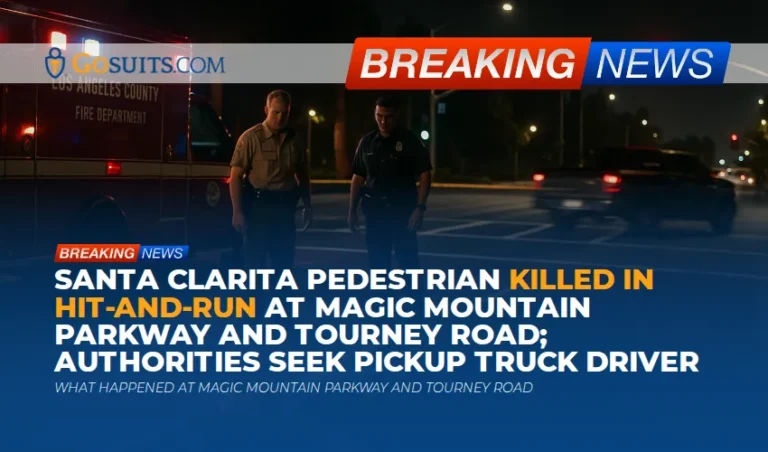
On Friday night, at approximately 8:22 p.m., deputies responded to a hit-and-run crash at the intersection of Magic Mountain Parkway and Tourney Road in Santa Clarita. According to initial reports, a pedestrian was struck by a large, dark-colored pickup truck. The driver did not remain at the scene and continued westbound on Magic Mountain Parkway. Los Angeles County Fire Department personnel arrived and pronounced the man deceased at the scene. Authorities had not released the name of the victim at the time of reporting, pending notification of next of kin. No suspect description was available at that time.
While investigators continue working to identify the vehicle and driver, that busy stretch near the Valencia commercial core sees steady traffic on weekend evenings. If you were in the area, even a small detail, like a partial plate, a distinctive lift kit, a loud exhaust, or a damaged headlight or mirror you noticed afterward, can be important.
Local context around the Santa Clarita corridor
Santa Clarita residents know this corridor well. Magic Mountain Parkway funnels drivers to and from Six Flags Magic Mountain and the shopping and dining areas near Town Center Drive and the Westfield Valencia Town Center. Tourney Road connects a mix of offices and hotels, with steady evening traffic as people leave work, grab dinner, or head toward the I-5. Lighting varies by block, and sightlines can be influenced by the gentle curves and landscaping along medians. Friday nights often bring a surge of visitors and locals, which means more pedestrians at crosswalks and midblock crossings.
Pedestrian safety is a community concern across Southern California. Nationally, federal safety agencies have noted rising pedestrian fatalities in recent years, highlighting the need for visibility, safe speeds, and drivers who yield lawfully at crosswalks [8][9][10]. Local knowledge also matters. Residents often point out where crosswalks feel long, where signals may not give enough time to cross comfortably, or where turning drivers roll through rights on red. If you regularly walk or bike through this area, your observations can help shape safety improvements in the months ahead.
Who investigates and how to get official records
In Santa Clarita, traffic collisions in city limits are typically handled by the local sheriff’s station. Depending on the circumstances, other agencies may support the investigation or reconstruction. Families and witnesses often have questions about the records they can request and what each document contains. Here are the main items and where they generally come from.
Traffic collision report
A law enforcement traffic collision report typically includes the narrative of what officers found, diagrams, measurements, witness statements, involved vehicle information, and any citations or noted violations. If the California Highway Patrol responds, CHP collision reports can be requested through the CHP portal or at an area office [5]. If another agency handled the report, families can ask that agency about how to request a copy once it is available. Reports in fatal crashes often take longer because of extensive investigation and reconstruction steps.
Autopsy report and death certificate
In Los Angeles County, autopsy and related records are handled by the Medical Examiner-Coroner. Next of kin can request copies of the autopsy report and the death certificate through the County’s process. The Medical Examiner’s office also manages decedent identification, personal effects, and official cause and manner of death determinations [7]. For many families, these records are central to understanding what happened and are often required in insurance and court processes.

911 audio, intersection signal data, and public records
Depending on agency retention policies and the specifics of this intersection, there may be 911 recordings, dispatch logs, and traffic-signal phase timing or preemption records relevant to timing and movement. Requesting these materials often involves a formal Public Records Act request. California’s Public Records Act provides public access to many government records, with exceptions for active investigations and privacy-protected information [12]. Time is often short for traffic camera overwrites, so early requests can make a difference.
DMV reporting after crashes with injury or death
California requires involved parties to report a crash to the DMV in certain situations, including when there is injury or death. The report is made on the SR‑1 form within 10 days regardless of fault. The DMV provides instructions and forms on its site [6]. For families navigating paperwork during grief, a trusted representative, such as legal counsel, can help ensure deadlines are met.
Civil law overview for families after a fatal pedestrian hit-and-run
This was reported as a hit-and-run, which raises both safety and legal concerns. Under California law, drivers involved in injury or fatal crashes have a duty to stop, render reasonable aid, and exchange information [1]. Failing to remain at the scene can complicate a civil claim, especially when the at-fault driver’s identity is unknown. Even so, there are civil pathways that families can explore.
Wrongful death and survival actions
California law allows certain surviving family members to bring a wrongful death claim for losses they suffer due to a loved one’s death caused by another’s wrongful act or negligence. A related survival action may address the decedent’s own claims that survive to the estate. There are time limits. In most cases, wrongful death claims must be filed within two years from the date of death [2]. If a public entity might be implicated due to roadway design, signal timing, or maintenance, an administrative claim against the public entity generally must be presented within six months of the incident before a lawsuit can proceed in court [3]. These deadlines are strict.
When the driver is unknown: uninsured motorist and other coverage
Many families ask how a civil case can move forward if the driver fled and has not yet been identified. One common path is uninsured motorist coverage. In California, uninsured motorist and underinsured motorist coverage can apply even when the at-fault driver is unknown, including in true hit-and-run crashes, if certain conditions are met. The California Department of Insurance provides a helpful consumer guide explaining how UM and UIM coverage works [4]. This can be a lifeline in cases where a criminal investigation is ongoing or where the driver has not yet been located.
It can be difficult to navigate these issues without seasoned guidance. Families often reach out to fatal accident lawyers to help evaluate coverage avenues such as UM, medical payments, and any umbrella policy that may apply.
Statements to insurers
Insurance carriers may contact relatives quickly for statements, authorizations, or early offers. It is generally wise to speak with an attorney before giving recorded statements or signing broad medical releases. What someone says to an insurance adjuster can be used to question liability or damages later. Because a hit-and-run can trigger special policy conditions, counsel can review these details and help avoid missteps.

Evidence to preserve right now
In fast-moving investigations near busy corridors like Magic Mountain Parkway, evidence can disappear quickly. Even while law enforcement handles the criminal investigation, families and community members can help protect civil evidence.
Nearby cameras and digital trails
Think about where a large dark pickup might have come from or gone after heading westbound. Possible camera sources include:
- Retail and restaurant fronts along Town Center Drive and around the shopping center’s parking entrances.
- Hotel and office building drives on and near Tourney Road that often have driveway cameras pointed at the street.
- Gas stations and convenience stores at major corners like The Old Road and McBean Parkway, which sometimes capture plate-level detail.
- Ride-hailing trip logs and delivery telematics for anyone on a rideshare or delivery run nearby with timestamped GPS.
- Home doorbell or security cameras on nearby residential streets, if the vehicle cut through to avoid main arteries.
If you have footage, keep the original files and export copies. Do not alter timestamps or compress the video. Note the exact camera location, direction, and the time source. Requesting CCTV promptly is key because many systems overwrite in days, not weeks. For a practical walk-through tailored to this region, see our guide on hit run claim steps los angeles.
Witness outreach and vehicle description
Small details can crack a case. A unique bed rack, a mismatched fender, a lifted suspension, a loud aftermarket exhaust, dark window tint, or a missing front plate can all help narrow the field. Witnesses should write down what they recall right away, including the direction of travel and any evasive maneuvers. Provide tips to investigators and retain a copy for civil counsel.
Scene preservation and measurements
Photographs of skid marks, debris fields, shoe scuffs, broken glass patterns, and gouge marks in the roadway can help reconstructionists determine impact angle and speed range. Return to the scene quickly for daytime and nighttime photos from a pedestrian’s perspective and the driver’s approach. If safe, measure crosswalk width, lane widths, and the distance from the stop line to the conflict point. In civil cases, these measurements can support expert analysis.
Medical and coroner documentation
Keep all communications from the Medical Examiner-Coroner. Autopsy reports, toxicology, and the death certificate become critical documents for later civil proof and benefits applications. The Los Angeles County Medical Examiner-Coroner explains how families can request records and the expected timelines [7].
How insurers typically respond in hit-and-run cases
In hit-and-run fatalities, insurers often move quickly to secure statements and policy documents. Two issues come up repeatedly.
- Disputes over whether a true hit-and-run occurred. Some policies require physical contact or independent corroboration. Insurers may dispute whether the facts meet a given policy’s UM definition. Guidance from the California Department of Insurance can be helpful when understanding these provisions [4].
- Early low valuations. Without the at-fault driver identified, carriers sometimes undervalue losses or question causation. Preserving independent evidence and avoiding early broad releases can help keep options open as the investigation progresses.
Families dealing with grief should not also have to interpret policy fine print or push back against aggressive adjuster tactics. Counsel who regularly handle pedestrian fatality claims in this region can interface with carriers, line up experts, and build the claim file with the precision these cases require. When a matter involves complex insurance and potential roadway issues, many turn to Los Angeles fatal accident lawyers who understand the local roads, agencies, and court practices.
Support and resources in Los Angeles County
There is no easy way through a sudden loss. A few government resources can help with immediate and practical needs.
- Los Angeles County Medical Examiner-Coroner. Provides decedent records, cause and manner of death, and release procedures. Families can request autopsy reports, toxicology, and death certificates through the County’s records process [7].
- California Victim Compensation Board (CalVCB). Offers financial assistance to eligible victims and families for certain crime-related expenses, including funeral and burial, grief counseling, and income loss. Eligibility rules and application steps are explained by CalVCB [11].
- Los Angeles County Department of Mental Health. Provides crisis support and grief resources countywide, including connections to local mental health providers and community programs [13].
- California Office of Traffic Safety. Publishes pedestrian safety insights and statewide initiatives that communities can leverage to advocate for street safety improvements [10].
If you witnessed the crash: step-by-step
Witnesses play a vital role in hit-and-run investigations. Here is a practical path you can follow.
- Write down everything you recall. Vehicle make and model, color, any unique details, direction of travel, lane position, and estimated speed. Include what the pedestrian was doing and where they were in the crosswalk or roadway.
- Save and share photos or video. Do not edit or filter. Keep original files with timestamps. Note where you were standing and which way the camera was facing.
- Provide contact information to investigators. Make it easy for law enforcement to reach you for follow-up, and let them know if you find additional footage or recall new details later.
- Check your vehicle for contact transfer. If your own car was nearby and you suspect debris or paint transfer, photograph it before cleaning.
- Avoid posting specifics on social media. Public posts can complicate official investigations and civil claims. Share details directly with investigators.

Why acting quickly matters and what to do next
Time matters after a hit-and-run fatality. Critical camera footage may auto-delete within days, and legal deadlines begin to run at once. A few early actions can keep pathways open.
- Secure evidence immediately. Request nearby CCTV, preserve phone photos, and note potential witnesses. Early preservation gives investigators and civil counsel more to work with.
- Obtain key records as they become available. Track the traffic collision report, coroner’s records, and any 911 or signal-timing data that can be released.
- Review all insurance coverages. Before calling any insurer, speak with an attorney to understand how uninsured motorist, medical payments, or other policies may apply. What someone says to the insurance company can be used against them later on.
- Calendar deadlines. The two-year window for wrongful death is the general rule, but some claims have much shorter administrative deadlines, such as six months for many public-entity claims [2][3].
These steps help ensure families have choices as the investigation unfolds and do not lose important rights due to expiring timelines or missing evidence.
Commentary from Gosuits Los Angeles, California Personal Injury Attorney
Our hearts are with the family and everyone in the Santa Clarita community who is grieving this loss. This article is meant for general information and education during a difficult moment.
From a civil-injury standpoint, a nighttime pedestrian hit-and-run at a well-traveled intersection raises urgent questions about visibility, driver behavior, and potential camera evidence. The most pressing priorities are locating and identifying the pickup, preserving nearby CCTV before it is overwritten, and documenting the scene from both a pedestrian and driver perspective. The public should also know that certain insurance protections can apply even when the at-fault driver has not yet been identified, and that strict timelines begin to run immediately.
Insurance companies and large corporations often take advantage of the fact that people do not know the fine print. They may ask for recorded statements before families understand how policy conditions work in hit-and-run cases. They may push broad medical authorizations or float early numbers that do not account for the full measure of loss. Without someone to push back, key evidence can go missing and critical coverage paths can be overlooked.
A free consultation can help clarify immediate next steps, from requesting the right records to preserving video and evaluating insurance options such as UM coverage. Speaking with counsel first can also prevent common missteps in early communications with adjusters.
References
- California Vehicle Code § 20001 Duty to stop at scene of accident – California Legislative Information
- California Code of Civil Procedure § 335.1 Statute of Limitations for wrongful death – California Legislative Information
- California Government Code § 911.2 Time for presenting claims to public entities – California Legislative Information
- Uninsured and Underinsured Motorist Coverage Consumer Guide – California Department of Insurance
- Collision Reports – California Highway Patrol
- Accident Reporting Requirements in California – California DMV
- Records Requests – Los Angeles County Medical Examiner-Coroner
- Pedestrian Safety – National Highway Traffic Safety Administration
- Pedestrian Safety – Centers for Disease Control and Prevention
- Pedestrian Safety Fact Sheet – California Office of Traffic Safety
- California Victim Compensation Board – State of California
- California Public Records Act Overview – California Department of Justice
- Resources and Support – Los Angeles County Department of Mental Health