- What we know about the San Fernando Valley hit-and-run
- Understanding rights after a deadly hit-and-run in California
- Steps families can take in the first days
- Where to get official help and records in Los Angeles County
- How investigations typically proceed in a multi-vehicle collision
- Community concerns we are hearing
- Civil timelines and deadlines that may apply
- Practical insurance tips for this corridor
- A note to local residents traveling near Woodman Avenue
- Why acting promptly matters and what to do next
- Commentary from Gosuits Los Angeles, California Personal Injury Attorney
What we know about the San Fernando Valley hit-and-run
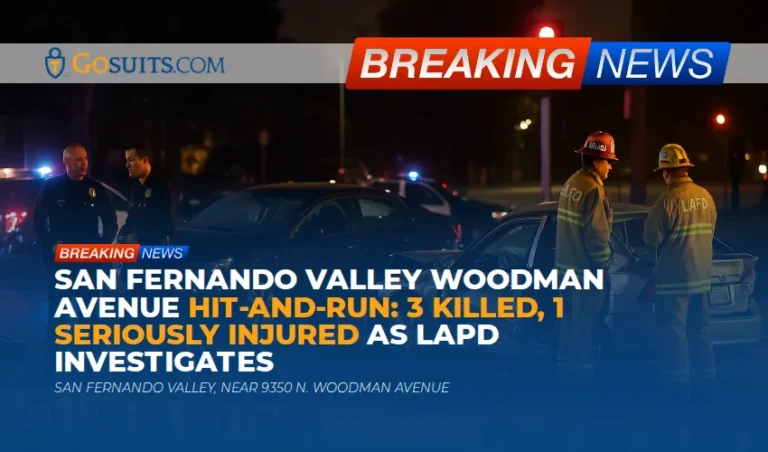
On a Friday night, three people lost their lives and another person was seriously injured in a three-car crash in the San Fernando Valley. According to reports, the collision occurred at approximately 9:35 p.m. near 9350 N. Woodman Avenue. The Los Angeles Police Department stated that a suspect driver fled the scene after the crash. Los Angeles Fire Department personnel arrived to find three deceased individuals in two separate vehicles. Firefighters also extricated a 35-year-old man who was trapped; he was transported to a nearby hospital. LAFD indicated the intersection would remain closed for an extended period and advised drivers to take alternate routes.
While all details have not been released publicly, the known facts point to a devastating event at a busy Valley intersection where neighborhoods like Arleta, Panorama City, and Pacoima meet. Anyone who travels Woodman Avenue knows it is a major north-south corridor with steady traffic, especially on weekend evenings. When a crash like this happens, it does not just stop traffic. It shakes families, neighbors, nearby businesses, and anyone who calls the Valley home.
We remain mindful that families may still be receiving notifications. This overview focuses on practical information, safety, and general civil law context related to serious traffic collisions and hit-and-run incidents in California.
When and where it happened
The collision was reported around 9:35 p.m. on a Friday night near 9350 N. Woodman Avenue in the San Fernando Valley. That stretch of Woodman sits within a cluster of residential streets, schools, and small commercial corridors. Several arterial streets connect into Woodman from the east and west, and night-hour traffic can remain brisk with commuters and local residents heading home, grabbing food, or visiting friends.
Law enforcement and fire agency statements
Agencies publicly reported the following:
- Three-car collision at a San Fernando Valley intersection near 9350 N. Woodman Avenue.
- Suspect fled the scene according to the Los Angeles Police Department.
- Three people were found deceased in two vehicles when firefighters arrived.
- A 35-year-old man was extricated and transported to a hospital for treatment.
- Intersection closure for an extended period, with urges to use alternate routes.
As the investigation unfolds, additional details may be released by LAPD, LAFD, or the Los Angeles County Department of Medical Examiner. Families often receive information first before the public, and that process takes time.
Road impact and local context
Extended closures following a fatal collision are common. Reconstruction requires measurements, scene mapping, and documentation by specialized units. Neighboring blocks may experience detours along streets like Arleta Avenue, Van Nuys Boulevard, or Terra Bella Street depending on the exact intersection setup. Bus routes and late-evening commuters can experience significant delays. If you live or work near Woodman, you may have noticed a bigger presence of traffic officers, cones, and tape. These measures protect the integrity of the investigation and the safety of responders working in the roadway.
Understanding rights after a deadly hit-and-run in California
When a driver flees the scene of a crash that causes injury or death, it raises both criminal and civil issues. This overview focuses on the civil side, which concerns compensation, accountability, and the legal rights of victims and families.

Hit-and-run duties under California law
California law requires drivers involved in injury or fatal crashes to stop, provide identifying information, and render reasonable aid. The duty to stop and exchange information is set out in the California Vehicle Code. These statutes are frequently referenced in civil proceedings because failing to follow them can support a finding that the fleeing driver was negligent as a matter of law, known as negligence per se in civil terms.
Even when the driver is not immediately identified, families still have civil options, which may involve their own insurance policies, claims through state programs, and ongoing coordination with investigators.
Wrongful death and survival actions
California recognizes two distinct civil claims after a fatal collision:
- Wrongful death, which allows certain family members to recover for their personal losses, such as the loss of financial support, companionship, and funeral expenses. Eligible claimants are defined by statute.
- Survival action, which is brought by the decedent’s estate to recover losses the person could have claimed if they had survived, such as medical expenses and other economic damages up to the time of death.
The statutes governing these claims include:
- Code of Civil Procedure section 377.60 wrongful death
- Code of Civil Procedure section 377.30 survival actions
These actions can be brought against responsible individuals or entities, which may include drivers, vehicle owners, employers if a driver was on the job, and others who contributed to the crash through negligence.
Insurance pathways when the driver flees
Families often worry that a hit-and-run means there is no financial recovery at all. There are several potential pathways, each with its own rules:
- Uninsured motorist bodily injury coverage. Many California auto policies include UM coverage for injury or death caused by an unidentified hit-and-run driver. Policies vary on documentation requirements and proof of physical contact. An attorney can review coverage details and deadlines before any statements are given to adjusters.
- Underinsured motorist coverage. If a driver is identified later and their liability limits are too low, underinsured coverage may apply after the liability limits are exhausted.
- Medical payments coverage. Some policies carry MedPay that can help with immediate medical or funeral expenses regardless of fault.
- Liability policies of identified at-fault parties. If an investigation identifies a driver or a negligent employer, claims proceed against those liability policies.
- California Victim Compensation Board. In qualifying situations, this state program may help with funeral, grief counseling, and certain out-of-pocket expenses for victims of violent crime, which can include vehicular crimes. See the California Victim Compensation Board at victims.ca.gov.
California requires minimum liability coverage for vehicles on the road. The Department of Motor Vehicles provides details about financial responsibility and accident reporting requirements, including the SR-1 form that must be submitted to DMV within 10 days when a crash involves injury, death, or property damage above a threshold. See DMV accident reporting information. Because statements in these forms can affect later claims, it is wise to consult an attorney before filing.
Steps families can take in the first days
Nothing about the early days after a fatal crash is easy. The priorities are safety, dignity, and steady gathering of information without adding stress. The following general steps may help families and supporters navigate the process with fewer surprises.
Prioritize safety and preserve what can be preserved
- Collect and secure personal effects from the vehicle when it is released. Keep items in a safe place and photograph everything before moving it. Do not discard or repair anything until an attorney reviews it.
- Write down firsthand memories while events are fresh. A simple timeline of calls, texts, and what each person saw or heard helps later.
- Preserve digital evidence. Save phone photos, dashcam footage, and any messages referencing the crash. Back up data to a second device or cloud storage.
- Note nearby cameras. Many Valley intersections have traffic cameras, and local businesses may have security video. Jot down locations and the names of businesses near the crash area on Woodman Avenue and surrounding blocks. Video systems often overwrite quickly.

Get official records started
- Police traffic collision report. Request the report once it is available. It will include involved vehicles, witness statements, diagrams, and preliminary fault assessments. If LAPD Valley Traffic Division is handling the case, they can advise on availability and process. Statements to any insurer or official should be coordinated with counsel first.
- Coroner information. The Los Angeles County Department of Medical Examiner provides decedent identification status, case numbers, and copies of autopsy and examination reports when available. Their site includes request instructions: me.lacounty.gov.
- Death certificates. These are issued through the Los Angeles County Registrar-Recorder/County Clerk. Certified copies are often needed for estate and claim matters. See lavote.gov.
- DMV accident reporting. If you are an involved party with knowledge of the crash details, California law may require submission of the SR-1 accident report within 10 days. Review the DMV page and consult an attorney before filing: DMV SR-1 guidance.
Identify and protect witnesses
- Collect names and contact information for anyone who saw or heard the collision or its aftermath. Evening-hour crashes often have multiple witnesses in apartment buildings or businesses nearby.
- Document what each person recalls, including sounds, the order of impacts, and any description of a fleeing vehicle or driver. Details about vehicle damage, direction of travel, or headlights can be pivotal.
- Ask nearby businesses to preserve video. A polite written request can help a business save footage for investigators. An attorney can send preservation letters quickly.
Where to get official help and records in Los Angeles County
These public resources can provide vital documents and assistance. Some items are available only to next of kin or involved parties. If you are uncertain about eligibility or the steps, an attorney can coordinate requests on your behalf.
- Los Angeles County Department of Medical Examiner. Case status, autopsy and examination reports, and information about identification. Visit me.lacounty.gov.
- Los Angeles County Registrar-Recorder/County Clerk. Certified death certificates and related vital records. Visit lavote.gov.
- California Victim Compensation Board. Possible assistance for eligible victims and families with funeral costs, grief counseling, and certain out-of-pocket expenses. Visit victims.ca.gov.
- California DMV accident reporting and insurance verification. SR-1 requirements and instructions. Visit dmv.ca.gov.
- California Office of Traffic Safety. Statewide safety initiatives and data trends that may inform community discussions. Visit ots.ca.gov.
If the collision involved a commercial vehicle, rideshare, or delivery service, additional agencies or corporate claim departments may be involved. Documentation needs increase in those scenarios, and response times can vary.
How investigations typically proceed in a multi-vehicle collision
Multi-vehicle crashes in the Valley are often investigated by specialized traffic units. The work is meticulous. Here is what usually happens, in broad strokes:
- Scene control and rescue. Firefighters and paramedics prioritize extrication and medical care while officers secure the perimeter and protect evidence.
- On-scene measurements. Officers mark rest positions, skid marks, gouges, scrape patterns, and vehicle debris. Laser mapping and photography are common.
- Vehicle inspections. Investigators document damage, airbag deployment, black box data if available, and any defects. Towed vehicles are stored until release.
- Witness canvassing. Officers knock on doors, visit nearby businesses, and request available video. In a corridor like Woodman Avenue, this may include gas stations, markets, and apartment complexes.
- Hit-and-run follow-up. When a driver flees, officers look for parts left behind, paint transfer, and vehicle systems that could match a make or model. Tips from the public are often valuable.
- Supplemental reports. Initial reports are followed by supplemental narratives and diagrams. For families, it can take weeks for the full packet to be complete.
Civil investigations often run in parallel. Attorneys may hire independent reconstructionists to preserve tire marks quickly, download event data recorders, and secure video before it is overwritten.
Community concerns we are hearing
Neighbors along Woodman Avenue and surrounding blocks have shared several recurring concerns in past incidents. The questions below reflect community themes, not quoted statements from this case.
- Is this intersection known for prior crashes? Many major Valley corridors see recurring incidents due to traffic volume and speed variations. The specifics are intersection-dependent. Public data from state and federal sources can help identify trends over time.
- What about street lighting and visibility at night? Visibility issues can contribute to nighttime crashes. Investigations consider lighting, sightlines, signage, and signal timing.
- How can residents help? If you have video or saw anything unusual around the time of the crash, preserve it and share it with investigators. Even small details can connect dots.
- What if the driver is not found? Insurance and state programs may still provide avenues for recovery. An attorney can evaluate UM coverage and coordinate with the California Victim Compensation Board when appropriate.
Civil timelines and deadlines that may apply
California law sets time limits for filing civil claims. Missing a deadline can forfeit rights. Here are several that commonly apply, noted for general awareness:
- Two-year statute for wrongful death claims under Code of Civil Procedure section 335.1.
- Survival actions are governed by separate statutes and may involve additional rules tied to the decedent’s date of death and estate administration.
- Claims involving public entities can have much shorter deadlines. If a government vehicle or roadway condition is implicated, claims can require notice within six months under the Government Claims Act. Legal counsel can determine if this applies.
- Insurance notice requirements and contractual deadlines can be shorter than statutory timelines. Policies typically require prompt notice and cooperation, and they may set specific timeframes for UM or UIM claims.
Because facts differ in every case, a detailed, situation-specific review is essential before any forms are filed or statements are given.
Practical insurance tips for this corridor
Insurance communication after a hit-and-run can feel overwhelming. There is also the risk of saying something that an adjuster interprets in a way that harms a claim. Consider the following general guidance.
- Consult an attorney first before speaking with any insurance company, including your own. Statements can be recorded and used to limit or deny claims later.
- Do not guess about speed, distance, or timing. If you do not know, say so. Speculation is often used against claimants.
- Provide documents, not narratives, when possible. Collision reports, photos, and medical records carry more weight than off-the-cuff summaries.
- Review UM, UIM, and MedPay provisions. Policies differ in how they define hit-and-run validation, physical contact requirements, and proof burdens.
- Preserve all billing and receipts related to funeral services, grief counseling, transportation, and time off. These documents make a difference in claims evaluations.
- Coordinate DMV reporting with legal counsel. The SR-1 form is a legal document. Accuracy matters. See dmv.ca.gov.
A note to local residents traveling near Woodman Avenue
If you live near Woodman Avenue in the greater Arleta and Panorama City area, expect intermittent closures as investigators and cleanup crews finish their work. Late evening closures can push traffic onto residential streets. If you drive after dark, slow down earlier than usual, anticipate pedestrians stepping off curbs near detours, and give first responders extra space. For the immediate future, consider using alternate routes that connect to Van Nuys Boulevard or Laurel Canyon Boulevard depending on your direction of travel. Listen for detour guidance if you use transit lines that cross Woodman.
Community patience matters during these closures. They allow investigators to do the careful work that families deserve and may prevent further incidents in a live roadway.

Why acting promptly matters and what to do next
There are concrete steps that, when taken promptly, can protect claims and provide clarity for everyone involved. Acting early reduces the risk that time sensitive evidence will be lost.
- Secure time sensitive evidence. Traffic camera loops, private security footage, and vehicle event data recorders can overwrite quickly or be lost once vehicles are salvaged. Early preservation makes reconstruction more reliable.
- Prevent administrative missteps. Insurance policies and state rules have notice requirements. Timely, accurate filings reduce disputes and delays.
- Coordinate official records. Collision reports, autopsy findings, and death certificates are foundational. Organizing them early lowers stress down the line.
- Map coverage and financial pathways. Identifying UM, UIM, MedPay, and potential third party liability sooner helps avoid gaps that create avoidable hardship.
- Avoid harmful statements. Insurance conversations often begin within days. An attorney can prepare a plan so that communications are careful, factual, and complete.
What should be done, specifically
- Preserve vehicles and parts before any repair or disposal. Maintain chain of custody for key components.
- Send preservation requests to nearby businesses that may have video of Woodman Avenue and intersecting streets at the time of the crash.
- Organize documents, including identifying information, insurance policies, medical records, funeral invoices, and any witness contacts.
- Review legal deadlines for wrongful death and potential public entity claims to avoid forfeiting rights due to timing.
- Consult an attorney first before contacting any insurer. What gets said to an adjuster can be cited later, sometimes out of context.
The benefit of taking these steps is straightforward. Evidence remains intact, deadlines are met, and conversations with insurers are grounded in documents rather than guesswork. That sequence tends to reduce disputes and keeps the focus where it belongs.
Commentary from Gosuits Los Angeles, California Personal Injury Attorney
Our hearts are with the families, friends, and neighbors affected by the crash near 9350 N. Woodman Avenue. The San Fernando Valley is a close knit community, and a loss like this cuts deep. This commentary is for educational purposes and general information. It is meant to help the community understand the civil landscape that follows a deadly hit-and-run.
From a civil perspective, a driver who leaves the scene of an injury or fatal collision violates clear duties set out in California law. Those duties exist to ensure that injured people get help quickly and that families receive accurate identification and information. When those duties are ignored, the harm multiplies. In multi-vehicle events, investigators work to separate primary collision factors from secondary impacts. That includes impact sequencing, speed analysis, lighting, and visibility. Even if a fleeing driver is not identified immediately, there are still viable paths forward through uninsured motorist claims, estate based claims, and state resources for victims. The mix depends on policy language and facts uncovered by investigators.
Insurance companies and large corporations often move quickly to protect their interests. Adjusters may request recorded statements, broad medical authorizations, or quick signatures on forms that limit later claims. That speed can disadvantage people who are grieving and still gathering basic documents. We have seen insurers rely on incomplete narratives, inconsistent witness recollections, or technicalities in policy language to reduce or deny valid claims. A careful, document first approach helps counter those tactics.
Obtaining a free consultation early in the process provides clarity. It does not obligate anyone to take a particular step. It allows families to ask hard questions, understand coverage options like UM and UIM, and set a plan for preserving evidence and meeting deadlines. Most importantly, it helps ensure that communications with insurers are thoughtful and accurate, because what is said to an insurance company can be used later and may shape the outcome.
We stand with the San Fernando Valley community during this difficult time and encourage anyone impacted to lean on trusted resources and take measured steps that protect their rights while honoring their loved ones.