- What happened on San Elijo Road in San Marcos
- Where and when the collision occurred
- Injuries, fatality, and immediate response
- What investigators typically look for in a cross-median crash
- How to obtain key records: police report, autopsy report, and death certificates
- Legal insight for families after a fatal motor vehicle crash
- Insurance issues and why early guidance matters
- Practical steps to preserve evidence and protect rights
- Local safety context and roadway factors in San Marcos
- Community and county resources that may help
- Why timely action matters after a serious collision
- Commentary from Gosuits San Marcos, California Personal Injury Attorney
What happened on San Elijo Road in San Marcos
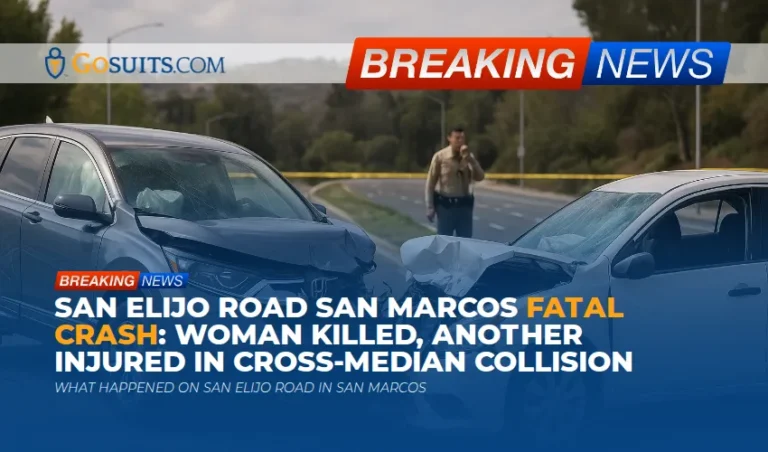
According to information released by the San Diego County Sheriff’s Office, a collision on San Elijo Road in San Marcos involved two vehicles, a gray Honda CR-V and a white Nissan Sentra. Investigators stated the woman driving the Nissan Sentra was traveling westbound when she lost control, crossed the center median, and collided with the oncoming Honda CR-V. The driver of the Nissan was pronounced deceased at the scene. The driver of the CR-V, also a woman, was transported to a hospital for treatment and is cooperating with authorities. The San Marcos Sheriff’s Station Traffic Unit is leading the investigation, and anyone with information is encouraged to call 760-510-5200.
At this stage, authorities have not publicly identified a definitive cause of the loss of control. In complex roadway events like a cross-median impact, investigators typically determine whether any combination of factors may have contributed, including driver behavior, mechanical issues, roadway design or conditions, visibility, or other traffic influences.
Where and when the collision occurred
The crash occurred around 3 p.m. on a Tuesday along San Elijo Road, a busy connector that locals use to move between San Elijo Hills, Elfin Forest, Rancho Santa Fe Road, and central San Marcos. Around midafternoon, traffic often includes a mix of commuters, school-day travel, and local errands. Anyone familiar with this corridor knows that the terrain includes curves, slight grades, and speed transitions near neighborhoods and parks like Double Peak Park and the San Elijo Hills Town Center. That mix of features can make lane discipline and speed management crucial.
Injuries, fatality, and immediate response
Deputies and first responders arrived shortly after the crash. The Nissan driver was declared deceased at the scene. The Honda CR-V driver was hospitalized. In incidents like this, first responders secure the area, render medical aid, and protect evidence for the traffic investigators who will reconstruct what happened.
After a fatal crash in San Diego County, the Medical Examiner’s Office typically becomes involved to confirm identity and determine the medical cause and manner of death. That process can require transport from the scene, coordination with law enforcement, and later family communications regarding next steps such as release of remains and the process for requesting reports. The San Diego County Medical Examiner provides family resources and explanations of their procedures on their official site, which can be helpful during the most difficult moments. See the county’s Medical Examiner information here: San Diego County Medical Examiner.
What investigators typically look for in a cross-median crash
When a vehicle crosses a center median into opposing lanes, the collision forces can be severe, particularly if there is a head-on component. National roadway safety research has long emphasized that median crossings and head-on impacts have a high risk of serious injury or fatality because of the energy involved when two vehicles moving in opposite directions collide. Federal highway guidance about median treatments highlights why preventing cross-median events can be lifesaving; see the Federal Highway Administration’s overview of median barriers here: FHWA on median barriers.
In reconstructing a collision like this, investigators generally consider:
- Roadway and environmental conditions such as light, weather, roadway surface, and visibility. In coastal North County, late afternoon glare or recent rain can affect traction and sightlines.
- Vehicle dynamics and mechanical condition including tire integrity, braking systems, steering components, and any evidence of pre-impact failures.
- Driver inputs and attentiveness assessed through statements, physical evidence, and possible electronic data recorders that store speed or brake application data.
- Traffic context including speed of both vehicles, lane positions, and whether other motorists or obstacles influenced maneuvers that preceded the cross-median movement.
The San Diego County Sheriff’s Office maintains policies and procedures for traffic investigations, evidence handling, and collision reporting through its stations. Families can find general agency information here: San Diego County Sheriff’s Office. If a collision occurs on a state highway, the California Highway Patrol would typically lead the investigation and manage the traffic collision report process. CHP’s information for requesting traffic collision reports is published here: CHP Traffic Collision Report.

How to obtain key records: police report, autopsy report, and death certificates
In the aftermath of a San Marcos car accident with a fatality, obtaining accurate records helps families handle insurance and estate matters and understand what happened. Here are the primary records and where to request them.
1. Traffic collision report
- Investigating agency: For crashes within the City of San Marcos handled by deputies, the investigating agency is the San Diego County Sheriff’s Department, San Marcos Sheriff’s Station. For this incident, authorities encouraged anyone with information to call 760-510-5200.
- How to request: Collision reports are typically available to involved parties and next of kin after the report is approved. The Sheriff’s Department provides records through its stations and Records & Identification Division in accordance with California law. Start with the station handling the case, then follow their instructions for a records request. Agency information: San Diego County Sheriff’s Office.
- CHP reports: If CHP handled your crash, follow the instructions on the CHP site using form CHP 190. See: CHP Traffic Collision Report.
2. Medical Examiner and autopsy report
- Office: The San Diego County Medical Examiner handles death investigations in the county.
- What families can request: Family members can request autopsy and investigation reports when available. Processing times vary based on the complexity of the case and completion of testing.
- Where to start: Family guidance, report request instructions, and contact details are published on the county site: San Diego County Medical Examiner.
3. Death certificates
- Agency: San Diego County Assessor/Recorder/County Clerk.
- Use: Death certificates are required for insurance claims, estate administration, and financial institutions.
- Where to request: See county resources for certified copies: San Diego County ARCC.
4. Roadway and weather context
- Road conditions: For current and recent closures or hazards on state routes, Caltrans QuickMap is a useful reference: Caltrans QuickMap.
- Safety trends: California’s Office of Traffic Safety publishes data dashboards and statewide safety updates that provide helpful context for collision trends: California OTS.
Legal insight for families after a fatal motor vehicle crash
A fatal crash raises difficult questions about liability, fault, and what claims might be available. In California, family members may have civil claims if another party’s negligence contributed to the death. The state’s wrongful death statutes are located at Code of Civil Procedure section 377.60 and related provisions, which outline who may bring a claim and the types of damages available under the law. You can review the statute text here: California Codes on leginfo.
Key considerations include:
- Liability is evidence driven. Even when a vehicle crosses a median, investigators still test and examine whether other factors played a role. Mechanical defects, unsafe roadway conditions, visibility obstructions, or other drivers’ actions may be relevant. Witness statements, electronic data, and the physical damage profile matter.
- Comparative fault. California follows a comparative negligence system. Fault can be apportioned among multiple contributors. That makes a thorough review of the facts critical.
- Wrongful death vs. survival claims. Eligible heirs may bring a wrongful death case, while the estate may bring a survival action for damages the decedent sustained before death. The nuances of who can recover what are defined by statute.
- Insurance layers. Liability insurance, underinsured or uninsured motorist coverage, med-pay benefits, and sometimes third-party entities like vehicle manufacturers or public entities can be part of the analysis depending on the facts and evidence.
While this San Marcos collision remains under investigation, families often consult with car accident lawyers or wrongful death lawyers to understand civil options and timelines. Law firms focused on serious roadway crashes can explain how vehicle accident injury claims are evaluated, what documentation is needed, and how insurers typically respond in fatal cases. Any conversation should be for educational purposes so families can make informed choices about next steps.
Insurance issues and why early guidance matters
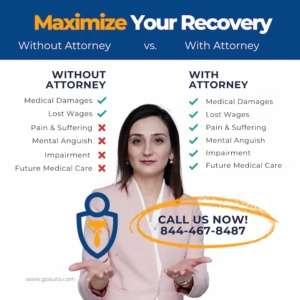
Serious collisions typically trigger multiple insurance notifications and claims. The order and content of those communications can affect outcomes. It is best to contact an attorney first before speaking to any insurance company about the facts of the collision. What someone says to an insurance adjuster can be recorded and used later to challenge fault or damages.
Points to keep in mind as claims begin:
- Liability carriers will want statements and may ask for recorded interviews. Do not assume they are neutral fact-finders. Adjusters are trained to minimize exposure for their insureds.
- First-party coverages such as uninsured or underinsured motorist can be vital in a fatal crash, especially if the at-fault party lacks sufficient limits. These claims are made against the decedent’s or household policy and can involve policy interpretation issues.
- Medical payments coverage may help with immediate expenses for injured survivors in the other vehicle, depending on policy terms.
- Documentation matters. Collision reports, Medical Examiner findings, photographs, and repair or total loss documentation support valuation and causation. Keep originals and share copies only after receiving clear guidance.
Experienced auto accident attorneys, car crash injury lawyers, and accident compensation attorneys commonly review coverages, preserve accident-scene evidence, and coordinate with investigators. Many families also seek car accident legal help to avoid unintentional misstatements that might later be used to dispute claims.
Practical steps to preserve evidence and protect rights
When a collision leads to a fatality, evidence preservation becomes urgent. Civil cases can take shape quickly in the background while the official investigation proceeds. The following actions can help keep options open:
- Secure records early. Request the traffic collision report from the San Marcos Sheriff’s Station when it becomes available. If CHP is involved in your case, use its formal request process. See: CHP traffic collision reports.
- Collect independent evidence. Save photographs, dashcam files, and smartphone videos taken before or after the crash. If a nearby business at San Elijo Hills Town Center or along San Elijo Road has camera views of the corridor, ask promptly about retention policies.
- Identify witnesses. Names, phone numbers, and any notes about what they saw or heard can be critical. Provide this information to the investigating agency.
- Preserve the vehicles. Do not authorize disposal of a totaled vehicle until counsel has reviewed the need for a mechanical or electronic data examination.
- Document weather and road conditions. Save screenshots from Caltrans QuickMap for the timeframe around the crash: Caltrans QuickMap.
- Be cautious with adjusters. Before giving a statement to any insurer, consult counsel. Insurance communications are strategic and can shape the narrative of fault and damages.
California requires drivers to report certain crashes to the DMV using an SR-1 if there is injury, death, or property damage at or above the statutory threshold. Guidance is available here: California DMV accident reporting. Families should coordinate with counsel on whether and how the SR-1 applies in a fatal crash scenario.
Local safety context and roadway factors in San Marcos
San Marcos residents know that San Elijo Road winds through hillside neighborhoods and connects to Rancho Santa Fe Road and Elfin Forest. The corridor includes mixed speeds, curves, and grade changes, and it serves school traffic, cyclists heading to Double Peak Park, and commuters moving toward State Route 78. Late afternoon traffic around 3 p.m. can include school pickups and work breaks, which adds merging movements and occasional sudden slowdowns.
At a broader level, California safety officials monitor traffic trends and emphasize strategies to reduce severe crashes, including better separation of opposing traffic where feasible. The Federal Highway Administration notes that median barriers are an established countermeasure to reduce the severity of cross-median events by physically preventing intrusions into opposing traffic, even at relatively high speeds. See: FHWA median barrier overview.
Statewide collision data and safety initiatives are published by the California Office of Traffic Safety. Their dashboards and annual reports highlight patterns that communities use to improve local road safety: California OTS. Using these references, municipalities and county agencies evaluate whether infrastructure, signage, or enforcement changes might help at specific corridors over time.
Community and county resources that may help
- San Diego County Sheriff’s Office for case-related inquiries, traffic unit questions, and how to request a collision report. Main agency site: sdsheriff.gov. For this collision, the San Marcos Sheriff’s Station encourages calls to 760-510-5200.
- San Diego County Medical Examiner for family guidance, autopsy report requests, and release of remains: County Medical Examiner.
- San Diego County ARCC for certified death certificates needed for insurance and estate matters: County Assessor/Recorder/County Clerk.
- California DMV for accident reporting requirements and SR-1 form guidance: DMV accident reporting.
- Caltrans QuickMap for road conditions and closures that can help establish context around the time of a crash: QuickMap.
- California Office of Traffic Safety for state-level safety data and trends: OTS.
For those navigating grief, San Diego County’s Health and Human Services Agency maintains behavioral health information and access points through county portals. You can start at the county’s main site and follow prompts to Behavioral Health Services: San Diego County.
Why timely action matters after a serious collision
When a fatal collision occurs, several processes start at once. The investigation moves forward, vehicles are towed and possibly stored, and insurers begin file reviews. Meanwhile, evidence can disappear quickly, including digital surveillance that may overwrite on a short loop. Here is what should happen promptly, and why it matters.
- Request and preserve critical records. Ask the investigating agency how to request the traffic collision report as soon as it is ready. Early copies help identify witnesses, vehicle owners, and policy information that tends to go stale over time.
- Preserve vehicles and components. If a mechanical issue is suspected, preserving the vehicle allows an independent inspection. Once a vehicle is salvaged, crucial evidence can be lost forever.
- Collect and secure digital evidence. Neighborhood cameras around San Elijo Hills and businesses near San Elijo Road may overwrite in days. Prompt requests greatly increase the chance of retention.
- Coordinate insurance carefully. The order and content of communications can shape liability narratives. Early, informed coordination helps avoid missteps that may be hard to fix later.
- Track legal time limits. California civil claims have statutes of limitation that can bar recovery if missed. Certain public-entity claims require notices within a much shorter period than general civil claims.
- Document loss and expenses. Keep a running file for funeral expenses, counseling invoices, wage documentation, and related costs. Organized documentation supports valuation later.
Taking these steps early can preserve options, reduce uncertainty, and provide clarity as agencies complete their investigations.
Commentary from Gosuits San Marcos, California Personal Injury Attorney
Our hearts are with everyone affected by the collision on San Elijo Road. Losing a neighbor in such a sudden, public way touches the entire San Elijo Hills and San Marcos community. Please understand that the information here is for education and general awareness.
From a civil-injury perspective, cross-median crashes demand careful, methodical analysis. Even when an initial report notes a vehicle lost control and entered opposing lanes, it is still important to examine every contributing factor, from possible mechanical issues to roadway conditions and traffic context at that hour. Thorough reconstruction and a fair review of all evidence are key to understanding liability.
Insurance carriers and large corporations manage these cases every day. They know how to ask questions that frame the narrative in a way that reduces their responsibility. Statements are often recorded, small inconsistencies are highlighted, and delays can be used to wear families down. Without early guidance, people can unknowingly give up important rights or miss critical evidence that would have helped show what really happened.
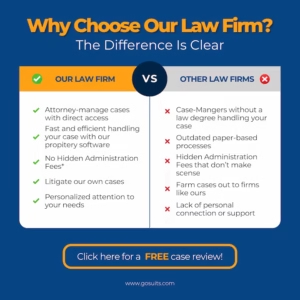
A free consultation can serve as a pressure-free way to understand rights, timelines, and what evidence should be preserved immediately. It can also clarify how motor vehicle accident attorneys, auto collision lawyers, automobile injury attorneys, or serious car accident lawyers typically approach fatal cases, how wrongful death and survival claims differ, and what to expect from insurers. Many families simply want a roadmap so they can make informed choices and focus on healing while the investigation continues.