- What we know about the San Dimas bicycle collision on January 10, 2026
- Where the crash occurred and why this corridor matters to San Dimas riders
- Official information sources to contact right away
- Police report and incident number
- Autopsy and coroner records
- If the California Highway Patrol investigated
- 911 audio, dispatch logs, and traffic signal records
- Understanding rights after a fatal bicycle crash in California
- What investigators and insurers will look at
- Bicyclist safety laws that matter on Baseline Road and San Dimas Avenue
- Data snapshot: bicyclist fatalities and nighttime risk
- Insurance coverage pathways that may apply
- Preserving and gathering evidence in San Dimas
- Timelines and legal deadlines
- Supportive services and practical help in Los Angeles County
- Steps to take now, and why timing matters
- Commentary from Gosuits San Dimas, California Personal Injury Attorney
- References
What we know about the San Dimas bicycle collision on January 10, 2026
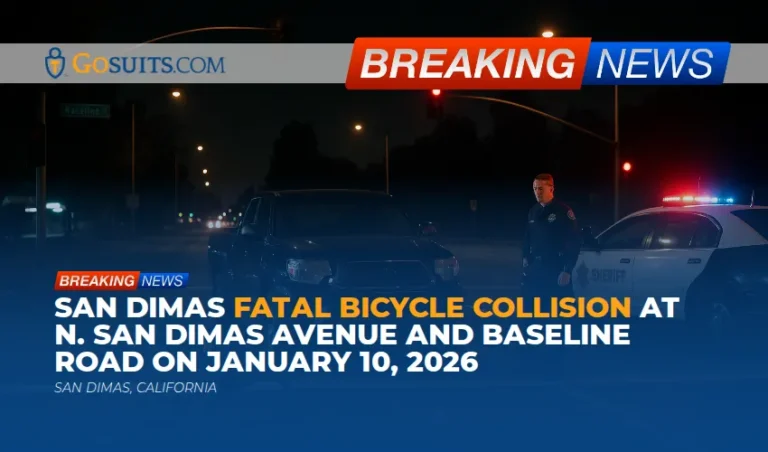
On Friday evening, January 10, 2026, a man riding a bicycle was struck by the driver of a pickup on North San Dimas Avenue near East Baseline Road in San Dimas. The crash occurred around 6:30 pm, and the rider was transported to a local hospital, where he died. The victim has not been publicly identified as of this writing. A sheriff’s spokesperson reportedly described the collision as appearing accidental, and the driver remained at the scene. No official determination of fault has been released.
Because the crash occurred after dark and along a busy arterial near the foothills, investigators will likely review lighting and visibility, vehicle speed, roadway design features, and any available witness statements or camera footage. That review takes time. Preliminary comments rarely reflect the full evidentiary picture, which often includes scene measurements, vehicle inspections, and coroner findings.
Families and community members in San Dimas and the broader San Gabriel Valley know this corridor well. Baseline Road carries significant east to west traffic just south of the I-210 Foothill Freeway, and North San Dimas Avenue connects neighborhoods north of Bonita Avenue to popular recreation areas like San Dimas Canyon Park and Frank G. Bonelli Regional Park. It is understandable that people want answers quickly, yet it is equally important to let the official fact gathering run its course.
Where the crash occurred and why this corridor matters to San Dimas riders
The location reported was near the intersection of North San Dimas Avenue and East Baseline Road. Baseline is a key surface street that threads through foothill communities including La Verne and Glendora, and it intersects several north to south neighborhood collectors. Evening traffic can be brisk, especially on Fridays when commuters head home and visitors make their way toward Bonelli Park and Puddingstone Lake. Lighting conditions in January are challenging, with civil twilight ending early, so drivers and people biking often share the road in true nighttime conditions during the evening commute.
Local riders use North San Dimas Avenue as a connector from residential streets toward Bonelli Park, the San Dimas Downtown area near Bonita Avenue and Cataract, and the Class II bike lanes that exist in some nearby jurisdictions. The presence and condition of bike lanes on specific blocks near Baseline Road are not uniform across the corridor, which can force riders to mix with traffic. In practice, that means understanding and following California’s bicycle operation rules is critical for all road users, not just cyclists, since drivers must also comply with safe passing and lookout duties.
Official information sources to contact right away
In the immediate days following a fatal traffic collision, certain agencies hold key records that help families understand what happened. Below are the primary sources and what they typically provide.
Police report and incident number
San Dimas is served by the Los Angeles County Sheriff’s Department through the San Dimas Station. The investigating agency typically assigns a report or incident number, which is essential when requesting a copy. In fatality cases, initial reports may be withheld until the investigation reaches a stage where release is permitted under California law. Families can ask the watch commander or records unit at the San Dimas Station about:
- Traffic Collision Report: Narrative, involved parties, diagrams, listed violations if any, and witness statements. Portions may be redacted.
- Supplemental reports: Follow up interviews, scene measurements, and collision investigation team notes, if applicable.
- Evidence logs: Documentation of collected physical evidence.
If a report is not yet available, requesting the incident number and the assigned investigator’s name helps in tracking updates and providing additional information as needed. Public access is governed by the California Public Records Act, with certain exemptions for active investigations and personal privacy. The Act is codified in Government Code sections 6250 to 6270 and related provisions [10].
Autopsy and coroner records
The Los Angeles County Medical Examiner conducts the death investigation. Families may request confirmation of identity once made, obtain the case number, and later request copies of the autopsy report, cause and manner of death findings, toxicology results if performed, and the death certificate. The Medical Examiner provides public guidance and record request information through the County’s website [8].
If the California Highway Patrol investigated
Some traffic collisions on state routes or in unincorporated areas are handled by the California Highway Patrol. If CHP was the primary investigating agency, collision reports are released through the CHP process using the CHP 190 form, often requested directly from the local CHP office that investigated. The CHP provides general guidance for collision records and public records requests on their official site [11].
911 audio, dispatch logs, and traffic signal records
Families and their representatives sometimes request 911 audio, CAD logs, and radio traffic to establish timelines. Requests are possible under the California Public Records Act, with redactions as required by law [10]. Signal timing logs or maintenance records for nearby traffic signals may be held by the city or county public works department depending on jurisdiction. Because some transportation data is retained for limited periods, early requests are important.
Understanding rights after a fatal bicycle crash in California
California law provides civil remedies in the aftermath of a fatal traffic collision. Two distinct claims often arise from the same tragedy: a wrongful death claim and a survival action.
- Wrongful death: This claim belongs to eligible heirs and is authorized under Code of Civil Procedure section 377.60. It allows the decedent’s family to seek compensation for their losses stemming from the death, such as the loss of support, companionship, and guidance [1].
- Survival action: Under Code of Civil Procedure section 377.30, the decedent’s estate may pursue claims the decedent could have brought had they survived, such as certain economic losses up to death [2].
These are civil claims, separate from any traffic citation or criminal matter. Families commonly consult with wrongful death lawyers to understand eligibility and the different damages categories that may be available under California law. Consultation at an early stage helps align evidence collection with the legal standards that apply.
What investigators and insurers will look at
When a bicyclist is struck by a pickup on a major arterial at night, investigators and insurers typically examine a familiar set of issues. None of these determinations should be assumed; each is fact specific and supported by evidence.
- Lighting and visibility: California requires bicycles operated at night to have a white front lamp visible from 300 feet and specified reflectors or a red rear lamp visible from 500 feet. Investigators will document compliance with these requirements, set out in Vehicle Code section 21201 [3].
- Passing distance: Drivers overtaking a bicyclist must provide at least three feet of clearance when passing, as stated in Vehicle Code section 21760, commonly known as the Three Feet for Safety Act [4].
- Speed, stopping distance, and reaction time: Nighttime reduces visual contrast and can lengthen driver perception response time. National Highway Traffic Safety Administration resources explain general risks for bicyclists in traffic, including visibility challenges [5].
- Lane position and rider operation: California rules on when a bicyclist must ride as far right as practicable or may control the lane are in Vehicle Code section 21202. Investigators consider whether conditions such as hazards, lane width, or preparation for a turn affected lane position [6].
- Bike lane presence: If a bike lane exists, Vehicle Code section 21208 addresses when a bicyclist should use it and recognized exceptions [7].
- Distraction and impairment: Standard collision workups include evaluating whether distraction or impairment played a role for any party.
- Sight lines and roadway features: Vegetation, parked vehicles, lighting, traffic volumes, and signal timing can affect visibility and decision making along a corridor like Baseline Road in the San Gabriel Valley foothills.
The evidence from these inquiries informs liability assessments by insurers. Because early statements can be misunderstood or taken out of context, it is generally wise to speak with a qualified attorney before providing a recorded statement to any insurance adjuster.
Bicyclist safety laws that matter on Baseline Road and San Dimas Avenue
Understanding the rules that protect people who bike helps community members assess what might be relevant at this location. The following California laws are often central to nighttime collisions on busy arterials:
- Three Feet for Safety Act (Vehicle Code 21760). A driver passing a bicycle must allow at least three feet. If three feet is not possible due to traffic or roadway conditions, the driver must slow to a reasonable and prudent speed and only pass when it will not endanger the bicyclist [4]. For a deeper practical explanation tailored to California riders and drivers, see our knowledge resource on the California three foot law cyclists.
- Bicycle equipment (Vehicle Code 21201). At night, a white front lamp, red rear reflector or red lamp, and side reflectors are required, with specified visibility distances [3].
- Operation on the roadway (Vehicle Code 21202). This section explains when a cyclist should ride as far right as practicable and the many exceptions where a cyclist may lawfully ride away from the right edge or control the lane, including substandard lane width or to avoid hazards [6].
- Bike lane rules (Vehicle Code 21208). This section covers using a bike lane when one exists and lawful reasons a cyclist may leave it, such as preparing for a left turn or avoiding debris [7].
These rules impose duties on both drivers and bicyclists. Along corridors like Baseline Road and the North San Dimas Avenue approach, lighting, vehicle speed, and lane widths influence how these duties play out on the ground.
Data snapshot: bicyclist fatalities and nighttime risk
Traffic safety data provides context for this tragedy without assigning fault. State and national sources show persistent risks for people bicycling, especially in low light.
- National perspective: NHTSA’s bicyclist safety materials and Traffic Safety Facts publications highlight that a significant share of bicyclist fatalities occur in urban areas and during evening or nighttime hours when visibility is lower [5].
- California trends: The California Office of Traffic Safety tracks bicyclist safety and emphasizes visibility, lighting, and driver behavior as key factors. OTS resources also support local safety programs intended to reduce bicyclist injuries and fatalities [9].
- Regional mapping: UC Berkeley SafeTREC’s Transportation Injury Mapping System offers collision mapping tools that allow users to view historical bicycle collision patterns in Los Angeles County communities, including the San Gabriel Valley [12].
- Public health view: The CDC provides background on bicyclist injuries and evidence based prevention strategies, especially around visibility and motorist behavior [13].
Data does not explain how any single collision occurred, but it helps neighbors and policymakers in places like San Dimas focus on roadway design, illumination, and passing behavior that can make a difference along arterial corridors.
Insurance coverage pathways that may apply
Fatal collisions often involve multiple insurance considerations. These pathways are case specific, but understanding the general framework helps when asking the right questions.
- At fault driver’s liability insurance: If an investigation shows the driver was negligent, the driver’s liability policy is the primary coverage. Pickup trucks may be privately owned or used in a business context, which can affect available limits based on the policy type.
- Uninsured or underinsured motorist coverage: In California, a household’s auto policy often extends UM or UIM benefits to a bicyclist hit by a motor vehicle. The California Department of Insurance provides consumer guidance on how auto insurance, including UM and UIM coverage, works in our state [14].
- Medical payments coverage: Some auto policies provide optional med pay that can apply regardless of fault and can help with immediate expenses.
- Wrongful death and survival claims: The structure of these claims determines the categories of damages available and who may recover them. Families often consult with wrongful death lawyers to align insurance communications, evidence preservation, and damages documentation.
Insurance adjusters frequently seek recorded statements. What is said early can be used later in ways that are hard to anticipate. Speaking with a seasoned attorney before any recorded statement helps ensure that communications do not unintentionally harm valid claims.
Preserving and gathering evidence in San Dimas
Evidence can disappear quickly along busy corridors like Baseline Road. Preserving it is one of the most practical steps a community member can take when helping a family through the immediate aftermath.
- Preserve the bicycle and equipment: Do not repair or alter the bicycle, helmet, lights, or clothing. Secure and document their condition with photographs and a written chain of custody.
- Secure nearby video: Ask nearby homes and businesses for any camera footage. Many systems automatically overwrite within days. Time stamps, camera location, and export formats should be documented.
- Scene photographs: Capture the roadway, skid or yaw marks, debris fields, lighting conditions, and any obstructions. Nighttime photos taken around the same time as the collision can be very informative.
- Witness outreach: Politely request contact information for anyone who might have seen the collision, heard the impact, or arrived just after. Record how and when each contact was made.
- Public records requests: Written requests for 911 audio, CAD logs, and any available traffic signal timing records should be submitted promptly, relying on the California Public Records Act procedures [10].
- Attorney preservation letters: A lawyer can send evidence preservation letters to involved parties, nearby businesses, and agencies to reduce the risk that relevant data is lost, intentionally or otherwise.
Timelines and legal deadlines
California imposes strict deadlines that depend on the type of claim and whether any public entity is potentially involved.
- Wrongful death and personal injury statute: The general statute of limitations for wrongful death and most negligence claims arising from a vehicle collision is two years from the date of death, under Code of Civil Procedure section 335.1 [15].
- Government Claims Act: If a roadway defect or public entity conduct is alleged, a government claim must typically be filed within six months, under Government Code section 911.2, before any lawsuit can proceed [16].
- Records retention: Agencies and private entities have varying data retention policies. Early requests are often critical to obtain time sensitive records.
Because every case is different, timely consultation with a qualified attorney can prevent missed deadlines and help identify all potential responsible parties.
Supportive services and practical help in Los Angeles County
A fatal collision leaves loved ones navigating grief and logistics at the same time. In Los Angeles County, several public services can help with immediate needs:
- Medical Examiner: Confirming identity, securing the death certificate, and obtaining autopsy findings happen through the Los Angeles County Medical Examiner. Their site provides guidance on processes and record requests [8].
- Public health and safety information: The CDC offers accessible, research based information on bicycle injuries and prevention that may help families understand broader safety issues while advocates work toward safer roads [13].
- State safety resources: The California Office of Traffic Safety funds local initiatives and public education, including materials related to bicyclist safety and roadway sharing etiquette [9].
- Data transparency: UC Berkeley SafeTREC’s TIMS portal lets the public visualize historical collision data for planning and advocacy across LA County communities, including San Dimas and the San Gabriel Valley [12].
For many families, neighbors are the first line of help, from coordinating meals to keeping an eye out for potential witnesses. That community fabric matters here in San Dimas, where people gather at places like the downtown corridor along Bonita Avenue, San Dimas Canyon trailheads, and around Raging Waters during the warmer seasons.
Steps to take now, and why timing matters
There are practical actions that can safeguard truth finding and protect legal options. Early action is important because video overwrites, witnesses disperse, and deadlines approach.
- Document everything: Collect the incident number, the assigned investigator’s name, and the towing company location if a vehicle or bicycle was impounded. Keep all hospital and ambulance records in one folder.
- Request key records early: Submit written requests for the traffic collision report, 911 audio, and CAD logs. Ask the Medical Examiner for the case number and learn when reports will be available.
- Preserve physical evidence: Store the bicycle, helmet, lighting, and clothing in a secure place. Do not clean or repair anything until an investigator or attorney has reviewed it.
- Avoid recorded insurance statements: Insurance adjusters often call within days. Speak with an attorney first. What is said can be used later, and small phrasing choices can have outsized effects.
- Consider roadway and lighting issues: Photograph streetlights, signal timing displays if visible, and any environmental factors at around the same time of night. These details fade quickly from memory.
- Mind the deadlines: Put reminder dates on the calendar for the two year statute of limitations for wrongful death claims and the six month government claim deadline if any public entity might be implicated [15][16].
- Consult early for alignment: A no cost consultation can help align evidence gathering with the standards that insurers and courts use, including decisions about experts, vehicle inspections, and damages documentation.
Commentary from Gosuits San Dimas, California Personal Injury Attorney
Our hearts are with the family and loved ones of the man killed while biking near North San Dimas Avenue and East Baseline Road. This write up is offered for educational purposes and general information so the community understands what typically happens after a fatal traffic collision and where to find reliable resources.
From a civil injury perspective, the location and timing raise the familiar questions that collision teams review in nighttime bicycle crashes along busy arterials: whether passing clearance was honored, whether lighting and visibility were adequate, what speeds and sight lines were involved, and how roadway design interacts with driver and cyclist behavior. The answers depend on evidence that is still developing and should not be rushed. Even where phrases like accidental are used early, that term does not resolve civil responsibility under California negligence law.
Insurance companies and, at times, corporate policyholders often move quickly to shape the narrative. They may seek recorded statements before families understand the nuances of roadway rules like the Three Feet for Safety Act, or before a full picture of lighting and sight lines emerges. Adjusters are trained communicators. Small concessions in phrasing can later be framed as admissions, and families may not realize how comparative fault arguments can be constructed from incomplete facts. This is why many people choose to speak with wrongful death lawyers before any recorded statement, allowing a neutral fact finding process to occur without avoidable missteps.
A free consultation serves several purposes. It allows careful review of insurance coverages, including UM or UIM benefits that might apply, helps prioritize time sensitive evidence such as nearby camera footage, and frames any government claim deadlines if design or maintenance issues are suspected. It also provides a measure of clarity at a time when information is scattered and grief is fresh.
References
- Wrongful Death Statute, Code of Civil Procedure 377.60 – California Legislative Information
- Survival Actions, Code of Civil Procedure 377.30 – California Legislative Information
- Bicycle Equipment Requirements, Vehicle Code 21201 – California Legislative Information
- Three Feet for Safety Act, Vehicle Code 21760 – California Legislative Information
- Bicyclist Safety Overview – National Highway Traffic Safety Administration
- Operation on Roadway, Vehicle Code 21202 – California Legislative Information
- Use of Bicycle Lanes, Vehicle Code 21208 – California Legislative Information
- Los Angeles County Medical Examiner-Coroner Public Information – County of Los Angeles
- Bicycle Safety Campaigns and Resources – California Office of Traffic Safety
- California Public Records Act, Gov. Code 6250 et seq. – California Legislative Information
- Public Records Request Information – California Highway Patrol
- Transportation Injury Mapping System – UC Berkeley SafeTREC
- Bicyclist Safety and Injury Prevention – Centers for Disease Control and Prevention
- Automobile Insurance Consumer Information – California Department of Insurance
- Statute of Limitations for Wrongful Death, CCP 335.1 – California Legislative Information
- Government Claims Act Deadlines, Gov. Code 911.2 – California Legislative Information