- Northeast Side Pedestrian Fatality: What We Know
- What Authorities Have Confirmed So Far
- Location Context: North Loop 1604 East near Bulverde Road
- How Pedestrian Crashes Are Investigated in San Antonio
- Texas Laws That Often Shape Fault in Pedestrian Collisions
- Family Rights After a Fatal Crash Under Texas Civil Law
- Insurance Questions and Common Pitfalls to Avoid
- Where to Request Official Records in Bexar County and Texas
- Evidence Families Can Preserve Early
- Safety and Traffic Realities on Loop 1604 Access Roads
- Supportive, Practical Steps During the First Weeks
- Call to Action: Timely Steps Community Members Can Take
- Commentary from Gosuits San Antonio, Texas Personal Injury Attorney
- References
Northeast Side Pedestrian Fatality: What We Know
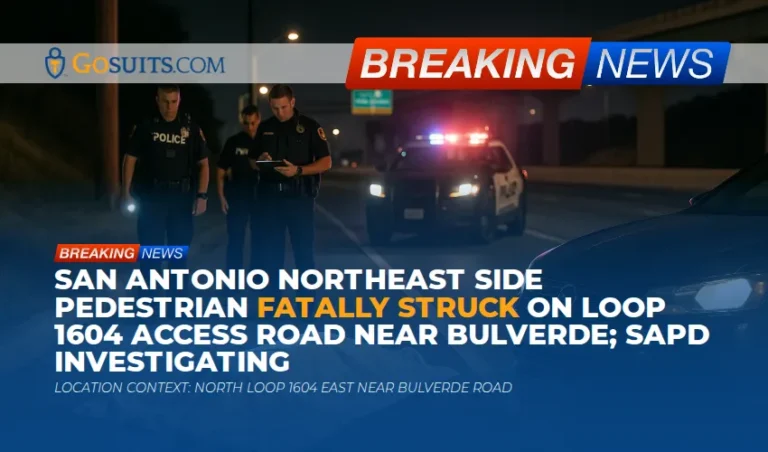
A late evening walk on San Antonio’s Northeast Side ended in tragedy over the weekend. According to officials, a pedestrian was struck by a vehicle on the North Loop 1604 East access road near Bulverde Road, just before 11 p.m. on Saturday. The Bexar County Medical Examiner’s Office later identified the victim as a 27-year-old man and determined the cause of death to be blunt force injuries sustained in the collision. The driver remained on scene and cooperated with San Antonio Police Department investigators. An official SAPD investigation continues. These are the core facts publicly released at this time, and residents in nearby neighborhoods like Encino Ranch, Cibolo Canyon Village, Stone Oak, and those who use the Bulverde Road entries to 1604 felt the impact of that news as they started their workweek.
When a crash like this happens on a frontage road or at an entry ramp, it is natural to ask how and why it occurred. The answers typically come from carefully gathered evidence, roadway measurements, available video, and witness statements rather than assumptions. Until the full investigation is complete, it is prudent to focus on support for loved ones, the preservation of available evidence, and the orderly collection of official records that document what happened.
What Authorities Have Confirmed So Far
Officials have publicly shared the following details, summarized with respect for the victim and family:
- Time and date: Just before 11 p.m. on a Saturday evening.
- Place: 3800 block of North Loop 1604 East near Bulverde Road on the Northeast Side.
- Event: A vehicle traveling eastbound on the access road attempted to enter Loop 1604 East and struck a pedestrian who was walking along the roadway.
- Medical findings: The Bexar County Medical Examiner’s Office ruled the cause of death as blunt force injuries from an accident [1].
- Driver status: SAPD reports the driver stayed at the scene and cooperated. The investigation remains open.
Those core facts help frame the inquiry, but many important questions remain for investigators, including speed, lighting conditions, lane position, precise path of travel, visibility, and sequence of movements immediately before impact.
Location Context: North Loop 1604 East near Bulverde Road
Locals know the frontage roads along Loop 1604 can be complex, especially where vehicles transition from access roads to entrance ramps and then merge toward the main lanes. Near Bulverde Road, nighttime lighting, traffic volumes, and driver expectations can change quickly. Pedestrians on or near a frontage road may be present for many reasons, including walking to or from nearby neighborhoods, rideshare connections, or dealing with a disabled vehicle.
While roadway context can matter, determining what specifically happened in a given incident ultimately comes down to evidence from the crash scene and credible sources. The City of San Antonio has adopted Vision Zero principles that emphasize safer streets for people walking, biking, and driving, and the city continues to study corridors like Loop 1604 for safety improvements [12].
How Pedestrian Crashes Are Investigated in San Antonio
When a fatal crash occurs, law enforcement typically conducts a step-by-step investigation that may include:
- Scene documentation: Measurements of the roadway, skid or yaw marks, final rest positions, debris fields, and lighting conditions at the time of the crash.
- Vehicle inspections: Checking lighting, windshield condition, braking systems, and potential event data recorder information if available.
- Witness interviews: Statements from drivers, passengers, bystanders, adjacent business employees, and first responders.
- Video evidence: Requests for nearby surveillance footage, traffic cameras where accessible, and in-vehicle dash cameras that may show approach paths or signal phases.
- Medical examiner findings: Timelines tied to injury patterns help confirm sequence of events and are part of the official record [1].
- Crash reports: In Texas, official crash reports are later made available through the state’s system when they meet reporting criteria [3].
Because these steps take time, families often look for parallel ways to preserve information, such as asking nearby businesses to retain video before it is overwritten and writing down the names and contact information of any witnesses who came forward at the scene.

Texas Laws That Often Shape Fault in Pedestrian Collisions
Texas law outlines duties for both pedestrians and drivers. Some of the most frequently cited provisions in collision analyses include:
- Driver duty to avoid collisions with pedestrians: Texas Transportation Code section 552.008 requires drivers to exercise due care to avoid colliding with a pedestrian, sound the horn when necessary, and take care when children or incapacitated persons are present [4].
- Pedestrians walking along roadways: Section 552.006 addresses where a pedestrian may walk if sidewalks are not provided, generally requiring pedestrians to walk on the left side of the roadway facing traffic on two-way roads and as near as practicable to the outside edge on one-way roads [5].
- Speed and control: Drivers must operate at a reasonable and prudent speed under the circumstances, factoring in hazards and conditions that exist at the time, including nighttime visibility and the presence of people near travel lanes [6].
These statutory duties do not answer every question, and fault assessment in a specific case depends on all the facts. But they do establish a baseline framework that investigators and insurers consider. Statewide, agencies like TxDOT and NHTSA continue to emphasize pedestrian safety and visibility through public education and infrastructure strategies [11] [15].
Family Rights After a Fatal Crash Under Texas Civil Law
Texas civil law provides two distinct avenues following a fatal collision. Families commonly hear the terms “wrongful death” and “survival” and wonder how they differ.
Wrongful death claims
Under Chapter 71 of the Texas Civil Practice and Remedies Code, certain surviving family members may bring a claim for their losses resulting from a death caused by the wrongful act, neglect, carelessness, unskillfulness, or default of another person or entity [7]. Eligible relatives generally include the spouse, children, and parents. A wrongful death claim focuses on the family’s losses, such as companionship and guidance, mental anguish, and sometimes lost financial contributions, depending on the case facts. If no eligible family member files within a defined period, the decedent’s estate representative may file on behalf of the statutory beneficiaries.
Survival actions
Texas also recognizes a survival claim, which preserves the decedent’s own cause of action so that it “survives” to the estate. This allows recovery for damages the decedent could have pursued had they lived, such as conscious pain and suffering before death and certain medical expenses, when supported by the evidence [8].
Both paths have deadlines. In Texas, the general statute of limitations for wrongful death and personal injury claims is two years from the date of the incident, subject to limited exceptions [9]. Timelines can be complex depending on who is involved, whether a governmental entity might be implicated, and other factors, so families often choose to speak with a seasoned legal professional early to understand their options and avoid unintentional waiver of rights. For an overview of pedestrian rights and case-building considerations, see Pedestrian Rights in Car Accidents in Texas.
It can also help to learn the language insurers and adjusters use. Some families prefer to consult privately with wrongful death attorneys before making recorded statements to any insurer. Doing so can help them understand which facts matter, what documents to gather, and how statements could be later interpreted.

Insurance Questions and Common Pitfalls to Avoid
Insurance coverage is multi-layered in pedestrian collisions. While every case is different, these points often come up:
- Liability insurance basics: Texas requires drivers to carry minimum liability limits, often referred to as 30, 60, 25, which stands for 30,000 dollars per injured person, 60,000 dollars per crash total for bodily injuries, and 25,000 dollars for property damage. Many drivers carry more than the minimum, and other coverages may apply depending on the facts [10].
- Uninsured or underinsured motorist coverage: If available on a household policy, UM or UIM can sometimes step in when the at-fault driver has no insurance or too little to cover proven losses. Policy language and notice requirements matter, so it is important to review documents carefully.
- Recorded statements and releases: Insurance companies may ask for recorded statements early or request signed medical authorizations and releases. What is said can be used later, and broad releases can give access to unrelated records. For that reason, many families choose to consult a lawyer first, then decide what to share and when.
- Preserving evidence for coverage disputes: If coverage is contested, preserving photos, video, vehicle data, and emergency response records can be critical. A clear record of notice to all potentially involved insurers helps avoid later disputes about timing.
If a claim is contemplated, it is wise to speak with counsel before contacting insurance carriers. Early guidance can help prevent avoidable missteps, since an insurer’s primary obligation is to its policyholder and bottom line. In larger-loss cases, insurers sometimes push for quick resolutions that do not account for all categories of recoverable damages under Texas law.
In our experience working with families in Bexar County, San Antonio wrongful death attorneys can help level the playing field by explaining policy limits, identifying all available coverages, and coordinating a plan to secure crucial records without jeopardizing the right to pursue full accountability.
Where to Request Official Records in Bexar County and Texas
Families often need to gather several official documents after a fatal crash. Here is where those typically come from, with links to authoritative government sources in the references:
- San Antonio Police Department crash report: SAPD provides access to crash reports once available, and many reports can also be purchased through the state’s Crash Records Information System, known as CRIS [2] [3].
- Bexar County Medical Examiner documents: The Bexar County Medical Examiner’s Office handles autopsy reports and certain decedent records. The office has published procedures for requesting records and communicating with next of kin [1].
- Public information requests: Texas’ Public Information Act describes how members of the public can request records from state and local agencies and what to expect from the process [13].
When making requests, include dates, precise locations, incident numbers if known, and the names of agencies that responded. Ask for any available 911 call logs, Computer Aided Dispatch summaries, and body-worn camera or dash camera footage housed with the agency when appropriate. If a business or homeowner camera might have captured the scene, contact them promptly to prevent automatic deletion.
Evidence Families Can Preserve Early
Well before any civil claim is filed, families can help preserve important proof. Consider the following practical steps:
- Write down what you know: Dates, times, landmarks, weather, and lighting conditions. Small details fade quickly and can matter later.
- Collect scene photos and maps: If safe and permitted, gather photos that show signage, lane markings, access ramp geometry, nearby driveways, and potential sight lines. Take night photos if the crash occurred at night.
- Identify witnesses: Keep a simple log of names, phone numbers, and what each person recalls. Do not pressure anyone, just record the basics.
- Secure digital records: Save texts, ride receipts, location history, smartwatch activity, and any contemporaneous notes. Screenshots with timestamps are helpful.
- Track expenses and time: Funeral receipts, travel costs, time missed from work for memorial arrangements, and counseling appointments. Organized records provide clarity.
Families sometimes feel overwhelmed by the number of agencies, forms, and deadlines that appear all at once. Starting a simple single folder or notebook, digital or paper, can reduce stress and ensure nothing gets lost.
Safety and Traffic Realities on Loop 1604 Access Roads
North Loop 1604 East near Bulverde Road sits at the edge of several fast-growing residential and commercial areas. Access roads and entrance ramps concentrate complex movements into relatively short distances. Visibility at night can vary with lighting and headlight glare from merging traffic.
Texas and national safety agencies have repeatedly highlighted the heightened dangers that pedestrians face in mixed environments like frontage roads and high-speed corridors. Campaigns encourage reflectivity, use of sidewalks where available, and extra caution during peak evening hours when drivers may have reduced visibility [11] [15]. Local efforts like Vision Zero San Antonio seek to reduce serious injuries and fatalities through engineering, education, and enforcement across the city’s transportation network [12].
Supportive, Practical Steps During the First Weeks
In the first weeks after a loss, many families juggle funeral arrangements with the need to secure records, understand benefits, and protect their legal options. These steps can help organize what comes next:
- Confirm contacts with agencies: Note the SAPD case number, the investigator’s name, and the Bexar County Medical Examiner case reference. Save all voicemails and emails.
- Obtain preliminary records: Request the crash report when available and ask the medical examiner’s office how and when autopsy records can be released to next of kin [1] [3].
- Review insurance policies: Locate automobile policies in the household to see if uninsured or underinsured motorist coverage exists. Hold off on recorded statements until you have private guidance.
- Consider counseling and community support: San Antonio has numerous community groups and faith communities that provide support. For immediate crisis support, the 988 Lifeline is available nationwide and overseen by SAMHSA [14].
- Document memorial and travel costs: Keep copies of every receipt. These records can be relevant when later accounting for losses.
If anyone reaches out claiming to offer legal services at the scene or within days of the crash, remember that Texas has strict rules about solicitation. Take your time and choose any professional help on your own terms.
Call to Action: Timely Steps Community Members Can Take
Here is a concise roadmap community members can follow after a serious crash involving a pedestrian on a frontage or access road:
- Start an incident file today: Centralize notes, agency contacts, and receipts in one place. This reduces stress and prevents lost details.
- Request official records as they become available: Place requests with SAPD and the CRIS system, and ask the Bexar County Medical Examiner about the release timeline. Early requests help preserve your place in line and ensure you obtain the unaltered records directly from official sources [1] [2] [3].
- Preserve private evidence immediately: Ask nearby businesses to retain video, save phone location history, and photograph lighting and signage. Time is of the essence because many systems automatically overwrite footage within days.
- Consult a qualified attorney before contacting insurers: What is said to any insurance company may be recorded and later used to limit or contest a claim. A private consultation can clarify rights and strategy without committing to any course of action.
- Monitor safety issues for the community: Report damaged or obscured signs, non-functioning lighting, or other hazards to the City of San Antonio so the issues can be logged and addressed as part of an overall Vision Zero approach [12].
Acting promptly achieves two things. First, it protects evidence that can vanish. Second, it sets a steady pace for handling records, benefits, and any future claims well within Texas deadlines for civil actions [9].

Commentary from Gosuits San Antonio, Texas Personal Injury Attorney
Our hearts are with those grieving this Northeast Side tragedy. Losing a loved one so close to home along Loop 1604 is devastating, and we recognize that many in nearby neighborhoods pass this stretch every day. The information in this article is meant for education and general awareness, and it is not a substitute for individualized guidance about any specific situation.
Based on what has been publicly reported so far, the incident occurred as a vehicle on the access road began to enter Loop 1604 East and struck a pedestrian walking along the roadway. When crashes unfold in transition zones like access roads and entrance ramps, there are often key questions about visibility, lane positioning, vehicle speed relative to conditions, and driver reaction times. Texas law places responsibilities on both drivers and pedestrians, and investigators will aim to reconstruct those moments using physical evidence, video, and credible witness statements.
In the weeks that follow, insurance companies and sometimes corporate entities move quickly to manage potential liability. They may request recorded statements, broad medical releases, or quick resolutions before the full scope of loss is understood. Many people do not realize that these early interactions can shape outcomes by locking in statements or limiting available records. Taking time to understand coverage, preserve evidence, and consider the distinct remedies available under Texas wrongful death and survival statutes is important before engaging with any insurer.
Families often benefit from a free consultation to understand processes and timelines. These conversations help people make informed choices about next steps, including whether to request additional investigative work, how to handle insurer communications, and how to organize documents needed for any potential claim.
References
- Bexar County Medical Examiner’s Office – Bexar.org
- San Antonio Police Department Records and Reports – SanAntonio.gov
- Crash Records Information System (CRIS) Purchase – TxDOT.gov
- Texas Transp. Code § 552.008 Driver to Exercise Due Care – Statutes.Capitol.Texas.gov
- Texas Transp. Code § 552.006 Use of Sidewalk – Statutes.Capitol.Texas.gov
- Texas Transp. Code § 545.351 Maximum Speed Requirement – Statutes.Capitol.Texas.gov
- Texas Civil Practice and Remedies Code Chapter 71 Wrongful Death – Statutes.Capitol.Texas.gov
- Texas Civil Practice and Remedies Code § 71.021 Survival – Statutes.Capitol.Texas.gov
- Texas Civil Practice and Remedies Code § 16.003 Limitations – Statutes.Capitol.Texas.gov
- Texas Auto Insurance Consumer Guide and Minimums – Texas Department of Insurance
- Pedestrian Safety – National Highway Traffic Safety Administration
- Vision Zero San Antonio – SanAntonio.gov
- Texas Public Information Act Guidance – Texas Attorney General
- 988 Suicide and Crisis Lifeline Information – SAMHSA.gov
- Walk Smart Pedestrian Safety Campaign – TxDOT.gov