- What we know about the IH-35 Cassin Road multi-vehicle crash
- Why these collisions happen on San Antonio’s I-35
- Legal and insurance considerations after a multi-vehicle and semi-truck crash in Texas
- Where to get official records in San Antonio
- Practical next steps for those affected
- How claims typically work when multiple vehicles are involved
- Local safety and infrastructure notes near Cassin Road
- Call-to-action: Important steps to take now
- Commentary from Gosuits San Antonio, Texas Personal Injury Attorney
- References
What we know about the IH-35 Cassin Road multi-vehicle crash
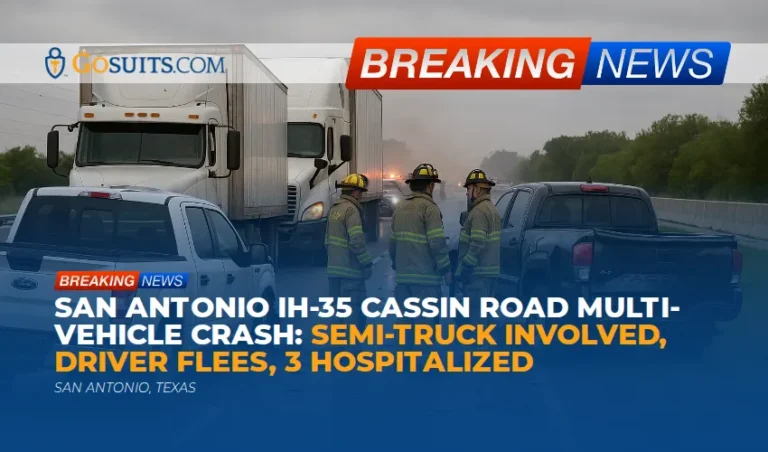
Early Saturday around 6 a.m., lanes on Interstate 35 Southbound near the Cassin Road bridge on San Antonio’s South Side were shut down after a serious multi-vehicle collision. San Antonio Police Department officers reported that a Ford F-150 traveling at a high rate of speed rear-ended a Toyota Tacoma in the 9000 block of IH-35 Southbound. The force pushed the Tacoma into a grassy median and onto an access road. The F-150 then struck a metal barrier on the bridge, blocking two lanes. Moments later, a semi-truck crashed into the back of the F-150. According to authorities, the driver of the Ford F-150 left the area before emergency crews arrived. Two passengers from the pickup, a 25-year-old man and a 17-year-old, and the 37-year-old driver of the Tacoma were transported to a nearby hospital for treatment.
Timeline of events as reported
Based on the information released, the sequence appears to have unfolded quickly in predawn light. First, the Ford F-150 rear-ended the Toyota Tacoma while moving southbound. Second, the Tacoma was pushed off its lane trajectory into the median and toward an access road. Third, the F-150 struck a metal barrier on the bridge, partially obstructing travel lanes. Finally, a semi-truck traveling behind the scene collided with the rear of the stationary or disabled F-150. SAPD indicated the F-150 driver left before first responders arrived.
Injuries reported
Three people were transported for medical care: two passengers from the Ford F-150, ages 25 and 17, and the 37-year-old driver of the Toyota Tacoma. No fatalities were reported at the scene in the initial update. It is not uncommon in high-energy highway crashes for symptoms such as headaches, dizziness, neck or back pain, or concussion symptoms to appear hours after the collision rather than immediately. Seeking timely medical evaluation helps both health outcomes and documentation for potential claims.
Roadway impact and traffic conditions
The crash impacted two southbound lanes on IH-35 at the Cassin Road bridge, a stretch that funnels South Side traffic during early weekend travel. Even outside of weekday rush hours, heavy truck traffic and early-morning commuters use this corridor. Lane closures at bridges can create sudden slowdowns and elevate the risk of secondary crashes.
Why these collisions happen on San Antonio’s I-35
San Antonio’s South Side has grown substantially, and I-35 is a main artery for local drivers, commercial carriers, and regional freight. When a rear-end collision occurs at highway speeds, a few recurring risk factors often play a role.
Speed and following distance
Texas law requires drivers to maintain an assured clear distance between vehicles and to control speed under the conditions present, not just under the posted limit. The Transportation Code addresses both following distance and maximum speed that is reasonable and prudent given traffic, weather, and roadway conditions [3] [4]. National safety data consistently shows that speeding reduces a driver’s ability to steer safely around curves or objects and extends stopping distance, especially on wet or variable surfaces [5].
Heavy truck dynamics in traffic
When a semi-truck is part of a chain-reaction event, physics matters. Large commercial vehicles need significantly more distance to stop than passenger vehicles, particularly when fully loaded. Federal data and safety research on large truck crashes highlight both the severity of outcomes and the importance of adequate spacing and speed management for heavy vehicles [6]. When a disabled vehicle blocks a lane on a bridge approach, a tractor-trailer behind it has less room and time to react.
Secondary collisions and sightlines
Bridge structures, curves, and elevation changes can limit sight distances. If the first impact disables a vehicle in a travel lane, the next drivers may not appreciate the hazard until very late. This is one reason Texas traffic rules emphasize speed reasonable for conditions and maintaining space cushions. In early morning hours, low-angle light and driver alertness can further complicate reaction times.

Legal and insurance considerations after a multi-vehicle and semi-truck crash in Texas
While every crash investigation is unique, several Texas legal principles commonly arise in rear-end and chain-reaction highway collisions. What follows is general information to help the community understand the issues often evaluated after this kind of incident.
Rear-end impacts and duty to control speed
In Texas, drivers must not follow more closely than is reasonable and prudent and must drive at a speed that allows them to stop safely based on traffic and road conditions [3] [4]. In many rear-end collisions, insurers and courts examine whether a trailing driver failed to control speed or maintain assured clear distance. That inquiry can influence civil fault assessments.
Leaving the scene and duty to render aid
Texas law requires a driver involved in a crash resulting in injury or death to stop, remain at the scene, and render aid as necessary [2]. When a driver leaves before first responders arrive, it may affect insurance handling and complicate the fact-finding process in civil claims. It can also prompt questions about whether the driver had applicable insurance or was impaired. From a civil perspective, unavailability of the driver can delay liability determinations and claims processing.
Comparative responsibility in multi-vehicle crashes
Texas follows a modified comparative responsibility system. Fault can be apportioned among multiple drivers and entities, and a claimant generally must be 50 percent or less at fault to recover damages from others [7]. In a chain-reaction crash, investigators may consider the initial rear-end impact, vehicle speeds, lane obstructions, and the actions of subsequent drivers who collided with stopped or disabled vehicles.
Commercial motor carrier considerations
When a semi-truck is involved, additional layers of evidence and responsibility often enter the picture. Investigators and insurance carriers may review hours-of-service compliance, electronic logging device records, inspection and maintenance files, and driver training, among other items. Federal regulations set baseline rules for driver hours of service and logging requirements [12] [13]. Even in a quick sequence event, these materials can inform whether a motor carrier or driver met the applicable standards of care.
Where to get official records in San Antonio
After a highway crash like the one near the Cassin Road bridge, obtaining official records can help families and injured people understand what happened. Here are the typical local and state resources to contact.
San Antonio Police Department crash reports and records
SAPD crash reports and incident records are typically available through the department’s records unit. Residents can request documents, body-worn camera video when applicable, and related materials as permitted by the Texas Public Information Act via the city’s official portals [10] [11].
Texas Department of Transportation crash reports
Law enforcement agencies submit official Texas CR-3 crash reports to the Texas Department of Transportation. These may be requested through the state’s web-based system once processed [1]. Families sometimes obtain both the local police record and the TxDOT CR-3 to ensure they have the complete official documentation.

EMS and fire response records
For medical transport or on-scene treatment records within San Antonio, EMS documentation may be available through the city’s open records process, subject to privacy laws. Expect to verify identity or provide authorization before any protected health information is released [11] [15].
Hospital records
Patients can request their own hospital records directly from the treating facility’s Health Information Management or Medical Records department. Photo ID and signed authorization are typically required. If a patient is a minor, a parent or legal guardian will usually need to sign the request.
Practical next steps for those affected
Serious crashes are disorienting. The priorities below can help people organize immediate needs and protect their options.
Health and documentation
- Seek medical evaluation quickly. Even if injuries seem minor, prompt care can identify hidden issues and establish a clear record of symptoms and treatment.
- Save all discharge and imaging records. Keep copies of hospital summaries, radiology reports, medication lists, and referrals. These documents often become critical in insurance evaluations.
- Track symptoms over time. Use a journal to note pain levels, mobility changes, headaches, sleep issues, and missed work. Consistent notes help show the real impact on daily life.
Evidence preservation
- Photograph vehicles and the crash scene. If possible, capture all sides of each vehicle, close-ups of damage, airbag deployment, skid marks, barrier impacts, debris fields, and the bridge area at Cassin Road.
- Secure dashcam or phone footage. If any vehicle had cameras, back up those files immediately. Preserving digital evidence early prevents accidental loss.
- Collect witness information. Names, phone numbers, and brief statements can be invaluable, especially where a driver left the scene.
Insurance and communications
- Speak with a qualified attorney before giving recorded statements. Insurance adjusters may request detailed interviews quickly. What someone says early can be used later to challenge injury causation or fault allocation.
- Understand Texas auto insurance rights. The Texas Department of Insurance publishes consumer guidance that can help explain coverage benefits and duties after a crash [9].
- Review available coverages. Check for liability, uninsured or underinsured motorist, personal injury protection, and medical payments coverages. In multi-vehicle events, multiple policies may come into play.
For a deeper walkthrough on managing early insurance interactions, this guide may help: How to deal with insurance companies after an accident.
People navigating collisions that involve a semi-truck often consult truck accident lawyers to understand fault, identify all potential insurers, and prioritize evidence preservation specific to commercial motor carriers.
How claims typically work when multiple vehicles are involved
Multi-vehicle crashes can feel overwhelming because there are often several insurers, drivers, and sometimes a trucking company and its liability carrier. Here is how claims usually unfold.
Identifying every applicable policy
Adjusters will look for primary liability coverage for each potentially at-fault driver. When a commercial motor carrier is involved, the truck’s liability policy becomes central for injuries and property damage caused by the tractor-trailer. If a driver who contributed to the crash left the scene or lacks adequate coverage, some injured people turn to their own uninsured or underinsured motorist policies.
Primary versus excess coverage
In a chain reaction, claims are sometimes paid in layers. The at-fault driver’s liability policy is primary for the harms they caused. If multiple at-fault drivers share responsibility, their insurers may negotiate contributions based on percentage fault. If the primary policy limits are inadequate for the full losses, underinsured motorist coverage can become a secondary source. Each situation is fact-specific.
Evidence that often drives liability decisions
- Crash reports and scene diagrams. Police narratives, diagrams, and vehicle positions help reconstruct the sequence of impacts.
- Physical evidence. Guardrail or barrier strikes on the Cassin Road bridge, skid patterns, and resting positions provide clues about speed and braking.
- Electronic data. Passenger vehicles may have event data recorders governed by federal rules for light vehicles [14]. Commercial motor carriers also maintain various electronic logs and telematics, including ELD data for hours of service [12] [13].
- Medical documentation. Consistent medical records link injuries to crash forces and timing, which is essential for causation.
Because insurers evaluate these materials through their own lens, many people prefer independent guidance. When a semi-truck is involved on IH-35, it is sensible for those affected to discuss the matter with San Antonio truck accident lawyers who know how to promptly secure carrier records and protect critical data.
Local safety and infrastructure notes near Cassin Road
The Cassin Road bridge area on I-35 Southbound serves drivers moving between San Antonio’s South Side neighborhoods and points farther south. Even on a weekend morning, commercial traffic is steady. Bridge approaches typically narrow shoulders and limit maneuvering space. If a crash disables a pickup in a travel lane, following drivers have a tighter window to perceive and avoid the hazard.
Weather and light conditions around sunrise can also influence visibility. In San Antonio, the transition from pre-dawn darkness to early daylight varies seasonally. Glare, shadow contrasts on bridge decks, and damp road surfaces can all lengthen effective stopping distances, especially for heavy trucks. While the precise contributing factors for this morning’s crash remain under investigation, these local conditions are worth keeping in mind.
Call-to-action: Important steps to take now

What to do
- Request official reports quickly. Obtain the SAPD incident and crash report and, when available, the TxDOT CR-3. Timely requests ensure you receive the clearest documentation of the event [1] [10].
- Preserve all evidence. Save photos, video, dashcam files, and any correspondence. If a commercial truck is involved, consider sending a written preservation request to the carrier as soon as possible so relevant records are not overwritten.
- Prioritize medical follow-up. Keep appointments, follow home-care instructions, and maintain a symptom journal.
- Speak with a legal professional before calling insurers. Initial statements can affect how fault and injuries are evaluated. A free consultation can help people understand their rights and avoid missteps.
Why acting now matters
- Evidence can disappear. Bridge impact marks can be repaired, vehicle data can be lost, and electronic logs may be overwritten on routine cycles. Early action preserves proof that strengthens a claim.
- Deadlines apply. Texas civil claims are generally subject to a two-year statute of limitations for personal injury, and some insurance benefits have shorter notice requirements [8] [9].
- Multiple insurers may get involved. In multi-vehicle crashes with a semi-truck, coordination among several carriers can cause delays or disputes. Having a plan early simplifies the process.
Commentary from Gosuits San Antonio, Texas Personal Injury Attorney
Our thoughts are with everyone hurt in the crash near the Cassin Road bridge. Incidents like this shake families and worry neighbors, especially when they happen on a route so many of us travel regularly on the South Side. What follows is educational and intended to help the community understand the civil issues that typically arise after a multi-vehicle highway collision.
From the details shared publicly, the sequence began with a rear-end impact at speed, a barrier strike that blocked travel lanes, and then a secondary collision involving a semi-truck. In civil evaluations, investigators often examine whether drivers maintained speed and spacing appropriate for conditions and whether a disabled vehicle created a sudden hazard. When a driver leaves the scene before responders arrive, it complicates fact-gathering and can delay fair resolution for the injured.
Insurance companies and large motor carriers are well organized. They often deploy adjusters and response teams quickly. Without guidance, people can feel pressured into early statements or quick settlements before the full extent of injuries and losses are known. Recorded interviews taken days after a traumatic event can be used later to challenge memory or minimize symptoms. Knowing your rights and the typical playbook can level the field.
It is important to consider a free consultation with a seasoned professional before speaking with any insurer. That conversation helps clarify which policies may apply, what evidence should be preserved immediately, and how comparative responsibility could be argued under Texas law. No one should have to navigate the aftermath of a complex highway crash alone or without clear information.
References
- Crash Report Online Purchase System – Texas Department of Transportation
- Texas Transportation Code Sec. 550.021 Accident Involving Personal Injury or Death – Texas Legislature Online
- Texas Transportation Code Sec. 545.062 Following Distance – Texas Legislature Online
- Texas Transportation Code Sec. 545.351 Maximum Speed Requirement – Texas Legislature Online
- Speeding – National Highway Traffic Safety Administration
- Large Truck and Bus Crash Facts – Federal Motor Carrier Safety Administration
- Texas Civil Practice and Remedies Code Chapter 33 Comparative Responsibility – Texas Legislature Online
- Texas Civil Practice and Remedies Code Sec. 16.003 Limitations Period – Texas Legislature Online
- Consumer Bill of Rights For Personal Automobile Insurance – Texas Department of Insurance
- Police Records – City of San Antonio
- Open Records Requests – City of San Antonio
- Summary of Hours of Service Regulations – FMCSA
- Electronic Logging Devices – FMCSA
- 49 CFR Part 563 Event Data Recorders – eCFR
- Overview of the Public Information Act – Office of the Texas Attorney General