- What happened on the southbound 215 Freeway in Riverside
- Where and when the crash occurred, lane closures, and community context
- Why wrong-way freeway crashes are often deadly
- What investigators typically examine after a wrong-way collision
- Immediate steps to obtain official information and records
- How to request the CHP collision report
- How to request the coroner’s report and death certificate
- Checking closures and roadway updates
- Traffic cameras and nearby video sources
- 911 audio and dispatch logs
- Vehicles, black boxes, and phones
- Wrong-way driving and negligence per se under California law
- If the at-fault driver was on the job or in a company vehicle
- When public entities are implicated and claim deadlines
- Insurance coverages that may apply, including UM and UIM
- Practical guidance for handling insurance communications
- Community safety along Riverside’s 215 corridor
- Action steps to consider now
- Commentary from Gosuits Riverside, California Personal Injury Attorney
- References
What happened on the southbound 215 Freeway in Riverside
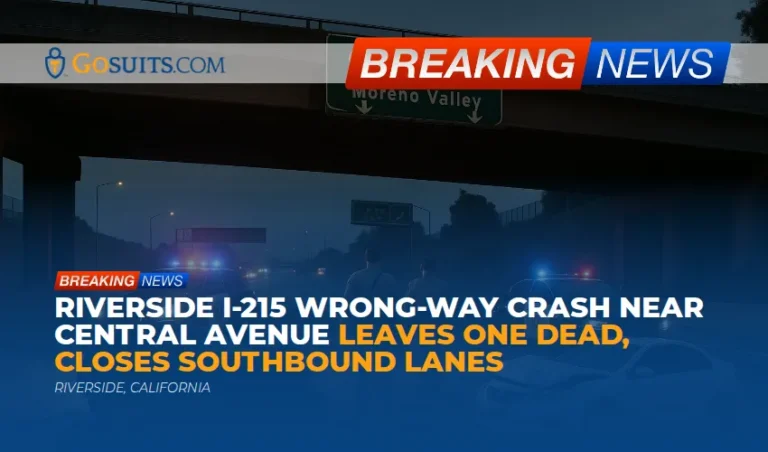
Early Wednesday morning, a deadly wrong-way crash shut down all lanes of the southbound 215 Freeway in Riverside. According to initial information reflected in the California Highway Patrol’s traffic log, a driver was traveling northbound in the southbound lanes and crashed near Central Avenue at approximately 12:20 a.m. At least one person died. The southbound lanes were closed for several hours and reopened around 5:15 a.m.
Officials have not released full details about how many vehicles were involved or why the driver entered the wrong side of the freeway. That part often takes time. Investigators typically review dispatch logs, witness statements, video sources, and physical evidence from the roadway and vehicles before issuing a final collision report.
Where and when the crash occurred, lane closures, and community context
The incident occurred near the Central Avenue overcrossing on the I-215 in Riverside. Drivers who use this segment know it as a crucial connector between downtown Riverside and the Box Springs area stretching toward Moreno Valley. In the overnight hours, long-haul traffic and late-night shifts share the corridor with residents heading to or from workplaces around the University neighborhood, Riverside Community Hospital, and logistics hubs near March Air Reserve Base.
Because this crash happened around 12:20 a.m., many motorists in the area would have encountered unexpected closures and detours. CHP and Caltrans typically coordinate to shut lanes for safety and to allow investigators room to work, resulting in backups that can reach the University Avenue or Alessandro interchanges. Here, lanes reopened around 5:15 a.m., ahead of the morning commute into downtown and the UC Riverside area.
Why wrong-way freeway crashes are often deadly
Wrong-way collisions on divided highways are among the most severe crashes on any roadway. They frequently involve high closing speeds and head-on or near head-on impacts. National safety agencies have investigated these patterns for years. The National Transportation Safety Board has highlighted the high lethality of wrong-way driving and its common late-night profile, noting contributing factors like impairment and fatigue in many cases [1]. The Federal Highway Administration has documented countermeasures such as enhanced “Do Not Enter” and “Wrong Way” signs, high-visibility pavement markings, and ramp treatments to help prevent drivers from entering the wrong direction [2].
Late night and pre-dawn hours tend to correlate with higher rates of wrong-way events. While each case is different, it is common for investigations to examine whether impairment, driver confusion, recent ramp configurations, or roadway lighting played a role [1][2]. Importantly, none of these general trends should be taken as conclusions about this specific Riverside crash. Those answers come from the official collision report and any supplemental findings released later.
What investigators typically examine after a wrong-way collision
Wrong-way freeway collisions trigger an in-depth review. On the I-215, CHP is the primary investigating agency. Investigators commonly look at:
- Entry point and ramp design: Which ramp or median crossing was used and whether standard warning signs and markings were in place and visible at night [2].
- Vehicle dynamics and roadway evidence: Skid or yaw marks, direction of debris fields, and rest positions to reconstruct the path of travel.
- Driver condition and history: Fatigue, distraction, medical episodes, or other factors. When relevant, toxicology is addressed by the coroner’s office.
- Speed and impact severity: Often supported by on-board data from event data recorders in modern cars.
- Third-party information: 911 recordings, dispatch logs, traffic camera clips, and nearby business or dashcam video.
That evidence helps determine the sequence of events, contributing causes, and any civil fault. It also informs future roadway countermeasures if design issues are identified by Caltrans or local agencies [2].
Immediate steps to obtain official information and records
In the first days after a serious crash, it can be hard to know which offices hold which records. The following overview focuses on Riverside-area freeway incidents, where CHP, the coroner, and state and county offices may each have a piece of the puzzle.
How to request the CHP collision report
For freeway crashes in Riverside, CHP prepares the traffic collision report. Families or involved parties can request a copy by following the California Highway Patrol’s collision records procedures. CHP provides the “CHP 190” request form and instructions on its website [3]. You’ll typically need the date, time, location, and, if available, the incident or report number. If those details are not yet known, staff at the CHP Riverside Area office can often help locate the report once it is approved for release.
Why this matters: the CHP report contains the investigating officer’s narrative, diagrams, and initial findings. Insurance companies rely on it, and it helps families understand the official account of what happened.
How to request the coroner’s report and death certificate
When a crash causes a fatality, the county coroner’s office manages the decedent’s examination and, later, the release of reports to qualified next of kin. In Riverside County, the Sheriff-Coroner handles these duties. While report availability can take time due to pending tests, certified copies of death certificates are issued through California Vital Records channels. The California Department of Public Health provides guidance on how to obtain death records, including eligibility and application steps [4].
Families often request the coroner’s report to understand medical findings and the manner of death. This can also be important documentation for insurance claims and probate matters.
Checking closures and roadway updates
Real-time updates about freeway closures and re-openings in Riverside are usually communicated through CHP’s traffic incident systems and Caltrans’ traveler information tools. The state and federal agencies also publish broader roadway safety information and wrong-way countermeasures for public awareness [2]. For immediate travel planning, motorists commonly monitor the early-morning commute along the I-215 corridor toward Moreno Valley and Perris, especially if an overnight incident has occurred near Central Avenue or University Avenue.
Preserving key evidence quickly
Video and digital records are often overwritten within days, sometimes hours. If there is a possibility that road cameras, private security systems, or dashcams captured the collision or its lead-up, acting fast can make all the difference. Consider the following categories and move promptly.
Traffic cameras and nearby video sources
Caltrans freeway cameras, city intersection cameras, and private security systems near overcrossings or frontage roads may hold short-term video clips. Some systems operate on brief retention cycles. Adjacent businesses near the Central Avenue overcrossing, gas stations at nearby ramps, and logistics yards along the 215 corridor may also retain clips that capture the wrong-way vehicle before or after the collision.
For a practical walkthrough on video evidence requests and timelines in California, see Request CCTV Footage After a California Car Accident. Securing video early helps reconstruct paths of travel and corroborate witness accounts.
911 audio and dispatch logs
Emergency calls, radio traffic, and computer-aided dispatch logs can establish when a wrong-way driver was first reported, the path of travel, and the timing of lane closures. California’s Public Records Act sets the general framework for how such records may be requested, subject to exemptions and privacy protections. In a fast-moving freeway event, these logs can place vehicles and responders minute by minute.

Vehicles, black boxes, and phones
Modern vehicles often store crash-related parameters such as speed, brake application, and seatbelt status in an event data recorder. Airbag control modules and infotainment systems may also contain information about phone connections or navigation inputs. Preservation letters to insurers and tow yards are essential to prevent vehicles from being destroyed or data overwritten before experts can download them. When injuries are severe or a fatality occurs, devices like smartphones can also hold location data or messages relevant to timeline reconstruction. These steps are highly time sensitive.
Civil law context and potential liability after a wrong-way crash
After a wrong-way freeway collision, families often ask what civil rights and options exist. While every case is fact-specific, California law sets out several core principles that commonly apply.
Wrong-way driving and negligence per se under California law
California’s Vehicle Code requires drivers to travel on the correct side on divided highways and to obey roadway signs and markings. Driving on the wrong side of a divided highway is prohibited under Section 21651 [5]. More broadly, drivers must keep to the right half of the roadway absent an exception [6]. When a driver violates a safety statute and causes harm, courts can treat that violation as evidence of negligence, a concept often referred to as negligence per se.
These standards are part of why many Riverside car accident lawyers emphasize a careful review of the collision report, roadway design, and video evidence. The correct application of traffic statutes matters both for public safety and for determining civil fault.
If the at-fault driver was on the job or in a company vehicle
When a wrong-way driver is operating a company vehicle or acting within the scope of employment, the employer may face liability under California’s respondeat superior doctrine. In such cases, commercial liability policies and umbrella coverage could be implicated. Confirming whether the driver was working, commuting, or off duty can influence which insurers are involved and what policy limits might be available.
In crashes with catastrophic injuries or fatalities, experienced car accident lawyers often investigate whether any third-party vendors or vehicle owners share responsibility. That can include rental car entities or fleet lessors, depending on the facts and applicable statutes.
When public entities are implicated and claim deadlines
Public entities like Caltrans or local agencies can be named in civil claims only in limited circumstances, typically involving dangerous conditions of public property. These cases are complex. If someone believes a roadway design or sign placement contributed to a crash, California’s Government Claims Act requires a written claim to the public entity, usually within six months of the incident for personal injury or wrongful death claims [7]. Missing that administrative deadline can affect later options. Again, this is not a statement that any public entity bears responsibility here; it is general context for those evaluating all possibilities.
Insurance coverages that may apply, including UM and UIM
In a wrong-way crash with a fatality, multiple policies may be in play: the at-fault driver’s auto liability coverage, any applicable employer policy, and possibly umbrella coverage. If the at-fault driver lacks sufficient insurance, uninsured or underinsured motorist coverage can provide benefits to eligible claimants under their own or a household member’s policy, depending on policy terms and California law. The California Department of Insurance publishes consumer guidance about UM and UIM coverage and how it functions after a crash [8].
Because insurance policies have exclusions, notice requirements, and other important provisions, many people choose to review their potential claims strategy with Riverside car accident lawyers early on.
Practical guidance for handling insurance communications
Insurance adjusters often reach out quickly, sometimes before the CHP report is available. They may ask for recorded statements, authorizations to obtain records, or early settlement discussions. Those steps can carry significant consequences, especially when facts are still developing.
- Talk to an attorney first: Before contacting any insurance company, consider getting a free consultation with a qualified attorney who handles serious freeway crash cases. Statements given to insurers can be used against claimants later if details are misstated or incomplete.
- Limit early authorizations: Broad medical or records authorizations can open the door to unrelated history. Narrowly tailor any releases only after a careful review of what is truly relevant.
- Preserve evidence: Send preservation notices regarding vehicles, EDR data, 911 audio, and available video to insurers and carriers early. Evidence can disappear fast.
- Document harms and losses: Keep organized records of funeral and memorial costs, counseling and grief support expenses, wage information, and household services losses. These are often compensable categories in a civil claim.
In our experience, car accident lawyers frequently caution that quick settlements rarely reflect the full scope of losses in fatal freeway crashes. Waiting for key records, and understanding the long-term impact of a life lost, allows for better-informed decisions.
Community safety along Riverside’s 215 corridor
Residents know the 215 corridor through Riverside and nearby Moreno Valley as a mix of commuter and freight traffic. Overnight, visibility can vary, and drivers may enter ramp systems near Central Avenue or University Avenue while fatigued. FHWA’s recommended countermeasures for wrong-way prevention include improved sign placement, lower mounting heights on ramps, reflective pavement markers that read “wrong way” to a misdirected driver, and larger “Do Not Enter” treatments [2]. Some of those features are increasingly common at Southern California ramps and interchanges.
Community awareness also matters. Reporting a wrong-way vehicle immediately through 911, providing location details such as “southbound 215 near Central Avenue,” can help CHP and Caltrans respond quickly. Even small actions can help prevent secondary collisions or prompt faster lane closures while responders work.

Action steps to consider now
In the days after a deadly wrong-way collision, taking timely, focused steps can preserve options and reduce uncertainty. The following actions are time sensitive and can materially affect outcomes.
- Secure official records: Request the CHP collision report when available and track the coroner’s report timeline. These documents anchor the factual record of what happened.
- Preserve video and audio: Send prompt requests to Caltrans, nearby businesses, and any known dashcam owners. Ask tow yards and insurers to hold vehicles for inspection and EDR downloads.
- Coordinate benefits: Review all potentially applicable insurance policies, including auto, UM/UIM, life insurance, and any employer-provided benefits. Policy language and claim deadlines vary.
- Protect communications: Before providing recorded statements or signing releases, consult an attorney. What people say to insurers can be used against them later on.
- Note key deadlines: For claims potentially involving a public entity, the Government Claims Act generally requires written notice within six months [7]. Wrongful death civil actions typically have a two-year limitations period in California [9]. Calendar these dates early.
Taking these steps promptly helps ensure important evidence and legal rights do not slip away while the community continues to absorb the impact of a sudden freeway closure and a life lost.
Commentary from Gosuits Riverside, California Personal Injury Attorney
Our hearts go out to everyone impacted by this wrong-way crash on the I-215 near Central Avenue. Articles like this are intended for general information and community awareness. Families deserve time, space, and clear guidance as official facts emerge.
Based on what is known, investigators will likely focus on where the wrong-way entry occurred, the condition of signage and ramp markings at night, and any third-party video. Wrong-way incidents on divided highways are uniquely dangerous and often unfold in seconds. Sorting out how and why it happened is the first step toward accountability and prevention.
Insurance companies and large corporations know the process well and move fast. They may request statements, broad authorizations, or propose early settlements before the full picture is clear. That dynamic can take advantage of what many people do not know about collision reports, EDR downloads, public records, and policy language. It is appropriate to slow down, gather key documents, and get questions answered before speaking at length to insurers.
A free consultation gives people a chance to understand timelines, evidence preservation, and how coverages like UM and UIM may apply after a wrong-way collision. It is also a chance to identify potential claim deadlines, including those that apply when public entities are involved. Knowledge brings control in a difficult moment.
References
- Wrong-Way Driving: Special Investigation Report – National Transportation Safety Board
- Wrong-Way Driving Countermeasures – Federal Highway Administration
- Collision Reports and Records Requests – California Highway Patrol
- Vital Records: Birth, Death, Fetal Death, Still Birth – California Department of Public Health
- California Vehicle Code Section 21651 – Driving on Divided Highways
- California Vehicle Code Section 21650 – Right Side of Roadway
- Government Code Section 911.2 – Claims Presentation Periods
- Uninsured/Underinsured Motorist Coverage – California Department of Insurance
- Code of Civil Procedure Section 335.1 – Two-Year Statute for Injury/Wrongful Death