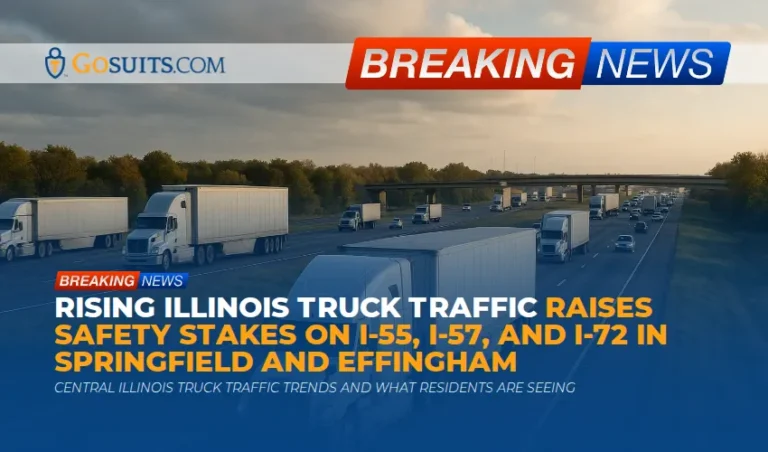
- Central Illinois truck traffic trends and what residents are seeing
- Why heavy trucks change the risk on I-55, I-57, I-72, and local connectors
- Common causes of Illinois commercial truck crashes
- What Illinois law says about fault, claims, and timelines
- Who to contact for official records in Springfield, Effingham, and nearby communities
- Steps to take after a crash involving a semi or commercial vehicle
- Evidence that can make or break an Illinois truck case
- Insurance realities after an Illinois truck crash
- Safety habits that help around big rigs
- Community context: seasonal weather and work zones in central Illinois
- How rising freight traffic affects families and local roads
- Commentary from Gosuits Springfield, Illinois Personal Injury Attorney
- Action steps you can take today
- References
Central Illinois truck traffic trends and what residents are seeing
If you drive the stretches of I-55 by the north end of Springfield, hop onto I-72 toward Decatur, or travel through Effingham where I-57 and I-70 cross, you have probably noticed it. More tractor trailers, more box trucks, and more delivery vehicles weaving into everyday commutes. Illinois Department of Transportation data show that commercial vehicle activity has grown statewide over the last decade. The Effingham area, a major crossroads for interstate freight, experienced a sharp rise in 2024 alone, reflecting the surge in logistics linked to e-commerce peaks and distribution hubs [1].
Residents describe the difference most on weekday mornings and late evenings, when long-haul freight flows overlap with school, work, and hospital shift changes. Central Illinois is in the middle of the country’s east-west and north-south freight corridors, so even communities that feel far from big cities see the ripple effects along ramps, two-lane connectors, and frontage roads near interchanges.
Why heavy trucks change the risk on I-55, I-57, I-72, and local connectors
Semis are vital to the economy, but physics is unforgiving on the highway. A fully loaded combination vehicle can weigh up to 80,000 pounds under federal limits. That mass translates into longer stopping distances, larger blind spots, and higher crash forces than a typical passenger car can withstand [2]. On I-55 near the 6th Street exit or along I-72’s sweeping curves approaching Springfield, those differences matter when traffic bunches up or weather turns bad.
Stopping distance for a loaded tractor trailer can be more than twice that of a passenger car at highway speeds, especially on wet or icy pavement. High centers of gravity also make certain maneuvers riskier for tall vehicles, like evasive lane changes at speed or abrupt braking on a downgrade. In mixed traffic, the margin for error is slimmer for everyone around a semi.
Central Illinois weather adds another layer. Winter ice and freezing fog, spring flooding around low-lying stretches near river bottoms, and summer thunderstorms can quickly reduce friction and visibility. These conditions stretch stopping distances even further and can make a heavy trailer more prone to jackknife or rollover if speed and following distance are not adjusted to conditions [13], [15].
Common causes of Illinois commercial truck crashes
Every crash is unique, but patterns show up repeatedly in central Illinois collision investigations. Here are contributing factors that surface often in police reports and safety analyses:
- Driver fatigue and schedule pressure. Federal Hours of Service rules limit how long most property-carrying drivers can be on duty, but pressure to meet delivery windows still leads to fatigue-related errors. Fatigue slows reaction time and impairs judgment in ways that mimic alcohol impairment [3].
- Improper loading and cargo securement. Freight that is undersecured or top-heavy can shift, causing instability and rollovers. Federal cargo securement standards set minimums for tie-downs and methods, and violations can be serious when combined with sudden maneuvers [4].
- Following too closely. On I-55 south of Sherman or near the I-72 interchange, traffic often compresses quickly. Trucks need extra space, and tailgating can cascade into multi-vehicle rear-end collisions.
- Distracted driving. Glancing at a device or dispatch tablet for a few seconds at 65 mph covers a football field of road. Even momentary distraction dramatically raises risk.
- Equipment problems. Worn brakes, tire issues, and lighting failures are familiar contributors. Carriers are required to keep maintenance records and perform periodic inspections to keep vehicles roadworthy [12].
- Speed too fast for conditions. Even when under the posted limit, a speed that is safe for a car may not be safe for a loaded semi on slick pavement or in heavy traffic.
- Jackknife and trailer swing. When the trailer’s momentum overcomes tractor control during braking or evasive maneuvers, the rig can fold and sweep across lanes, creating high-risk situations for nearby drivers.
If you want a deeper dive into how licensing violations and safety lapses are evaluated in these cases, see our detailed guide on CDL violations and negligence in Illinois truck crashes.

What Illinois law says about fault, claims, and timelines
When a truck crash harms someone in Springfield, Effingham, or surrounding towns, several bodies of law shape what happens next. Illinois uses a modified comparative negligence system. An injured person can pursue compensation as long as their share of fault does not exceed 50 percent. Any award is reduced by the person’s percentage of fault [6].
Civil claims tied to truck crashes can involve multiple defendants: the driver, the motor carrier, a freight broker, a shipper, and sometimes a maintenance contractor or parts manufacturer. Those relationships matter for insurance coverage and legal responsibility. Federal and state regulations may be evidence of the standard of care in a case, whether it involves hours of service, cargo securement, or vehicle maintenance [3], [4], [12].
Recordkeeping rules can be important. For example, logbook and electronic logging device records for hours of service are typically retained for a limited period, and maintenance files have their own retention requirements. Preserving those records quickly is a key early step in many claims [11], [12].
Time limits also apply. In many personal injury cases, Illinois law sets a two-year statute of limitations, though unique facts can change deadlines. Wrongful death claims follow separate rules and timeframes [7], [8]. If a government vehicle or agency is involved in the crash, different procedures and shorter deadlines may apply. Because these rules are technical, it is prudent to consult a qualified attorney promptly to understand which timelines govern your situation.
If you are trying to learn about representation options, some people start by speaking with truck accident lawyers to understand how these laws and regulations may apply to their case. Others specifically look for Chicago truck accident lawyers who can meet in person and navigate local procedures.
Who to contact for official records in Springfield, Effingham, and nearby communities
After a serious crash, getting the official records helps families make informed decisions. In central Illinois, these are common places to request records or clarification:
- Police report. If Illinois State Police investigated, you can request a traffic crash report through the Illinois State Police system. If Springfield Police Department or Effingham Police Department handled the scene, reports are typically available through those local agencies. The report number and the exact date and location will speed up the search. Illinois law also addresses how police records are prepared and when they are available to the public [9], [10].
- Emergency medical records. Hospital emergency departments in Springfield and Effingham can provide records to patients or authorized representatives. If care was provided by EMS, the ambulance service may have a separate record of vitals and care provided on scene and in transit.
- Autopsy report and death certificates. In fatal crashes, the county coroner conducts investigations and maintains autopsy records. Families typically request the coroner’s report directly from the county coroner’s office. Death certificates are issued through the county clerk and the Illinois Department of Public Health Vital Records, depending on the stage of the process [14].
- Crash scene photos and 911 audio. Depending on the agency, you may request photographs, 911 call audio, and body or dash camera footage under the Illinois Freedom of Information Act. Some items can be exempt or redacted, but FOIA provides a framework for requesting many types of public records [10].
- Road and weather information. Historical weather conditions from the National Weather Service can help confirm visibility or precipitation at the time and place of the crash. IDOT work zone logs or roadway maintenance records can sometimes be requested from the relevant district office [1], [15].
Steps to take after a crash involving a semi or commercial vehicle
When a tractor trailer is involved, the aftermath can feel overwhelming. Here is a practical path to protect health and preserve information, adapted to central Illinois roads and agencies.
- Call 911 and focus on safety. Move to a safe location if you can. Turn on hazard flashers. Use flares or triangles only if you can do so safely.
- Get medical evaluation. Even if you feel okay, get checked. Crash-related head, neck, and internal injuries can appear hours later.
- Request the investigating agency and report number. Ask the officer which agency is handling the report and how to obtain it later.
- Document the scene if safe. Photos of vehicle positions, skid marks, debris fields, and visible damage can be invaluable. Capture close-ups and wide angles, including traffic controls and lane markings.
- Identify the trucking parties. Photograph the cab and trailer DOT numbers, license plates, and any company names or USDOT/MC markings on the doors and trailer.
- Avoid detailed statements to insurers before you get legal guidance. What you say can be used against you later. It is wise to talk to an attorney first, especially before recorded statements.
- Preserve relevant documents. Keep medical bills, pay stubs for lost time, tow and repair estimates, and any correspondence.
Many people also keep a brief daily journal of pain, limitations, sleep, and missed activities for the first few weeks. It is easy to forget details later, and contemporaneous notes can help show how the crash affected daily life.
Evidence that can make or break an Illinois truck case
Commercial vehicle cases are evidence intensive. While the police report and photos matter, the following categories often drive outcomes:
- Driver hours and dispatch data. Electronic logging device records, driver qualification files, dispatch notes, and fuel and toll receipts can reveal duty periods and rest compliance. Carriers have limited retention periods for some of these records, so early preservation letters are important [11].
- Maintenance and inspection files. Annual inspections, brake service records, and post-trip inspection reports can show whether the vehicle was roadworthy and whether issues were recurring [12].
- Cargo securement evidence. Bills of lading, load diagrams, and tie-down documentation help determine if freight was secured under federal standards [4].
- Electronic data from vehicles. Event data recorders, engine control module data, and telematics can provide speed, braking, throttle, and fault code information near the time of the crash.
- Scene and environmental data. Work zone schematics, traffic signal timing records, and weather station logs can all be relevant in reconstructing what happened [1], [15].
Because carriers and insurers act quickly after serious incidents, it is common for attorneys to send formal preservation notices and to follow with targeted requests. Waiting can mean key data gets overwritten under routine retention policies.

Insurance realities after an Illinois truck crash
Commercial carriers maintain higher liability limits than most personal auto policies. That does not mean prompt or fair resolution. Insurers often move fast to control the narrative. Investigators may contact people involved within days to lock in recorded statements. Those statements can be used to argue comparative fault later.
From a practical standpoint, it is sensible to speak with a lawyer before calling any insurance company about the crash. The reason is simple: phrases like “I did not see the truck” or “I might have been going a little fast” can be quoted back months later, even if they lack full context. People also may not realize a conversation is being recorded. Attorneys can guide what to share, when to share it, and how to prevent misunderstandings that can harm a claim.
If you are still gathering information and exploring your options, many start by consulting truck accident lawyers to better understand rights and timelines in this context. Others prefer to meet with Chicago truck accident lawyers who know local procedures, common insurer tactics, and where to look for traffic or camera footage in town.
Safety habits that help around big rigs
While no one can control every variable on the highway, a few habits can help reduce risk when sharing the road with heavy trucks:
- Give trucks space. Leave extra following distance and avoid lingering alongside the trailer, especially on the right side where the blind spot is largest.
- Pass cleanly and do not cut back in too soon. Making sure you see the truck’s headlights in your mirror before moving back over gives the driver the space needed to react.
- Expect wide turns. Trucks need room to swing for right turns. Anticipate trailer off-tracking when approaching intersections in Springfield’s downtown grid or Effingham’s busy retail corridors.
- Be predictable. Use signals early, maintain steady speed through merges, and avoid sudden braking on ramps like those connecting I-55 and I-72.
- Adjust for weather and work zones. Slow down and increase following distance when surfaces are wet or slick. Expect sudden stops near lane closures and flagging operations.
Community context: seasonal weather and work zones in central Illinois
Local drivers know the drill. Icy mornings along I-55 north of town can turn to slush by midday. Thunderstorms blowing across the Sangamon River valley can bring quick drops in visibility on I-72. Work zones pop up in construction season, with narrowed lanes and shifting patterns on bridges and interchanges.
IDOT’s winter driving guidance is clear: slow down, increase following distance, and give plows and heavy equipment space to work. The National Weather Service in Central Illinois provides real-time updates that are helpful to check before heading out on longer drives, particularly for those stretches between Lincoln, Springfield, Taylorville, and Effingham where conditions can vary quickly [13], [15].
How rising freight traffic affects families and local roads
The broader freight trend affects more than commutes. Families with teen drivers worry about merging next to large rigs. Delivery vehicles crowd shoulders near interchanges. Rural two-lane connectors carry a mix of farm equipment, school buses, and 53-foot trailers.
State and federal safety data show that when a large truck is involved in a crash, injuries can be severe for occupants of smaller vehicles. National data from NHTSA highlight the disproportionate share of serious injuries and fatalities borne by other road users in multi-vehicle collisions with large trucks [5]. That is why community awareness, prudent driving habits, and timely access to accurate legal and safety information matter so much here.
Commentary from Gosuits Springfield, Illinois Personal Injury Attorney
Our hearts are with everyone in central Illinois navigating busier interstates and the unsettling close calls that sometimes follow. This article is meant for general information and education. It is not tailored to any one situation.
From a legal perspective, the story playing out across Springfield and Effingham is the story of a freight network running at high volume through the heart of our communities. That means more interactions between heavy trucks and families in passenger cars. When crashes occur, we often see familiar threads. Fatigue meeting schedule pressure. Loads that were not secured as they should have been. Braking distances that failed to account for slick pavement or a lane closure. Each of those threads ties back to rules in place for a reason, and to evidence that needs to be preserved quickly to paint an accurate picture.
Insurance companies and corporate defendants understand the power of first narratives. They get adjusters and investigators on the phone fast, often before people have even had a full medical workup. Some ask broad questions that sound routine but are designed to lock in statements that can be used to argue partial fault or to minimize injuries that may evolve over time. Knowing that, it is important to get informed guidance before engaging in recorded statements or signing authorizations that open your entire medical history.
A free consultation serves a straightforward purpose. It helps people understand which deadlines are coming up, which records should be requested immediately, and how to interact with insurers without inadvertently harming their case. It is also a chance to hear how cases like yours proceed in our local courts and what to expect from the process.

Action steps you can take today
Here are practical, time-sensitive steps that make a difference after a serious truck crash in central Illinois.
- Write down the investigating agency and report number. This saves time when requesting the police report and any supplemental materials later.
- Preserve evidence immediately. Save photos and videos to a secure folder. Keep damaged items, and do not repair the vehicle until it has been thoroughly documented.
- Request key records early. Police reports, ambulance run sheets, ER records, and, in fatal cases, coroner reports form the spine of any claim. Early requests can shorten delays down the line.
- Avoid recorded statements to insurers until you get legal guidance. What is said now can be quoted back later. Understanding your rights first can prevent problems.
- Track symptoms and recovery. Use a simple daily log to note pain levels, sleep quality, missed work, and activities you could not do. This helps show the human impact in a clear timeline.
- Mark your calendar for key deadlines. Illinois’ general two-year timeline for many injury claims is strict, and special rules may apply for cases involving government entities or wrongful death. Acting early protects your options [7], [8].
Request your police report Schedule a free consultation Start a recovery journal
References
- Illinois State Freight Plan – Illinois Department of Transportation
- Federal Size and Weight Regulations for Commercial Motor Vehicles – FHWA
- Summary of Hours of Service Regulations – FMCSA
- 49 CFR 393.100 Cargo Securement – eCFR
- Traffic Safety Facts: Large Trucks – NHTSA
- 735 ILCS 5/2-1116 Comparative Fault – Illinois General Assembly
- 735 ILCS 5/13-202 Personal Injury Limitations – Illinois General Assembly
- 740 ILCS 180/2 Wrongful Death Act – Illinois General Assembly
- Traffic Crash Reports – Illinois State Police
- Illinois Freedom of Information Act, 5 ILCS 140 – Illinois General Assembly
- 49 CFR 395.8 Driver’s Record of Duty Status and Retention – eCFR
- 49 CFR 396.3 Inspection, Repair, and Maintenance – eCFR
- Winter Driving Safety – Illinois Department of Transportation
- Death Records – Illinois Department of Public Health
- National Weather Service Central Illinois – NOAA