- What we know about the Playa del Rey tragedy
- Local context at Pershing Drive and Manchester Avenue
- Agencies and records families can request
- California civil rights and options after a fatal collision
- Potential liability issues often evaluated in bicycle collisions
- Practical steps to preserve evidence and protect a civil case
- Insurance considerations and cautions
- Community grief and safer-streets context
- Why acting promptly matters
- Commentary from Gosuits Los Angeles, California Personal Injury Attorney
- References
What we know about the Playa del Rey tragedy
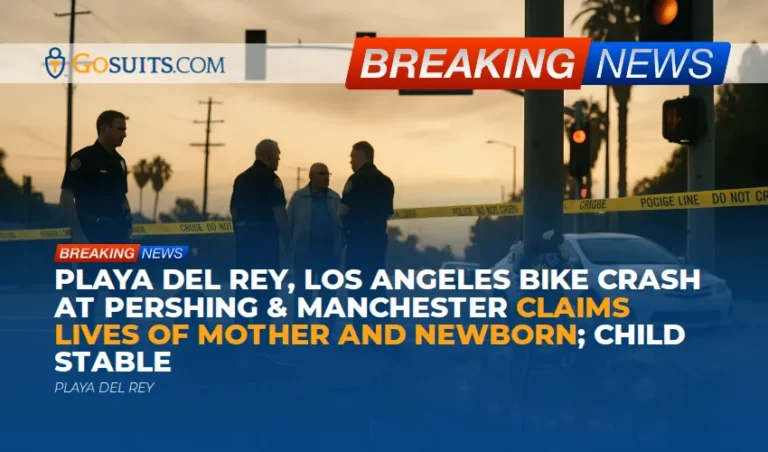
On a Saturday evening around 6 p.m., near the intersection of Pershing Drive and Manchester Avenue in Playa del Rey, a white Toyota Camry struck a woman riding a bicycle with her family, according to the Los Angeles Police Department. Her 3-year-old child was a passenger on her bike. The child was reported in stable condition after being transported to a hospital. The mother was transported as well and later died. Reports shared by the family indicate she was seven months pregnant; the baby girl was delivered and taken to the Neonatal Intensive Care Unit at UCLA Mattel Children’s Hospital, and tragically passed away the following night. The driver, described by police as an elderly man, remained at the scene.
Authorities have not released a full investigative analysis. At this stage, public details reflect that the collision occurred at a busy Playa del Rey junction known to see a mix of commuter and beach-bound traffic, especially on weekend evenings. A memorial with candles, flowers, and family photos has been placed near the site, a testament to how deeply this loss is felt in the community. We will avoid speculation here and focus on verified facts and the civil-law and safety context that can help families navigate what comes next.
Local context at Pershing Drive and Manchester Avenue
Neighbors around Playa del Rey, Westchester, and the Ballona Wetlands area know the stretch where Pershing Drive meets Manchester Avenue well. It is a corridor that funnels traffic between Westchester Parkway, the coastal neighborhoods heading toward Dockweiler State Beach, and routes skirting the LAX airfield. Many local families ride along nearby paths in the early evening when the weather cools and winds off the ocean settle. That same timing can coincide with sun-angle glare, dinner-hour traffic, and people hurrying to and from the beach or the airport corridor.
Intersections like Pershing and Manchester combine multiple lanes, turning movements, changing light cycles, and the possibility of drivers misjudging a cyclist’s speed or position. Regardless, California law recognizes people on bikes as legitimate roadway users with the same rights and responsibilities as motorists, and drivers must exercise due care around them [3]. The evaluation of how and why this crash happened will rely on meticulous fact gathering by investigators and, if a civil claim is brought, by the family’s representatives through lawful discovery.
Agencies and records families can request
LAPD traffic collision report and investigative records
Traffic collision reports help reconstruct what occurred and identify witnesses, diagrams, and preliminary observations. In Los Angeles city cases, these are prepared by LAPD traffic officers. Although procedures vary by division, families commonly request the report once it is approved and released. If additional records exist, such as evidence logs or supplemental diagrams, some may be disclosable subject to exemptions under the California Public Records Act. The Public Records Act is codified in Government Code and gives the public the right to inspect or obtain copies of non-exempt records [12].
For crashes on state highways, the California Highway Patrol handles reports, and CHP publishes instructions for requesting collision reports statewide. Even if CHP is not the investigating agency for this case, their resource shows what’s typically needed, such as incident date, location, and party names [11].
Los Angeles County Medical Examiner-Coroner
The LA County Department of Medical Examiner provides autopsy reports, investigative findings, and other records that can be vital in understanding cause and manner of death. Families can request these records through the department’s established process. The Medical Examiner’s website explains how to submit requests and the categories of records available to next of kin or authorized representatives [8]. Death certificates themselves are issued through vital records, but Medical Examiner documentation often provides clinical detail that helps both with closure and with any civil proceedings.
Death certificates
Certified copies of death certificates are available through the California Department of Public Health’s Office of Vital Records, or through the Los Angeles County Registrar-Recorder/County Clerk. The state’s vital records portal outlines eligibility, forms of identification, and ordering methods for certificates [9].

Hospital records and the right to access medical information
Medical records from treating hospitals, including emergency departments and NICU units, are part of the record of what happened medically after a collision. Under federal law, patients and certain personal representatives have a right to access designated medical records. The U.S. Department of Health and Human Services explains how the HIPAA Right of Access works, including timelines and reasonable cost-based fees for copies [10]. For minors, parents and legal guardians often have access rights, subject to specific exceptions under law.
911 audio, traffic camera footage, and other public records
Depending on circumstances, families may seek 911 call audio, Computer-Aided Dispatch logs, traffic signal timing data, or nearby public camera footage. Availability varies, and retention periods can be short. Requests are typically made under the California Public Records Act to the relevant agency. The Attorney General’s CPRA guidance provides a useful overview of how requests should be handled and what exemptions may apply [12]. Put simply, the earlier a request is made, the better the chance that time-sensitive data still exists.
California civil rights and options after a fatal collision
Wrongful death and survival actions
California has two complementary civil claims that can arise after fatal injuries: a wrongful death claim and a survival action.
- Wrongful death. This claim belongs to certain family members and seeks damages for their losses caused by the death, such as the loss of financial support, love, companionship, and household services. The law regulating who can bring the claim and what it covers is set out in the California Code of Civil Procedure [4].
- Survival action. This is brought on behalf of the estate to recover claims the decedent could have pursued had they survived, such as medical bills and certain economic losses incurred before death. It is governed by a different statute [5].
Families often pursue both claims when appropriate, and the exact categories of recoverable damages depend on the facts and the statutes. The civil courts evaluate evidence about liability and damages, independent from any police findings.
Time limits and special deadlines
In most California personal injury and wrongful death matters, the general statute of limitations is two years from the date of injury or death, respectively [6]. If a potential defendant is a public entity, such as a city, county, or public agency, an administrative claim under the Government Claims Act often must be presented within six months of the injury or accrual date before a lawsuit may proceed in civil court [7]. These are strict deadlines. Calculating the correct timeline can be nuanced, which is why families often consult with counsel promptly to avoid any waiver of rights.
Bicyclists’ legal status and duties on the road
California law treats a person riding a bicycle on the roadway like the driver of a vehicle for most rules of the road, granting the same rights and imposing similar duties [3]. Drivers must exercise due care, especially near intersections, driveways, and areas with high foot and bike traffic. When passing a bicycle, motorists must provide at least three feet of clearance, where applicable, and slow to a safe speed if three feet are not feasible [2]. These rules do not assign fault in this case; rather, they frame the general legal obligations that can be considered when investigators and, if needed, a civil court evaluate what happened.
Potential liability issues often evaluated in bicycle collisions
Driver duties toward cyclists
Motorists must monitor for vulnerable road users and adjust speed and lateral position to avoid collisions. The Three Feet for Safety Act codifies a minimum passing distance and emphasizes slowing when safe passing space is limited [2]. In intersection environments, common questions include whether a driver yielded appropriately, obeyed signal indications, and scanned properly before turning or proceeding.
Intersection design and visibility
Intersections with multiple lanes, skewed approaches, or high speeds can reduce reaction time. Even without assigning blame, investigators typically evaluate sight lines, the presence or absence of bike lanes, vehicle approach speeds, and whether lighting or sun glare could have affected visibility at the time of day. These factors may inform both safety recommendations and the evidentiary record in a civil matter.
Comparative fault is a legal framework, not a conclusion
California uses comparative fault to apportion responsibility if more than one party contributed to a collision. That does not imply anything about this crash. It simply means that civil courts can consider all conduct that contributed to harm and assign percentages if necessary. Families should know that allegations of comparative fault can arise even when a person on a bike or on foot did nothing wrong; insurers often raise these arguments as leverage in negotiations.
Practical steps to preserve evidence and protect a civil case
It is common for families to feel overwhelmed. Gathering and preserving time-sensitive evidence does not need to happen all at once, but it does help to start early. The following steps are general, not case-specific.
- Request official records quickly. Ask for the traffic collision report once available, and submit timely requests for any 911 audio, CAD logs, or traffic signal timing data that might exist. CPRA guidance underscores that agencies must respond within specific timeframes [12].
- Document the scene and memorial items. If safe, photograph the collision area, skid marks, debris locations, and visibility conditions at the same time of day. If a memorial is placed, respectfully photograph it before items are removed, as it helps document community context and timeline.
- Identify and contact witnesses. Neighbors, fellow riders, or passersby may have valuable observations. Promptly noting names and contact details preserves opportunities for later statements.
- Secure medical and coroner records. Request hospital records under HIPAA’s Right of Access and track timelines for responses [10]. From the LA County Medical Examiner, request available reports as they are finalized [8].
- Preserve digital data. Save photos, phone location data, fitness app ride logs, and any family devices that may contain relevant timestamps.
- Consider vehicle inspections. In many cases, preserving the involved bicycle and securing an opportunity to inspect the driver’s vehicle can help experts assess impact angles, speeds, and crush patterns.
- Track all expenses and support needs. Maintain organized records of funeral costs, travel to medical appointments, time off work, counseling, and child-care. These details can matter in a civil claim.
To keep paperwork from becoming overwhelming, some families find it useful to follow a structured list created for this kind of matter. One resource that fits Los Angeles families is this Los Angeles wrongful death checklist that outlines documents and steps to consider in the weeks ahead.
If a family decides to bring a wrongful death claim, the process will require careful documentation and attention to deadlines. A wrongful death claim typically includes evidence from police, medical providers, and loved ones to establish both liability and the full measure of losses recognized under California law.
Because of unique local procedures and timing, families pursuing a wrongful death claim in Los Angeles often benefit from early guidance on records requests, insurance coverage checks, and how to avoid pitfalls when speaking with adjusters.
Insurance considerations and cautions
Do not rush to give recorded statements
It is common for an at-fault driver’s insurance company to contact families quickly. It may sound routine, but recorded statements can later be used to challenge liability or minimize the loss. It is wise to speak with an attorney before giving any statement to an insurer, and to seek a free consultation to understand rights, timelines, and what not to say. What is said early can be difficult to unravel later.
Liability, UM/UIM, and other coverages
- At-fault driver liability policy. This is usually the first coverage evaluated. Limits vary widely and are not always sufficient for catastrophic losses.
- Uninsured/underinsured motorist coverage. UM/UIM on a household auto policy can sometimes apply to bicycle collisions if policy conditions are met. It can be crucial when the at-fault limits are inadequate.
- Medical payments coverage. MedPay, if present, may help with immediate medical costs regardless of fault, though its interaction with other coverages and liens should be reviewed carefully.
- Wrongful death and survival claims. Each has distinct damages categories; insurers often analyze them separately when evaluating exposure.
Insurers are sophisticated entities. They evaluate exposure immediately and may look for admissions or statements that reduce payout potential. That is why families are routinely advised to consult counsel first. The wrong casual remark can be quoted back later in negotiations.
Community grief and safer-streets context
Playa del Rey is a place where families roll out for evening rides along Ballona Creek, where kids learn to balance on two wheels near the bluffs by Loyola Marymount, and where people watch airliners rise and descend while the marine layer drifts over Westchester. When a family outing ends in tragedy, it shakes everyone. Candles at the corner, neighbors stopping to reflect, and parents clinging to little ones on the walk home communicate what words cannot.
While formal findings will take time, tragedies like this prompt citywide questions: Are drivers giving cyclists the space and attention the law requires? Are intersection approaches forgiving enough of human mistakes? There is no single fix. Yet a shared culture of care on streets is built moment by moment by people behind the wheel choosing to slow slightly, scan deliberately, and yield generously.
Why acting promptly matters
What, specifically, should happen next in the civil context after a fatal collision? Several distinct actions tend to matter, and timing affects each of them.
- Secure the core records early. Police reports, medical records, and coroner files anchor any civil evaluation. Agencies have processing queues and legal timelines. Early, complete requests reduce delay and the risk of missing data.
- Lock down time-sensitive evidence. Traffic camera footage, 911 audio, and private business video may be overwritten in days or weeks. Submitting preservation letters and CPRA requests quickly can be the difference between having footage and relying solely on memory and diagrams [12].
- Map out all insurance coverage now. Determining available insurance across all potentially applicable policies helps families plan. This can include the at-fault policy, household UM/UIM, and, in rare circumstances, other applicable coverages.
- Calendar every deadline immediately. Statutes of limitations and, if any public entity is involved, Government Claims Act deadlines are unforgiving. A calendared plan ensures no claim right is lost by accident [6] [7].
- Avoid insurer traps. Insurance adjusters sometimes request quick recorded statements or releases. Without guidance, people may sign or say something that narrows claims. Understanding rights first helps prevent missteps.
- Support the family’s wellbeing. Counseling, school notifications, workplace arrangements, and community support all help stabilize the near term so the legal process can be managed with care and patience.
The benefit of timely action is straightforward: better evidence, clearer timelines, and a steadier process. The cost of delay is lost footage, faded memories, and procedural hurdles. Acting now preserves options later.
Commentary from Gosuits Los Angeles, California Personal Injury Attorney
Our hearts are with the family, their friends, and the Playa del Rey community. This piece is offered for education and general information only. It is not a substitute for speaking directly with a lawyer about the specific facts and laws that may apply.
From a civil-injury perspective, this is the kind of heartbreaking collision no neighborhood should ever experience. A family out on bikes at dusk is part of what we all cherish about living near the coast. When a driver strikes a rider, the law looks closely at visibility, speed, yielding behavior, and the duty of care motorists owe to people on bikes. California statutes recognize cyclists as full participants in traffic and require drivers to pass with safe clearance and proceed carefully at intersections. A careful, evidence-based reconstruction will matter here.
Insurance companies and corporations move quickly to protect themselves after serious incidents. They review statements for inconsistencies, highlight any uncertainty to dispute liability, and sometimes press families for early recorded interviews or broad medical authorizations. People are rarely warned that what they say on a difficult day can be quoted back months later to minimize a claim. Knowing the playbook can prevent common pitfalls.
In the wake of a fatal collision, getting a free consultation can help families understand timelines, the difference between wrongful death and survival actions, and how to approach insurers and records requests. It also helps people understand what not to say to adjusters. Even a short conversation can clarify the road map, reduce stress, and make sure time-sensitive evidence is preserved while the family focuses on healing and remembrance.
References
- Traffic Safety Facts: Bicyclists and Other Cyclists, 2022 – NHTSA
- California Vehicle Code § 21760 Three Feet for Safety Act – California Legislature
- California Vehicle Code § 21200 Bicycles: Rights and Duties – California Legislature
- Code of Civil Procedure § 377.60 Wrongful Death – California Legislature
- Code of Civil Procedure § 377.30 Survival Actions – California Legislature
- Code of Civil Procedure § 335.1 Two-Year Limitations – California Legislature
- Government Code § 911.2 Presentment of Claims to Public Entities – California Legislature
- Requesting Reports and Services – LA County Department of Medical Examiner
- Vital Records and Certificates – California Department of Public Health
- Individuals’ Right under HIPAA to Access Health Information – HHS
- Request a Collision Report – California Highway Patrol
- California Public Records Act Overview – California Attorney General
- California Collision Data – Office of Traffic Safety