- What happened on Frankford Road in Far North Dallas
- What remains under investigation
- Community context in Far North Dallas
- Pedestrian rights at Texas intersections
- Potential civil liability and legal pathways
- How investigations determine fault and what evidence matters
- Where to obtain police reports, autopsy information, and official records
- Insurance considerations after a deadly crash
- Practical steps to protect a potential claim
- Why acting now matters
- Commentary from Gosuits Dallas, Texas Personal Injury Attorney
- References
What happened on Frankford Road in Far North Dallas
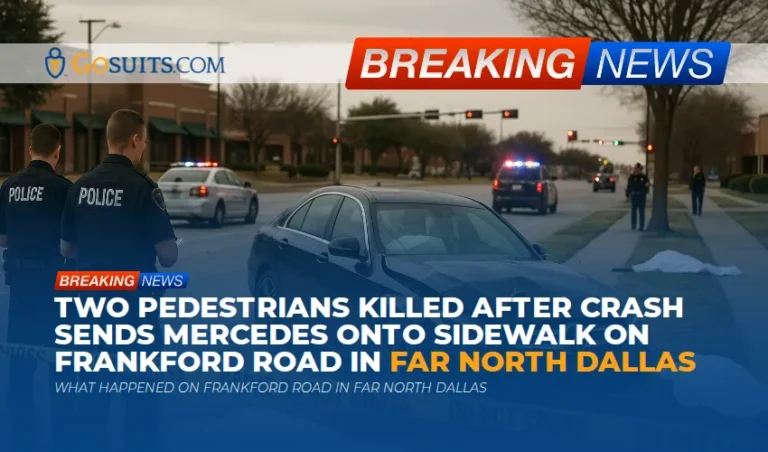
Shortly before 6 p.m. on a Thursday evening in Far North Dallas, a two-vehicle crash at Frankford Road ended in tragedy. According to statements from officers at the scene, a black Mercedes traveling east on Frankford collided with a white Nissan traveling south. The impact sent the Mercedes onto the sidewalk, where it struck two men who had been waiting to cross. Both pedestrians, described as being in their 40s, were transported to a local hospital and later died. The male driver of the Mercedes and the female driver of the Nissan were hospitalized with non-life-threatening injuries. A third person involved was not injured. Frankford Road was closed for several hours during the investigation and later reopened.
As of the latest available information, Dallas police had not released the identities of the deceased pending notification of next of kin. A city councilmember publicly called the incident a tragedy and asked the community for prayers. No charging decisions had been announced at the time those details were shared.
What remains under investigation
When crashes occur at or near busy intersections, investigators typically examine a wide range of factors. For this collision, the following are key unknowns that are generally addressed as part of a standard serious crash inquiry:
- Signal phase and right of way at the moment of impact, including whether any driver had a green, yellow, or red light, or a protected turn phase if applicable.
- Vehicle speeds and braking before the impact, which investigators often assess through skid marks, crush damage, and event data recorder downloads when available [9].
- Line of sight and lighting conditions, including whether evening lighting, headlight use, or roadway lighting could have affected visibility.
- Distraction, impairment, or fatigue indicators for any driver, based on interviews and, where warranted, toxicology results.
- Pedestrian position and movement relative to the sidewalk, curb ramp, or crosswalk area at the time the Mercedes left the roadway.
Until the Dallas Police Department releases its findings, specific fault determinations should not be assumed. Serious crash reviews typically include diagramming, interviews, surveillance canvassing, and sometimes 3D reconstruction analysis. The outcome of these steps helps clarify how and why this incident unfolded.
Community context in Far North Dallas
Far North Dallas residents know Frankford Road as a busy east-west corridor that serves neighborhoods near Preston, Hillcrest, and Coit, along with access to the Dallas North Tollway corridor and nearby retail centers. Early evening traffic on weekdays can be brisk as commuters head home, and pedestrian activity often picks up around dinner hours. In February, dusk arrives early, so visibility can change quickly around that time of day. Those conditions are not unusual, but they underscore why intersection design, signal timing, and driver attentiveness are so important along this stretch.
Beyond the immediate facts, crashes like this weigh heavily on nearby communities, including Bent Tree, Preston Highlands, and surrounding pocket neighborhoods that rely on Frankford Road. People walk to bus stops, jog along neighborhood sidewalks, and cross at signalized corners to reach shops, schools, and places of worship. When a sidewalk space becomes part of a crash scene, it shakes a community’s confidence in everyday safety.

Pedestrian rights at Texas intersections
Texas law establishes clear expectations for both drivers and people on foot. Drivers must exercise due care to avoid colliding with pedestrians, sound their horn when necessary, and take added caution when a person is visually impaired or a child is present [3]. This duty of care applies whether a person is in a marked crosswalk, an unmarked crosswalk at an intersection, or approaching a crossing area. The Transportation Code also describes how pedestrians should use crosswalks and obey traffic control signals where present [3].
Two provisions are often central in intersection cases:
- Duty of due care: Drivers must exercise due care to avoid colliding with pedestrians and take proper precautions when required by circumstances [3].
- Crosswalk rules: At intersections, pedestrians typically have the right to cross when they have a walk signal or when they are already in the crosswalk and it is safe to do so under applicable signals or signage [3].
Although the two men in this Dallas crash were waiting on a sidewalk when struck, the same driver duty to exercise due care applies to keeping vehicles on the roadway and away from people on foot. In civil cases, these statutory duties can inform how fault is assessed.
Potential civil liability and legal pathways
From a personal injury and wrongful death perspective, several civil law concepts may apply in a crash where a vehicle leaves the roadway and hits pedestrians:
- Negligence: If a driver failed to use ordinary care, such as by speeding, running a light, failing to yield, or not maintaining control of the vehicle, that negligence can support liability for resulting injuries or deaths. The specifics depend on the evidence gathered during the investigation.
- Comparative responsibility: Texas uses a proportionate responsibility system to allocate fault among parties. If more than one driver contributed to the sequence of events that caused the sidewalk strike, fault can be apportioned. A claimant is barred from recovery only if found more than 50 percent at fault, which typically does not apply to sidewalk pedestrians in a scenario like this, but each case depends on facts [7].
- Wrongful death and survival claims: Families of those killed by negligence may pursue wrongful death claims for losses such as companionship and financial support, and an estate may bring a survival claim for damages the decedent would have had had they lived. Both paths are governed by Texas Civil Practice and Remedies Code Chapter 71 [5].
- Punitive damages standard: In rare cases, exemplary damages may be considered if there is clear and convincing evidence of gross negligence. Applicability is fact specific and subject to statutory standards [5].
Time limits matter. In Texas, many wrongful death and personal injury claims must be filed within two years, subject to various exceptions and nuances. The statute of limitations is found in the Civil Practice and Remedies Code Section 16.003 [6].
How investigations determine fault and what evidence matters
Even when initial news updates give a basic sketch, full answers usually require methodical evidence work. In a serious Dallas car accident that injures bystanders, investigators and later civil practitioners typically look at the following:
On scene documentation
- Diagramming and measurements: Skid marks, yaw patterns, final rest positions, debris fields, and curb or pole strikes can help estimate speed and direction of forces.
- Vehicle inspections: Damage profiles, airbag deployment data, and whether safety systems functioned can be relevant to causation and injury patterns.
- Signal timing and phasing: If the intersection is signalized, records of timing plans are often requested to understand which movement had the right of way.

Digital and physical records
- Event data recorders: Many late model vehicles store pre-crash data like speed, brake use, and throttle position that can be downloaded with proper tools and chain of custody [9].
- Video sources: Adjacent businesses, residential doorbell cameras, transit buses, and traffic engineering cameras can yield footage. Because video overwrites quickly, early preservation letters are vital.
- 911 and CAD logs: Dispatch records can provide timelines and identify witnesses who called in the crash.
Human factors and roadway context
- Visibility and lighting: Evening glare, headlight use, and the effectiveness of roadway lighting can factor into perception response time.
- Driver attention and impairment: Interviews, device forensics where permitted, and toxicology for drivers may be part of the official review.
- Pedestrian refuge and protection: The presence of curb ramps, median islands, or barriers informs risk at a given corner. Federal guidance highlights proven safety countermeasures such as high-visibility crosswalks and curb extensions for similar environments [8].
Where to obtain police reports, autopsy information, and official records
Families dealing with a sudden loss face a confusing mix of agencies and paperwork. These are the main places people in Dallas typically contact after a fatal roadway incident:
- Crash report: Texas crash reports are generally obtained through the Texas Department of Transportation’s Crash Records Information System portal. You can search by crash details and request a certified copy for official use [2].
- Dallas Police Department case information: For case status, next steps, or to share additional witness information, the Dallas Police Department’s Vehicle Crimes Unit is usually the point of contact. Case numbers shown on the TxDOT portal or initial incident logs help when calling. Public access to many records is governed by the Texas Public Information Act [10].
- Autopsy and toxicology: In Dallas County, autopsy services are handled by the county medical examiner’s office. Next of kin are typically advised directly by investigators. Autopsy and toxicology timelines can vary depending on lab testing demands, especially when toxicology screening is required. Families can later request copies in accordance with county procedures and state law.
- Death certificate: Certified death certificates in Texas are issued by the Department of State Health Services Vital Statistics Unit. Funeral homes often initiate requests, but family members can also follow up through state channels [11].
- 911 audio and dispatch logs: These may be requested through open records processes subject to confidentiality protections and redactions under Texas law [10].
When requesting records, have the incident date, time, location, and any report or case number ready. If you plan to pursue a claim, coordinating these requests with counsel can help preserve chain of custody and ensure sensitive evidence is secured promptly.
Insurance considerations after a deadly crash
Civil claims arising from a sidewalk strike can involve multiple insurance policies. The at-fault driver’s liability coverage is usually primary for injury or death claims. If more than one driver contributed to the event, multiple liability carriers may be involved. In addition, households sometimes have underinsured motorist coverage that could apply if liability limits are inadequate, though every policy must be reviewed for applicability and exclusions.
Texas law outlines who may bring wrongful death and survival actions and the kinds of damages that may be sought, including pecuniary loss, mental anguish, and loss of companionship [5]. Families navigating these issues often have questions about claim sequencing, policy limits disclosure, and how medical and funeral expenses are handled. The Texas Department of Insurance provides consumer guidance on handling auto claims, what adjusters can and cannot ask, and timelines that may apply [12].
Insurers often reach out quickly after serious incidents. Before giving recorded statements or signing authorizations, it is common to speak with an attorney to understand rights and obligations. What someone says to an adjuster can be used against them later. For general information about finding and working with car accident lawyers, it helps to understand typical investigation and negotiation steps as early as possible.
For those looking locally, many find it valuable to consult with Dallas car accident lawyers who routinely work with area investigators and are familiar with Dallas corridors like Frankford, Coit, and Preston. Local familiarity can help with quick evidence preservation and witness outreach.
Practical steps to protect a potential claim
Thoughtful, early action can make a difference in crash cases that involve pedestrians on sidewalks. Consider these practical measures:
- Preserve evidence immediately: Save clothing, shoes, glasses, backpacks, and any damaged personal items. Do not clean or repair them until you have documented their condition with photos and, if appropriate, coordinated with counsel.
- Collect and centralize documents: Keep hospital and EMS records, funeral and memorial invoices, employer letters about income or benefits, and any correspondence from insurance companies in one place. Create a simple index to track what you have.
- Request official records in a coordinated way: Crash reports through TxDOT, dispatch logs, and potential video sources can be time sensitive. Video at nearby businesses or homes may overwrite within days.
- Avoid informal statements to insurers: Speak with an attorney first before giving recorded statements or signing medical or employment releases. Statements can be taken out of context and used against claimants later.
- Document the human impact: In wrongful death matters, contemporaneous notes about family roles, caregiving, and milestones missed can help explain non-economic damages later, subject to the rules of evidence.
- Learn the basics of pedestrian rights: A clear understanding of how Texas law treats sidewalk and crosswalk cases can be empowering. See this helpful overview on Pedestrian rights in car accidents in Texas for plain-language context you can use when speaking with insurers or investigators.
Many families benefit from a single point of contact to handle agency requests and follow-ups. That coordination keeps timelines from slipping and reduces the risk of missed evidence windows.
Why acting now matters
Several deadlines and practical realities create urgency in roadway fatality cases in Dallas and across Texas:
- Statute of limitations: Many wrongful death and survival claims must be filed within two years in Texas, subject to limited exceptions [6].
- Evidence preservation windows: Business security systems and residential doorbells often overwrite within days or weeks. Early preservation letters and in-person canvassing can capture critical footage before it disappears.
- Vehicle data retention: Event data recorders can be overwritten or lost if vehicles are moved, repaired, or salvaged without proper holds in place [9].
- Open records timelines: Requests made under the Texas Public Information Act move faster when they are accurate, complete, and targeted. Knowing which records to request and how to frame them can save precious time [10].
- Insurance claim sequencing: Coordinating liability claims across multiple carriers, and evaluating whether underinsured motorist coverage is implicated, is most effective when started early.
What should be done next is straightforward: identify and preserve all possible evidence, request core records, and obtain a free consultation with a seasoned Texas personal injury attorney to understand rights and next steps. Acting promptly protects options while the facts are still fresh and recoverable.

Commentary from Gosuits Dallas, Texas Personal Injury Attorney
Our hearts go out to the families and friends of the two men killed while waiting on a sidewalk to cross in Far North Dallas. Losing loved ones this way is devastating, and our community feels that loss alongside you. What follows is general information to help people understand the civil side of incidents like this, not a substitute for case-specific guidance.
From a civil injury perspective, the core issue is why a vehicle ended up on a sidewalk where people had every reason to feel safe. In these intersection collisions, fault can involve one or both drivers, depending on right of way, speed, and control. That is why early evidence preservation is so important. Video, event data recorders, and on-scene measurements help answer questions the community rightly asks.
Insurance companies and corporate defendants often move fast to shape the narrative, request broad medical or employment authorizations, and secure statements that may limit future recovery. That pace can overwhelm families in mourning. It is common for adjusters to appear helpful while collecting details they later use to minimize claims. Being careful about what is shared, and when, helps keep the playing field level.
A free consultation is important because it helps people understand the process without pressure. It clarifies who may bring wrongful death and survival claims, what damages may be available under Texas law, and how to coordinate with Dallas investigators and TxDOT records. Even a short conversation can provide clarity about timelines, video canvassing, and the practical steps that preserve options while the official investigation continues.
References
- Pedestrian Safety – National Highway Traffic Safety Administration
- Crash Records Information System (CRIS) – Texas Department of Transportation
- Texas Transportation Code, Chapter 552. Pedestrians – Texas Legislature Online
- Pedestrian Safety – Centers for Disease Control and Prevention
- Texas Civil Practice and Remedies Code, Chapter 71. Wrongful Death; Survival – Texas Legislature Online
- Texas Civil Practice and Remedies Code, Section 16.003. Limitations – Texas Legislature Online
- Texas Civil Practice and Remedies Code, Chapter 33. Proportionate Responsibility – Texas Legislature Online
- Safe Transportation for Every Pedestrian (STEP) – Federal Highway Administration
- Event Data Recorders – National Highway Traffic Safety Administration
- Open Government – Office of the Texas Attorney General
- Death Records – Texas Department of State Health Services
- Auto insurance claims: tips and resources – Texas Department of Insurance