- What we know about the Touhy Avenue pedestrian crash in Niles
- Local context: why this stretch of Touhy Avenue is challenging for people on foot
- Illinois pedestrian law overview and how it applies
- Injury response, trauma care, and documentation in the Chicago north suburbs
- How to obtain police reports, public records, and medical examiner documents
- Evidence to preserve after a pedestrian crash
- Liability and insurance considerations after a pedestrian injury
- Community safety takeaways for Touhy Avenue and similar corridors
- Why taking action matters now
- Commentary from Gosuits Niles, Illinois Personal Injury Attorney
- References
What we know about the Touhy Avenue pedestrian crash in Niles
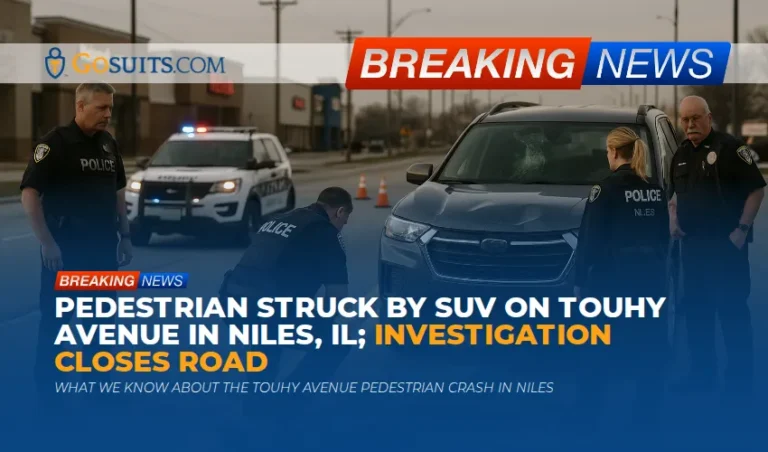
Early Tuesday, Niles police reported that a pedestrian was struck by a sport utility vehicle in the 5600 block of West Touhy Avenue. Following the collision, Touhy was fully closed in both directions between Central Avenue and Lehigh Avenue while officers investigated and cleared the scene. Police did not release the pedestrian’s condition at the time of their notice. This portion of Touhy, on the Niles and Skokie boundary, serves a major retail corridor with big-box stores and large-format shopping centers, bringing steady traffic and frequent turning movements throughout the day.
While official investigative conclusions have not been shared publicly, closures like this typically indicate that law enforcement is documenting the scene, collecting witness statements, and coordinating with emergency medical responders. On suburban arterials, it is common to see prolonged closures where there may be serious injuries, complicated traffic control, or the need to survey sightlines and signal timing.
Local context: why this stretch of Touhy Avenue is challenging for people on foot
Residents in the north suburbs know Touhy Avenue well. It is a primary east-west artery connecting communities like Niles, Skokie, and Lincolnwood to O’Hare-area employment centers and the North Shore. The segment around the 5600 block includes large parking fields, wide curb cuts, and multiple driveways serving shopping clusters like Village Crossing. That means a high volume of turns in and out of access points combined with through traffic moving at arterial speeds.
If you walk that corridor, you have probably noticed:
- Long crossing distances at multilane intersections, which can require multiple signal phases to complete if a pedestrian moves at an average pace.
- Frequent driveway cuts where drivers focus on gaps in traffic rather than scanning sidewalks for people walking along the frontage.
- Delivery traffic during early morning hours serving big-box stores, which can increase heavy vehicle and SUV presence while lighting and visibility vary seasonally.
- Seasonal challenges in February, including dark morning commutes and potential snowbanks that limit sidewalk space and sightlines. Even when the pavement is clear, low winter sun angles and dawn lighting can reduce contrast between pedestrians and the background, a risk factor nationally identified in pedestrian crash patterns [6].
None of these contextual factors determine fault in a single case; they do, however, explain why investigators typically take extra steps on corridors like Touhy to understand driver behavior, signal timing, visibility, and pedestrian positioning. National research shows that pedestrian fatalities are concentrated in urban areas and along higher-speed arterial roads, especially outside full daylight hours [6], and the Federal Highway Administration has long cautioned about multilane road designs that challenge safe pedestrian crossings without supportive features [7].
Illinois pedestrian law overview and how it applies
Drivers’ duty of care
Illinois law requires every driver to exercise due care to avoid colliding with any pedestrian and to give warning by sounding the horn when necessary. Drivers must also exercise proper precaution upon observing any child or any obviously confused or incapacitated person on a roadway [2]. This baseline duty applies regardless of whether a pedestrian is within a marked crosswalk, at an unmarked crosswalk at an intersection, or elsewhere in the roadway.

Right-of-way in crosswalks
At crosswalks without traffic signals, Illinois drivers must yield the right-of-way to pedestrians. When traffic signals are present, pedestrians must obey the signals, and drivers must yield to pedestrians lawfully within the crosswalk [1].
Crossing outside crosswalks
When crossing outside a marked crosswalk or an unmarked crosswalk at an intersection, pedestrians are generally required to yield to vehicles on the roadway. Even then, the driver’s due care obligations still stand. A pedestrian’s obligation to yield outside a crosswalk does not grant drivers permission to operate carelessly around people on foot [3].
How investigators use these rules
In suburban arterial incidents, police and crash reconstruction teams commonly evaluate:
- Signal phases and timing to see which movements had the right-of-way when impact occurred.
- Driver speed and sightlines including stopping sight distance, glare, and potential obstructions.
- Pedestrian approach such as whether the person was within a crosswalk, stepping off a median, or navigating around snowbanks or construction.
- Vehicle type and front-end geometry since higher-front vehicles like SUVs can change the nature of injuries, especially to the head and torso [6].
These legal standards inform civil liability decisions and insurance evaluations, and they help families understand what questions to ask as facts become available.
Injury response, trauma care, and documentation in the Chicago north suburbs
When serious injuries are suspected, area responders often transport patients to the nearest appropriate trauma center. In the Niles area, Level 1 trauma capability in the northern Cook County region is provided by hospitals such as Advocate Lutheran General Hospital in Park Ridge, among others designated by the Illinois Department of Public Health [10]. Level 1 centers provide 24-hour in-house surgical teams, rapid imaging, and subspecialty support for complex trauma.
Why does that matter? In pedestrian impacts, forces can involve head injury, thoracic trauma, and multi-system harm. Early, well-documented evaluation and care are vital both for health and for later insurance review. Trauma records, EMS run sheets, and imaging results form the backbone of objective medical evidence. They also help treating physicians communicate prognosis and ongoing care needs to family members.
From a documentation standpoint, it helps when medical providers include mechanism-of-injury details captured by EMS, estimated vehicle speed if available, and descriptions of visible injuries at the scene. Those details can later be correlated with crash-scene measurements and photographs.
How to obtain police reports, public records, and medical examiner documents
Police reports and crash documents
For crashes investigated by the Illinois State Police, there is a state process to obtain traffic crash reports [8]. Many suburban crashes are handled by local police departments, and families will typically request the report directly from that agency’s records division. Illinois law provides public access to records with certain privacy protections.
If additional documentation is needed, Illinois’ Freedom of Information Act provides a framework for requesting non-exempt public records from a government body. Requests should be specific about dates, locations, and the category of records sought, such as 911 audio, CAD logs, or traffic signal timing sheets, keeping in mind that some materials may be withheld or redacted for privacy or investigative reasons [9].
Medical examiner records in Cook County
Where a fatality is involved, the Cook County Medical Examiner handles examinations and related documentation. Families may request autopsy reports and investigative files according to the office’s public records procedures. The Medical Examiner’s website provides instructions for requesting records and explains what materials may be available and when [4].
Why these records matter
Police reports, photos, and diagram pages help establish movement and point-of-impact. Autopsy or medical documentation, where applicable, can clarify the mechanism of injury. Traffic engineering records, like signal timing sheets or speed studies, can shed light on whether environmental or operational factors may have influenced the event. Together, these materials can help families and insurers understand what happened in a way that goes beyond initial headlines.
Evidence to preserve after a pedestrian crash
On corridors like Touhy Avenue, timely evidence preservation makes a real difference. Camera footage can be overwritten quickly, and physical marks on pavement fade under traffic and weather. Here is a practical, community-focused checklist that aligns with how investigations are often built:
- Scene photos and video taken as soon as safely possible, capturing crosswalk markings, skid or yaw marks, debris fields, traffic signal heads, and nearby business cameras. Winter conditions make timing critical, since snowplows and thaw cycles can erase traces within hours.
- Business and plaza camera requests. Retail centers along Touhy often have multiple cameras pointed toward driveways and intersections. Ask managers to preserve the footage window around the time of the crash because many systems overwrite within days.
- Vehicle inspection for headlight condition, windshield visibility, crash damage alignment, and event data recorder availability. Even non-airbag deployments may still store useful pre-impact data on some vehicles.
- Witness information including delivery drivers, store employees, and early-morning commuters who frequent the corridor. Their memory is freshest right after the incident.
- Signal timing and phasing from the operating agency where a signalized intersection is involved. Timing sheets and any recent timing plan changes can be requested through public records channels.
- EMS and hospital documentation to capture the mechanism-of-injury narrative and early medical findings.
In Illinois civil cases, doctrines about allocation of fault can hinge on the quality and completeness of preserved evidence. For readers who want a deeper dive into a doctrine that sometimes comes up in Illinois vehicle cases involving pedestrians, see our guide on the Last Clear Chance Rule in Illinois Car Accidents.
Liability and insurance considerations after a pedestrian injury
Determining civil liability in a pedestrian crash is a careful, step-by-step process. Illinois law looks at negligence, causation, and the allocation of fault among the people and entities involved. On an urban arterial like Touhy, potential issues that investigators and claim adjusters may evaluate include driver speed and attention, right-of-way compliance, pedestrian positioning, sightline obstructions, and whether turning movements were performed safely given the surrounding context.
NHTSA’s national data show that a majority of pedestrian fatalities occur in urban areas and often during periods of darkness, with higher risk on arterial roadways that are not primarily residential [6]. While these national patterns provide context, each individual crash depends on the specific facts documented by police, EMS, and any reconstruction professionals.
Insurance companies typically begin by securing vehicle damage photos, reviewing the police narrative, and requesting recorded statements. It is common for adjusters to ask questions about the pedestrian’s clothing colors, crossing path, and whether they looked for traffic before entering the roadway. Anything said to an insurance company can be used later in claim evaluation, so it is generally wise to consult an attorney before engaging directly with any insurer. Early, legally informed guidance can help prevent avoidable missteps and ensure the record is accurate and complete. The risks are not hypothetical; recorded statements can be parsed line-by-line months later.
For those navigating this process without a legal background, car accident lawyers can help interpret how Illinois pedestrian right-of-way and due care statutes interact with the facts. Separately, and used in a different paragraph to follow the publication’s linking standards, Niles car accident lawyers can help communicate with insurers while evidence is secured and medical needs are still being evaluated.
Concepts that sometimes arise in Illinois pedestrian cases
- Due care vs. right-of-way: A driver’s due-care duty is continuous and does not disappear just because a pedestrian is outside a crosswalk. Conversely, pedestrians must follow signals and yield appropriately when crossing mid-block. Allocation of fault, if any, often rests on how these duties interacted at the specific time and place [1] [2] [3].
- Visibility and speed: Investigations frequently examine whether the driver could have seen and stopped in time at the prevailing speed. FHWA materials discuss how treatments on multilane roads can improve pedestrian conspicuity and reduce conflicts, providing a framework for understanding risk on corridors like Touhy [7].
- Injury documentation: Medical records that connect the mechanism of injury to observed harm are pivotal in proving causation and damages in civil claims.
Illinois’ general limitation period for personal injury actions is commonly two years, measured from the date of injury, though exceptions may apply based on the parties involved or the nature of the claim. The statute is codified at 735 ILCS 5/13-202 [5]. Deadlines are procedural and missing one can have serious consequences, so it is prudent to confirm the applicable time limits for any particular situation.
Insurance coverage analyses may involve third-party liability coverage, potential underinsured motorist coverage for the pedestrian if they carry their own auto policy, and health insurance lien considerations under Illinois law. Families are sometimes surprised to learn that a pedestrian’s own auto policy can apply even if they were not in a vehicle, depending on policy language.
Community safety takeaways for Touhy Avenue and similar corridors
It is natural for neighbors to ask what could make corridors like Touhy safer for everyone who lives, shops, and works nearby. While every location is unique, federal transportation safety programs point to countermeasures that reduce conflicts on multilane suburban arterials. These include enhanced crosswalk visibility, median refuge islands, leading pedestrian intervals, and access management to reduce the number of conflict points across driveways. FHWA’s Safe Transportation for Every Pedestrian materials summarize several of these tools and their safety benefits [7].
Illinois statewide data show pedestrian safety remains a priority. The Illinois Department of Transportation publishes annual Crash Facts and Statistics that help communities understand trends, identify high-risk roadway types, and prioritize improvements [11]. Using a combination of enforcement of existing laws, engineering changes, and public education can help corridors like Touhy balance mobility with safety.
Why taking action matters now
When a pedestrian is struck on a busy arterial like Touhy Avenue, the first few days can determine how complete the record will be months later. Here is what should be done, and why timing matters:
- Preserve footage immediately. Many plaza and storefront cameras along Touhy overwrite within 3 to 7 days. Preservation requests should go out to the businesses with cameras that face the corridor, driveways, and intersections near the 5600 block. The benefit is objective, time-stamped video that can clarify movement, signal status, and speed estimation.
- Secure the police report and supplemental materials. Beyond the face sheet, ask for diagram pages and marked photos if available. The sooner those are obtained, the faster any inconsistencies can be addressed while memories are fresh.
- Compile medical documentation from day one. Keep EMS run sheets, ED notes, imaging reports, and discharge instructions together. Early, accurate records help physicians coordinate care and create a clear medical narrative later.
- Avoid recorded statements to insurers until after legal consultation. Statements made in the first 24 to 72 hours can be replayed and scrutinized later. Consulting an attorney first helps ensure the facts are presented accurately, and anything that requires clarification is addressed correctly.
- Track expenses and impacts. Transportation costs, time away from work, and caregiving burdens accumulate quickly. Capturing them in real time prevents undercounting later.
- Set calendar reminders for key deadlines. While general statutes provide two years for injury claims in Illinois, related deadlines can be shorter in certain contexts. Marking timeframes avoids last-minute scrambles.
Acting promptly keeps options open, supports better medical and legal decision-making, and reduces the risk that critical information will be lost.

Commentary from Gosuits Niles, Illinois Personal Injury Attorney
Our thoughts are with everyone affected by the pedestrian crash on Touhy Avenue. We recognize how jarring and life-altering these events can be for families and the wider Niles community. This article is intended for general information and education, based on publicly available details and established Illinois safety and traffic laws.
From a personal injury perspective, arterial corridors like Touhy present known risks because they combine higher speeds, frequent turning movements to and from big-box driveways, and pedestrian activity tied to the shopping centers. When an SUV strikes a pedestrian, investigators will focus on right-of-way, driver attentiveness, and visibility conditions, but also on the continuous duty of due care that Illinois law imposes on drivers. The questions to answer are specific: who had the movement at the time, could the driver perceive and react in time, did roadway features or driveway geometry influence the conflict, and how do the medical records align with the reported mechanism of injury.
Insurance companies and large corporate stakeholders understand the technical side of these cases. They routinely move fast to shape the narrative, often seeking early recorded statements and requesting broad medical authorizations. Those tactics can capitalize on a person’s lack of familiarity with the process. When someone is still processing the shock of a sudden crash, it is extremely common to miss key details or inadvertently accept an adjuster’s framing of events. That is why it is sensible to speak with a seasoned attorney before engaging with any insurer. Statements provided too early, or without clarity, may be used against the claimant later.
A free consultation serves a practical purpose. It allows a discussion of timelines, evidence preservation needs, and next steps without committing to any particular strategy or outcome. It also helps families understand how Illinois law applies to their specific situation and what questions to ask the investigating agency or medical providers in the days ahead.
References
- 625 ILCS 5/11-1002 Pedestrians’ right-of-way at crosswalks – Illinois General Assembly
- 625 ILCS 5/11-1003.1 Drivers to exercise due care – Illinois General Assembly
- 625 ILCS 5/11-1003 Crossing at other than crosswalks – Illinois General Assembly
- Cook County Medical Examiner: Records and Services – Cook County Government
- 735 ILCS 5/13-202 Limitations for actions for damages for personal injury – Illinois General Assembly
- Pedestrian Safety Facts and Resources – National Highway Traffic Safety Administration
- Safe Transportation for Every Pedestrian (STEP) – Federal Highway Administration
- Traffic Crash Reports – Illinois State Police
- Illinois Freedom of Information Act, 5 ILCS 140 – Illinois General Assembly
- Illinois Designated Trauma Centers – Illinois Department of Public Health
- Crash Facts and Statistics – Illinois Department of Transportation