- What we know about the Harbor 110 Express Lanes fatal pedestrian crash
- Where it happened and how traffic was affected
- How freeway fatality investigations work in Los Angeles County
- How families can request official records and documents
- Key California safety and legal context for freeway pedestrian collisions
- Insurance and claim considerations after a fatal freeway crash
- Evidence to preserve quickly in a freeway collision
- Local context around the 110 and 105 interchange
- Recent multi-vehicle crashes on Los Angeles freeways
- Practical next steps community members can take now
- Commentary from Gosuits Los Angeles, California Personal Injury Attorney
- References
What we know about the Harbor 110 Express Lanes fatal pedestrian crash
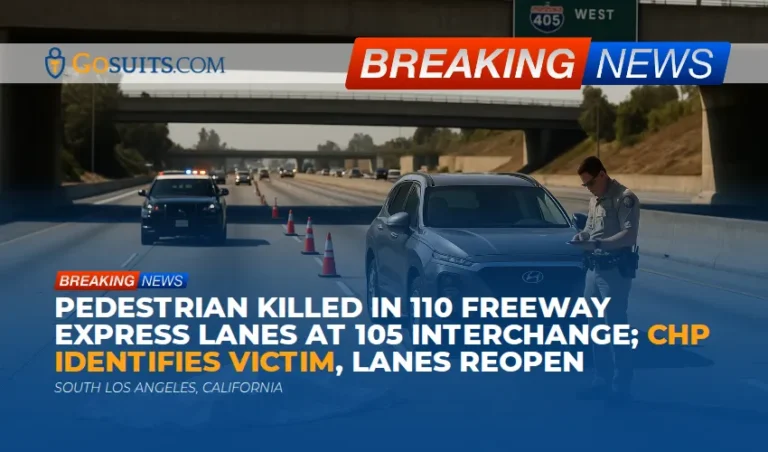
A tragic crash in South Los Angeles claimed the life of a pedestrian on the Harbor 110 Freeway early Saturday afternoon. According to information shared by California Highway Patrol, the call was reported at approximately 12:40 p.m. in the northbound Express Lanes under the Glenn Anderson 105 Freeway. Responding officers found the pedestrian within the Express Lanes and the individual was pronounced deceased at the scene. The driver of a gray Hyundai SUV, a woman, remained at the scene and cooperated with authorities. CHP began investigating the circumstances surrounding the death shortly after.
The Los Angeles County Department of Medical Examiner later identified the decedent as 41-year-old Johnny Ansdell. His city of residence was not available at the time of reporting. Traffic in the Express Lanes was held for an extended period after the incident. CHP issued a Sigalert at 1:17 p.m., then lifted it at 3:19 p.m. as the lanes reopened after on-scene investigation and clearance.
What led to the pedestrian entering and attempting to cross the Express Lanes remains under investigation. In situations like this, authorities typically evaluate driver statements, physical evidence on the roadway, any available camera footage, and reports from witnesses to reconstruct what happened and why.
Where it happened and how traffic was affected
The interchange of the Harbor 110 Freeway and the Glenn Anderson 105 Freeway sits in the heart of South Los Angeles, surrounded by neighborhoods such as Willowbrook, Vermont Vista, Athens, and Green Meadows. The Metro ExpressLanes run in the freeway median in this stretch. When a serious collision occurs inside those managed lanes, first responders must access the scene through limited entry points while coordinating lane closures across a divided facility.
With traffic held in the northbound Express Lanes for several hours, drivers moving through the central Los Angeles corridor experienced delays. Holding lanes for collision investigation and cleanup is standard after a fatal crash to protect emergency personnel and to preserve evidence for investigators. In this case, traffic alerts were in place for roughly two hours until CHP cleared the scene and reopened the lanes.
How freeway fatality investigations work in Los Angeles County
When a fatal crash occurs on a state highway in Los Angeles County, CHP generally leads the traffic investigation. Investigators document road evidence such as skid marks and debris fields, inspect involved vehicles for damage patterns and mechanical status, take measurements, collect statements, and seek out camera footage. At the same time, the Los Angeles County Department of Medical Examiner takes jurisdiction over the decedent to determine cause and manner of death and to make a formal identification. The Medical Examiner may perform an autopsy and, where appropriate, toxicology testing. Timelines for lab results can vary based on caseload and the type of testing required.
If families need a copy of the collision report to understand what the investigating officers recorded, CHP provides a formal process to request it for eligible parties [1]. For Medical Examiner records, including the final autopsy report and cause of death, families can submit requests through the LA County Department of Medical Examiner’s records portal [2].
How families can request official records and documents
In the wake of a fatal freeway collision, official documents can feel overwhelming to navigate. Here are the core records and how they are typically obtained in Los Angeles County. We’re including the underlying government sources in the References section to help you find the correct pages without guesswork.
CHP collision report
Families and legal representatives can request a copy of the CHP collision report. CHP uses an application process, and requests are generally limited to involved parties, their legal counsel, and certain authorized insurers due to confidentiality provisions. The CHP website outlines how to submit a request and what proof is required [1]. If you are unsure which CHP Area Office handled the investigation, CHP’s online office locator can help you identify and contact the correct office for guidance [11].
Medical Examiner records
The Los Angeles County Department of Medical Examiner maintains decedent records and provides public and next-of-kin access to certain documents. Families can request the autopsy report, cause and manner of death certification, and other records through the Medical Examiner’s official portal and instructions [2]. Processing times can vary, especially if toxicology is pending.
Death certificate
Death certificates in Los Angeles County are issued through the Registrar-Recorder/County Clerk. Certified copies may be needed for insurance, probate, and other official matters. The County provides ordering details and eligibility requirements on its site [10].
Traffic collision reporting to DMV
California law requires parties to report crashes to the DMV using an SR-1 form when certain criteria are met, including when there has been an injury or death. The DMV explains who must file and the deadline for doing so [6]. Families handling affairs on behalf of a decedent should review this requirement with counsel to determine what is necessary and who should submit it.
Public records and video requests
In some cases, Caltrans freeway cameras or nearby public agency cameras may have captured segments of traffic conditions. Caltrans QuickMap shows active traffic cameras but does not archive footage for public download [7]. If requesting camera footage from a public agency, time is critical. Agencies may have short retention policies, and access can be limited by law. Coordination with an attorney can increase the chances of timely and proper preservation requests.
When documents are incomplete or seem inaccurate, it helps to keep a contemporaneous log of what you receive and when. Many Angelenos find that starting a simple folder for reports, letters, and claim correspondence prevents important items from getting lost. For a step-by-step city-specific checklist that pairs well with the records above, see los angeles injury claim paperwork list you should start today.
Key California safety and legal context for freeway pedestrian collisions
Freeways in California are controlled-access roadways that generally prohibit pedestrians for safety reasons. The state Vehicle Code authorizes prohibitions on pedestrian access to freeways where posted, which is typical throughout Los Angeles County [3]. At the same time, drivers continue to owe a duty of reasonable care to avoid collisions where possible. That dual reality is why investigators look closely at both roadway restrictions and the actions of drivers and pedestrians to understand causation and responsibility.
Separately, drivers involved in crashes that cause injury or death must remain at the scene and fulfill their statutory duties. California Vehicle Code section 20001 outlines those obligations [4]. In this incident, authorities noted that the SUV driver remained at the scene and cooperated with law enforcement.
If a death is linked to negligent conduct, California allows certain family members to bring a wrongful death claim and, in many cases, a survival action on behalf of the estate. California’s statute of limitations for wrongful death is generally two years from the date of death, although there are exceptions and shorter deadlines when public entities are involved [5]. Because filing deadlines can be unforgiving, families benefit from clarifying their timeline early, especially if any potential claim could involve a government agency.
Public agencies sometimes become part of the analysis in freeway incidents, particularly if questions arise about signage, barriers, lighting, or the design and maintenance of a roadway. That does not mean an agency is responsible for a given crash. It simply means evidence preservation and legal deadlines deserve early attention so the facts can be investigated adequately.
Insurance and claim considerations after a fatal freeway crash
In collisions where a pedestrian is killed, several insurance layers may be implicated. These can include the driver’s liability insurance, any available excess or umbrella coverage, and potentially uninsured or underinsured motorist coverage associated with the decedent’s household policy. Each policy is contract specific, with definitions and exclusions that matter. Before talking to any insurer about the facts of the crash, it is wise to get a free consultation with a qualified attorney who can advise on what to share and what to avoid saying at the outset.
Even basic conversations with an adjuster can be recorded. Statements that seem harmless in the moment can later be used to dispute liability or damages. Many people turn to car accident lawyers to organize communication, ensure evidence is preserved, and manage negotiations so that the family’s energy can stay focused on immediate needs.
Insurance companies often move quickly to gather claimant statements, apply policy limitations, and request medical records. They do this to assess their exposure. Without guidance, families might inadvertently sign a broad medical or record release or make comments about fault that are taken out of context. To rebalance that information gap, reaching out to Los Angeles car accident lawyers early in the process can help establish a structure for communications and ensure that claims are properly documented from day one.
Evidence to preserve quickly in a freeway collision
Evidence on freeways changes fast. Vehicles are moved, debris is cleared, and digital trail data can be overwritten. Quick action protects the investigative record.
- Identify and preserve camera sources. Caltrans traffic cameras display live images to the public, but those images are not made available as a downloadable archive [7]. Other potential sources include adjacent city traffic cameras, freeway ramp cameras, and privately maintained cameras on business properties. Preservation requests have to go to the right custodian, fast.
- Locate witnesses and obtain contact details. CHP reports often list witnesses, but not always. Drivers who were held in the Express Lanes may have dash camera footage or recall crucial details. A brief, polite request for a name and number can make a difference later.
- Document the scene and vehicle condition. Photos of roadway markings, vehicle damage, and any unusual conditions such as lighting or construction should be captured as soon as it is safe and lawful to do so. If a vehicle is towed to a yard, note the location and any storage policies that might affect inspection access.
- Track official notices and deadlines. If there is any chance a claim could involve a public agency, special claim notice rules may apply. The safest approach is to assume short deadlines and work backward from the incident date to avoid missing a window.
- Keep a central file. Families managing affairs during grief do not need extra stress. Use a simple binder or shared digital folder to keep the evolving set of reports, correspondence, and receipts in one place.
If documentation feels like the hardest part, a local checklist can help you get started without overthinking it. The los angeles injury claim paperwork list you should start today is geared toward organizing the essentials that insurers and agencies typically request.
Local context around the 110 and 105 interchange
The 110 and 105 interchange is one of the Southland’s busiest hubs, mixing Metro’s managed ExpressLanes, connector ramps, and frequent commuter traffic heading toward Downtown Los Angeles, the South Bay, and LAX. On weekends, the flow includes families headed to youth sports fields around Algin Sutton Recreation Center and drivers leaving events south of Exposition Park, with traffic patterns surging and settling through the day. When a crash occurs in the ExpressLanes, responders often must stage from limited access points near the median, which can prolong lane closures.
For those who live and work along this corridor, the reopening at 3:19 p.m. was a relief after the extended hold. Still, a fatal collision ripples well beyond traffic. It affects families, drivers who witnessed the event, and first responders who shoulder the scene’s weight. South Los Angeles residents know too well how quickly a clear day can turn into gridlock and concern on the Harbor Freeway.
Recent multi-vehicle crashes on Los Angeles freeways
In recent weeks, Los Angeles has seen multiple serious crashes on major corridors. A four vehicle crash near Los Feliz shut down lanes on the 5 Freeway and left one person deceased at the scene. Separately, a major multi vehicle collision in Boyle Heights on the southbound 5 involved a semi truck and several vehicles, resulting in numerous injuries and a hard closure at 4th Street. In another incident last fall, a pursuit suspect on the 110 Freeway attempted to flee a moving vehicle and was tragically struck by several motorists. Each case is different, but together they reflect the high speeds and complex geometry that make our freeways unforgiving when something goes wrong.
What the safety data says about pedestrians and freeways
National data underscores how vulnerable people on foot are in high speed environments. NHTSA’s most recent pedestrian report shows thousands of pedestrian deaths nationwide in 2022, highlighting elevated risk in locations with high vehicle speeds and limited refuge options [8]. Federal highway guidance continues to encourage engineering and operational strategies that reduce conflict between motor vehicles and vulnerable road users, particularly in high speed corridors [9]. While pedestrians are seldom expected on freeways, the data is a reminder that the margin for error is thin. Good investigation work and careful evidence preservation matter because a small detail can change how a collision is understood.
Practical next steps community members can take now
This section is meant to help anyone in our community who finds themselves supporting a loved one after a fatal freeway crash. It is not specific legal advice, but rather a plain language roadmap of tasks and timing.
- Clarify who will handle records and estate tasks. Decide who will serve as the primary point of contact with CHP, the Medical Examiner, and insurers. That person should maintain a single file and timeline of what is requested and received.
- Request official reports in the right order. Start with the CHP collision report request and the Medical Examiner records request [1] [2]. The death certificate request usually follows through the Department of Registrar Recorder [10].
- Preserve potential evidence immediately. Send written preservation requests to potential custodians for any camera footage and to the tow yard for vehicle inspection access. Confirm receipt and follow up regularly.
- Speak with an attorney before talking to insurers. If an insurance claim might be filed, get a free consultation first. What someone says to an insurer can be recorded and used against them later, even if the intention was to be helpful. Early guidance can prevent avoidable missteps.
- Mark the calendar for deadlines. Note the two year wrongful death statute of limitations as a general rule and consider shorter claim deadlines if any public entity might be involved in the potential claim [5].
- Take care of the immediate. Funeral planning, notifications to employers, and accessing available benefits require time and attention. It helps to delegate tasks among trusted relatives or friends to avoid burnout.
Why now? Evidence disappears quickly. Camera footage can be overwritten, vehicles can be repaired or salvaged, and eyewitness memories fade. Insurers often start building their file within days. Starting early does not force a decision about whether to bring a claim; it simply keeps the option open by preserving what you might need later.
Commentary from Gosuits Los Angeles, California Personal Injury Attorney
Our hearts go out to the family and friends of the person who lost their life on the 110 Freeway. Incidents like this are devastating, and we share this information to help the community understand the process and the resources available. The details reported so far indicate the pedestrian was in the Express Lanes when struck, and the driver remained at the scene while CHP investigated. On freeways, even a momentary misstep or split second of inattention can lead to catastrophic outcomes, which is why a thorough, fact driven investigation is essential.
From a civil perspective, investigators will look for answers to core questions. What prompted the pedestrian to be in the Express Lanes at that moment? What did traffic look like in the minutes leading up to the impact? Were there any visibility or roadway conditions that played a role? Were there opportunities for avoidance? Careful review of the CHP report, physical evidence, witness accounts, and any available video often helps clarify those answers. We emphasize this because responsibility and fault are factual determinations, not assumptions.
In the days after a crash, insurers and large corporations move fast. Adjusters call, recorded statements are requested, and broad release forms may be presented under the guise of speeding things up. People dealing with shock or grief often share more than they need to or agree to terms that make later recovery harder. We see this across Los Angeles freeways and surface streets alike. Knowing your rights and setting up a structured communication channel can prevent statements from being used against you down the line.
It is important to obtain a free consultation before contacting any insurance company about the facts of the incident. A conversation with a seasoned professional can clarify your options, explain how policy limits and coverage types work, and prioritize evidence preservation. The goal is to protect your family’s interests while the facts are still being established and before critical records disappear.
References
- How to Obtain a Copy of a Collision Report – California Highway Patrol
- Requesting Records – Los Angeles County Department of Medical Examiner
- California Vehicle Code 21960 – Leginfo
- California Vehicle Code 20001 – Leginfo
- Code of Civil Procedure 335.1 – Statute of Limitations for Wrongful Death
- Report of Traffic Accident Occurring in California SR-1 – California DMV
- QuickMap – Caltrans
- Traffic Safety Facts 2022 Data: Pedestrians – NHTSA
- Pedestrian Safety – Federal Highway Administration
- Death Records – Los Angeles County Registrar-Recorder/County Clerk
- Find a CHP Area Office – California Highway Patrol