- What Happened at Harry Hines Boulevard and Moody Street
- Known Facts from Dallas Police and Dallas Fire-Rescue
- What Remains Under Investigation
- Why This Victory Park Location Matters for Safety
- Immediate Steps After a Dallas Car Accident Involving a Pedestrian
- How to Obtain Official Records in Dallas
- Texas Law That Often Applies in Pedestrian and Intersection Collisions
- Insurance Coverages That May Apply in a Dallas Pedestrian Accident
- Common Drivers of Intersection and Pedestrian Injury Crashes, Backed by Data
- What Injured People and Families Can Expect in the Weeks Ahead
- Community Actions to Improve Safety Around Harry Hines and Moody
- Commentary from Gosuits Dallas, Texas Personal Injury Attorney
- Act Now: Practical Steps and Why Timing Matters
What Happened at Harry Hines Boulevard and Moody Street
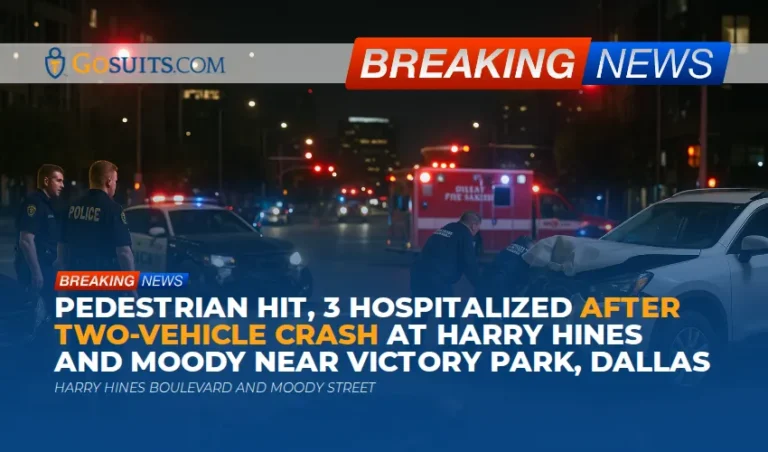
On Thursday evening around 7:30 p.m., at the intersection of Harry Hines Boulevard and Moody Street on the edge of Victory Park, Dallas police say two vehicles collided. The force of that collision pushed one of the vehicles off its path and into a pedestrian who was standing near the intersection. Three people in total were taken to local hospitals, including the pedestrian. Officials have not released conditions or identities. This intersection sits just northwest of the American Airlines Center and sees steady vehicle and foot traffic, especially during evening hours.
Known Facts from Dallas Police and Dallas Fire-Rescue
What first responders reported
Dallas Police Department officers and Dallas Fire-Rescue responded to a major crash at Harry Hines and Moody at about 7:30 p.m. Investigators determined two vehicles were involved in the initial impact. One of those vehicles then struck a pedestrian positioned nearby. The pedestrian was transported to a hospital, and at least two other individuals from the vehicles were also hospitalized.
Information source
Details summarized here are based on statements from Dallas police and Dallas Fire-Rescue.
What Remains Under Investigation
Officials have not yet stated whether the additional hospitalized individuals were drivers or passengers. No identities have been released. The cause of the initial collision is still under investigation, and there is no public finding on fault at this time. When law enforcement finishes the investigation, a crash report is typically finalized and becomes available to eligible requestors under Texas law.
Why This Victory Park Location Matters for Safety
Residents know the corridor along Harry Hines Boulevard can feel busy and complex, with turning traffic, signal timing, and pedestrians working their way toward or from nearby venues and neighborhoods. Moody Street is a connector toward the Design District and into Victory Park, where people often cross on foot to get to restaurants, residential towers, or entertainment. Even without a major event happening, the early evening window is a common time for commute traffic to intersect with pedestrian activity.
Intersections are where multiple decision points converge, and in a dense urban core like near Victory Park, small mistakes can have large consequences. Visibility, speed choices, and yielding behavior all affect whether a near miss becomes a serious injury.
Immediate Steps After a Dallas Car Accident Involving a Pedestrian
Prioritize safety and medical care
Right after a collision, safety comes first. Move to a safe location if possible. Call 911 for urgent medical help and to report the crash. Even if injuries seem minor, getting evaluated is important because symptoms can worsen over hours or days.
Document what you can, if it is safe
- Photograph the scene: Capture vehicle positions, debris fields, skid or yaw marks, traffic signals, crosswalks, and lighting conditions.
- Identify witnesses: Ask for names and contact information for anyone who saw the crash.
- Note the environment: Time of day, weather, lane markings, nearby construction, and any obstructed signs or sightlines can matter.
Report the crash and preserve records
- Call law enforcement: Drivers in Texas must report certain crashes, and officers who investigate file an official report submitted to the state. See the Texas Transportation Code regarding reporting and officer crash reports at Transportation Code Chapter 550.
- Avoid recorded statements to insurers before legal guidance: What someone says to an insurance company can be used against them later. It is wise to get a free consultation with a personal injury attorney before speaking to any insurer about fault, injuries, or settlement.
How to Obtain Official Records in Dallas
Police crash report
After Dallas police complete and approve the report, eligible parties can obtain it through the state system. Texas law governs who can receive a copy and how reports are released. See Transportation Code 550.065 for release rules and eligibility.
Crash reports are submitted by investigating officers under Transportation Code 550.062. If a crash is not investigated by an officer, a driver may have duties to report under Section 550.026.
Emergency response and CAD records
Certain dispatch logs and incident records may be available through the Texas Public Information Act, subject to exemptions. The Texas Attorney General provides guidance on public information requests and what is public. See the AG’s overview for the public here: Texas Public Information Act basics.
Medical records
Patients and authorized representatives have rights to request medical records from hospitals and providers that rendered care after a Dallas pedestrian accident. Federal rules under HIPAA define a right of access to health information, with limited exceptions. See the U.S. Department of Health and Human Services guidance at HIPAA Right of Access.
Autopsy or inquest reports in fatal cases
While officials have not reported a fatality here, in fatal crashes an inquest or autopsy can be ordered under Texas law, with records handled by the local medical examiner. The governing provisions are in the Texas Code of Criminal Procedure, Chapter 49. See Code of Criminal Procedure Chapter 49.
Texas Law That Often Applies in Pedestrian and Intersection Collisions
Pedestrian right of way and driver duties
- Crosswalks: Drivers must yield the right of way to a pedestrian in a crosswalk when there is no traffic signal or when a pedestrian has a walk signal. See Transportation Code 552.003.
- Outside crosswalks: Pedestrians crossing at a point other than a crosswalk must yield to vehicles, but drivers always owe a general duty to exercise due care to avoid collisions. See Transportation Code 552.005.
- Traffic signals: Movement through signalized intersections is governed by Transportation Code 544.007. Violations like running a red light can be important in determining civil liability.
- Stop and render aid: Drivers involved in injury crashes must remain at the scene and render aid. See Transportation Code 550.023.
Comparative negligence
Texas uses proportionate responsibility. If a party is 51 percent or more responsible, they cannot recover for their injuries from others. If they are 50 percent or less responsible, any recovery may be reduced by their percentage of responsibility. See Civil Practice and Remedies Code 33.001. This is one reason why clear evidence from the scene, witnesses, and traffic signals becomes critical in a Dallas pedestrian accident.
Time limits and notice deadlines
- Statute of limitations: In many Texas personal injury cases, the general filing deadline is two years from the date of injury. See Civil Practice and Remedies Code 16.003.
- Government claims: If a city or other governmental unit is potentially involved, written notice deadlines can be much shorter under the Texas Tort Claims Act. See Civil Practice and Remedies Code 101.101.
Hospital liens
Texas hospitals may assert a lien for certain accident-related care. These liens attach to a patient’s claim against responsible parties, with specific rules and limits. See Property Code Chapter 55. Understanding how a lien interacts with any insurance settlement can help families plan for medical bills.
Insurance Coverages That May Apply in a Dallas Pedestrian Accident
Several different insurance coverages may come into play after a Dallas car accident that injures a pedestrian. Which ones apply depends on facts, but here are common sources.
- At fault driver’s liability insurance: Pays bodily injury damages up to policy limits if that driver is legally responsible. This often includes medical bills, lost wages, and noneconomic harms under Texas law, subject to proof and defenses.
- Uninsured or underinsured motorist coverage: If a negligent driver lacks insurance or has too little, an injured person’s own UM or UIM policy can provide benefits. UM and UIM can be on an auto policy even for pedestrians hit while walking.
- Personal Injury Protection or Medical Payments: Texas auto policies include Personal Injury Protection unless rejected in writing. PIP can cover medical costs and some lost income regardless of fault. MedPay may also be available in some policies.
- Health insurance: Health plans often pay initial medical charges, then may assert subrogation rights. Coordination between auto insurance, PIP, health insurance, and liens is an important part of the claim process.
- Commercial or employer policies: If a vehicle involved was a company car or involved in a work task, commercial liability or employer coverage might apply. Facts determine this.
Before contacting any insurer, it is prudent to speak with a personal injury attorney in a free consultation. Early recorded statements, medical authorizations, or casual comments about fault can be used to reduce or deny a claim later.
Common Drivers of Intersection and Pedestrian Injury Crashes, Backed by Data
While the cause of this crash is not yet known, agencies have long studied why intersection and pedestrian injuries happen, particularly in urban corridors like Victory Park.
- Speed and injury severity: National Highway Traffic Safety Administration notes that speed contributes to both crash likelihood and severity. Higher speeds increase the distance a vehicle travels during a driver’s reaction and lengthen stopping distance, which raises the risk for pedestrians in particular. See NHTSA pedestrian safety overview.
- Intersections concentrate risk: The Federal Highway Administration explains that intersections are conflict points where streams of traffic intersect, merge, or diverge, making them a primary location for severe crashes. See FHWA Intersection Safety.
- Urban environment and nighttime visibility: The Centers for Disease Control and Prevention notes that pedestrian injuries occur frequently in urban areas and during nighttime hours, when visibility is reduced. See CDC pedestrian safety.
These insights matter for legal and safety analysis. A review will often include traffic signal timing records, surveillance or dash camera video, measured braking distances, lighting, and whether crosswalks were marked and functioning.
What Injured People and Families Can Expect in the Weeks Ahead
Medical care and follow up
After a serious Dallas pedestrian accident, many injuries evolve. Concussions can present with delayed symptoms. Soft tissue injuries may stiffen as inflammation rises. Orthopedic issues sometimes require imaging that is not performed in the first hours. The care plan can change as specialists weigh in. Keep all follow up appointments, and request copies of records for your file. The HIPAA Right of Access guidance from HHS explains how to request copies and typical timelines for providers to respond. See HHS guidance.
Property damage and rental cars
If a vehicle is damaged, an adjuster typically inspects it or reviews photos. For a pedestrian, damaged personal items like a phone, glasses, or a backpack may be part of a claim. If multiple insurers are involved, coordination can be time consuming. Provide only factual information and avoid guessing about speed, distance, or fault when speaking to any insurer.
Insurance communications
- Recorded statements: Insurers often request a statement soon after a loss. The safest approach is to consult an attorney before agreeing to any recorded interview.
- Medical authorizations: Insurers may send broad releases. It is common to limit authorizations to relevant records and time periods, consistent with your rights.
- Bills and liens: Hospital lien rules can affect settlement disbursement. See Texas Property Code Chapter 55.
Crash report timing
The investigating officer’s crash report is typically submitted soon after the collision. Once filed and approved, eligible parties can request a copy according to Transportation Code 550.065. The report usually includes diagramming, listed factors, and citations if any, though the presence or absence of a citation is not the final word on civil fault.
Community Actions to Improve Safety Around Harry Hines and Moody
Neighbors in Victory Park and the Design District care deeply about safe streets. If you regularly walk to the American Airlines Center, nearby apartments, or restaurants along Harry Hines, you know that small infrastructure decisions can make a big difference. Consider these steps.
- Report signal or signage issues: If you notice signal timing that feels unsafe for pedestrians, missing signs, or damaged crosswalk markings, report it through city service channels.
- Document recurring hazards: Photos and dates of near misses or blocked sightlines can help city staff understand patterns and prioritize fixes.
- Support traffic calming and lighting upgrades: Safer speeds and better nighttime visibility improve outcomes for everyone. FHWA highlights the safety value of proven countermeasures at intersections. See FHWA Intersection Safety.

Commentary from Gosuits Dallas, Texas Personal Injury Attorney
We are thinking about the pedestrian and the two other people hospitalized after the collision at Harry Hines and Moody. Crashes like this shake a neighborhood. This discussion is for general information and education, and it is not a substitute for guidance about anyone’s specific situation.
From a civil injury standpoint, investigators will look closely at the decision points at the intersection. Signal phases, turning movements, speed, and line of sight can all factor into whether a driver or multiple drivers are legally responsible for a pedestrian being struck. Because one vehicle was pushed into a pedestrian after the initial impact, the sequence matters and can involve liability questions between the two drivers as well as duties owed to people on foot.
Insurance companies and large corporations know that injured people are vulnerable right after a wreck. It is common to see quick calls asking for recorded statements, broad medical authorizations, or early settlement offers that do not account for future treatment, wage loss, or the full impact of a life change. Adjusters work within rules designed to limit what is paid out. People who do not deal with these procedures every day can understandably miss technical deadlines or key categories of damages, especially when they are trying to heal.
A free consultation can level the playing field. It helps someone understand responsibilities under Texas law, how comparative negligence could affect recovery, what coverages may apply, and how to avoid missteps with insurers. Even one conversation can clarify next steps and protect important rights while the investigation unfolds.
Act Now: Practical Steps and Why Timing Matters
- Secure key records promptly: Request medical records, imaging, and discharge summaries as soon as possible, and keep all bills and receipts. Timely documentation strengthens any claim and helps with care coordination.
- Preserve evidence before it disappears: Save vehicle data, photos, clothing, and damaged personal items. Identify nearby cameras, such as security cameras aimed at Harry Hines and Moody, and ask that footage be preserved before it is overwritten.
- Track symptoms and time missed: Keep a daily log of pain, limitations, and missed work or school. These details often fade over time but are vital in explaining the real-world impact of a Dallas pedestrian accident.
- Mind legal and insurance timelines: Texas has firm deadlines for filing civil injury claims and for providing notice in special circumstances. See the general two year limitation period at CPRC 16.003 and the government notice provisions at CPRC 101.101. Meeting these timelines can be the difference between a valid claim and one that cannot be pursued.
- Speak with a lawyer before contacting insurers: What is said to an insurance company can be used later to argue down or deny a claim. A quick free consultation helps someone understand their rights and the best order of steps.
Why now
Evidence gets lost, memories fade, and video systems overwrite quickly. Medical providers and insurers move on timeline rules. Acting promptly helps protect health, preserves rights, and gives a clearer path through the practical challenges following a serious collision in Victory Park.
Legal and Safety References
- Texas Transportation Code Chapter 550 crash reporting and duties after a crash, including 550.062, 550.065, and 550.023.
- Texas Transportation Code Chapter 552 pedestrians, including 552.003 and 552.005.
- Texas Transportation Code 544.007 traffic control signals.
- Texas Civil Practice and Remedies Code 33.001 proportionate responsibility.
- Texas Civil Practice and Remedies Code 16.003 limitations for personal injury.
- Texas Civil Practice and Remedies Code 101.101 notice to governmental units.
- Texas Property Code Chapter 55 hospital liens.
- NHTSA Pedestrian Safety overview and data on risks.
- FHWA Intersection Safety and why intersections concentrate conflict points.
- CDC Pedestrian Safety patterns in urban and nighttime pedestrian risk.
- HHS HIPAA Right of Access for obtaining medical records.
- Texas Code of Criminal Procedure Chapter 49 inquests and autopsies in fatal cases.
- Texas Attorney General overview of public records access.