- What we know about the Palm Desert pedestrian collision
- Location and local context around 42nd Avenue and Cook Street
- Pedestrian safety and California right of way laws
- How investigators typically handle a vehicle versus pedestrian crash
- Evidence to preserve right now
- Common injuries in pedestrian impacts and why immediate care matters
- Insurance and liability issues after a pedestrian collision in California
- Getting records: police report, 911 audio, traffic signal data, and medical records
- Who to call in Riverside County for official information
- Time limits: civil deadlines most families do not hear about early
- Community notes on safety near Cook Street and across Palm Desert
- Next practical moves
- Commentary from Gosuits Palm Desert, California Personal Injury Attorney
- References
What we know about the Palm Desert pedestrian collision
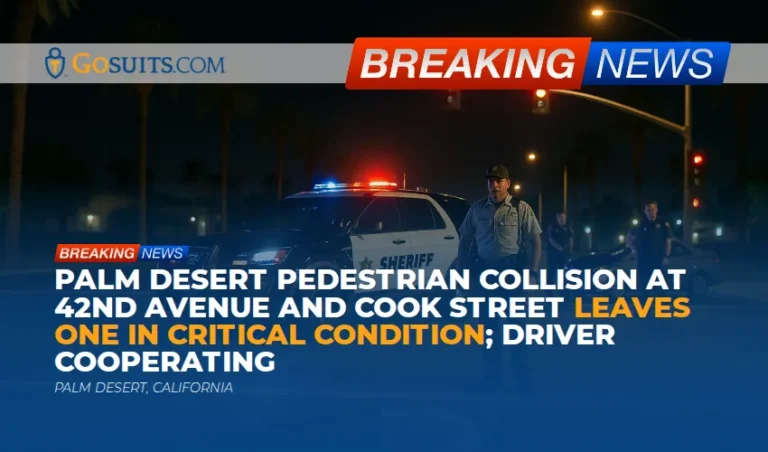
Deputies with the Riverside County Sheriff’s Office responded to a reported vehicle versus pedestrian collision at about 8:03 p.m. on Saturday night in Palm Desert, at or near the intersection of 42nd Avenue and Cook Street. When first responders arrived, they found a pedestrian who had sustained major injuries. That person was transported to a local hospital and was reported to be in critical condition. According to deputies, the driver remained at the scene and cooperated with investigators. No arrests have been made at this time, and the investigation remains active. These details were reported Sunday evening by local media and reflect what authorities have publicly shared so far.
Location and local context around 42nd Avenue and Cook Street
Cook Street is a familiar north-south corridor in the Coachella Valley that helps connect neighborhoods between Highway 111 and the I-10. Evening traffic can include locals returning from work along the corridor, students heading to or from nearby campuses like College of the Desert, and visitors traveling to dinner spots around El Paseo. 42nd Avenue and Cook Street sits in a part of Palm Desert where lighting, speed, and driver attention all matter, especially after sunset. At around 8 p.m. in early March, it is fully dark, and visibility depends heavily on street lighting, headlamps, reflective clothing, and how well drivers and pedestrians see and react to each other.
Even one blocked streetlight, a curve in the roadway, or vehicles turning out of driveways can complicate sight lines. The time of night can also influence traffic signal timing and turning patterns at intersections. It is too early to say which of these factors, if any, played a role here. What we can say is that intersections like Cook are critical junctures where small lapses can have outsized consequences for people on foot.
Pedestrian safety and California right of way laws
Several California rules often come up after a vehicle strikes a pedestrian. The point is not to assign blame without facts, but to understand the legal framework that guides many investigations and insurance assessments in our state.
- Marked and unmarked crosswalks: Drivers must yield the right of way to pedestrians crossing within a marked crosswalk or within an unmarked crosswalk at an intersection, and must exercise due care for pedestrian safety [1]. Pedestrians also have a duty to use care for their own safety and not suddenly step into a path that makes a collision unavoidable [1].
- Crossing outside a crosswalk: When pedestrians cross outside a crosswalk, they must yield the right of way to vehicles, but drivers still have a continuing duty to exercise due care and avoid hitting them if reasonably possible [2].
- Basic speed law: Regardless of the posted limit, drivers must not drive faster than is reasonable or prudent given weather, visibility, traffic, and the roadway’s surface and width [3]. At night, visibility and stopping distance are central to what is “reasonable.”
- Stopping and staying at the scene: In California, drivers involved in injury collisions are required to stop and remain at the scene. Early reporting and cooperation with responders are legally required and can save lives [4].
Zooming out, statewide safety agencies remind us that pedestrian crashes are both common and severe. Nationally, pedestrian deaths have risen in recent years, and speed is a consistent factor in survivability [5][6]. California’s traffic safety office also highlights the persistent risks pedestrians face across urban corridors statewide [7]. None of these data points tell us what happened on 42nd and Cook, but they explain why investigators look closely at lighting, speed, turning movements, and crossing decisions whenever a person on foot is seriously hurt.
How investigators typically handle a vehicle versus pedestrian crash
Deputies and collision reconstruction teams generally follow a methodical approach. If you have questions about what they may be looking at, this overview can help.
- Scene preservation: Officers document vehicle resting positions, skid or yaw marks, gouges, debris fields, and lighting conditions. They note whether crosswalks are present and whether signals were functioning.
- Vehicle inspection: Front-end damage patterns, hood dents, and windshield impacts can suggest an angle or speed. Damage height and pedestrian shoe scuffs on bumpers sometimes help triangulate point of contact.
- Lighting and visibility: Investigators often return at the same hour to assess ambient light, headlight throw, and glare. They may measure distances to determine nighttime stopping sight distance and whether a reasonably careful driver could have perceived a pedestrian in time.
- Witness statements and video: Canvassing nearby businesses and residences for cameras, collecting 911 audio timing, and interviewing witnesses are common steps. If a nearby signal has data logs, agencies may request timing records.
- Medical findings: Injury patterns can corroborate impact points or vehicle speed ranges. This step is sensitive and handled through medical channels and, in severe cases, coordination with county authorities.
Because this Palm Desert crash is still under active investigation, findings have not been released publicly. Families and community members should expect updates to emerge gradually as evidence is collected and analyzed.
Evidence to preserve right now
When a pedestrian is critically injured, important evidence can fade quickly. Even if you are still waiting for official updates, there are practical steps to help preserve the truth of what happened.
- Photos and video: If safe and lawful to do so, capture images of the area, lighting, traffic signs, and any nearby cameras on storefronts or homes. Note the time and your vantage point.
- Nearby cameras: Many intersections and commercial strips around Cook Street have private security cameras. Requesting copies promptly is key because many systems overwrite within days.
- Witness names: Collect full names and multiple contact methods. Brief notes about where each person stood and what they noticed can be invaluable later.
- Clothing and personal items: Do not wash or discard damaged clothing or shoes. These items can bear transfer marks that inform reconstruction.
- Medical records from day one: Start a complete file that includes imaging reports, physician notes, and discharge instructions.
For a deeper, California-focused evidence checklist, see how to gather strong evidence for personal injury cases in california.
Common injuries in pedestrian impacts and why immediate care matters
Pedestrians lack protective buffers, so even moderate speeds can cause severe trauma. Common injuries include traumatic brain injuries, spinal injuries, long-bone fractures, internal organ damage, and complex lacerations. National health agencies emphasize that prompt emergency care is crucial for survival and long-term outcomes. Early imaging, neurosurgical evaluation when warranted, and careful monitoring for internal bleeding can make a meaningful difference [8].
Within the Coachella Valley, critically injured patients are often transported to regional trauma centers for advanced care. California’s Emergency Medical Services Authority recognizes designated trauma hospitals that are equipped for the most severe injuries [9]. For the greater Palm Springs and Palm Desert area, trauma activation commonly routes to Desert Regional Medical Center in Palm Springs, which has served as a Level II trauma center for the region. Exact hospital destination in any case depends on many factors, including patient condition, resource availability, and transport logistics.
Insurance and liability issues after a pedestrian collision in California
From a civil standpoint, liability in a pedestrian crash often turns on whether a driver or a pedestrian failed to use reasonable care under the circumstances. In California, fault can be shared between parties under comparative fault principles, which means recovery can be reduced by a person’s percentage of fault, if any. The Judicial Council’s jury instructions discuss how juries weigh comparative responsibility in injury cases [10].
Insurers will evaluate many of the same facts law enforcement examines, along with statements given by those involved. That is one reason many people speak with an attorney before making recorded statements. What someone says early on can be used to dispute liability or minimize claimed harms later. Seasoned car accident lawyers often coordinate the flow of information, help protect claimants from leading questions, and press for full documentation of injuries and losses.
Because this crash occurred at night, adjusters may focus on illumination, whether a crosswalk was used, the driver’s speed relative to conditions, and whether either party could have avoided the collision with reasonable care. If roadway design or lighting deficiencies contributed, potential claims against a public entity have special and shorter notice requirements under California’s Government Claims Act [11]. In more routine scenarios, claims proceed through the at-fault driver’s auto liability carrier and, if needed, through the injured person’s underinsured motorist coverage. When community members want local perspective, many turn to Palm Desert car accident lawyers for help navigating insurance and evidence questions unique to the Coachella Valley’s roads and intersections.
Getting records: police report, 911 audio, traffic signal data, and medical records
After a severe pedestrian collision, families often need several types of records to understand what happened. Availability and timing vary by agency and the status of the investigation.
- Police traffic collision report: The Riverside County Sheriff’s Office typically generates a collision report for serious injury crashes within its jurisdiction. While that report is being prepared or if the case is still active, certain sections may be withheld. On California state highways patrolled by CHP, the California Highway Patrol has a published process to request reports [12]. For city streets, the local investigating agency handles the report.
- 911 audio and CAD logs: Families can request 911 recordings and dispatcher logs under the California Public Records Act, subject to exemptions for active investigations and privacy [13]. These records can help establish precise timelines.
- Traffic signal timing and camera footage: Where traffic signals or municipal cameras exist, request preservation notices quickly. Agencies may have short retention windows. Coordination through public records channels, again under the CPRA, can be effective [13].
- Medical records: The treating hospital and any subsequent providers maintain detailed records. Request complete files, including imaging, operative reports, and physical therapy notes. These documents often become key evidence of the nature and extent of harm.
If pursuing any claim, it is wise to consult with an attorney before contacting insurance companies. Statements to insurers can be recorded and later used to challenge fault or minimize injuries, and a consultation can help set a strategy that protects your rights from day one. Many also consult car accident lawyers to help draft and send evidence preservation letters to at-fault parties and relevant agencies.
Who to call in Riverside County for official information
Based on what authorities have shared, the primary investigating agency is the Riverside County Sheriff’s Office. Families typically contact the Sheriff’s station that handled the call to request public information, ask about the collision report status, or provide additional witness details. If a victim’s condition is critical, hospital communications teams may only release limited information to protect privacy.
If, in the worst case, a fatality occurs, the Riverside County Sheriff-Coroner’s Bureau would manage next of kin notifications, jurisdictional decisions, and autopsy determinations. Autopsy and coroner records have specific access rules set by California law, and next of kin usually receive guidance directly from the Coroner’s Office on what is available and when. For certified death certificates, California’s Department of Public Health provides statewide instructions and eligibility criteria for obtaining copies [14].
Other agencies can have relevant data. If a segment of roadway is maintained by Caltrans, families sometimes coordinate with Caltrans District 8 for engineering, signage, or lighting records. Where city-managed infrastructure is involved, Palm Desert’s public works or traffic engineering teams may be the proper contact. Each of these requests is usually routed through public records channels consistent with state law [13].
Time limits: civil deadlines most families do not hear about early
California generally provides a two-year statute of limitations for personal injury claims arising from negligence, measured from the date of injury [15]. There are exceptions and nuances, but this default deadline matters because investigations and medical recovery can stretch on for months. If a public entity may be responsible in any way, written claims must typically be presented within six months of the incident under the Government Claims Act, with specific formatting and delivery requirements [11]. Missing these deadlines can affect available civil remedies.
It is common for multiple clocks to run at once. Insurance policies can include internal notice provisions, and evidence retention schedules at public agencies can be short. This is another reason people seek guidance early, to make sure their requests and notices land on time and in the correct form.
Community notes on safety near Cook Street and across Palm Desert
Residents know Cook Street as a practical connector across Palm Desert, often used as an alternative to Highway 111 or Washington Street. At night, lighting consistency, glare from oncoming traffic, and the ebb and flow of evening activity near shopping areas and residential complexes can all affect visibility and reaction time. The Safe System approach promoted by federal transportation agencies stresses that mistakes will happen, so roads and vehicles should be designed to reduce the chance that a mistake becomes a life-altering event [6]. That can include measures like enhanced crosswalk visibility, speed management, pedestrian refuge islands, and lighting improvements on corridors where people commonly walk.
Local conversations around El Paseo, Civic Center Park, and neighborhoods along Hovley Lane often touch on walkability and safe night crossings, especially during the busy season when tourism and events pick up. While we await official details about this specific collision, it is reasonable for the community to continue advocating for lighting upkeep, consistent crosswalk markings, and driver awareness campaigns reminding motorists to expect people on foot at all hours. California’s traffic safety office regularly emphasizes these themes statewide [7].
Next practical moves
When a serious pedestrian collision happens in a tight-knit community like Palm Desert, many people want to do something concrete and helpful. Here are measured steps that tend to matter in the first days and weeks.
- Prioritize medical care and recovery planning: Stabilization and specialist follow up come first. Keep a single binder or digital folder for all records, imaging, and bills. Consistent documentation helps future decision-making.
- Preserve and request time-sensitive evidence: Send prompt preservation requests to nearby businesses with cameras, ask relevant agencies to preserve traffic signal data, and collect witness information. Do this before memories fade and footage is overwritten.
- Coordinate communications: Consider having one point person for communications so messages to agencies and insurers stay consistent. Before placing calls to insurance companies, consult an attorney so you understand which details to share and what can wait. Recorded statements can be used later to limit recovery.
- Track all out-of-pocket costs: Save receipts for medications, mobility devices, transportation to appointments, and home modifications. These costs often become part of a civil claim’s documented harms.
- Calendar legal and records deadlines: Note the two-year injury statute and any six-month public entity notice requirements. Also calendar likely dates when agencies overwrite or archive potential evidence so you can request preservation or copies in time.
Acting on these steps early can improve clarity, reduce stress, and preserve options that might otherwise quietly slip away.

Commentary from Gosuits Palm Desert, California Personal Injury Attorney
Our hearts go out to the person struck and to everyone who loves them. News like this is hard to read, especially when it happens on familiar roads. The notes below are offered for general information and community awareness while we await official findings.
From what authorities have shared, this was a nighttime vehicle versus pedestrian collision at or near a major corridor. In cases like this, small factors can stack up quickly. Visibility at night, driver speed relative to conditions, and whether a crosswalk was used are common focus areas. Investigators will also be looking for camera footage from nearby properties and accurate witness timelines.
In the aftermath, insurance companies move quickly. Adjusters are trained to lock in statements, frame the narrative, and evaluate a case using the smallest possible set of facts. Large carriers and corporations count on the reality that most people do not know what to say, what to ask for, or how to secure and read technical evidence like signal timing data. That information gap can be used to argue partial fault or minimize injuries.
It is important to get a free consultation before speaking at length with any insurer. A brief conversation can clarify rights, help structure requests for key records, and reduce the risk that an early statement gets used out of context. In serious injury cases, that kind of early guidance can help protect both health and legal options while the investigation runs its course.
References
- California Vehicle Code section 21950 – California Legislative Information
- California Vehicle Code section 21954 – California Legislative Information
- California Vehicle Code section 22350 – California Legislative Information
- California Vehicle Code section 20003 – California Legislative Information
- Pedestrian Safety – National Highway Traffic Safety Administration
- Safe System Approach – Federal Highway Administration
- Pedestrian Safety Facts – California Office of Traffic Safety
- Traumatic Brain Injury: Get the Facts – Centers for Disease Control and Prevention
- California Trauma Center System – Emergency Medical Services Authority
- Judicial Council of California Civil Jury Instructions (CACI) – California Courts
- Government Code section 911.2 – California Legislative Information
- How to Obtain a Traffic Collision Report – California Highway Patrol
- California Public Records Act Overview – California Department of Justice
- Vital Records – California Department of Public Health
- Code of Civil Procedure section 335.1 – California Legislative Information