- What We Know About the Highway 101 Crash North of Ventura
- Local Context: Overnight Traffic and Emergency Response in Ventura County
- Rollover Crashes and Ejection: Why These Injuries Are So Severe
- How CHP Investigates Major Crashes and What Families Can Expect
- How to Obtain Official Records: Police Report, Autopsy Findings, and Vital Records
- Civil Law Overview in California After a Fatal Crash
- Insurance Issues After a Single-Vehicle Fatal Crash
- Preserving Evidence Quickly
- Community Safety and Prevention on the 101 Corridor
- Why Acting Promptly Matters After a Fatal Crash
- Commentary from Gosuits Ventura, California Personal Injury Attorney
- References
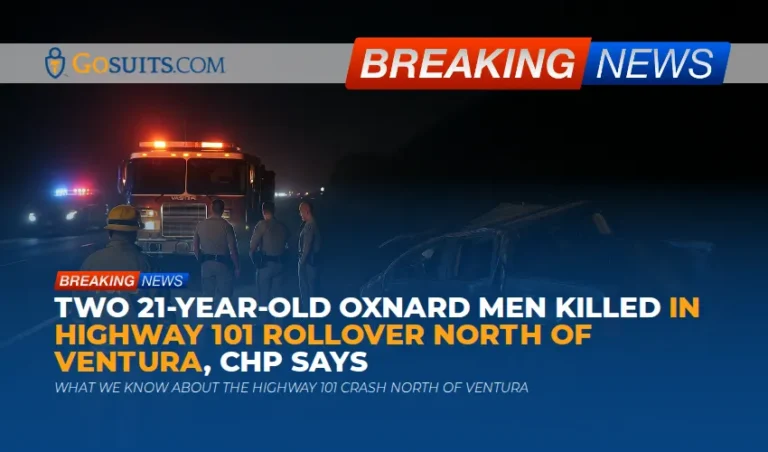
What We Know About the Highway 101 Crash North of Ventura
Ventura CHP reported that two 21-year-old Oxnard men died following a crash on Highway 101 north of Ventura just before 2:30 a.m. Saturday. Officers found an overturned Chevy Colorado with two people ejected. First responders transported two people from the scene to a local hospital for treatment, and the 21-year-old driver was pronounced dead at the scene, according to the Ventura County Fire Department. Ventura CHP noted that southbound Highway 101 remained open and the cause of the crash is still under investigation.
This section reflects publicly reported facts. Investigators typically release further details after they complete scene reconstruction, talk to witnesses, and review medical and mechanical findings. That process can take weeks.
Local Context: Overnight Traffic and Emergency Response in Ventura County
Highway 101 is the spine of Ventura County, carrying late-night travelers, service workers heading between Oxnard, Ventura, and Carpinteria, and visitors returning from the Santa Barbara waterfront. In the early morning hours, stretches north of Ventura can feel quiet and dark. When a serious crash happens, response often involves Ventura CHP for traffic control and investigation, Ventura County Fire for rescue and medical support, and transport to nearby emergency departments in Ventura.
Area residents know how quickly conditions can change along this oceanfront corridor. Fog can roll in off the water, and wind can push high-profile vehicles. None of that confirms what happened here; it simply acknowledges what local drivers experience throughout the year. The official investigation will determine what factors, if any, played a role.
Rollover Crashes and Ejection: Why These Injuries Are So Severe
Rollover crashes carry a high risk of catastrophic injury and death, especially when occupants are ejected. National safety agencies repeatedly find that seat belts dramatically reduce the odds of total or partial ejection in a crash. NHTSA emphasizes that wearing a seat belt is one of the single most effective ways to prevent ejection and fatal injury in passenger vehicles [2]. CDC research echoes this, noting seat belts reduce serious crash-related injuries and deaths for front-seat passengers, and help prevent ejection entirely [3]. California law requires vehicle occupants to be properly restrained with seat belts, with very limited exceptions [4].
Beyond restraint use, other technical factors often come into play in a rollover. Tire failure, roadway edge drop-offs, overcorrection, speed, fatigue, distraction, and impairment are all well-documented contributors in rollover mechanisms. It is also possible for a rollover to be triggered by a sudden evasive maneuver to avoid an obstacle or another vehicle that never makes contact and leaves the scene. Reconstructing these dynamics is the role of the investigating agency.
How CHP Investigates Major Crashes and What Families Can Expect
The California Highway Patrol follows a methodical approach when a fatal or major-injury collision occurs. Typically, officers will:
- Secure the scene and document evidence including vehicle positions, roadway markings, debris fields, tire marks, lighting, and weather observations.
- Identify and interview witnesses if possible, and request any available dashcam or roadside camera footage before it is overwritten.
- Conduct a mechanical inspection of involved vehicles if a defect is suspected, and request event data recorder information when available.
- Coordinate with the county medical examiner-coroner on cause and manner of death determinations and any toxicology testing. In California, coroners have statutory duties to investigate certain deaths, including those from collisions [12].
After evidence is compiled, CHP prepares a collision report that includes diagrams, measurements, and a preliminary assessment of causes and factors. Families and involved parties can request the report once it is ready through the appropriate CHP Area Office or designated records process [8] [9].

How to Obtain Official Records: Police Report, Autopsy Findings, and Vital Records
In the days and weeks after a fatal crash, families often need several official documents. Here is how these are typically obtained in California, with Ventura County context where helpful.
CHP Collision Report
- Which agency holds it: For crashes on Highway 101 north of Ventura, the lead agency is usually the California Highway Patrol Ventura Area Office.
- How to request: CHP provides a process for collision report requests by mail or in person. The agency’s public guidance explains who may obtain a report and the information required to verify eligibility. Start with the CHP office that investigated and ask about current procedures and fees [8] [9].
- What to have ready: Collision date and time, location, names of involved parties, CHP report number if available, and proof you are an authorized requester.
Autopsy and Toxicology
- Which agency holds it: The county medical examiner-coroner where the death occurred. In California, coroners are responsible for determining cause and manner of death in qualifying cases [12].
- What to expect: Autopsy findings are often available to next of kin, while full toxicology can take several weeks to process and report. Release protocols and eligibility will follow California law.
Death Certificate
- Which agency holds it: Death certificates are issued through vital records. For statewide information and ordering pathways, see the California Department of Public Health’s Vital Records resources [11].
- What to expect: Requesters must verify their relationship and identity. Certified copies are typically needed to manage estate matters and certain insurance benefits.

Other Potential Records
- Emergency medical records from the hospital that treated survivors. Hospitals will require proper authorization or proof of legal authority.
- Traffic operations data such as lane closures and incident logs are viewable in real time on Caltrans QuickMap. While not a substitute for a collision report, QuickMap can help corroborate timing and traffic impacts [10].
Civil Law Overview in California After a Fatal Crash
After a fatal collision, California law may allow certain family members to bring a wrongful death action against the responsible party, and a separate survival action on behalf of the decedent’s estate. Generally:
- Wrongful death allows specified heirs to seek compensation for losses they personally suffered from the death, such as the loss of financial support and companionship, under Code of Civil Procedure section 377.60 [6].
- Survival actions allow the decedent’s estate to pursue claims the person could have brought had they lived, under Code of Civil Procedure section 377.30 [7].
- Time limits are strict. The general limitations period for wrongful death in California is two years from the date of death, per Code of Civil Procedure section 335.1 [5]. Filing deadlines can be shorter if a government entity is involved.
If you are looking for a deeper plain-language walkthrough of next steps families often consider after a roadway fatality, this resource may help: what happens if someone is killed in a car accident.
Families often find it helpful to speak with seasoned car accident lawyers who can explain how liability is evaluated in single-vehicle rollovers, what insurance coverage may respond, and how evidence is preserved while the CHP investigation is ongoing.
Insurance Issues After a Single-Vehicle Fatal Crash
Insurance questions after a fatal crash can be complex, especially when multiple passengers and households are affected. Here are common issues that arise in California cases:
- Liability coverage: In a single-vehicle crash, potential claims by injured passengers or wrongful death claims by heirs may be presented against the at-fault driver’s liability policy. If the driver also died, the claim proceeds against their estate and insurer.
- Uninsured or underinsured motorist (UM/UIM): If a phantom vehicle contributed to the crash without making contact and cannot be identified, UM or UIM coverage in a passenger’s own policy might be implicated, depending on policy language and proof available.
- Medical payments coverage (Med Pay): Some auto policies provide limited benefits for medical expenses regardless of fault.
- Life insurance and employer benefits: Separate from auto insurance, these may help with immediate financial needs and funeral costs.
Insurers often contact families quickly, asking for recorded statements or broad medical authorizations. It is generally prudent to consult an attorney before giving any recorded statement to an insurance company. What is said early on can be used to narrow or dispute claims later. Many find that consulting with Ventura car accident lawyers first helps them understand rights and obligations before engaging with adjusters.
Preserving Evidence Quickly
Key evidence in rollover cases can be lost if not safeguarded promptly:
- Vehicle retention: Totaled vehicles can be moved to storage lots and then scrapped on short timelines. Families or their representatives can request holds to preserve the vehicle so that photos, measurements, and data downloads can be performed.
- Event data recorder (EDR): Many vehicles store speed, braking, seat belt status, and steering data shortly before a crash. EDR access typically requires proper equipment and chain-of-custody protocols.
- Roadway and environmental evidence: Skid marks, yaw marks, gouges, and debris fields can fade or be cleaned up within hours. Early scene documentation helps fill in the picture.
- Digital evidence: Cell phone usage logs, app location data, and dashcam footage can corroborate timelines. Roadside traffic cameras and business cameras may overwrite video in days unless specifically preserved.
- Traffic operations records: Caltrans QuickMap logs of lane closures and incident timestamps can help confirm response timing and traffic patterns near the scene [10].
Community Safety and Prevention on the 101 Corridor
Ventura County neighbors know the 101 well. Many of us have driven that north-of-Ventura stretch in the small hours after a late work shift, a concert in Santa Barbara, or a long-haul trip. Tragedies like this remind us of steps that reduce risk for everyone who shares the road.
- Always buckle up and make sure passengers are restrained. State law requires it, and it remains one of the most effective protections in every crash mode [2] [4].
- Respect fatigue. If you are nodding off or rubbing your eyes, consider swapping drivers, pulling off safely, or taking a brief rest if conditions allow.
- Slow at night and in uncertainty. Darkness, glare from oncoming headlights, wet patches, or debris can appear without warning.
- Check conditions before leaving. Caltrans QuickMap offers live updates on closures and hazards along Highway 101 in Ventura County and beyond [10].
For a snapshot of local collision trends, the California Office of Traffic Safety publishes county-level collision rankings and indicators that communities and safety planners use to target improvements [1].
Why Acting Promptly Matters After a Fatal Crash
In the aftermath of a fatal collision, time-sensitive tasks can help protect rights, clarify facts, and prevent the loss of critical evidence. Here is what many families, friends, and community supporters focus on in the early weeks:
- Identify and preserve evidence: Request that storage yards hold vehicles and that potential video sources be preserved. Early preservation can allow qualified reconstruction professionals to analyze what happened while the details are still recoverable.
- Organize essential records: Keep a central folder with incident dates and times, contact details for hospitals and first responders, any photos or messages, and later, copies of official reports.
- Coordinate official documents: Start the process for CHP collision reports, autopsy or coroner records as they become available, and certified death certificates through state vital records [9] [11].
- Limit insurance communications until informed: Insurers may seek early recorded statements. Consider the benefit of getting legal guidance first so that statements are accurate and complete, and made with a full understanding of policy rights and obligations.
- Watch deadlines: California’s civil filing deadlines vary depending on the type of claim and whether a government entity is involved. Understanding time limits early helps prevent missed claims [5].
Acting earlier often means more options later. Evidence that disappears, missed follow-ups, or confusing claims communications can narrow the path forward. Staying organized, documenting each step, and seeking qualified guidance are practical ways to keep momentum while honoring the person who was lost.

Commentary from Gosuits Ventura, California Personal Injury Attorney
Our hearts are with the families, friends, and neighbors affected by this tragedy north of Ventura. Losing young lives in a sudden rollover shakes the entire Oxnard and Ventura community. This overview is shared for educational purposes and general information so people understand the process that follows a fatal highway crash.
Based on what has been reported, investigators will be examining rollover dynamics, restraint status, potential roadway or vehicle factors, and any contributing behaviors. Ejection and severe injuries in a rollover often point investigators toward questions about speed, steering inputs, pavement edge conditions, and restraint use, among many other possibilities. It is appropriate that CHP and the county’s medical examiner-coroner complete their work before anyone draws conclusions.
From our experience, insurance companies and large corporations that enter the picture after a fatal collision can move fast to shape the narrative. Adjusters sometimes seek recorded statements before families know the full picture. They may discourage independent inspection of vehicles or downplay the value of preserving data and video. This is why knowledge matters. Understanding how liability and coverage can apply in a single-vehicle rollover, and what proof actually decides those questions, evens the playing field.
When a family faces medical bills, funeral costs, and the sudden loss of income or support, a no-cost, confidential consultation can be an important first step to understand options and timelines. Questions can be answered without risk, and people can learn what to expect from insurers, what documents to gather, and how evidence is protected while the CHP report and coroner findings are pending.
References
- Collision Rankings and Traffic Safety Data – California Office of Traffic Safety
- Seat Belts: Why They Matter – National Highway Traffic Safety Administration
- Seat Belts: Get the Facts – Centers for Disease Control and Prevention
- California Vehicle Code § 27315 (Seat Belt Law) – California Legislative Information
- Code of Civil Procedure § 335.1 (Wrongful Death Limitations Period) – California Legislative Information
- Code of Civil Procedure § 377.60 (Wrongful Death) – California Legislative Information
- Code of Civil Procedure § 377.30 (Survival Actions) – California Legislative Information
- Find a CHP Area Office – California Highway Patrol
- How to Obtain a Collision Report – California Highway Patrol
- QuickMap Real-Time Traffic – Caltrans
- Vital Records: Birth, Death, Marriage – California Department of Public Health
- Government Code § 27491 (Coroner’s Duties) – California Legislative Information