- What we know about the I-57 crash near 99th Street
- Timeline and location context on Chicago’s South Side
- Why secondary crashes happen around emergency scenes on I-57
- Illinois Move Over law and driver duties when lights are flashing
- Initial steps for those affected after a highway collision
- How to get official records: police report, fire incident report, and medical documentation
- Medical care pathways and nearby trauma resources
- Insurance and liability questions in emergency-vehicle collisions
- Preserving evidence after a serious highway crash
- Community safety takeaways for South Side drivers
- Call-to-action: Why timely steps matter after an interstate injury
- Commentary from Gosuits Chicago, Illinois Personal Injury Attorney
- References
What we know about the I-57 crash near 99th Street
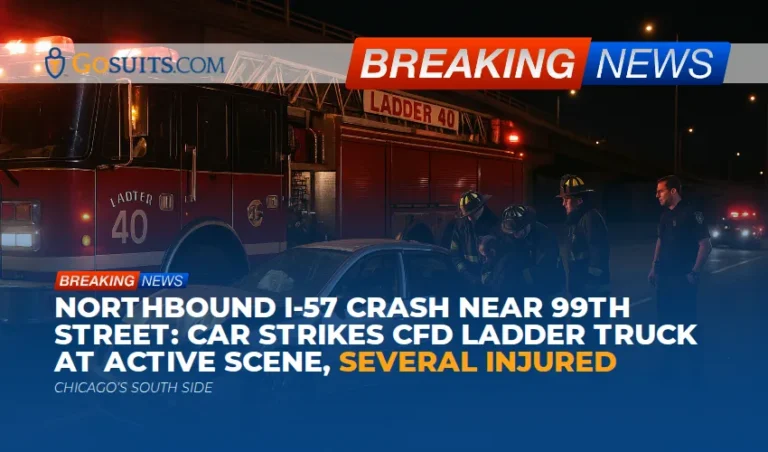
Early Sunday morning, a silver Chevrolet struck a Chicago Fire Department ladder truck on northbound I-57 near 99th Street while the fire apparatus was already on scene for a prior crash. According to the Illinois State Police, the ladder truck was stationary in the left and center lanes with emergency lights activated when the Chevrolet failed to slow down and hit the front of the truck at about 2:30 a.m. Several people were transported to nearby hospitals. As of the initial report, authorities had not released the number of injured people or the extent of their injuries. All northbound lanes reopened by about 4:30 a.m.
Crashes that happen at active emergency scenes are among the most dangerous moments on a highway. The abrupt slowing, lane blockages, bright strobes, and rubbernecking can create chain reactions if oncoming drivers do not reduce speed and move over promptly. Illinois’ Move Over law spells out those safety duties when emergency lights are present, which is particularly relevant to what happened here on I-57 [1][2].
Timeline and location context on Chicago’s South Side
The collision occurred around 2:30 a.m. on northbound I-57 near 99th Street. This stretch of I-57 connects the South Side neighborhoods around Washington Heights, Fernwood, and West Beverly to the Dan Ryan corridor and beyond. Overnight hours on this corridor can see high-speed traffic and variable visibility, especially around curves or overpasses, which can make a stopped emergency vehicle scene feel sudden for approaching drivers. Within two hours, authorities reopened all northbound lanes, suggesting scene safety, medical transport, and roadway clearance were handled quickly.
For Chicago drivers who use this segment regularly, the 95th Street Red Line Transit Center sits just east of the I-57 and I-94 junction, and lane patterns can compress quickly north of 103rd Street. Those local dynamics are a reminder that nighttime slowdowns and flashing lights ahead demand immediate speed reduction and a safe lane change if possible.
Why secondary crashes happen around emergency scenes on I-57
Traffic incident management researchers and roadway safety agencies track the danger of secondary crashes at active scenes. When a fire truck or ambulance is blocking lanes to protect an earlier crash, drivers approaching at highway speed may be slow to react, distracted, or uncertain about how to navigate the closure. Nationwide, transportation safety programs emphasize rapid scene protection, effective traffic control, and public awareness regarding Move Over obligations to reduce these secondary impacts [3].
On urban interstates like I-57, contributing factors can include:
- Limited sight distance as drivers crest a grade or pass under lighting transitions.
- Speed differentials where approaching vehicles fail to slow in time.
- Lane changes at the last second when drivers notice blocked lanes late.
- Distraction or impairment, especially during overnight hours.
- Rubbernecking behavior that diverts attention from the traffic pattern ahead.
Illinois crash data consistently shows that speed, distraction, and failure to yield contribute to serious outcomes on high-speed roadways [4].
Illinois Move Over law and driver duties when lights are flashing
Under Illinois law, when approaching any stationary authorized emergency vehicle displaying flashing lights, drivers must reduce speed, proceed with due caution, and, if possible and safe, change lanes away from the vehicle. This is commonly known as Scott’s Law or the Move Over law. The statute applies broadly to police, fire, EMS, and other authorized vehicles performing official duties, as well as to other stationary vehicles displaying hazard lights in some contexts [1][2].
Although law enforcement has not released a fault determination, the facts described make the Move Over requirements highly relevant. At a minimum, these rules help explain what drivers must do when fire crews are protecting an earlier crash with lane blockages and active warning lights.
Initial steps for those affected after a highway collision
In the first days after a traffic collision, medical care and documentation come first. If someone was treated at the scene or transported by CFD or private ambulance, request copies of run sheets and discharge records as soon as practical. Medical documentation creates a clear picture of injuries and helps prevent later disputes about timing or cause.
It is also wise to learn the practical steps that often protect a claim’s integrity in Chicago. The city’s roadway network, insurer practices, and health system can feel like a maze. For a step-by-step refresher tailored to local conditions, see What to do after a car accident in Chicago.
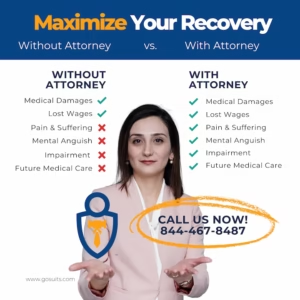
Before speaking with any insurance adjuster, consider consulting an attorney who handles roadway injury matters. What someone says in an early recorded statement can be used against them later, even if they are still in pain or on medication. Conversations about symptoms, prior conditions, and crash mechanics are often complex and better navigated with guidance. Many people start by searching for car accident lawyers to understand timelines, documentation, and insurance coverages before they return insurer calls.
How to get official records: police report, fire incident report, and medical documentation
Official documents provide the backbone of any civil insurance claim. For an incident on I-57 investigated by the Illinois State Police, the following records are common starting points:
- Illinois State Police traffic crash report: ISP maintains traffic crash reports for incidents they investigate. Their crash report request portal and instructions are available through ISP’s public website [5]. If the report is not yet available, note the report or event number from officers at the scene or from discharge paperwork, then calendar a follow-up date to check availability.
- Chicago Fire Department incident run sheet: The City of Chicago processes public records requests under Illinois FOIA. Individuals can submit a FOIA request to the Chicago Fire Department for incident records such as patient care reports or run logs, subject to privacy protections [6].
- Hospital and EMS records: Request emergency department records, radiology, and test results directly from the hospital’s Health Information Management department. Confirm whether any records are held by a private ambulance provider and request those separately.
- Cook County Medical Examiner (only if a fatality later occurs): Records requests, including autopsy reports, are processed by the Cook County Medical Examiner’s Office with procedures detailed online [7]. There is no indication of fatalities in this incident at the time of reporting.
- Traffic camera or incident management data: In some cases, traffic management systems maintain limited footage or incident logs. Availability varies and retention can be short. Coordination with the investigating agency is recommended. Transportation agencies emphasize quick preservation when video may exist [3].
Keep copies of everything and organize them chronologically. If an attorney is retained later, having a clean file with dates, providers, and account numbers speeds up requests and reduces duplication.
Medical care pathways and nearby trauma resources
Serious highway crashes can cause hidden injuries that do not fully reveal themselves in the first 24 to 48 hours. If new symptoms appear after discharge, return for evaluation promptly and note any changes in pain, dizziness, numbness, or mobility.
On the South Side, Level I trauma resources include major centers such as the University of Chicago Medicine and John H. Stroger, Jr. Hospital of Cook County. The Illinois Department of Public Health maintains statewide trauma center designations and hospital locations, which can help families confirm where patients might be transferred when injuries are severe [8].
Insurance and liability questions in emergency-vehicle collisions
When a private vehicle collides with a stationary emergency vehicle working a prior crash, multiple insurance policies can come into play. At a minimum, the driver’s liability policy and any medical payments coverage are relevant. Some household members may also have uninsured or underinsured motorist coverage that applies in certain scenarios. The Illinois Secretary of State outlines the state’s mandatory insurance framework for vehicle owners, which sets the basic coverage structure many claims start with [9].
Illinois follows a modified comparative fault system, which can reduce or bar recovery depending on a claimant’s percentage of responsibility. The statute governing comparative negligence provides the legal framework that insurers use when evaluating fault allocations [10]. Given the Move Over law’s requirements when emergency lights are present, fault analysis may focus heavily on speed reduction and safe lane changes as vehicles approach a blocked scene [2].
Collisions involving municipal or state vehicles introduce additional layers. Claims that implicate government entities are subject to specific procedures and immunities under Illinois law. The Local Governmental and Governmental Employees Tort Immunity Act, for example, can affect how and when certain claims proceed [11]. These procedures have strict timelines and notice rules, which is one reason many people seek guidance from Chicago car accident lawyers before filing paperwork or giving recorded statements to insurance carriers.
Insurance companies and public entities often conduct parallel investigations. Statements to any insurer, including your own, can become part of the evidence record. People commonly speak with car accident lawyers to understand policy limits, coverage stacking, health insurance liens, and documentation standards before they engage in detailed insurer interviews.
Preserving evidence after a serious highway crash
Even when everyone is focused on medical care, preserving evidence early can make a real difference later. Consider the following steps:
- Photographs and video: Save any photos or dashcam clips from the scene. If others on scene took images, ask for copies. Capture vehicle positions, damage, skid marks, flares, traffic cones, and signage that show the emergency scene layout.
- Witness information: Identify witnesses as soon as possible. On highways, third-party drivers may have called 911 and left. If contact details are on the police report, follow up quickly before memories fade.
- Vehicle data: Modern vehicles often store event data related to speed and braking. Preservation letters to the vehicle owner’s insurer and any relevant entities can help prevent overwriting. Transportation safety agencies stress early, coordinated incident management partly for this reason [3].
- Medical records and symptom journaling: Keep a dated symptom log and save all billing statements and explanation of benefits forms. Consistency helps tie symptoms to the crash.
- Official reports: Follow up regularly for the Illinois State Police crash report and any CFD incident documents [5][6].
Community safety takeaways for South Side drivers
Residents who navigate I-57 through Washington Heights and nearby neighborhoods know how fast conditions can change at night. The lessons from this crash are simple but lifesaving:
- Scan for lights far ahead: On interstates, warning lights can appear suddenly over a rise. Start slowing as soon as you see them.
- Signal and move over early: Make a clean, predictable lane change away from the blocked lanes when safe and legal to do so.
- Reduce speed significantly: Even if you cannot move over, the law requires you to slow and proceed with due caution around emergency vehicles [2].
- Minimize distraction: Rubbernecking raises the risk for everyone in the traffic stream. Keep attention on the traffic pattern and the vehicles around you.
Public agencies and responder training teams continue to promote Move Over education statewide. NHTSA and state partners stress that small driver choices make a big difference in secondary crash risks [1].
Call-to-action: Why timely steps matter after an interstate injury
The exact step to take: collect and secure records. That means requesting the Illinois State Police crash report, obtaining CFD run sheets if transported, and pulling hospital discharge summaries. Written documentation anchors the timeline and supports any later insurance submission.
The benefit of acting now: evidence fades fast. Dashcam files overwrite. Witnesses change phone numbers. Some transportation video is purged on short retention cycles. A prompt paper trail preserves facts that determine responsibility and insurance coverage outcomes [3].
Why timing matters this week: Illinois claims potentially involving public entities can have special procedures and shorter deadlines under Illinois law [11]. Even before the full police report is ready, organizing medical records, photographs, and a symptom diary helps align next steps. Many people also seek a free consultation with a seasoned and skilled injury attorney before making insurance statements, since early comments can be cited later in ways that hurt a claim.
Commentary from Gosuits Chicago, Illinois Personal Injury Attorney
Our thoughts are with everyone hurt in this I-57 crash and with the Chicago firefighters who were already working a dangerous scene in the overnight hours. This article is offered for educational purposes and general information.
Based on the facts reported, the situation highlights exactly why Illinois’ Move Over law exists. When emergency lights are flashing and lanes are blocked, drivers approaching must slow dramatically and, when safe, move over. On a dark stretch near 99th Street, that duty is critical for everyone’s safety.
Insurance carriers and even public entities often capitalize on gaps in knowledge. Adjusters may ask for broad medical authorizations, push for quick recorded statements, or suggest that symptoms are unrelated unless they were documented immediately. In complex scenes like this, statements and paperwork given too early or without context can undercut a legitimate injury claim later.
A free consultation helps people understand coverage layers, obligations under comparative negligence rules, and how Illinois procedures work when public vehicles are involved. It is an opportunity to learn about medical documentation, preserving evidence, and how to avoid common pitfalls with insurers, without pressure or commitment.
References
- Move Over Laws – NHTSA
- 625 ILCS 5/11-907 Move Over law – Illinois General Assembly
- Traffic Incident Management Overview – FHWA
- Illinois Roadway Crash Data – IDOT
- Traffic Crash Reports – Illinois State Police
- Freedom of Information Act Requests – City of Chicago
- Medical Examiner’s Office – Cook County
- Illinois Trauma Center Maps – Illinois Department of Public Health
- Mandatory Insurance – Illinois Secretary of State
- 735 ILCS 5/2-1116 Comparative Fault – Illinois General Assembly
- Local Governmental and Governmental Employees Tort Immunity Act – Illinois General Assembly